Compare commits
99 Commits
| Author | SHA1 | Date | |
|---|---|---|---|

|
9b35f463ae | ||
|
|
7b74486519 | ||
|
|
b276b44ded | ||
|
|
3792649ed9 | ||
|
|
5f08956605 | ||
|
|
643d89ed7b | ||
|
|
8ca459593c | ||
|
|
ee4208cc19 | ||
|
|
f6330e4bb8 | ||
|
|
4f3cf10a5c | ||
|
|
aa1954e81e | ||
|
|
482597bd0e | ||
|
|
d4b90e681c | ||
|
|
fcf9e43c4c | ||
|
|
b8d8cd19d3 | ||
|
|
536c2d966c | ||
|
|
f49cb0a5ac | ||
|
|
cef6bb2340 | ||
|
|
4c03253b30 | ||
|
|
ed09bb7370 | ||
|
|
5c46a25173 | ||
|
|
d1538f00df | ||
|
|
afa4acbbfb | ||
|
|
d9a530485f | ||
|
|
b2ad70b028 | ||
|
|
f49aae8ab0 | ||
|
|
f6debcf799 | ||
|
|
edbc4f1359 | ||
|
|
5242f066e7 | ||
|
|
af186800fa | ||
|
|
2bff4a5f44 | ||
|
|
edb73d50cf | ||
|
|
3dc09d55fd | ||
|
|
079fb1b0f5 | ||
|
|
17b2aa8111 | ||
|
|
78d484cfe0 | ||
|
|
182e12817d | ||
|
|
9179d57cc9 | ||
|
|
9cb9b746d8 | ||
|
|
57a0089664 | ||
|
|
53f7608872 | ||
|
|
838ce5b45a | ||
|
|
e878b9557e | ||
|
|
6638d37d6f | ||
|
|
4c29e15329 | ||
|
|
48890a2121 | ||
|
|
e312d7e18c | ||
|
|
6c38aaebf3 | ||
|
|
18b0ac44bf | ||
|
|
b6749eff2f | ||
|
|
c73a103280 | ||
|
|
a5d194f730 | ||
|
|
6320436b88 | ||
|
|
87325927ed | ||
|
|
4435cdf5b6 | ||
|
|
b041654611 | ||
|
|
e833dcefd4 | ||
|
|
29680f0ee8 | ||
|
|
670329700c | ||
|
|
62e17af311 | ||
|
|
e3938a2c85 | ||
|
|
49ffc3d99e | ||
|
|
34bb1c34a2 | ||
|
|
b27a56a296 | ||
|
|
ecd7095123 | ||
|
|
d449513861 | ||
|
|
6709e229b3 | ||
|
|
00a8f16262 | ||
|
|
00d16f8615 | ||
|
|
c90676d2b2 | ||
|
|
b89c011ad5 | ||
|
|
c3de31aa88 | ||
|
|
b6df0be865 | ||
|
|
a89f84f76e | ||
|
|
5a916cc221 | ||
|
|
dcf421ff93 | ||
|
|
d655258311 | ||
|
|
f6d13d4318 | ||
|
|
d5350d7c30 | ||
|
|
c63fd04c92 | ||
|
|
64b418a551 | ||
|
|
36c9c84047 | ||
|
|
88b4aaa301 | ||
|
|
eac4c227c9 | ||
|
|
d5eb7d4a55 | ||
|
|
80b15e16e2 | ||
|
|
cfacedbb1a | ||
|
|
c3bab033ed | ||
|
|
524f9bd84f | ||
|
|
4658ede9d6 | ||
|
|
f7b463aca1 | ||
|
|
c1a6e92b1d | ||
|
|
eefb0e427e | ||
|
|
c23d81b740 | ||
|
|
6dac231040 | ||
|
|
6fd3e531c3 | ||
|
|
c1c05991cf | ||
|
|
ab378e14d1 | ||
|
|
c0f9bf9ef5 |
5
.gitignore
vendored
5
.gitignore
vendored
@@ -8,4 +8,7 @@ src/version.h
|
||||
dev-config/
|
||||
db/
|
||||
copy_executable_local.sh
|
||||
nostr_login_lite/
|
||||
nostr_login_lite/
|
||||
style_guide/
|
||||
nostr-tools
|
||||
|
||||
|
||||
6
.gitmodules
vendored
6
.gitmodules
vendored
@@ -1,3 +1,9 @@
|
||||
[submodule "nostr_core_lib"]
|
||||
path = nostr_core_lib
|
||||
url = https://git.laantungir.net/laantungir/nostr_core_lib.git
|
||||
[submodule "c_utils_lib"]
|
||||
path = c_utils_lib
|
||||
url = ssh://git@git.laantungir.net:2222/laantungir/c_utils_lib.git
|
||||
[submodule "text_graph"]
|
||||
path = text_graph
|
||||
url = ssh://git@git.laantungir.net:2222/laantungir/text_graph.git
|
||||
|
||||
@@ -2,4 +2,6 @@
|
||||
description: "Brief description of what this command does"
|
||||
---
|
||||
|
||||
Run build_and_push.sh, and supply a good git commit message.
|
||||
Run increment_and_push.sh, and supply a good git commit message. For example:
|
||||
|
||||
./increment_and_push.sh "Fixed the bug with nip05 implementation"
|
||||
1
.rooignore
Normal file
1
.rooignore
Normal file
@@ -0,0 +1 @@
|
||||
src/embedded_web_content.c
|
||||
32
07.md
32
07.md
@@ -1,32 +0,0 @@
|
||||
NIP-07
|
||||
======
|
||||
|
||||
`window.nostr` capability for web browsers
|
||||
------------------------------------------
|
||||
|
||||
`draft` `optional`
|
||||
|
||||
The `window.nostr` object may be made available by web browsers or extensions and websites or web-apps may make use of it after checking its availability.
|
||||
|
||||
That object must define the following methods:
|
||||
|
||||
```
|
||||
async window.nostr.getPublicKey(): string // returns a public key as hex
|
||||
async window.nostr.signEvent(event: { created_at: number, kind: number, tags: string[][], content: string }): Event // takes an event object, adds `id`, `pubkey` and `sig` and returns it
|
||||
```
|
||||
|
||||
Aside from these two basic above, the following functions can also be implemented optionally:
|
||||
```
|
||||
async window.nostr.nip04.encrypt(pubkey, plaintext): string // returns ciphertext and iv as specified in nip-04 (deprecated)
|
||||
async window.nostr.nip04.decrypt(pubkey, ciphertext): string // takes ciphertext and iv as specified in nip-04 (deprecated)
|
||||
async window.nostr.nip44.encrypt(pubkey, plaintext): string // returns ciphertext as specified in nip-44
|
||||
async window.nostr.nip44.decrypt(pubkey, ciphertext): string // takes ciphertext as specified in nip-44
|
||||
```
|
||||
|
||||
### Recommendation to Extension Authors
|
||||
To make sure that the `window.nostr` is available to nostr clients on page load, the authors who create Chromium and Firefox extensions should load their scripts by specifying `"run_at": "document_end"` in the extension's manifest.
|
||||
|
||||
|
||||
### Implementation
|
||||
|
||||
See https://github.com/aljazceru/awesome-nostr#nip-07-browser-extensions.
|
||||
32
AGENTS.md
32
AGENTS.md
@@ -27,7 +27,7 @@
|
||||
## Critical Integration Issues
|
||||
|
||||
### Event-Based Configuration System
|
||||
- **No traditional config files** - all configuration stored as kind 33334 Nostr events
|
||||
- **No traditional config files** - all configuration stored in config table
|
||||
- Admin private key shown **only once** on first startup
|
||||
- Configuration changes require cryptographically signed events
|
||||
- Database path determined by generated relay pubkey
|
||||
@@ -35,7 +35,7 @@
|
||||
### First-Time Startup Sequence
|
||||
1. Relay generates admin keypair and relay keypair
|
||||
2. Creates database file with relay pubkey as filename
|
||||
3. Stores default configuration as kind 33334 event
|
||||
3. Stores default configuration in config table
|
||||
4. **CRITICAL**: Admin private key displayed once and never stored on disk
|
||||
|
||||
### Port Management
|
||||
@@ -48,20 +48,30 @@
|
||||
- Schema version 4 with JSON tag storage
|
||||
- **Critical**: Event expiration filtering done at application level, not SQL level
|
||||
|
||||
### Configuration Event Structure
|
||||
### Admin API Event Structure
|
||||
```json
|
||||
{
|
||||
"kind": 33334,
|
||||
"content": "C Nostr Relay Configuration",
|
||||
"kind": 23456,
|
||||
"content": "base64_nip44_encrypted_command_array",
|
||||
"tags": [
|
||||
["d", "<relay_pubkey>"],
|
||||
["relay_description", "value"],
|
||||
["max_subscriptions_per_client", "25"],
|
||||
["pow_min_difficulty", "16"]
|
||||
["p", "<relay_pubkey>"]
|
||||
]
|
||||
}
|
||||
```
|
||||
|
||||
**Configuration Commands** (encrypted in content):
|
||||
- `["relay_description", "My Relay"]`
|
||||
- `["max_subscriptions_per_client", "25"]`
|
||||
- `["pow_min_difficulty", "16"]`
|
||||
|
||||
**Auth Rule Commands** (encrypted in content):
|
||||
- `["blacklist", "pubkey", "hex_pubkey_value"]`
|
||||
- `["whitelist", "pubkey", "hex_pubkey_value"]`
|
||||
|
||||
**Query Commands** (encrypted in content):
|
||||
- `["auth_query", "all"]`
|
||||
- `["system_command", "system_status"]`
|
||||
|
||||
### Process Management
|
||||
```bash
|
||||
# Kill existing relay processes
|
||||
@@ -111,8 +121,8 @@ fuser -k 8888/tcp
|
||||
- Event filtering done at C level, not SQL level for NIP-40 expiration
|
||||
|
||||
### Configuration Override Behavior
|
||||
- CLI port override only affects first-time startup
|
||||
- After database creation, all config comes from events
|
||||
- CLI port override applies during first-time startup and existing relay restarts
|
||||
- After database creation, all config comes from events (but CLI overrides can still be applied)
|
||||
- Database path cannot be changed after initialization
|
||||
|
||||
## Non-Obvious Pitfalls
|
||||
|
||||
142
Dockerfile.alpine-musl
Normal file
142
Dockerfile.alpine-musl
Normal file
@@ -0,0 +1,142 @@
|
||||
# Alpine-based MUSL static binary builder for C-Relay
|
||||
# Produces truly portable binaries with zero runtime dependencies
|
||||
|
||||
ARG DEBUG_BUILD=false
|
||||
|
||||
FROM alpine:3.19 AS builder
|
||||
|
||||
# Re-declare build argument in this stage
|
||||
ARG DEBUG_BUILD=false
|
||||
|
||||
# Install build dependencies
|
||||
RUN apk add --no-cache \
|
||||
build-base \
|
||||
musl-dev \
|
||||
git \
|
||||
cmake \
|
||||
pkgconfig \
|
||||
autoconf \
|
||||
automake \
|
||||
libtool \
|
||||
openssl-dev \
|
||||
openssl-libs-static \
|
||||
zlib-dev \
|
||||
zlib-static \
|
||||
curl-dev \
|
||||
curl-static \
|
||||
sqlite-dev \
|
||||
sqlite-static \
|
||||
linux-headers \
|
||||
wget \
|
||||
bash
|
||||
|
||||
# Set working directory
|
||||
WORKDIR /build
|
||||
|
||||
# Build libsecp256k1 static (cached layer - only rebuilds if Alpine version changes)
|
||||
RUN cd /tmp && \
|
||||
git clone https://github.com/bitcoin-core/secp256k1.git && \
|
||||
cd secp256k1 && \
|
||||
./autogen.sh && \
|
||||
./configure --enable-static --disable-shared --prefix=/usr \
|
||||
CFLAGS="-fPIC" && \
|
||||
make -j$(nproc) && \
|
||||
make install && \
|
||||
rm -rf /tmp/secp256k1
|
||||
|
||||
# Build libwebsockets static with minimal features (cached layer)
|
||||
RUN cd /tmp && \
|
||||
git clone --depth 1 --branch v4.3.3 https://github.com/warmcat/libwebsockets.git && \
|
||||
cd libwebsockets && \
|
||||
mkdir build && cd build && \
|
||||
cmake .. \
|
||||
-DLWS_WITH_STATIC=ON \
|
||||
-DLWS_WITH_SHARED=OFF \
|
||||
-DLWS_WITH_SSL=ON \
|
||||
-DLWS_WITHOUT_TESTAPPS=ON \
|
||||
-DLWS_WITHOUT_TEST_SERVER=ON \
|
||||
-DLWS_WITHOUT_TEST_CLIENT=ON \
|
||||
-DLWS_WITHOUT_TEST_PING=ON \
|
||||
-DLWS_WITH_HTTP2=OFF \
|
||||
-DLWS_WITH_LIBUV=OFF \
|
||||
-DLWS_WITH_LIBEVENT=OFF \
|
||||
-DLWS_IPV6=ON \
|
||||
-DCMAKE_BUILD_TYPE=Release \
|
||||
-DCMAKE_INSTALL_PREFIX=/usr \
|
||||
-DCMAKE_C_FLAGS="-fPIC" && \
|
||||
make -j$(nproc) && \
|
||||
make install && \
|
||||
rm -rf /tmp/libwebsockets
|
||||
|
||||
# Copy only submodule configuration and git directory
|
||||
COPY .gitmodules /build/.gitmodules
|
||||
COPY .git /build/.git
|
||||
|
||||
# Clean up any stale submodule references (nips directory is not a submodule)
|
||||
RUN git rm --cached nips 2>/dev/null || true
|
||||
|
||||
# Initialize submodules (cached unless .gitmodules changes)
|
||||
RUN git submodule update --init --recursive
|
||||
|
||||
# Copy nostr_core_lib source files (cached unless nostr_core_lib changes)
|
||||
COPY nostr_core_lib /build/nostr_core_lib/
|
||||
|
||||
# Copy c_utils_lib source files (cached unless c_utils_lib changes)
|
||||
COPY c_utils_lib /build/c_utils_lib/
|
||||
|
||||
# Build c_utils_lib with MUSL-compatible flags (cached unless c_utils_lib changes)
|
||||
RUN cd c_utils_lib && \
|
||||
sed -i 's/CFLAGS = -Wall -Wextra -std=c99 -O2 -g/CFLAGS = -U_FORTIFY_SOURCE -D_FORTIFY_SOURCE=0 -Wall -Wextra -std=c99 -O2 -g/' Makefile && \
|
||||
make clean && \
|
||||
make
|
||||
|
||||
# Build nostr_core_lib with required NIPs (cached unless nostr_core_lib changes)
|
||||
# Disable fortification in build.sh to prevent __*_chk symbol issues
|
||||
# NIPs: 001(Basic), 006(Keys), 013(PoW), 017(DMs), 019(Bech32), 044(Encryption), 059(Gift Wrap - required by NIP-17)
|
||||
RUN cd nostr_core_lib && \
|
||||
chmod +x build.sh && \
|
||||
sed -i 's/CFLAGS="-Wall -Wextra -std=c99 -fPIC -O2"/CFLAGS="-U_FORTIFY_SOURCE -D_FORTIFY_SOURCE=0 -Wall -Wextra -std=c99 -fPIC -O2"/' build.sh && \
|
||||
rm -f *.o *.a 2>/dev/null || true && \
|
||||
./build.sh --nips=1,6,13,17,19,44,59
|
||||
|
||||
# Copy c-relay source files LAST (only this layer rebuilds on source changes)
|
||||
COPY src/ /build/src/
|
||||
COPY Makefile /build/Makefile
|
||||
|
||||
# Build c-relay with full static linking (only rebuilds when src/ changes)
|
||||
# Disable fortification to avoid __*_chk symbols that don't exist in MUSL
|
||||
# Use conditional compilation flags based on DEBUG_BUILD argument
|
||||
RUN if [ "$DEBUG_BUILD" = "true" ]; then \
|
||||
CFLAGS="-g -O0 -DDEBUG"; \
|
||||
STRIP_CMD=""; \
|
||||
echo "Building with DEBUG symbols enabled"; \
|
||||
else \
|
||||
CFLAGS="-O2"; \
|
||||
STRIP_CMD="strip /build/c_relay_static"; \
|
||||
echo "Building optimized production binary"; \
|
||||
fi && \
|
||||
gcc -static $CFLAGS -Wall -Wextra -std=c99 \
|
||||
-U_FORTIFY_SOURCE -D_FORTIFY_SOURCE=0 \
|
||||
-I. -Ic_utils_lib/src -Inostr_core_lib -Inostr_core_lib/nostr_core \
|
||||
-Inostr_core_lib/cjson -Inostr_core_lib/nostr_websocket \
|
||||
src/main.c src/config.c src/dm_admin.c src/request_validator.c \
|
||||
src/nip009.c src/nip011.c src/nip013.c src/nip040.c src/nip042.c \
|
||||
src/websockets.c src/subscriptions.c src/api.c src/embedded_web_content.c \
|
||||
-o /build/c_relay_static \
|
||||
c_utils_lib/libc_utils.a \
|
||||
nostr_core_lib/libnostr_core_x64.a \
|
||||
-lwebsockets -lssl -lcrypto -lsqlite3 -lsecp256k1 \
|
||||
-lcurl -lz -lpthread -lm -ldl && \
|
||||
eval "$STRIP_CMD"
|
||||
|
||||
# Verify it's truly static
|
||||
RUN echo "=== Binary Information ===" && \
|
||||
file /build/c_relay_static && \
|
||||
ls -lh /build/c_relay_static && \
|
||||
echo "=== Checking for dynamic dependencies ===" && \
|
||||
(ldd /build/c_relay_static 2>&1 || echo "Binary is static") && \
|
||||
echo "=== Build complete ==="
|
||||
|
||||
# Output stage - just the binary
|
||||
FROM scratch AS output
|
||||
COPY --from=builder /build/c_relay_static /c_relay_static
|
||||
513
IMPLEMENT_API.md
513
IMPLEMENT_API.md
@@ -1,513 +0,0 @@
|
||||
# Implementation Plan: Enhanced Admin Event API Structure
|
||||
|
||||
## Current Issue
|
||||
|
||||
The current admin event routing at [`main.c:3248-3268`](src/main.c:3248) has a security vulnerability:
|
||||
|
||||
```c
|
||||
if (event_kind == 23455 || event_kind == 23456) {
|
||||
// Admin event processing
|
||||
int admin_result = process_admin_event_in_config(event, admin_error, sizeof(admin_error), wsi);
|
||||
} else {
|
||||
// Regular event storage and broadcasting
|
||||
}
|
||||
```
|
||||
|
||||
**Problem**: Any event with these kinds gets routed to admin processing, regardless of authorization. This allows unauthorized users to send admin events that could be processed as legitimate admin commands.
|
||||
|
||||
**Note**: Event kinds 33334 and 33335 are no longer used and have been removed from the admin event routing.
|
||||
|
||||
## Required Security Enhancement
|
||||
|
||||
Admin events must be validated for proper authorization BEFORE routing to admin processing:
|
||||
|
||||
1. **Relay Public Key Check**: Event must have a `p` tag equal to the relay's public key
|
||||
2. **Admin Signature Check**: Event must be signed by an authorized admin private key
|
||||
3. **Fallback to Regular Processing**: If authorization fails, treat as regular event (not admin event)
|
||||
|
||||
## Implementation Plan
|
||||
|
||||
### Phase 1: Add Admin Authorization Validation
|
||||
|
||||
#### 1.1 Create Consolidated Admin Authorization Function
|
||||
**Location**: [`src/main.c`](src/main.c) or [`src/config.c`](src/config.c)
|
||||
|
||||
```c
|
||||
/**
|
||||
* Consolidated admin event authorization validator
|
||||
* Implements defense-in-depth security for admin events
|
||||
*
|
||||
* @param event - The event to validate for admin authorization
|
||||
* @param error_message - Buffer for detailed error messages
|
||||
* @param error_size - Size of error message buffer
|
||||
* @return 0 if authorized, -1 if unauthorized, -2 if validation error
|
||||
*/
|
||||
int is_authorized_admin_event(cJSON* event, char* error_message, size_t error_size) {
|
||||
if (!event) {
|
||||
snprintf(error_message, error_size, "admin_auth: null event");
|
||||
return -2;
|
||||
}
|
||||
|
||||
// Extract event components
|
||||
cJSON* kind_obj = cJSON_GetObjectItem(event, "kind");
|
||||
cJSON* pubkey_obj = cJSON_GetObjectItem(event, "pubkey");
|
||||
cJSON* tags_obj = cJSON_GetObjectItem(event, "tags");
|
||||
|
||||
if (!kind_obj || !pubkey_obj || !tags_obj) {
|
||||
snprintf(error_message, error_size, "admin_auth: missing required fields");
|
||||
return -2;
|
||||
}
|
||||
|
||||
// Validation Layer 1: Kind Check
|
||||
int event_kind = (int)cJSON_GetNumberValue(kind_obj);
|
||||
if (event_kind != 23455 && event_kind != 23456) {
|
||||
snprintf(error_message, error_size, "admin_auth: not an admin event kind");
|
||||
return -1;
|
||||
}
|
||||
|
||||
// Validation Layer 2: Relay Targeting Check
|
||||
const char* relay_pubkey = get_config_value("relay_pubkey");
|
||||
if (!relay_pubkey) {
|
||||
snprintf(error_message, error_size, "admin_auth: relay pubkey not configured");
|
||||
return -2;
|
||||
}
|
||||
|
||||
// Check for 'p' tag targeting this relay
|
||||
int has_relay_target = 0;
|
||||
if (cJSON_IsArray(tags_obj)) {
|
||||
cJSON* tag = NULL;
|
||||
cJSON_ArrayForEach(tag, tags_obj) {
|
||||
if (cJSON_IsArray(tag) && cJSON_GetArraySize(tag) >= 2) {
|
||||
cJSON* tag_name = cJSON_GetArrayItem(tag, 0);
|
||||
cJSON* tag_value = cJSON_GetArrayItem(tag, 1);
|
||||
|
||||
if (cJSON_IsString(tag_name) && cJSON_IsString(tag_value)) {
|
||||
const char* name = cJSON_GetStringValue(tag_name);
|
||||
const char* value = cJSON_GetStringValue(tag_value);
|
||||
|
||||
if (strcmp(name, "p") == 0 && strcmp(value, relay_pubkey) == 0) {
|
||||
has_relay_target = 1;
|
||||
break;
|
||||
}
|
||||
}
|
||||
}
|
||||
}
|
||||
}
|
||||
|
||||
if (!has_relay_target) {
|
||||
// Admin event for different relay - not unauthorized, just not for us
|
||||
snprintf(error_message, error_size, "admin_auth: admin event for different relay");
|
||||
return -1;
|
||||
}
|
||||
|
||||
// Validation Layer 3: Admin Signature Check (only if targeting this relay)
|
||||
const char* event_pubkey = cJSON_GetStringValue(pubkey_obj);
|
||||
if (!event_pubkey) {
|
||||
snprintf(error_message, error_size, "admin_auth: invalid pubkey format");
|
||||
return -2;
|
||||
}
|
||||
|
||||
const char* admin_pubkey = get_config_value("admin_pubkey");
|
||||
if (!admin_pubkey || strcmp(event_pubkey, admin_pubkey) != 0) {
|
||||
// This is the ONLY case where we log as "Unauthorized admin event attempt"
|
||||
// because it's targeting THIS relay but from wrong admin
|
||||
snprintf(error_message, error_size, "admin_auth: unauthorized admin for this relay");
|
||||
log_warning("SECURITY: Unauthorized admin event attempt for this relay");
|
||||
return -1;
|
||||
}
|
||||
|
||||
// All validation layers passed
|
||||
log_info("ADMIN: Admin event authorized");
|
||||
return 0;
|
||||
}
|
||||
|
||||
```
|
||||
|
||||
#### 1.2 Update Event Routing Logic
|
||||
**Location**: [`main.c:3248`](src/main.c:3248)
|
||||
|
||||
```c
|
||||
// Current problematic code:
|
||||
if (event_kind == 23455 || event_kind == 23456) {
|
||||
// Admin event processing
|
||||
int admin_result = process_admin_event_in_config(event, admin_error, sizeof(admin_error), wsi);
|
||||
} else {
|
||||
// Regular event storage and broadcasting
|
||||
}
|
||||
|
||||
// Enhanced secure code with consolidated authorization:
|
||||
if (result == 0) {
|
||||
cJSON* kind_obj = cJSON_GetObjectItem(event, "kind");
|
||||
if (kind_obj && cJSON_IsNumber(kind_obj)) {
|
||||
int event_kind = (int)cJSON_GetNumberValue(kind_obj);
|
||||
|
||||
// Check if this is an admin event
|
||||
if (event_kind == 23455 || event_kind == 23456) {
|
||||
// Use consolidated authorization check
|
||||
char auth_error[512] = {0};
|
||||
int auth_result = is_authorized_admin_event(event, auth_error, sizeof(auth_error));
|
||||
|
||||
if (auth_result == 0) {
|
||||
// Authorized admin event - process through admin API
|
||||
char admin_error[512] = {0};
|
||||
int admin_result = process_admin_event_in_config(event, admin_error, sizeof(admin_error), wsi);
|
||||
|
||||
if (admin_result != 0) {
|
||||
result = -1;
|
||||
strncpy(error_message, admin_error, sizeof(error_message) - 1);
|
||||
}
|
||||
// Admin events are NOT broadcast to subscriptions
|
||||
} else {
|
||||
// Unauthorized admin event - treat as regular event
|
||||
log_warning("Unauthorized admin event treated as regular event");
|
||||
if (store_event(event) != 0) {
|
||||
result = -1;
|
||||
strncpy(error_message, "error: failed to store event", sizeof(error_message) - 1);
|
||||
} else {
|
||||
broadcast_event_to_subscriptions(event);
|
||||
}
|
||||
}
|
||||
} else {
|
||||
// Regular event - normal processing
|
||||
if (store_event(event) != 0) {
|
||||
result = -1;
|
||||
strncpy(error_message, "error: failed to store event", sizeof(error_message) - 1);
|
||||
} else {
|
||||
broadcast_event_to_subscriptions(event);
|
||||
}
|
||||
}
|
||||
}
|
||||
}
|
||||
```
|
||||
|
||||
### Phase 2: Enhanced Admin Event Processing
|
||||
|
||||
#### 2.1 Admin Event Validation in Config System
|
||||
**Location**: [`src/config.c`](src/config.c) - [`process_admin_event_in_config()`](src/config.c:2065)
|
||||
|
||||
Add additional validation within the admin processing function:
|
||||
|
||||
```c
|
||||
int process_admin_event_in_config(cJSON* event, char* error_buffer, size_t error_buffer_size, struct lws* wsi) {
|
||||
// Double-check authorization (defense in depth)
|
||||
if (!is_authorized_admin_event(event)) {
|
||||
snprintf(error_buffer, error_buffer_size, "unauthorized: not a valid admin event");
|
||||
return -1;
|
||||
}
|
||||
|
||||
// Continue with existing admin event processing...
|
||||
// ... rest of function unchanged
|
||||
}
|
||||
```
|
||||
|
||||
#### 2.2 Logging and Monitoring
|
||||
Add comprehensive logging for admin event attempts:
|
||||
|
||||
```c
|
||||
// In the routing logic - enhanced logging
|
||||
cJSON* kind_obj = cJSON_GetObjectItem(event, "kind");
|
||||
cJSON* pubkey_obj = cJSON_GetObjectItem(event, "pubkey");
|
||||
int event_kind = kind_obj ? cJSON_GetNumberValue(kind_obj) : -1;
|
||||
const char* event_pubkey = pubkey_obj ? cJSON_GetStringValue(pubkey_obj) : "unknown";
|
||||
|
||||
if (is_authorized_admin_event(event)) {
|
||||
char log_msg[256];
|
||||
snprintf(log_msg, sizeof(log_msg),
|
||||
"ADMIN EVENT: Authorized admin event (kind=%d) from pubkey=%.16s...",
|
||||
event_kind, event_pubkey);
|
||||
log_info(log_msg);
|
||||
} else if (event_kind == 23455 || event_kind == 23456) {
|
||||
// This catches unauthorized admin event attempts
|
||||
char log_msg[256];
|
||||
snprintf(log_msg, sizeof(log_msg),
|
||||
"SECURITY: Unauthorized admin event attempt (kind=%d) from pubkey=%.16s...",
|
||||
event_kind, event_pubkey);
|
||||
log_warning(log_msg);
|
||||
}
|
||||
```
|
||||
|
||||
## Phase 3: Unified Output Flow Architecture
|
||||
|
||||
### 3.1 Current Output Flow Analysis
|
||||
|
||||
After analyzing both [`main.c`](src/main.c) and [`config.c`](src/config.c), the **admin event responses already flow through the standard WebSocket output pipeline**. This is the correct architecture and requires no changes.
|
||||
|
||||
#### Standard WebSocket Output Pipeline
|
||||
|
||||
**Regular Events** ([`main.c:2978-2996`](src/main.c:2978)):
|
||||
```c
|
||||
// Database query responses
|
||||
unsigned char* buf = malloc(LWS_PRE + msg_len);
|
||||
memcpy(buf + LWS_PRE, msg_str, msg_len);
|
||||
lws_write(wsi, buf + LWS_PRE, msg_len, LWS_WRITE_TEXT);
|
||||
free(buf);
|
||||
```
|
||||
|
||||
**OK Responses** ([`main.c:3342-3375`](src/main.c:3342)):
|
||||
```c
|
||||
// Event processing results: ["OK", event_id, success_boolean, message]
|
||||
unsigned char *buf = malloc(LWS_PRE + response_len);
|
||||
memcpy(buf + LWS_PRE, response_str, response_len);
|
||||
lws_write(wsi, buf + LWS_PRE, response_len, LWS_WRITE_TEXT);
|
||||
free(buf);
|
||||
```
|
||||
|
||||
#### Admin Event Output Pipeline (Already Unified)
|
||||
|
||||
**Admin Responses** ([`config.c:2363-2414`](src/config.c:2363)):
|
||||
```c
|
||||
// Admin query responses use IDENTICAL pattern
|
||||
int send_websocket_response_data(struct lws* wsi, cJSON* response_data) {
|
||||
unsigned char* buf = malloc(LWS_PRE + response_len);
|
||||
memcpy(buf + LWS_PRE, response_str, response_len);
|
||||
|
||||
// Same lws_write() call as regular events
|
||||
int result = lws_write(wsi, buf + LWS_PRE, response_len, LWS_WRITE_TEXT);
|
||||
|
||||
free(buf);
|
||||
return result;
|
||||
}
|
||||
```
|
||||
|
||||
### 3.2 Unified Output Flow Confirmation
|
||||
|
||||
✅ **Admin responses already use the same WebSocket transmission mechanism as regular events**
|
||||
|
||||
✅ **Both admin and regular events use identical buffer allocation patterns**
|
||||
|
||||
✅ **Both admin and regular events use the same [`lws_write()`](src/config.c:2393) function**
|
||||
|
||||
✅ **Both admin and regular events follow the same cleanup patterns**
|
||||
|
||||
### 3.3 Output Flow Integration Points
|
||||
|
||||
The admin event processing in [`config.c:2436`](src/config.c:2436) already integrates correctly with the unified output system:
|
||||
|
||||
1. **Admin Query Processing** ([`config.c:2568-2583`](src/config.c:2568)):
|
||||
- Auth queries return structured JSON via [`send_websocket_response_data()`](src/config.c:2571)
|
||||
- System commands return status data via [`send_websocket_response_data()`](src/config.c:2631)
|
||||
|
||||
2. **Response Format Consistency**:
|
||||
- Admin responses use standard JSON format
|
||||
- Regular events use standard Nostr event format
|
||||
- Both transmitted through same WebSocket pipeline
|
||||
|
||||
3. **Error Handling Consistency**:
|
||||
- Admin errors returned via same WebSocket connection
|
||||
- Regular event errors returned via OK messages
|
||||
- Both use identical transmission mechanism
|
||||
|
||||
### 3.4 Key Architectural Benefits
|
||||
|
||||
**No Changes Required**: The output flow is already unified and correctly implemented.
|
||||
|
||||
**Security Separation**: Admin events are processed separately but responses flow through the same secure WebSocket channel.
|
||||
|
||||
**Performance Consistency**: Both admin and regular responses use the same optimized transmission path.
|
||||
|
||||
**Maintenance Simplicity**: Single WebSocket output pipeline reduces complexity and potential bugs.
|
||||
|
||||
### 3.5 Admin Event Flow Summary
|
||||
|
||||
```
|
||||
Admin Event Input → Authorization Check → Admin Processing → Unified WebSocket Output
|
||||
Regular Event Input → Validation → Storage + Broadcast → Unified WebSocket Output
|
||||
```
|
||||
|
||||
Both flows converge at the **Unified WebSocket Output** stage, which is already correctly implemented.
|
||||
|
||||
## Phase 4: Integration Points for Secure Admin Event Routing
|
||||
|
||||
### 4.1 Configuration System Integration
|
||||
|
||||
**Required Configuration Values**:
|
||||
- `admin_pubkey` - Public key of authorized administrator
|
||||
- `relay_pubkey` - Public key of this relay instance
|
||||
|
||||
**Integration Points**:
|
||||
1. [`get_config_value()`](src/config.c) - Used by authorization function
|
||||
2. [`get_relay_pubkey_cached()`](src/config.c) - Used for relay targeting validation
|
||||
3. Configuration loading during startup - Must ensure admin/relay pubkeys are available
|
||||
|
||||
### 4.3 Forward Declarations Required
|
||||
|
||||
**Location**: [`src/main.c`](src/main.c) - Add near other forward declarations (around line 230)
|
||||
|
||||
```c
|
||||
// Forward declarations for enhanced admin event authorization
|
||||
int is_authorized_admin_event(cJSON* event, char* error_message, size_t error_size);
|
||||
```
|
||||
|
||||
### 4.4 Error Handling Integration
|
||||
|
||||
**Enhanced Error Response System**:
|
||||
|
||||
```c
|
||||
// In main.c event processing - enhanced error handling for admin events
|
||||
if (auth_result != 0) {
|
||||
// Admin authorization failed - send detailed OK response
|
||||
cJSON* event_id = cJSON_GetObjectItem(event, "id");
|
||||
if (event_id && cJSON_IsString(event_id)) {
|
||||
cJSON* response = cJSON_CreateArray();
|
||||
cJSON_AddItemToArray(response, cJSON_CreateString("OK"));
|
||||
cJSON_AddItemToArray(response, cJSON_CreateString(cJSON_GetStringValue(event_id)));
|
||||
cJSON_AddItemToArray(response, cJSON_CreateBool(0)); // Failed
|
||||
cJSON_AddItemToArray(response, cJSON_CreateString(auth_error));
|
||||
|
||||
// Send via standard WebSocket output pipeline
|
||||
char *response_str = cJSON_Print(response);
|
||||
if (response_str) {
|
||||
size_t response_len = strlen(response_str);
|
||||
unsigned char *buf = malloc(LWS_PRE + response_len);
|
||||
if (buf) {
|
||||
memcpy(buf + LWS_PRE, response_str, response_len);
|
||||
lws_write(wsi, buf + LWS_PRE, response_len, LWS_WRITE_TEXT);
|
||||
free(buf);
|
||||
}
|
||||
free(response_str);
|
||||
}
|
||||
cJSON_Delete(response);
|
||||
}
|
||||
}
|
||||
```
|
||||
|
||||
### 4.5 Logging Integration Points
|
||||
|
||||
**Console Logging**: Uses existing [`log_warning()`](src/main.c:993), [`log_info()`](src/main.c:972) functions
|
||||
|
||||
**Security Event Categories**:
|
||||
- Admin authorization success logged via `log_info()`
|
||||
- Admin authorization failures logged via `log_warning()`
|
||||
- Admin event processing logged via existing admin logging
|
||||
|
||||
## Phase 5: Detailed Function Specifications
|
||||
|
||||
### 5.1 Core Authorization Function
|
||||
|
||||
**Function**: `is_authorized_admin_event()`
|
||||
**Location**: [`src/main.c`](src/main.c) or [`src/config.c`](src/config.c)
|
||||
**Dependencies**:
|
||||
- `get_config_value()` for admin/relay pubkeys
|
||||
- `log_warning()` and `log_info()` for logging
|
||||
- `cJSON` library for event parsing
|
||||
|
||||
**Return Values**:
|
||||
- `0` - Event is authorized for admin processing
|
||||
- `-1` - Event is unauthorized (treat as regular event)
|
||||
- `-2` - Validation error (malformed event)
|
||||
|
||||
**Error Handling**: Detailed error messages in provided buffer for client feedback
|
||||
|
||||
### 5.2 Enhanced Event Routing
|
||||
|
||||
**Location**: [`main.c:3248-3340`](src/main.c:3248)
|
||||
**Integration**: Replaces existing admin event routing logic
|
||||
**Dependencies**:
|
||||
- `is_authorized_admin_event()` for authorization
|
||||
- `process_admin_event_in_config()` for admin processing
|
||||
- `store_event()` and `broadcast_event_to_subscriptions()` for regular events
|
||||
|
||||
**Security Features**:
|
||||
- Graceful degradation for unauthorized admin events
|
||||
- Comprehensive logging of authorization attempts
|
||||
- No broadcast of admin events to subscriptions
|
||||
- Detailed error responses for failed authorization
|
||||
|
||||
### 5.4 Defense-in-Depth Validation
|
||||
|
||||
**Primary Validation**: In main event routing logic
|
||||
**Secondary Validation**: In `process_admin_event_in_config()` function
|
||||
**Tertiary Validation**: In individual admin command handlers
|
||||
|
||||
**Validation Layers**:
|
||||
1. **Kind Check** - Must be admin event kind (23455/23456)
|
||||
2. **Relay Targeting Check** - Must have 'p' tag with this relay's pubkey
|
||||
3. **Admin Signature Check** - Must be signed by authorized admin (only if targeting this relay)
|
||||
4. **Processing Check** - Additional validation in admin handlers
|
||||
|
||||
**Security Logic**:
|
||||
- If no 'p' tag for this relay → Admin event for different relay (not unauthorized)
|
||||
- If 'p' tag for this relay + wrong admin signature → "Unauthorized admin event attempt"
|
||||
|
||||
## Phase 6: Event Flow Documentation
|
||||
|
||||
### 6.1 Complete Event Processing Flow
|
||||
|
||||
```
|
||||
┌─────────────────┐
|
||||
│ WebSocket Input │
|
||||
└─────────┬───────┘
|
||||
│
|
||||
▼
|
||||
┌─────────────────┐
|
||||
│ Unified │
|
||||
│ Validation │ ← nostr_validate_unified_request()
|
||||
└─────────┬───────┘
|
||||
│
|
||||
▼
|
||||
┌─────────────────┐
|
||||
│ Kind-Based │
|
||||
│ Routing Check │ ← Check if kind 23455/23456
|
||||
└─────────┬───────┘
|
||||
│
|
||||
┌────▼────┐
|
||||
│ Admin? │
|
||||
└────┬────┘
|
||||
│
|
||||
┌─────▼─────┐ ┌─────────────┐
|
||||
│ YES │ │ NO │
|
||||
│ │ │ │
|
||||
▼ │ ▼ │
|
||||
┌─────────────┐ │ ┌─────────────┐ │
|
||||
│ Admin │ │ │ Regular │ │
|
||||
│ Authorization│ │ │ Event │ │
|
||||
│ Check │ │ │ Processing │ │
|
||||
└─────┬───────┘ │ └─────┬───────┘ │
|
||||
│ │ │ │
|
||||
┌────▼────┐ │ ▼ │
|
||||
│Authorized?│ │ ┌─────────────┐ │
|
||||
└────┬────┘ │ │ store_event()│ │
|
||||
│ │ │ + │ │
|
||||
┌─────▼─────┐ │ │ broadcast() │ │
|
||||
│ YES NO │ │ └─────┬───────┘ │
|
||||
│ │ │ │ │ │ │
|
||||
│ ▼ ▼ │ │ ▼ │
|
||||
│┌─────┐┌───┴┐ │ ┌─────────────┐ │
|
||||
││Admin││Treat│ │ │ WebSocket │ │
|
||||
││API ││as │ │ │ OK Response │ │
|
||||
││ ││Reg │ │ └─────────────┘ │
|
||||
│└──┬──┘└───┬┘ │ │
|
||||
│ │ │ │ │
|
||||
│ ▼ │ │ │
|
||||
│┌─────────┐│ │ │
|
||||
││WebSocket││ │ │
|
||||
││Response ││ │ │
|
||||
│└─────────┘│ │ │
|
||||
└───────────┴───┘ │
|
||||
│ │
|
||||
└───────────────────────────┘
|
||||
│
|
||||
▼
|
||||
┌─────────────┐
|
||||
│ Unified │
|
||||
│ WebSocket │
|
||||
│ Output │
|
||||
└─────────────┘
|
||||
```
|
||||
|
||||
### 6.2 Security Decision Points
|
||||
|
||||
1. **Event Kind Check** - Identifies potential admin events
|
||||
2. **Authorization Validation** - Three-layer security check
|
||||
3. **Routing Decision** - Admin API vs Regular processing
|
||||
4. **Response Generation** - Unified output pipeline
|
||||
5. **Audit Logging** - Security event tracking
|
||||
|
||||
### 6.3 Error Handling Paths
|
||||
|
||||
**Validation Errors**: Return detailed error messages via OK response
|
||||
**Authorization Failures**: Log security event + treat as regular event
|
||||
**Processing Errors**: Return admin-specific error responses
|
||||
**System Errors**: Fallback to standard error handling
|
||||
|
||||
This completes the comprehensive implementation plan for the enhanced admin event API structure with unified output flow architecture.
|
||||
107
Makefile
107
Makefile
@@ -2,15 +2,16 @@
|
||||
|
||||
CC = gcc
|
||||
CFLAGS = -Wall -Wextra -std=c99 -g -O2
|
||||
INCLUDES = -I. -Inostr_core_lib -Inostr_core_lib/nostr_core -Inostr_core_lib/cjson -Inostr_core_lib/nostr_websocket
|
||||
LIBS = -lsqlite3 -lwebsockets -lz -ldl -lpthread -lm -L/usr/local/lib -lsecp256k1 -lssl -lcrypto -L/usr/local/lib -lcurl
|
||||
INCLUDES = -I. -Ic_utils_lib/src -Inostr_core_lib -Inostr_core_lib/nostr_core -Inostr_core_lib/cjson -Inostr_core_lib/nostr_websocket
|
||||
LIBS = -lsqlite3 -lwebsockets -lz -ldl -lpthread -lm -L/usr/local/lib -lsecp256k1 -lssl -lcrypto -L/usr/local/lib -lcurl -Lc_utils_lib -lc_utils
|
||||
|
||||
# Build directory
|
||||
BUILD_DIR = build
|
||||
|
||||
# Source files
|
||||
MAIN_SRC = src/main.c src/config.c src/request_validator.c
|
||||
MAIN_SRC = src/main.c src/config.c src/dm_admin.c src/request_validator.c src/nip009.c src/nip011.c src/nip013.c src/nip040.c src/nip042.c src/websockets.c src/subscriptions.c src/api.c src/embedded_web_content.c
|
||||
NOSTR_CORE_LIB = nostr_core_lib/libnostr_core_x64.a
|
||||
C_UTILS_LIB = c_utils_lib/libc_utils.a
|
||||
|
||||
# Architecture detection
|
||||
ARCH = $(shell uname -m)
|
||||
@@ -32,14 +33,27 @@ $(BUILD_DIR):
|
||||
mkdir -p $(BUILD_DIR)
|
||||
|
||||
# Check if nostr_core_lib is built
|
||||
# Explicitly specify NIPs to ensure NIP-44 (encryption) is included
|
||||
# NIPs: 1 (basic), 6 (keys), 13 (PoW), 17 (DMs), 19 (bech32), 44 (encryption), 59 (gift wrap)
|
||||
$(NOSTR_CORE_LIB):
|
||||
@echo "Building nostr_core_lib..."
|
||||
cd nostr_core_lib && ./build.sh
|
||||
@echo "Building nostr_core_lib with required NIPs (including NIP-44 for encryption)..."
|
||||
cd nostr_core_lib && ./build.sh --nips=1,6,13,17,19,44,59
|
||||
|
||||
# Generate version.h from git tags
|
||||
src/version.h:
|
||||
@if [ -d .git ]; then \
|
||||
echo "Generating version.h from git tags..."; \
|
||||
# Check if c_utils_lib is built
|
||||
$(C_UTILS_LIB):
|
||||
@echo "Building c_utils_lib..."
|
||||
cd c_utils_lib && ./build.sh lib
|
||||
|
||||
# Update main.h version information (requires main.h to exist)
|
||||
src/main.h:
|
||||
@if [ ! -f src/main.h ]; then \
|
||||
echo "ERROR: src/main.h not found!"; \
|
||||
echo "Please ensure src/main.h exists with relay metadata."; \
|
||||
echo "Copy from a backup or create manually with proper relay configuration."; \
|
||||
exit 1; \
|
||||
fi; \
|
||||
if [ -d .git ]; then \
|
||||
echo "Updating main.h version information from git tags..."; \
|
||||
RAW_VERSION=$$(git describe --tags --always 2>/dev/null || echo "unknown"); \
|
||||
if echo "$$RAW_VERSION" | grep -q "^v[0-9]"; then \
|
||||
CLEAN_VERSION=$$(echo "$$RAW_VERSION" | sed 's/^v//' | cut -d- -f1); \
|
||||
@@ -51,54 +65,34 @@ src/version.h:
|
||||
VERSION="v0.0.0"; \
|
||||
MAJOR=0; MINOR=0; PATCH=0; \
|
||||
fi; \
|
||||
echo "/* Auto-generated version information */" > src/version.h; \
|
||||
echo "#ifndef VERSION_H" >> src/version.h; \
|
||||
echo "#define VERSION_H" >> src/version.h; \
|
||||
echo "" >> src/version.h; \
|
||||
echo "#define VERSION \"$$VERSION\"" >> src/version.h; \
|
||||
echo "#define VERSION_MAJOR $$MAJOR" >> src/version.h; \
|
||||
echo "#define VERSION_MINOR $$MINOR" >> src/version.h; \
|
||||
echo "#define VERSION_PATCH $$PATCH" >> src/version.h; \
|
||||
echo "" >> src/version.h; \
|
||||
echo "#endif /* VERSION_H */" >> src/version.h; \
|
||||
echo "Generated version.h with clean version: $$VERSION"; \
|
||||
elif [ ! -f src/version.h ]; then \
|
||||
echo "Git not available and version.h missing, creating fallback version.h..."; \
|
||||
VERSION="v0.0.0"; \
|
||||
echo "/* Auto-generated version information */" > src/version.h; \
|
||||
echo "#ifndef VERSION_H" >> src/version.h; \
|
||||
echo "#define VERSION_H" >> src/version.h; \
|
||||
echo "" >> src/version.h; \
|
||||
echo "#define VERSION \"$$VERSION\"" >> src/version.h; \
|
||||
echo "#define VERSION_MAJOR 0" >> src/version.h; \
|
||||
echo "#define VERSION_MINOR 0" >> src/version.h; \
|
||||
echo "#define VERSION_PATCH 0" >> src/version.h; \
|
||||
echo "" >> src/version.h; \
|
||||
echo "#endif /* VERSION_H */" >> src/version.h; \
|
||||
echo "Created fallback version.h with version: $$VERSION"; \
|
||||
echo "Updating version information in existing main.h..."; \
|
||||
sed -i "s/#define VERSION \".*\"/#define VERSION \"$$VERSION\"/g" src/main.h; \
|
||||
sed -i "s/#define VERSION_MAJOR [0-9]*/#define VERSION_MAJOR $$MAJOR/g" src/main.h; \
|
||||
sed -i "s/#define VERSION_MINOR [0-9]*/#define VERSION_MINOR $$MINOR/g" src/main.h; \
|
||||
sed -i "s/#define VERSION_PATCH [0-9]*/#define VERSION_PATCH $$PATCH/g" src/main.h; \
|
||||
echo "Updated main.h version to: $$VERSION"; \
|
||||
else \
|
||||
echo "Git not available, preserving existing version.h"; \
|
||||
echo "Git not available, preserving existing main.h version information"; \
|
||||
fi
|
||||
|
||||
# Force version.h regeneration (useful for development)
|
||||
# Update main.h version information (requires existing main.h)
|
||||
force-version:
|
||||
@echo "Force regenerating version.h..."
|
||||
@rm -f src/version.h
|
||||
@$(MAKE) src/version.h
|
||||
@echo "Force updating main.h version information..."
|
||||
@$(MAKE) src/main.h
|
||||
|
||||
# Build the relay
|
||||
$(TARGET): $(BUILD_DIR) src/version.h src/sql_schema.h $(MAIN_SRC) $(NOSTR_CORE_LIB)
|
||||
$(TARGET): $(BUILD_DIR) src/main.h src/sql_schema.h $(MAIN_SRC) $(NOSTR_CORE_LIB) $(C_UTILS_LIB)
|
||||
@echo "Compiling C-Relay for architecture: $(ARCH)"
|
||||
$(CC) $(CFLAGS) $(INCLUDES) $(MAIN_SRC) -o $(TARGET) $(NOSTR_CORE_LIB) $(LIBS)
|
||||
$(CC) $(CFLAGS) $(INCLUDES) $(MAIN_SRC) -o $(TARGET) $(NOSTR_CORE_LIB) $(C_UTILS_LIB) $(LIBS)
|
||||
@echo "Build complete: $(TARGET)"
|
||||
|
||||
# Build for specific architectures
|
||||
x86: $(BUILD_DIR) src/version.h src/sql_schema.h $(MAIN_SRC) $(NOSTR_CORE_LIB)
|
||||
x86: $(BUILD_DIR) src/main.h src/sql_schema.h $(MAIN_SRC) $(NOSTR_CORE_LIB) $(C_UTILS_LIB)
|
||||
@echo "Building C-Relay for x86_64..."
|
||||
$(CC) $(CFLAGS) $(INCLUDES) $(MAIN_SRC) -o $(BUILD_DIR)/c_relay_x86 $(NOSTR_CORE_LIB) $(LIBS)
|
||||
$(CC) $(CFLAGS) $(INCLUDES) $(MAIN_SRC) -o $(BUILD_DIR)/c_relay_x86 $(NOSTR_CORE_LIB) $(C_UTILS_LIB) $(LIBS)
|
||||
@echo "Build complete: $(BUILD_DIR)/c_relay_x86"
|
||||
|
||||
arm64: $(BUILD_DIR) src/version.h src/sql_schema.h $(MAIN_SRC) $(NOSTR_CORE_LIB)
|
||||
arm64: $(BUILD_DIR) src/main.h src/sql_schema.h $(MAIN_SRC) $(NOSTR_CORE_LIB) $(C_UTILS_LIB)
|
||||
@echo "Cross-compiling C-Relay for ARM64..."
|
||||
@if ! command -v aarch64-linux-gnu-gcc >/dev/null 2>&1; then \
|
||||
echo "ERROR: ARM64 cross-compiler not found."; \
|
||||
@@ -122,7 +116,7 @@ arm64: $(BUILD_DIR) src/version.h src/sql_schema.h $(MAIN_SRC) $(NOSTR_CORE_LIB)
|
||||
fi
|
||||
@echo "Using aarch64-linux-gnu-gcc with ARM64 libraries..."
|
||||
PKG_CONFIG_PATH=/usr/lib/aarch64-linux-gnu/pkgconfig:/usr/share/pkgconfig \
|
||||
aarch64-linux-gnu-gcc $(CFLAGS) $(INCLUDES) $(MAIN_SRC) -o $(BUILD_DIR)/c_relay_arm64 $(NOSTR_CORE_LIB) \
|
||||
aarch64-linux-gnu-gcc $(CFLAGS) $(INCLUDES) $(MAIN_SRC) -o $(BUILD_DIR)/c_relay_arm64 $(NOSTR_CORE_LIB) $(C_UTILS_LIB) \
|
||||
-L/usr/lib/aarch64-linux-gnu $(LIBS)
|
||||
@echo "Build complete: $(BUILD_DIR)/c_relay_arm64"
|
||||
|
||||
@@ -171,12 +165,12 @@ init-db:
|
||||
# Clean build artifacts
|
||||
clean:
|
||||
rm -rf $(BUILD_DIR)
|
||||
rm -f src/version.h
|
||||
@echo "Clean complete"
|
||||
|
||||
# Clean everything including nostr_core_lib
|
||||
# Clean everything including nostr_core_lib and c_utils_lib
|
||||
clean-all: clean
|
||||
cd nostr_core_lib && make clean 2>/dev/null || true
|
||||
cd c_utils_lib && make clean 2>/dev/null || true
|
||||
|
||||
# Install dependencies (Ubuntu/Debian)
|
||||
install-deps:
|
||||
@@ -210,6 +204,23 @@ help:
|
||||
@echo " make check-toolchain # Check what compilers are available"
|
||||
@echo " make test # Run tests"
|
||||
@echo " make init-db # Set up database"
|
||||
@echo " make force-version # Force regenerate version.h from git"
|
||||
@echo " make force-version # Force regenerate main.h from git"
|
||||
|
||||
# Build fully static MUSL binaries using Docker
|
||||
static-musl-x86_64:
|
||||
@echo "Building fully static MUSL binary for x86_64..."
|
||||
docker buildx build --platform linux/amd64 -f examples/deployment/static-builder.Dockerfile -t c-relay-static-builder-x86_64 --load .
|
||||
docker run --rm -v $(PWD)/build:/output c-relay-static-builder-x86_64 sh -c "cp /c_relay_static_musl_x86_64 /output/"
|
||||
@echo "Static binary created: build/c_relay_static_musl_x86_64"
|
||||
|
||||
static-musl-arm64:
|
||||
@echo "Building fully static MUSL binary for ARM64..."
|
||||
docker buildx build --platform linux/arm64 -f examples/deployment/static-builder.Dockerfile -t c-relay-static-builder-arm64 --load .
|
||||
docker run --rm -v $(PWD)/build:/output c-relay-static-builder-arm64 sh -c "cp /c_relay_static_musl_x86_64 /output/c_relay_static_musl_arm64"
|
||||
@echo "Static binary created: build/c_relay_static_musl_arm64"
|
||||
|
||||
static-musl: static-musl-x86_64 static-musl-arm64
|
||||
@echo "Built static MUSL binaries for both architectures"
|
||||
|
||||
.PHONY: static-musl-x86_64 static-musl-arm64 static-musl
|
||||
.PHONY: all x86 arm64 test init-db clean clean-all install-deps install-cross-tools install-arm64-deps check-toolchain help force-version
|
||||
65
NOSTR_RELEASE.md
Normal file
65
NOSTR_RELEASE.md
Normal file
@@ -0,0 +1,65 @@
|
||||
# Relay
|
||||
|
||||
I am releasing the code for the nostr relay that I wrote use myself. The code is free for anyone to use in any way that they wish.
|
||||
|
||||
Some of the features of this relay are conventional, and some are unconventional.
|
||||
|
||||
## The conventional
|
||||
|
||||
This relay is written in C99 with a sqlite database.
|
||||
|
||||
It implements the following NIPs.
|
||||
|
||||
- [x] NIP-01: Basic protocol flow implementation
|
||||
- [x] NIP-09: Event deletion
|
||||
- [x] NIP-11: Relay information document
|
||||
- [x] NIP-13: Proof of Work
|
||||
- [x] NIP-15: End of Stored Events Notice
|
||||
- [x] NIP-20: Command Results
|
||||
- [x] NIP-33: Parameterized Replaceable Events
|
||||
- [x] NIP-40: Expiration Timestamp
|
||||
- [x] NIP-42: Authentication of clients to relays
|
||||
- [x] NIP-45: Counting results
|
||||
- [x] NIP-50: Keywords filter
|
||||
- [x] NIP-70: Protected Events
|
||||
|
||||
## The unconventional
|
||||
|
||||
### The binaries are fully self contained.
|
||||
|
||||
It should just run in linux without having to worry about what you have on your system. I want to download and run. No docker. No dependency hell.
|
||||
|
||||
I'm not bothering with other operating systems.
|
||||
|
||||
### The relay is a full nostr citizen with it's own public and private keys.
|
||||
|
||||
For example, you can see my relay's profile (wss://relay.laantungir.net) running here:
|
||||
|
||||
[Primal link](https://primal.net/p/nprofile1qqswn2jsmm8lq8evas0v9vhqkdpn9nuujt90mtz60nqgsxndy66es4qjjnhr7)
|
||||
|
||||
What this means in practice is that when you start the relay, it generates keys for itself, and for it's administrator (You can specify these if you wish)
|
||||
|
||||
Now the program and the administrator can have verifed communication between the two, simply by using nostr events. For example, the administrator can send DMs to the relay, asking it's status, and changing it's configuration through any client that can handle nip17 DMs. The relay can also send notifications to the administrator about it's current status, or it can publish it's status on a regular schedule directly to NOSTR as kind-1 notes.
|
||||
|
||||
Also included is a more standard administrative web front end. This front end communicates to the relay using an extensive api, which again is nostr events signed by the administrator. You can completely control the relay through signed nostr events.
|
||||
|
||||
## Screenshots
|
||||
|
||||

|
||||
Main page with real time updates.
|
||||
|
||||
|
||||
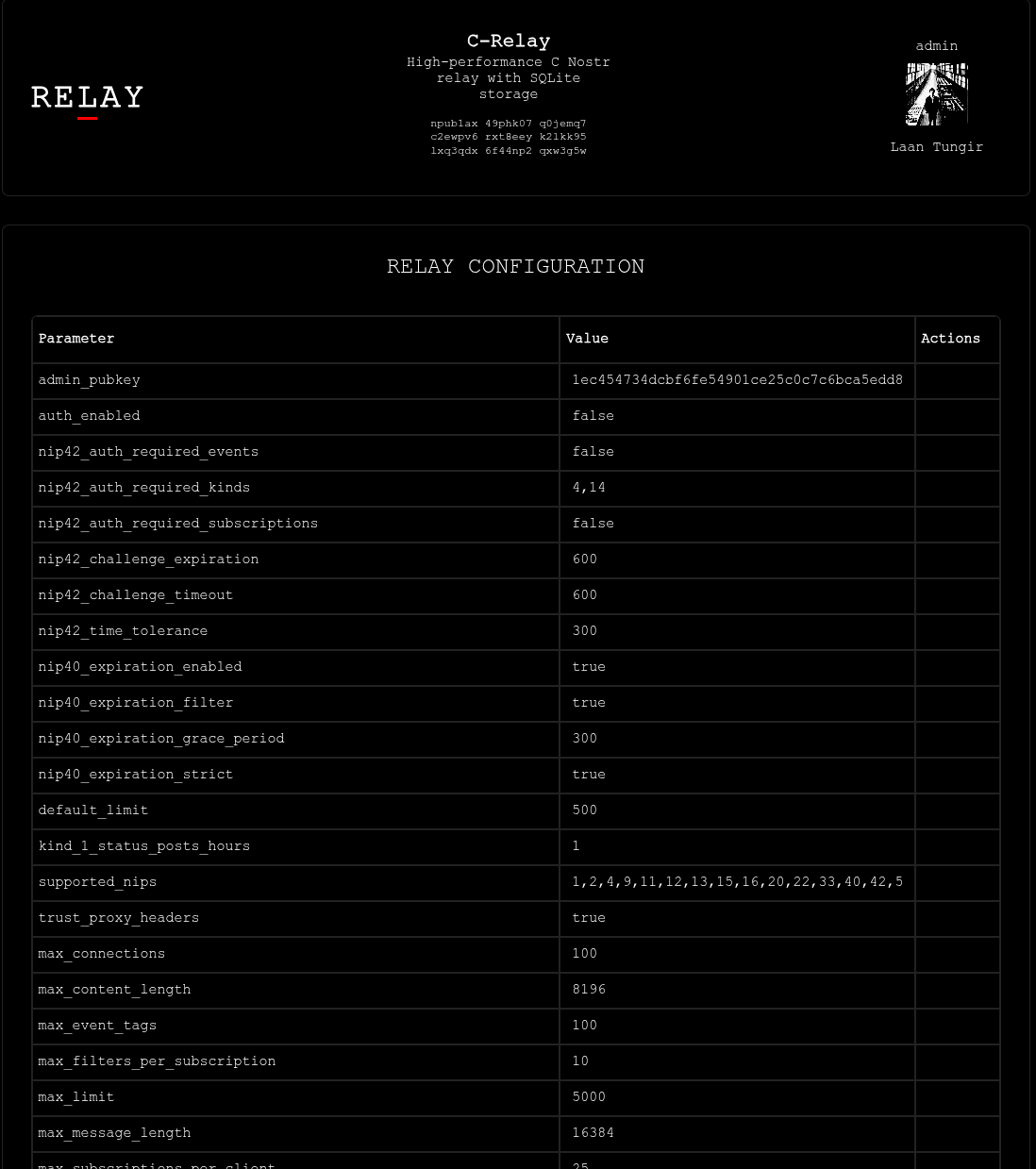
Set your configuration preferences.
|
||||
|
||||
|
||||
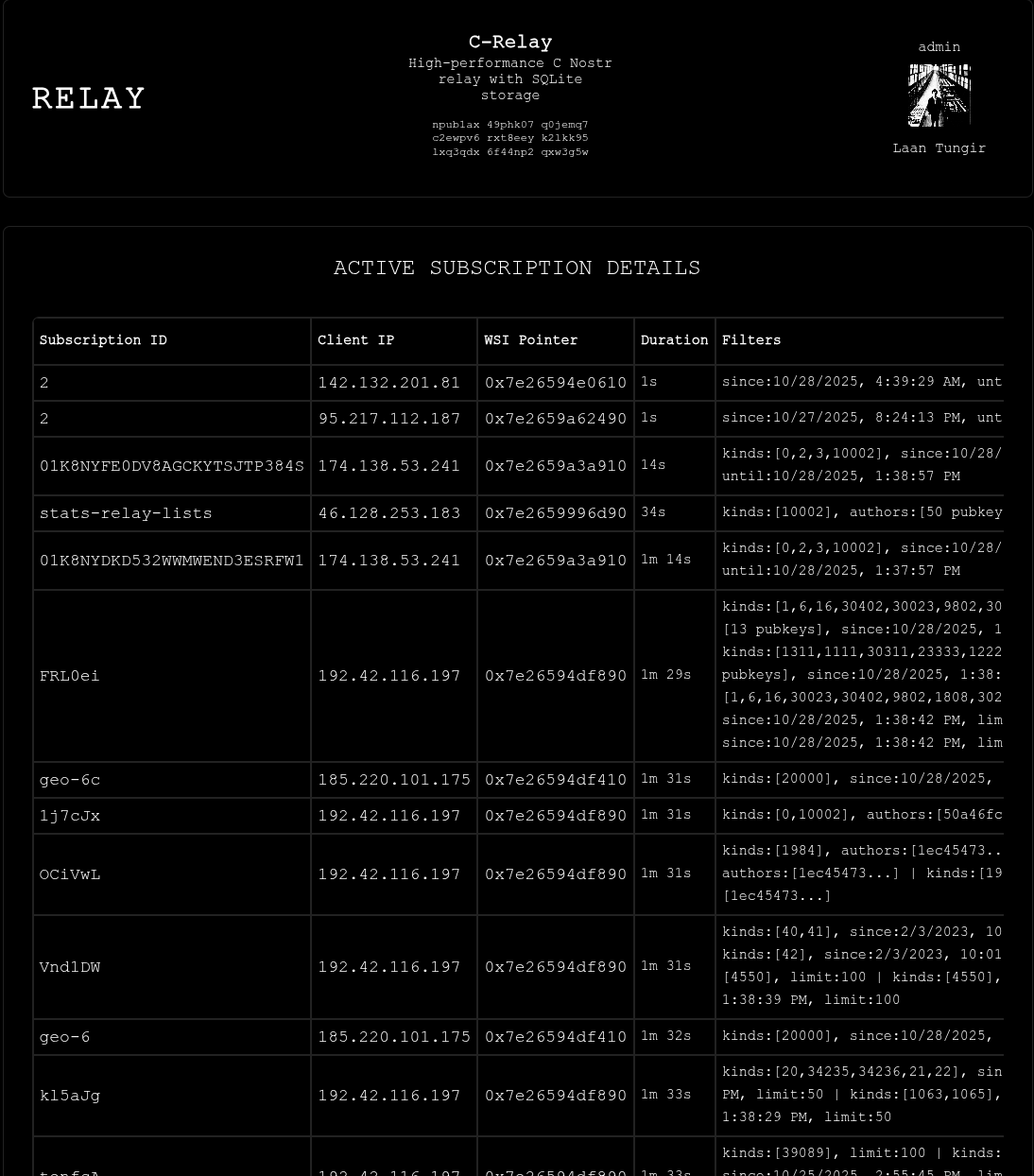
View current subscriptions
|
||||
|
||||
|
||||
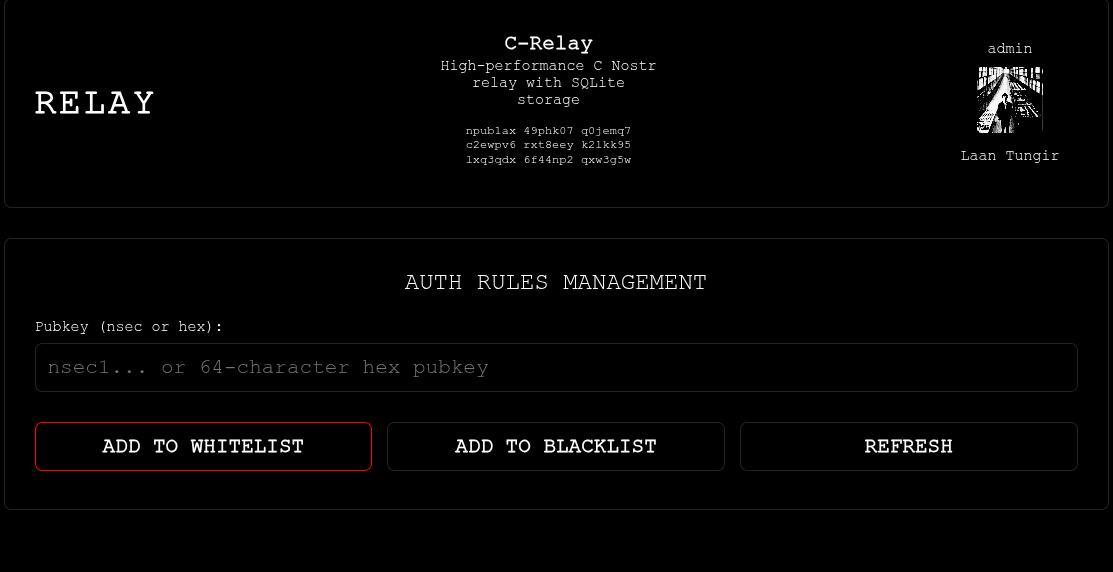
Add npubs to white or black lists.
|
||||
|
||||
|
||||
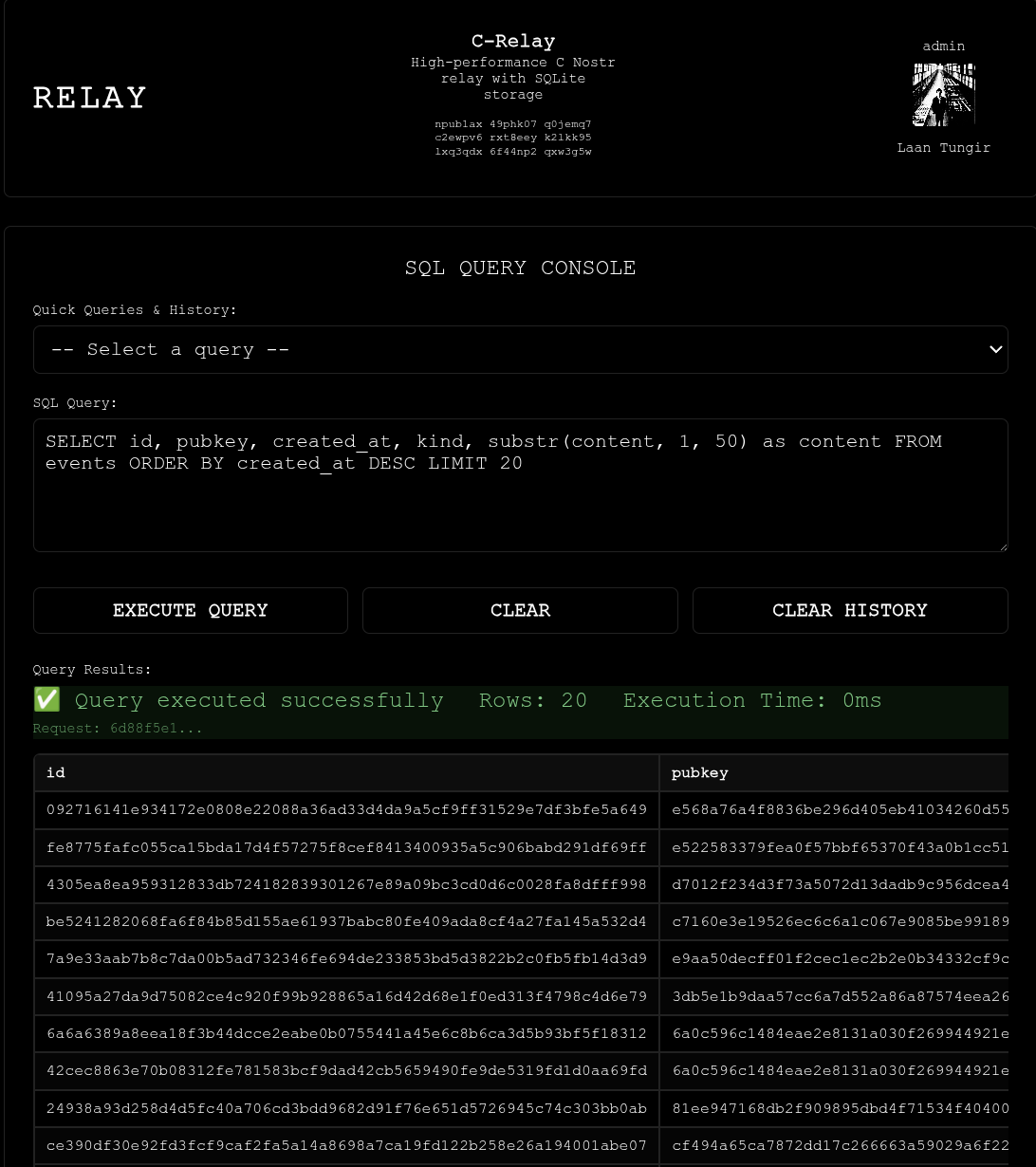
Run sql queries on the database.
|
||||
|
||||
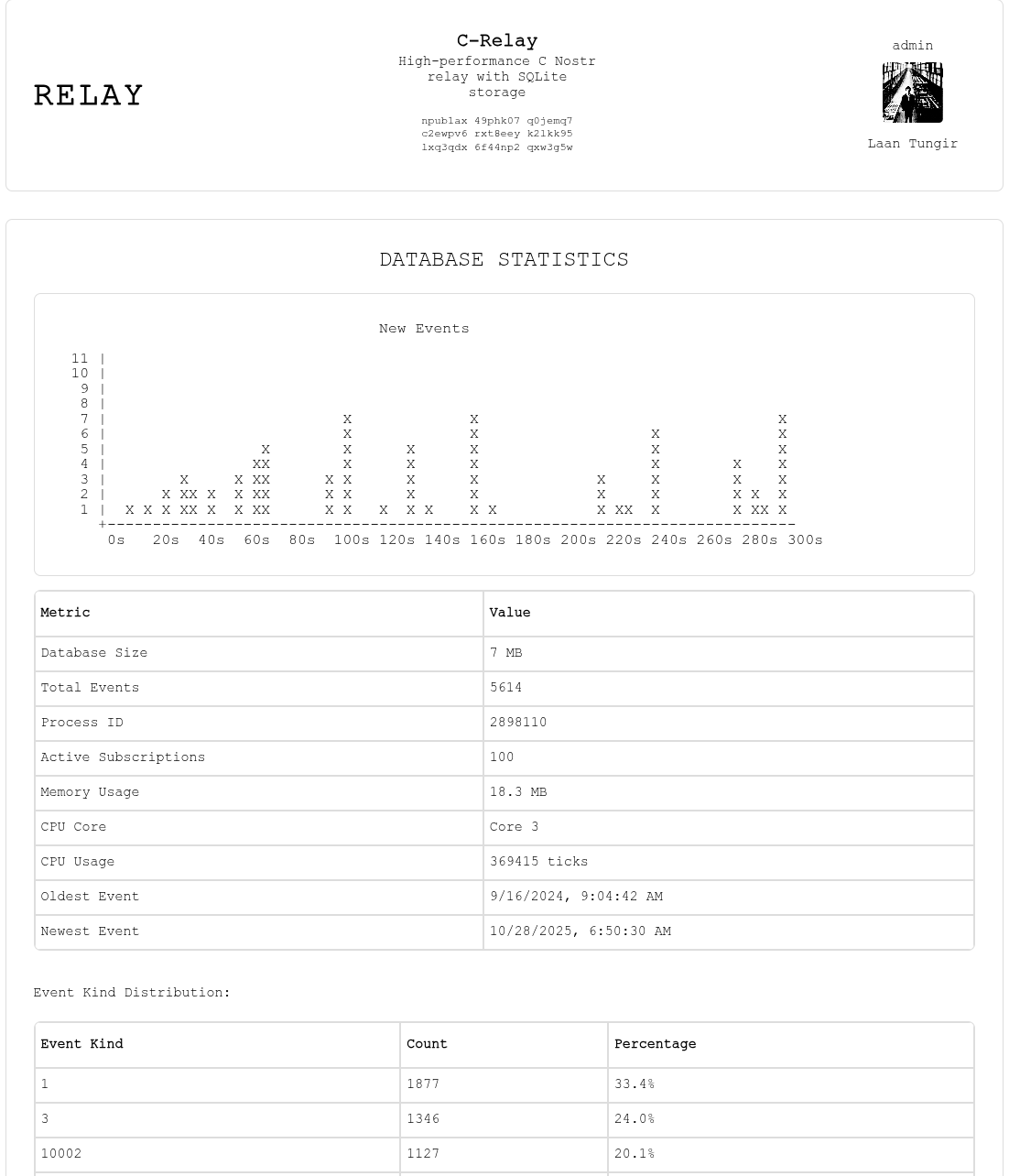
|
||||
Light mode.
|
||||
|
||||
345
README.md
345
README.md
@@ -1,8 +1,8 @@
|
||||
# C Nostr Relay - Event-Based Configuration System
|
||||
# C-Nostr Relay
|
||||
|
||||
A high-performance Nostr relay implemented in C with SQLite backend, featuring a revolutionary **zero-configuration** approach using event-based configuration management.
|
||||
A high-performance Nostr relay implemented in C with SQLite backend, featuring nostr event-based management.
|
||||
|
||||
## 📜 Supported NIPs
|
||||
## Supported NIPs
|
||||
|
||||
<!--
|
||||
NOTE FOR ASSISTANTS: When updating the NIPs checklist below, ONLY change [ ] to [x] to mark as complete.
|
||||
@@ -18,13 +18,89 @@ Do NOT modify the formatting, add emojis, or change the text. Keep the simple fo
|
||||
- [x] NIP-33: Parameterized Replaceable Events
|
||||
- [x] NIP-40: Expiration Timestamp
|
||||
- [x] NIP-42: Authentication of clients to relays
|
||||
- [ ] NIP-45: Counting results
|
||||
- [ ] NIP-50: Keywords filter
|
||||
- [ ] NIP-70: Protected Events
|
||||
- [x] NIP-45: Counting results
|
||||
- [x] NIP-50: Keywords filter
|
||||
- [x] NIP-70: Protected Events
|
||||
|
||||
## 🔧 Administrator API
|
||||
## Quick Start
|
||||
|
||||
C-Relay uses an innovative **event-based administration system** where all configuration and management commands are sent as signed Nostr events using the admin private key generated during first startup. All admin commands use **tag-based parameters** for simplicity and compatibility.
|
||||
Get your C-Relay up and running in minutes with a static binary (no dependencies required):
|
||||
|
||||
### 1. Download Static Binary
|
||||
|
||||
Download the latest static release from the [releases page](https://git.laantungir.net/laantungir/c-relay/releases):
|
||||
|
||||
```bash
|
||||
# Static binary - works on all Linux distributions (no dependencies)
|
||||
wget https://git.laantungir.net/laantungir/c-relay/releases/download/v0.6.0/c-relay-v0.6.0-linux-x86_64-static
|
||||
chmod +x c-relay-v0.6.0-linux-x86_64-static
|
||||
mv c-relay-v0.6.0-linux-x86_64-static c-relay
|
||||
```
|
||||
|
||||
### 2. Start the Relay
|
||||
|
||||
Simply run the binary - no configuration files needed:
|
||||
|
||||
```bash
|
||||
./c-relay
|
||||
```
|
||||
|
||||
On first startup, you'll see:
|
||||
- **Admin Private Key**: Save this securely! You'll need it for administration
|
||||
- **Relay Public Key**: Your relay's identity on the Nostr network
|
||||
- **Port Information**: Default is 8888, or the next available port
|
||||
|
||||
### 3. Access the Web Interface
|
||||
|
||||
Open your browser and navigate to:
|
||||
```
|
||||
http://localhost:8888/api/
|
||||
```
|
||||
|
||||
The web interface provides:
|
||||
- Real-time configuration management
|
||||
- Database statistics dashboard
|
||||
- Auth rules management
|
||||
- Secure admin authentication with your Nostr identity
|
||||
|
||||
### 4. Test Your Relay
|
||||
|
||||
Test basic connectivity:
|
||||
```bash
|
||||
# Test WebSocket connection
|
||||
curl -H "Accept: application/nostr+json" http://localhost:8888
|
||||
|
||||
# Test with a Nostr client
|
||||
# Add ws://localhost:8888 to your client's relay list
|
||||
```
|
||||
|
||||
### 5. Configure Your Relay (Optional)
|
||||
|
||||
Use the web interface or send admin commands to customize:
|
||||
- Relay name and description
|
||||
- Authentication rules (whitelist/blacklist)
|
||||
- Connection limits
|
||||
- Proof-of-work requirements
|
||||
|
||||
**That's it!** Your relay is now running with zero configuration required. The event-based configuration system means you can adjust all settings through the web interface or admin API without editing config files.
|
||||
|
||||
|
||||
## Web Admin Interface
|
||||
|
||||
C-Relay includes a **built-in web-based administration interface** accessible at `http://localhost:8888/api/`. The interface provides:
|
||||
|
||||
- **Real-time Configuration Management**: View and edit all relay settings through a web UI
|
||||
- **Database Statistics Dashboard**: Monitor event counts, storage usage, and performance metrics
|
||||
- **Auth Rules Management**: Configure whitelist/blacklist rules for pubkeys
|
||||
- **NIP-42 Authentication**: Secure access using your Nostr identity
|
||||
- **Event-Based Updates**: All changes are applied as cryptographically signed Nostr events
|
||||
|
||||
The web interface serves embedded static files with no external dependencies and includes proper CORS headers for browser compatibility.
|
||||
|
||||
|
||||
## Administrator API
|
||||
|
||||
C-Relay uses an innovative **event-based administration system** where all configuration and management commands are sent as signed Nostr events using the admin private key generated during first startup. All admin commands use **NIP-44 encrypted command arrays** for security and compatibility.
|
||||
|
||||
### Authentication
|
||||
|
||||
@@ -32,7 +108,7 @@ All admin commands require signing with the admin private key displayed during f
|
||||
|
||||
### Event Structure
|
||||
|
||||
All admin commands use the same unified event structure with tag-based parameters:
|
||||
All admin commands use the same unified event structure with NIP-44 encrypted content:
|
||||
|
||||
**Admin Command Event:**
|
||||
```json
|
||||
@@ -41,14 +117,16 @@ All admin commands use the same unified event structure with tag-based parameter
|
||||
"pubkey": "admin_public_key",
|
||||
"created_at": 1234567890,
|
||||
"kind": 23456,
|
||||
"content": "<nip44 encrypted command>",
|
||||
"content": "AqHBUgcM7dXFYLQuDVzGwMST1G8jtWYyVvYxXhVGEu4nAb4LVw...",
|
||||
"tags": [
|
||||
["p", "relay_public_key"],
|
||||
["p", "relay_public_key"]
|
||||
],
|
||||
"sig": "event_signature"
|
||||
}
|
||||
```
|
||||
|
||||
The `content` field contains a NIP-44 encrypted JSON array representing the command.
|
||||
|
||||
**Admin Response Event:**
|
||||
```json
|
||||
["EVENT", "temp_sub_id", {
|
||||
@@ -56,7 +134,7 @@ All admin commands use the same unified event structure with tag-based parameter
|
||||
"pubkey": "relay_public_key",
|
||||
"created_at": 1234567890,
|
||||
"kind": 23457,
|
||||
"content": "<nip44 encrypted response>",
|
||||
"content": "BpKCVhfN8eYtRmPqSvWxZnMkL2gHjUiOp3rTyEwQaS5dFg...",
|
||||
"tags": [
|
||||
["p", "admin_public_key"]
|
||||
],
|
||||
@@ -64,30 +142,44 @@ All admin commands use the same unified event structure with tag-based parameter
|
||||
}]
|
||||
```
|
||||
|
||||
The `content` field contains a NIP-44 encrypted JSON response object.
|
||||
|
||||
### Admin Commands
|
||||
|
||||
All commands are sent as nip44 encrypted content. The following table lists all available commands:
|
||||
All commands are sent as NIP-44 encrypted JSON arrays in the event content. The following table lists all available commands:
|
||||
|
||||
| Command Type | Tag Format | Description |
|
||||
|--------------|------------|-------------|
|
||||
| Command Type | Command Format | Description |
|
||||
|--------------|----------------|-------------|
|
||||
| **Configuration Management** |
|
||||
| `config_update` | `["relay_description", "My Relay"]` | Update relay configuration parameters |
|
||||
| `config_query` | `["config_query", "list_all_keys"]` | List all available configuration keys |
|
||||
| `config_update` | `["config_update", [{"key": "auth_enabled", "value": "true", "data_type": "boolean", "category": "auth"}, {"key": "relay_description", "value": "My Relay", "data_type": "string", "category": "relay"}, ...]]` | Update relay configuration parameters (supports multiple updates) |
|
||||
| `config_query` | `["config_query", "all"]` | Query all configuration parameters |
|
||||
| **Auth Rules Management** |
|
||||
| `auth_add_blacklist` | `["blacklist", "pubkey", "abc123..."]` | Add pubkey to blacklist |
|
||||
| `auth_add_whitelist` | `["whitelist", "pubkey", "def456..."]` | Add pubkey to whitelist |
|
||||
| `auth_delete_rule` | `["delete_auth_rule", "blacklist", "pubkey", "abc123..."]` | Delete specific auth rule |
|
||||
| `auth_query_all` | `["auth_query", "all"]` | Query all auth rules |
|
||||
| `auth_query_type` | `["auth_query", "whitelist"]` | Query specific rule type |
|
||||
| `auth_query_pattern` | `["auth_query", "pattern", "abc123..."]` | Query specific pattern |
|
||||
| **System Commands** |
|
||||
| `system_clear_auth` | `["system_command", "clear_all_auth_rules"]` | Clear all auth rules |
|
||||
| `system_status` | `["system_command", "system_status"]` | Get system status |
|
||||
| `stats_query` | `["stats_query"]` | Get comprehensive database statistics |
|
||||
| **Database Queries** |
|
||||
| `sql_query` | `["sql_query", "SELECT * FROM events LIMIT 10"]` | Execute read-only SQL query against relay database |
|
||||
|
||||
### Available Configuration Keys
|
||||
|
||||
**Basic Relay Settings:**
|
||||
- `relay_name`: Relay name (displayed in NIP-11)
|
||||
- `relay_description`: Relay description text
|
||||
- `relay_contact`: Contact information
|
||||
- `relay_software`: Software URL
|
||||
- `relay_version`: Software version
|
||||
- `supported_nips`: Comma-separated list of supported NIP numbers (e.g., "1,2,4,9,11,12,13,15,16,20,22,33,40,42")
|
||||
- `language_tags`: Comma-separated list of supported language tags (e.g., "en,es,fr" or "*" for all)
|
||||
- `relay_countries`: Comma-separated list of supported country codes (e.g., "US,CA,MX" or "*" for all)
|
||||
- `posting_policy`: Posting policy URL or text
|
||||
- `payments_url`: Payment URL for premium features
|
||||
- `max_connections`: Maximum concurrent connections
|
||||
- `max_subscriptions_per_client`: Max subscriptions per client
|
||||
- `max_event_tags`: Maximum tags per event
|
||||
@@ -103,6 +195,27 @@ All commands are sent as nip44 encrypted content. The following table lists all
|
||||
- `pow_min_difficulty`: Minimum proof-of-work difficulty
|
||||
- `nip40_expiration_enabled`: Enable event expiration (`true`/`false`)
|
||||
|
||||
**Monitoring Settings:**
|
||||
- `kind_24567_reporting_throttle_sec`: Minimum seconds between monitoring events (default: 5)
|
||||
|
||||
### Dynamic Configuration Updates
|
||||
|
||||
C-Relay supports **dynamic configuration updates** without requiring a restart for most settings. Configuration parameters are categorized as either **dynamic** (can be updated immediately) or **restart-required** (require relay restart to take effect).
|
||||
|
||||
**Dynamic Configuration Parameters (No Restart Required):**
|
||||
- All relay information (NIP-11) settings: `relay_name`, `relay_description`, `relay_contact`, `relay_software`, `relay_version`, `supported_nips`, `language_tags`, `relay_countries`, `posting_policy`, `payments_url`
|
||||
- Authentication settings: `auth_enabled`, `nip42_auth_required`, `nip42_auth_required_kinds`, `nip42_challenge_timeout`
|
||||
- Subscription limits: `max_subscriptions_per_client`, `max_total_subscriptions`
|
||||
- Event validation limits: `max_event_tags`, `max_content_length`, `max_message_length`
|
||||
- Proof of Work settings: `pow_min_difficulty`, `pow_mode`
|
||||
- Event expiration settings: `nip40_expiration_enabled`, `nip40_expiration_strict`, `nip40_expiration_filter`, `nip40_expiration_grace_period`
|
||||
|
||||
**Restart-Required Configuration Parameters:**
|
||||
- Connection settings: `max_connections`, `relay_port`
|
||||
- Database and core system settings
|
||||
|
||||
When updating configuration, the admin API response will indicate whether a restart is required for each parameter. Dynamic updates take effect immediately and are reflected in NIP-11 relay information documents without restart.
|
||||
|
||||
### Response Format
|
||||
|
||||
All admin commands return **signed EVENT responses** via WebSocket following standard Nostr protocol. Responses use JSON content with structured data.
|
||||
@@ -116,7 +229,7 @@ All admin commands return **signed EVENT responses** via WebSocket following sta
|
||||
"pubkey": "relay_public_key",
|
||||
"created_at": 1234567890,
|
||||
"kind": 23457,
|
||||
"content": "nip44 encrypted:{\"status\": \"success\", \"message\": \"Operation completed successfully\"}",
|
||||
"content": "nip44 encrypted:{\"query_type\": \"config_update\", \"status\": \"success\", \"message\": \"Operation completed successfully\", \"timestamp\": 1234567890}",
|
||||
"tags": [
|
||||
["p", "admin_public_key"]
|
||||
],
|
||||
@@ -131,7 +244,7 @@ All admin commands return **signed EVENT responses** via WebSocket following sta
|
||||
"pubkey": "relay_public_key",
|
||||
"created_at": 1234567890,
|
||||
"kind": 23457,
|
||||
"content": "nip44 encrypted:{\"status\": \"error\", \"message\": \"Error: invalid configuration value\"}",
|
||||
"content": "nip44 encrypted:{\"query_type\": \"config_update\", \"status\": \"error\", \"error\": \"invalid configuration value\", \"timestamp\": 1234567890}",
|
||||
"tags": [
|
||||
["p", "admin_public_key"]
|
||||
],
|
||||
@@ -146,7 +259,7 @@ All admin commands return **signed EVENT responses** via WebSocket following sta
|
||||
"pubkey": "relay_public_key",
|
||||
"created_at": 1234567890,
|
||||
"kind": 23457,
|
||||
"content": "nip44 encrypted:{\"query_type\": \"auth_rules\", \"total_results\": 2, \"data\": [{\"rule_type\": \"blacklist\", \"pattern_type\": \"pubkey\", \"pattern_value\": \"abc123...\", \"action\": \"deny\"}]}",
|
||||
"content": "nip44 encrypted:{\"query_type\": \"auth_rules_all\", \"total_results\": 2, \"timestamp\": 1234567890, \"data\": [{\"rule_type\": \"blacklist\", \"pattern_type\": \"pubkey\", \"pattern_value\": \"abc123...\", \"action\": \"allow\"}]}",
|
||||
"tags": [
|
||||
["p", "admin_public_key"]
|
||||
],
|
||||
@@ -161,7 +274,7 @@ All admin commands return **signed EVENT responses** via WebSocket following sta
|
||||
"pubkey": "relay_public_key",
|
||||
"created_at": 1234567890,
|
||||
"kind": 23457,
|
||||
"content": "nip44 encrypted:{\"query_type\": \"config_keys\", \"config_keys\": [\"auth_enabled\", \"max_connections\"], \"descriptions\": {\"auth_enabled\": \"Enable whitelist/blacklist rules\"}}",
|
||||
"content": "nip44 encrypted:{\"query_type\": \"config_all\", \"total_results\": 27, \"timestamp\": 1234567890, \"data\": [{\"key\": \"auth_enabled\", \"value\": \"false\", \"data_type\": \"boolean\", \"category\": \"auth\", \"description\": \"Enable NIP-42 authentication\"}, {\"key\": \"relay_description\", \"value\": \"My Relay\", \"data_type\": \"string\", \"category\": \"relay\", \"description\": \"Relay description text\"}]}",
|
||||
"tags": [
|
||||
["p", "admin_public_key"]
|
||||
],
|
||||
@@ -169,3 +282,193 @@ All admin commands return **signed EVENT responses** via WebSocket following sta
|
||||
}]
|
||||
```
|
||||
|
||||
**Configuration Update Success Response:**
|
||||
```json
|
||||
["EVENT", "temp_sub_id", {
|
||||
"id": "response_event_id",
|
||||
"pubkey": "relay_public_key",
|
||||
"created_at": 1234567890,
|
||||
"kind": 23457,
|
||||
"content": "nip44 encrypted:{\"query_type\": \"config_update\", \"total_results\": 2, \"timestamp\": 1234567890, \"status\": \"success\", \"data\": [{\"key\": \"auth_enabled\", \"value\": \"true\", \"status\": \"updated\"}, {\"key\": \"relay_description\", \"value\": \"My Updated Relay\", \"status\": \"updated\"}]}",
|
||||
"tags": [
|
||||
["p", "admin_public_key"]
|
||||
],
|
||||
"sig": "response_event_signature"
|
||||
}]
|
||||
```
|
||||
|
||||
**Configuration Update Error Response:**
|
||||
```json
|
||||
["EVENT", "temp_sub_id", {
|
||||
"id": "response_event_id",
|
||||
"pubkey": "relay_public_key",
|
||||
"created_at": 1234567890,
|
||||
"kind": 23457,
|
||||
"content": "nip44 encrypted:{\"query_type\": \"config_update\", \"status\": \"error\", \"error\": \"field validation failed: invalid port number '99999' (must be 1-65535)\", \"timestamp\": 1234567890}",
|
||||
"tags": [
|
||||
["p", "admin_public_key"]
|
||||
],
|
||||
"sig": "response_event_signature"
|
||||
}]
|
||||
```
|
||||
|
||||
**Database Statistics Query Response:**
|
||||
```json
|
||||
["EVENT", "temp_sub_id", {
|
||||
"id": "response_event_id",
|
||||
"pubkey": "relay_public_key",
|
||||
"created_at": 1234567890,
|
||||
"kind": 23457,
|
||||
"content": "nip44 encrypted:{\"query_type\": \"stats_query\", \"timestamp\": 1234567890, \"database_size_bytes\": 1048576, \"total_events\": 15432, \"database_created_at\": 1234567800, \"latest_event_at\": 1234567890, \"event_kinds\": [{\"kind\": 1, \"count\": 12000, \"percentage\": 77.8}, {\"kind\": 0, \"count\": 2500, \"percentage\": 16.2}], \"time_stats\": {\"total\": 15432, \"last_24h\": 234, \"last_7d\": 1456, \"last_30d\": 5432}, \"top_pubkeys\": [{\"pubkey\": \"abc123...\", \"event_count\": 1234, \"percentage\": 8.0}, {\"pubkey\": \"def456...\", \"event_count\": 987, \"percentage\": 6.4}]}",
|
||||
"tags": [
|
||||
["p", "admin_public_key"]
|
||||
],
|
||||
"sig": "response_event_signature"
|
||||
}]
|
||||
```
|
||||
|
||||
**SQL Query Response:**
|
||||
```json
|
||||
["EVENT", "temp_sub_id", {
|
||||
"id": "response_event_id",
|
||||
"pubkey": "relay_public_key",
|
||||
"created_at": 1234567890,
|
||||
"kind": 23457,
|
||||
"content": "nip44 encrypted:{\"query_type\": \"sql_query\", \"request_id\": \"request_event_id\", \"timestamp\": 1234567890, \"query\": \"SELECT * FROM events LIMIT 10\", \"execution_time_ms\": 45, \"row_count\": 10, \"columns\": [\"id\", \"pubkey\", \"created_at\", \"kind\", \"content\"], \"rows\": [[\"abc123...\", \"def456...\", 1234567890, 1, \"Hello world\"], ...]}",
|
||||
"tags": [
|
||||
["p", "admin_public_key"],
|
||||
["e", "request_event_id"]
|
||||
],
|
||||
"sig": "response_event_signature"
|
||||
}]
|
||||
```
|
||||
|
||||
### SQL Query Command
|
||||
|
||||
The `sql_query` command allows administrators to execute read-only SQL queries against the relay database. This provides powerful analytics and debugging capabilities through the admin API.
|
||||
|
||||
**Request/Response Correlation:**
|
||||
- Each response includes the request event ID in both the `tags` array (`["e", "request_event_id"]`) and the decrypted content (`"request_id": "request_event_id"`)
|
||||
- This allows proper correlation when multiple queries are submitted concurrently
|
||||
- Frontend can track pending queries and match responses to requests
|
||||
|
||||
**Security Features:**
|
||||
- Only SELECT statements allowed (INSERT, UPDATE, DELETE, DROP, etc. are blocked)
|
||||
- Query timeout: 5 seconds (configurable)
|
||||
- Result row limit: 1000 rows (configurable)
|
||||
- All queries logged with execution time
|
||||
|
||||
**Available Tables and Views:**
|
||||
- `events` - All Nostr events
|
||||
- `config` - Configuration parameters
|
||||
- `auth_rules` - Authentication rules
|
||||
- `subscription_events` - Subscription lifecycle log
|
||||
- `event_broadcasts` - Event broadcast log
|
||||
- `recent_events` - Last 1000 events (view)
|
||||
- `event_stats` - Event statistics by type (view)
|
||||
- `subscription_analytics` - Subscription metrics (view)
|
||||
- `active_subscriptions_log` - Currently active subscriptions (view)
|
||||
- `event_kinds_view` - Event distribution by kind (view)
|
||||
- `top_pubkeys_view` - Top 10 pubkeys by event count (view)
|
||||
- `time_stats_view` - Time-based statistics (view)
|
||||
|
||||
**Example Queries:**
|
||||
```sql
|
||||
-- Recent events
|
||||
SELECT id, pubkey, created_at, kind FROM events ORDER BY created_at DESC LIMIT 20
|
||||
|
||||
-- Event distribution by kind
|
||||
SELECT * FROM event_kinds_view ORDER BY count DESC
|
||||
|
||||
-- Active subscriptions
|
||||
SELECT * FROM active_subscriptions_log ORDER BY created_at DESC
|
||||
|
||||
-- Database statistics
|
||||
SELECT
|
||||
(SELECT COUNT(*) FROM events) as total_events,
|
||||
(SELECT COUNT(*) FROM subscription_events) as total_subscriptions
|
||||
```
|
||||
|
||||
|
||||
|
||||
|
||||
|
||||
|
||||
## Real-time Monitoring System
|
||||
|
||||
C-Relay includes a subscription-based monitoring system that broadcasts real-time relay statistics using ephemeral events (kind 24567).
|
||||
|
||||
### Activation
|
||||
|
||||
The monitoring system activates automatically when clients subscribe to kind 24567 events:
|
||||
|
||||
```json
|
||||
["REQ", "monitoring-sub", {"kinds": [24567]}]
|
||||
```
|
||||
|
||||
For specific monitoring types, use d-tag filters:
|
||||
|
||||
```json
|
||||
["REQ", "event-kinds-sub", {"kinds": [24567], "#d": ["event_kinds"]}]
|
||||
["REQ", "time-stats-sub", {"kinds": [24567], "#d": ["time_stats"]}]
|
||||
["REQ", "top-pubkeys-sub", {"kinds": [24567], "#d": ["top_pubkeys"]}]
|
||||
```
|
||||
|
||||
When no subscriptions exist, monitoring is dormant to conserve resources.
|
||||
|
||||
### Monitoring Event Types
|
||||
|
||||
| Type | d Tag | Description |
|
||||
|------|-------|-------------|
|
||||
| Event Distribution | `event_kinds` | Event count by kind with percentages |
|
||||
| Time Statistics | `time_stats` | Events in last 24h, 7d, 30d |
|
||||
| Top Publishers | `top_pubkeys` | Top 10 pubkeys by event count |
|
||||
| Active Subscriptions | `active_subscriptions` | Current subscription details (admin only) |
|
||||
| Subscription Details | `subscription_details` | Detailed subscription info (admin only) |
|
||||
| CPU Metrics | `cpu_metrics` | Process CPU and memory usage |
|
||||
|
||||
### Event Structure
|
||||
|
||||
```json
|
||||
{
|
||||
"kind": 24567,
|
||||
"pubkey": "<relay_pubkey>",
|
||||
"created_at": <timestamp>,
|
||||
"content": "{\"data_type\":\"event_kinds\",\"timestamp\":1234567890,...}",
|
||||
"tags": [
|
||||
["d", "event_kinds"]
|
||||
]
|
||||
}
|
||||
```
|
||||
|
||||
### Configuration
|
||||
|
||||
- `kind_24567_reporting_throttle_sec`: Minimum seconds between monitoring events (default: 5)
|
||||
|
||||
### Web Dashboard Integration
|
||||
|
||||
The built-in web dashboard (`/api/`) automatically subscribes to monitoring events and displays real-time statistics.
|
||||
|
||||
### Performance Considerations
|
||||
|
||||
- Monitoring events are ephemeral (not stored in database)
|
||||
- Throttling prevents excessive event generation
|
||||
- Automatic activation/deactivation based on subscriptions
|
||||
- Minimal overhead when no clients are monitoring
|
||||
|
||||
## Direct Messaging Admin System
|
||||
|
||||
In addition to the above admin API, c-relay allows the administrator to direct message the relay to get information or control some settings. As long as the administrator is signed in with any nostr client that allows sending nip-17 direct messages (DMs), they can control the relay.
|
||||
|
||||
The is possible because the relay is a full nostr citizen with it's own private and public key, and it knows the administrator's public key.
|
||||
|
||||
|
||||
|
||||
**Available DM commands**
|
||||
|
||||
The intent is not to be strict in the formatting of the DM. So for example if the relay receives any DM from the administrator with the words "stats" or "statistics" in it, it will respond to the administrator with a reply DM with the current relay statistics.
|
||||
|
||||
- `stats`|`statistics`: Relay statistics
|
||||
- `config`|`configuration`: Relay configuration
|
||||
|
||||
|
||||
|
||||
612
STATIC_MUSL_GUIDE.md
Normal file
612
STATIC_MUSL_GUIDE.md
Normal file
@@ -0,0 +1,612 @@
|
||||
# Static MUSL Build Guide for C Programs
|
||||
|
||||
## Overview
|
||||
|
||||
This guide explains how to build truly portable static binaries using Alpine Linux and MUSL libc. These binaries have **zero runtime dependencies** and work on any Linux distribution without modification.
|
||||
|
||||
This guide is specifically tailored for C programs that use:
|
||||
- **nostr_core_lib** - Nostr protocol implementation
|
||||
- **nostr_login_lite** - Nostr authentication library
|
||||
- Common dependencies: libwebsockets, OpenSSL, SQLite, curl, secp256k1
|
||||
|
||||
## Why MUSL Static Binaries?
|
||||
|
||||
### Advantages Over glibc
|
||||
|
||||
| Feature | MUSL Static | glibc Static | glibc Dynamic |
|
||||
|---------|-------------|--------------|---------------|
|
||||
| **Portability** | ✓ Any Linux | ⚠ glibc only | ✗ Requires matching libs |
|
||||
| **Binary Size** | ~7-10 MB | ~12-15 MB | ~2-3 MB |
|
||||
| **Dependencies** | None | NSS libs | Many system libs |
|
||||
| **Deployment** | Single file | Single file + NSS | Binary + libraries |
|
||||
| **Compatibility** | Universal | glibc version issues | Library version hell |
|
||||
|
||||
### Key Benefits
|
||||
|
||||
1. **True Portability**: Works on Alpine, Ubuntu, Debian, CentOS, Arch, etc.
|
||||
2. **No Library Hell**: No `GLIBC_2.XX not found` errors
|
||||
3. **Simple Deployment**: Just copy one file
|
||||
4. **Reproducible Builds**: Same Docker image = same binary
|
||||
5. **Security**: No dependency on system libraries with vulnerabilities
|
||||
|
||||
## Quick Start
|
||||
|
||||
### Prerequisites
|
||||
|
||||
- Docker installed and running
|
||||
- Your C project with source code
|
||||
- Internet connection for downloading dependencies
|
||||
|
||||
### Basic Build Process
|
||||
|
||||
```bash
|
||||
# 1. Copy the Dockerfile template (see below)
|
||||
cp /path/to/c-relay/Dockerfile.alpine-musl ./Dockerfile.static
|
||||
|
||||
# 2. Customize for your project (see Customization section)
|
||||
vim Dockerfile.static
|
||||
|
||||
# 3. Build the static binary
|
||||
docker build --platform linux/amd64 -f Dockerfile.static -t my-app-builder .
|
||||
|
||||
# 4. Extract the binary
|
||||
docker create --name temp-container my-app-builder
|
||||
docker cp temp-container:/build/my_app_static ./my_app_static
|
||||
docker rm temp-container
|
||||
|
||||
# 5. Verify it's static
|
||||
ldd ./my_app_static # Should show "not a dynamic executable"
|
||||
```
|
||||
|
||||
## Dockerfile Template
|
||||
|
||||
Here's a complete Dockerfile template you can customize for your project:
|
||||
|
||||
```dockerfile
|
||||
# Alpine-based MUSL static binary builder
|
||||
# Produces truly portable binaries with zero runtime dependencies
|
||||
|
||||
FROM alpine:3.19 AS builder
|
||||
|
||||
# Install build dependencies
|
||||
RUN apk add --no-cache \
|
||||
build-base \
|
||||
musl-dev \
|
||||
git \
|
||||
cmake \
|
||||
pkgconfig \
|
||||
autoconf \
|
||||
automake \
|
||||
libtool \
|
||||
openssl-dev \
|
||||
openssl-libs-static \
|
||||
zlib-dev \
|
||||
zlib-static \
|
||||
curl-dev \
|
||||
curl-static \
|
||||
sqlite-dev \
|
||||
sqlite-static \
|
||||
linux-headers \
|
||||
wget \
|
||||
bash
|
||||
|
||||
WORKDIR /build
|
||||
|
||||
# Build libsecp256k1 static (required for Nostr)
|
||||
RUN cd /tmp && \
|
||||
git clone https://github.com/bitcoin-core/secp256k1.git && \
|
||||
cd secp256k1 && \
|
||||
./autogen.sh && \
|
||||
./configure --enable-static --disable-shared --prefix=/usr \
|
||||
CFLAGS="-fPIC" && \
|
||||
make -j$(nproc) && \
|
||||
make install && \
|
||||
rm -rf /tmp/secp256k1
|
||||
|
||||
# Build libwebsockets static (if needed for WebSocket support)
|
||||
RUN cd /tmp && \
|
||||
git clone --depth 1 --branch v4.3.3 https://github.com/warmcat/libwebsockets.git && \
|
||||
cd libwebsockets && \
|
||||
mkdir build && cd build && \
|
||||
cmake .. \
|
||||
-DLWS_WITH_STATIC=ON \
|
||||
-DLWS_WITH_SHARED=OFF \
|
||||
-DLWS_WITH_SSL=ON \
|
||||
-DLWS_WITHOUT_TESTAPPS=ON \
|
||||
-DLWS_WITHOUT_TEST_SERVER=ON \
|
||||
-DLWS_WITHOUT_TEST_CLIENT=ON \
|
||||
-DLWS_WITHOUT_TEST_PING=ON \
|
||||
-DLWS_WITH_HTTP2=OFF \
|
||||
-DLWS_WITH_LIBUV=OFF \
|
||||
-DLWS_WITH_LIBEVENT=OFF \
|
||||
-DLWS_IPV6=ON \
|
||||
-DCMAKE_BUILD_TYPE=Release \
|
||||
-DCMAKE_INSTALL_PREFIX=/usr \
|
||||
-DCMAKE_C_FLAGS="-fPIC" && \
|
||||
make -j$(nproc) && \
|
||||
make install && \
|
||||
rm -rf /tmp/libwebsockets
|
||||
|
||||
# Copy git configuration for submodules
|
||||
COPY .gitmodules /build/.gitmodules
|
||||
COPY .git /build/.git
|
||||
|
||||
# Initialize submodules
|
||||
RUN git submodule update --init --recursive
|
||||
|
||||
# Copy and build nostr_core_lib
|
||||
COPY nostr_core_lib /build/nostr_core_lib/
|
||||
RUN cd nostr_core_lib && \
|
||||
chmod +x build.sh && \
|
||||
sed -i 's/CFLAGS="-Wall -Wextra -std=c99 -fPIC -O2"/CFLAGS="-U_FORTIFY_SOURCE -D_FORTIFY_SOURCE=0 -Wall -Wextra -std=c99 -fPIC -O2"/' build.sh && \
|
||||
rm -f *.o *.a 2>/dev/null || true && \
|
||||
./build.sh --nips=1,6,13,17,19,44,59
|
||||
|
||||
# Copy and build nostr_login_lite (if used)
|
||||
# COPY nostr_login_lite /build/nostr_login_lite/
|
||||
# RUN cd nostr_login_lite && make static
|
||||
|
||||
# Copy your application source
|
||||
COPY src/ /build/src/
|
||||
COPY Makefile /build/Makefile
|
||||
|
||||
# Build your application with full static linking
|
||||
RUN gcc -static -O2 -Wall -Wextra -std=c99 \
|
||||
-U_FORTIFY_SOURCE -D_FORTIFY_SOURCE=0 \
|
||||
-I. -Inostr_core_lib -Inostr_core_lib/nostr_core \
|
||||
-Inostr_core_lib/cjson -Inostr_core_lib/nostr_websocket \
|
||||
src/*.c \
|
||||
-o /build/my_app_static \
|
||||
nostr_core_lib/libnostr_core_x64.a \
|
||||
-lwebsockets -lssl -lcrypto -lsqlite3 -lsecp256k1 \
|
||||
-lcurl -lz -lpthread -lm -ldl && \
|
||||
strip /build/my_app_static
|
||||
|
||||
# Verify it's truly static
|
||||
RUN echo "=== Binary Information ===" && \
|
||||
file /build/my_app_static && \
|
||||
ls -lh /build/my_app_static && \
|
||||
echo "=== Checking for dynamic dependencies ===" && \
|
||||
(ldd /build/my_app_static 2>&1 || echo "Binary is static")
|
||||
|
||||
# Output stage - just the binary
|
||||
FROM scratch AS output
|
||||
COPY --from=builder /build/my_app_static /my_app_static
|
||||
```
|
||||
|
||||
## Customization Guide
|
||||
|
||||
### 1. Adjust Dependencies
|
||||
|
||||
**Add dependencies** by modifying the `apk add` section:
|
||||
|
||||
```dockerfile
|
||||
RUN apk add --no-cache \
|
||||
build-base \
|
||||
musl-dev \
|
||||
# Add your dependencies here:
|
||||
libpng-dev \
|
||||
libpng-static \
|
||||
libjpeg-turbo-dev \
|
||||
libjpeg-turbo-static
|
||||
```
|
||||
|
||||
**Remove unused dependencies** to speed up builds:
|
||||
- Remove `libwebsockets` section if you don't need WebSocket support
|
||||
- Remove `sqlite` if you don't use databases
|
||||
- Remove `curl` if you don't make HTTP requests
|
||||
|
||||
### 2. Configure nostr_core_lib NIPs
|
||||
|
||||
Specify which NIPs your application needs:
|
||||
|
||||
```bash
|
||||
./build.sh --nips=1,6,19 # Minimal: Basic protocol, keys, bech32
|
||||
./build.sh --nips=1,6,13,17,19,44,59 # Full: All common NIPs
|
||||
./build.sh --nips=all # Everything available
|
||||
```
|
||||
|
||||
**Common NIP combinations:**
|
||||
- **Basic client**: `1,6,19` (events, keys, bech32)
|
||||
- **With encryption**: `1,6,19,44` (add modern encryption)
|
||||
- **With DMs**: `1,6,17,19,44,59` (add private messages)
|
||||
- **Relay/server**: `1,6,13,17,19,42,44,59` (add PoW, auth)
|
||||
|
||||
### 3. Modify Compilation Flags
|
||||
|
||||
**For your application:**
|
||||
|
||||
```dockerfile
|
||||
RUN gcc -static -O2 -Wall -Wextra -std=c99 \
|
||||
-U_FORTIFY_SOURCE -D_FORTIFY_SOURCE=0 \ # REQUIRED for MUSL
|
||||
-I. -Inostr_core_lib \ # Include paths
|
||||
src/*.c \ # Your source files
|
||||
-o /build/my_app_static \ # Output binary
|
||||
nostr_core_lib/libnostr_core_x64.a \ # Nostr library
|
||||
-lwebsockets -lssl -lcrypto \ # Link libraries
|
||||
-lsqlite3 -lsecp256k1 -lcurl \
|
||||
-lz -lpthread -lm -ldl
|
||||
```
|
||||
|
||||
**Debug build** (with symbols, no optimization):
|
||||
|
||||
```dockerfile
|
||||
RUN gcc -static -g -O0 -DDEBUG \
|
||||
-U_FORTIFY_SOURCE -D_FORTIFY_SOURCE=0 \
|
||||
# ... rest of flags
|
||||
```
|
||||
|
||||
### 4. Multi-Architecture Support
|
||||
|
||||
Build for different architectures:
|
||||
|
||||
```bash
|
||||
# x86_64 (Intel/AMD)
|
||||
docker build --platform linux/amd64 -f Dockerfile.static -t my-app-x86 .
|
||||
|
||||
# ARM64 (Apple Silicon, Raspberry Pi 4+)
|
||||
docker build --platform linux/arm64 -f Dockerfile.static -t my-app-arm64 .
|
||||
```
|
||||
|
||||
## Build Script Template
|
||||
|
||||
Create a `build_static.sh` script for convenience:
|
||||
|
||||
```bash
|
||||
#!/bin/bash
|
||||
set -e
|
||||
|
||||
SCRIPT_DIR="$(cd "$(dirname "${BASH_SOURCE[0]}")" && pwd)"
|
||||
BUILD_DIR="$SCRIPT_DIR/build"
|
||||
DOCKERFILE="$SCRIPT_DIR/Dockerfile.static"
|
||||
|
||||
# Detect architecture
|
||||
ARCH=$(uname -m)
|
||||
case "$ARCH" in
|
||||
x86_64)
|
||||
PLATFORM="linux/amd64"
|
||||
OUTPUT_NAME="my_app_static_x86_64"
|
||||
;;
|
||||
aarch64|arm64)
|
||||
PLATFORM="linux/arm64"
|
||||
OUTPUT_NAME="my_app_static_arm64"
|
||||
;;
|
||||
*)
|
||||
echo "Unknown architecture: $ARCH"
|
||||
exit 1
|
||||
;;
|
||||
esac
|
||||
|
||||
echo "Building for platform: $PLATFORM"
|
||||
mkdir -p "$BUILD_DIR"
|
||||
|
||||
# Build Docker image
|
||||
docker build \
|
||||
--platform "$PLATFORM" \
|
||||
-f "$DOCKERFILE" \
|
||||
-t my-app-builder:latest \
|
||||
--progress=plain \
|
||||
.
|
||||
|
||||
# Extract binary
|
||||
CONTAINER_ID=$(docker create my-app-builder:latest)
|
||||
docker cp "$CONTAINER_ID:/build/my_app_static" "$BUILD_DIR/$OUTPUT_NAME"
|
||||
docker rm "$CONTAINER_ID"
|
||||
|
||||
chmod +x "$BUILD_DIR/$OUTPUT_NAME"
|
||||
|
||||
echo "✓ Build complete: $BUILD_DIR/$OUTPUT_NAME"
|
||||
echo "✓ Size: $(du -h "$BUILD_DIR/$OUTPUT_NAME" | cut -f1)"
|
||||
|
||||
# Verify
|
||||
if ldd "$BUILD_DIR/$OUTPUT_NAME" 2>&1 | grep -q "not a dynamic executable"; then
|
||||
echo "✓ Binary is fully static"
|
||||
else
|
||||
echo "⚠ Warning: Binary may have dynamic dependencies"
|
||||
fi
|
||||
```
|
||||
|
||||
Make it executable:
|
||||
|
||||
```bash
|
||||
chmod +x build_static.sh
|
||||
./build_static.sh
|
||||
```
|
||||
|
||||
## Common Issues and Solutions
|
||||
|
||||
### Issue 1: Fortification Errors
|
||||
|
||||
**Error:**
|
||||
```
|
||||
undefined reference to '__snprintf_chk'
|
||||
undefined reference to '__fprintf_chk'
|
||||
```
|
||||
|
||||
**Cause**: GCC's `-O2` enables fortification by default, which uses glibc-specific functions.
|
||||
|
||||
**Solution**: Add these flags to **all** compilation commands:
|
||||
```bash
|
||||
-U_FORTIFY_SOURCE -D_FORTIFY_SOURCE=0
|
||||
```
|
||||
|
||||
This must be applied to:
|
||||
1. nostr_core_lib build.sh
|
||||
2. Your application compilation
|
||||
3. Any other libraries you build
|
||||
|
||||
### Issue 2: Missing Symbols from nostr_core_lib
|
||||
|
||||
**Error:**
|
||||
```
|
||||
undefined reference to 'nostr_create_event'
|
||||
undefined reference to 'nostr_sign_event'
|
||||
```
|
||||
|
||||
**Cause**: Required NIPs not included in nostr_core_lib build.
|
||||
|
||||
**Solution**: Add missing NIPs:
|
||||
```bash
|
||||
./build.sh --nips=1,6,19 # Add the NIPs you need
|
||||
```
|
||||
|
||||
### Issue 3: Docker Permission Denied
|
||||
|
||||
**Error:**
|
||||
```
|
||||
permission denied while trying to connect to the Docker daemon socket
|
||||
```
|
||||
|
||||
**Solution**:
|
||||
```bash
|
||||
sudo usermod -aG docker $USER
|
||||
newgrp docker # Or logout and login
|
||||
```
|
||||
|
||||
### Issue 4: Binary Won't Run on Target System
|
||||
|
||||
**Checks**:
|
||||
```bash
|
||||
# 1. Verify it's static
|
||||
ldd my_app_static # Should show "not a dynamic executable"
|
||||
|
||||
# 2. Check architecture
|
||||
file my_app_static # Should match target system
|
||||
|
||||
# 3. Test on different distributions
|
||||
docker run --rm -v $(pwd):/app alpine:latest /app/my_app_static --version
|
||||
docker run --rm -v $(pwd):/app ubuntu:latest /app/my_app_static --version
|
||||
```
|
||||
|
||||
## Project Structure Example
|
||||
|
||||
Organize your project for easy static builds:
|
||||
|
||||
```
|
||||
my-nostr-app/
|
||||
├── src/
|
||||
│ ├── main.c
|
||||
│ ├── handlers.c
|
||||
│ └── utils.c
|
||||
├── nostr_core_lib/ # Git submodule
|
||||
├── nostr_login_lite/ # Git submodule (if used)
|
||||
├── Dockerfile.static # Static build Dockerfile
|
||||
├── build_static.sh # Build script
|
||||
├── Makefile # Regular build
|
||||
└── README.md
|
||||
```
|
||||
|
||||
### Makefile Integration
|
||||
|
||||
Add static build targets to your Makefile:
|
||||
|
||||
```makefile
|
||||
# Regular dynamic build
|
||||
all: my_app
|
||||
|
||||
my_app: src/*.c
|
||||
gcc -O2 src/*.c -o my_app \
|
||||
nostr_core_lib/libnostr_core_x64.a \
|
||||
-lssl -lcrypto -lsecp256k1 -lz -lpthread -lm
|
||||
|
||||
# Static MUSL build via Docker
|
||||
static:
|
||||
./build_static.sh
|
||||
|
||||
# Clean
|
||||
clean:
|
||||
rm -f my_app build/my_app_static_*
|
||||
|
||||
.PHONY: all static clean
|
||||
```
|
||||
|
||||
## Deployment
|
||||
|
||||
### Single Binary Deployment
|
||||
|
||||
```bash
|
||||
# Copy to server
|
||||
scp build/my_app_static_x86_64 user@server:/opt/my-app/
|
||||
|
||||
# Run (no dependencies needed!)
|
||||
ssh user@server
|
||||
/opt/my-app/my_app_static_x86_64
|
||||
```
|
||||
|
||||
### SystemD Service
|
||||
|
||||
```ini
|
||||
[Unit]
|
||||
Description=My Nostr Application
|
||||
After=network.target
|
||||
|
||||
[Service]
|
||||
Type=simple
|
||||
User=myapp
|
||||
WorkingDirectory=/opt/my-app
|
||||
ExecStart=/opt/my-app/my_app_static_x86_64
|
||||
Restart=always
|
||||
RestartSec=5
|
||||
|
||||
[Install]
|
||||
WantedBy=multi-user.target
|
||||
```
|
||||
|
||||
### Docker Container (Minimal)
|
||||
|
||||
```dockerfile
|
||||
FROM scratch
|
||||
COPY my_app_static_x86_64 /app
|
||||
ENTRYPOINT ["/app"]
|
||||
```
|
||||
|
||||
Build and run:
|
||||
```bash
|
||||
docker build -t my-app:latest .
|
||||
docker run --rm my-app:latest --help
|
||||
```
|
||||
|
||||
## Reusing c-relay Files
|
||||
|
||||
You can directly copy these files from c-relay:
|
||||
|
||||
### 1. Dockerfile.alpine-musl
|
||||
```bash
|
||||
cp /path/to/c-relay/Dockerfile.alpine-musl ./Dockerfile.static
|
||||
```
|
||||
|
||||
Then customize:
|
||||
- Change binary name (line 125)
|
||||
- Adjust source files (line 122-124)
|
||||
- Modify include paths (line 120-121)
|
||||
|
||||
### 2. build_static.sh
|
||||
```bash
|
||||
cp /path/to/c-relay/build_static.sh ./
|
||||
```
|
||||
|
||||
Then customize:
|
||||
- Change `OUTPUT_NAME` variable (lines 66, 70)
|
||||
- Update Docker image name (line 98)
|
||||
- Modify verification commands (lines 180-184)
|
||||
|
||||
### 3. .dockerignore (Optional)
|
||||
```bash
|
||||
cp /path/to/c-relay/.dockerignore ./
|
||||
```
|
||||
|
||||
Helps speed up Docker builds by excluding unnecessary files.
|
||||
|
||||
## Best Practices
|
||||
|
||||
1. **Version Control**: Commit your Dockerfile and build script
|
||||
2. **Tag Builds**: Include git commit hash in binary version
|
||||
3. **Test Thoroughly**: Verify on multiple distributions
|
||||
4. **Document Dependencies**: List required NIPs and libraries
|
||||
5. **Automate**: Use CI/CD to build on every commit
|
||||
6. **Archive Binaries**: Keep old versions for rollback
|
||||
|
||||
## Performance Comparison
|
||||
|
||||
| Metric | MUSL Static | glibc Dynamic |
|
||||
|--------|-------------|---------------|
|
||||
| Binary Size | 7-10 MB | 2-3 MB + libs |
|
||||
| Startup Time | ~50ms | ~40ms |
|
||||
| Memory Usage | Similar | Similar |
|
||||
| Portability | ✓ Universal | ✗ System-dependent |
|
||||
| Deployment | Single file | Binary + libraries |
|
||||
|
||||
## References
|
||||
|
||||
- [MUSL libc](https://musl.libc.org/)
|
||||
- [Alpine Linux](https://alpinelinux.org/)
|
||||
- [nostr_core_lib](https://github.com/chebizarro/nostr_core_lib)
|
||||
- [Static Linking Best Practices](https://www.musl-libc.org/faq.html)
|
||||
- [c-relay Implementation](./docs/musl_static_build.md)
|
||||
|
||||
## Example: Minimal Nostr Client
|
||||
|
||||
Here's a complete example of building a minimal Nostr client:
|
||||
|
||||
```c
|
||||
// minimal_client.c
|
||||
#include "nostr_core/nostr_core.h"
|
||||
#include <stdio.h>
|
||||
|
||||
int main() {
|
||||
// Generate keypair
|
||||
char nsec[64], npub[64];
|
||||
nostr_generate_keypair(nsec, npub);
|
||||
|
||||
printf("Generated keypair:\n");
|
||||
printf("Private key (nsec): %s\n", nsec);
|
||||
printf("Public key (npub): %s\n", npub);
|
||||
|
||||
// Create event
|
||||
cJSON *event = nostr_create_event(1, "Hello, Nostr!", NULL);
|
||||
nostr_sign_event(event, nsec);
|
||||
|
||||
char *json = cJSON_Print(event);
|
||||
printf("\nSigned event:\n%s\n", json);
|
||||
|
||||
free(json);
|
||||
cJSON_Delete(event);
|
||||
return 0;
|
||||
}
|
||||
```
|
||||
|
||||
**Dockerfile.static:**
|
||||
```dockerfile
|
||||
FROM alpine:3.19 AS builder
|
||||
RUN apk add --no-cache build-base musl-dev git autoconf automake libtool \
|
||||
openssl-dev openssl-libs-static zlib-dev zlib-static
|
||||
|
||||
WORKDIR /build
|
||||
|
||||
# Build secp256k1
|
||||
RUN cd /tmp && git clone https://github.com/bitcoin-core/secp256k1.git && \
|
||||
cd secp256k1 && ./autogen.sh && \
|
||||
./configure --enable-static --disable-shared --prefix=/usr CFLAGS="-fPIC" && \
|
||||
make -j$(nproc) && make install
|
||||
|
||||
# Copy and build nostr_core_lib
|
||||
COPY nostr_core_lib /build/nostr_core_lib/
|
||||
RUN cd nostr_core_lib && \
|
||||
sed -i 's/CFLAGS="-Wall/CFLAGS="-U_FORTIFY_SOURCE -D_FORTIFY_SOURCE=0 -Wall/' build.sh && \
|
||||
./build.sh --nips=1,6,19
|
||||
|
||||
# Build application
|
||||
COPY minimal_client.c /build/
|
||||
RUN gcc -static -O2 -Wall -std=c99 \
|
||||
-U_FORTIFY_SOURCE -D_FORTIFY_SOURCE=0 \
|
||||
-Inostr_core_lib -Inostr_core_lib/nostr_core -Inostr_core_lib/cjson \
|
||||
minimal_client.c -o /build/minimal_client_static \
|
||||
nostr_core_lib/libnostr_core_x64.a \
|
||||
-lssl -lcrypto -lsecp256k1 -lz -lpthread -lm -ldl && \
|
||||
strip /build/minimal_client_static
|
||||
|
||||
FROM scratch
|
||||
COPY --from=builder /build/minimal_client_static /minimal_client_static
|
||||
```
|
||||
|
||||
**Build and run:**
|
||||
```bash
|
||||
docker build -f Dockerfile.static -t minimal-client .
|
||||
docker create --name temp minimal-client
|
||||
docker cp temp:/minimal_client_static ./
|
||||
docker rm temp
|
||||
|
||||
./minimal_client_static
|
||||
```
|
||||
|
||||
## Conclusion
|
||||
|
||||
Static MUSL binaries provide the best portability for C applications. While they're slightly larger than dynamic binaries, the benefits of zero dependencies and universal compatibility make them ideal for:
|
||||
|
||||
- Server deployments across different Linux distributions
|
||||
- Embedded systems and IoT devices
|
||||
- Docker containers (FROM scratch)
|
||||
- Distribution to users without dependency management
|
||||
- Long-term archival and reproducibility
|
||||
|
||||
Follow this guide to create portable, self-contained binaries for your Nostr applications!
|
||||
58
api/embedded.html
Normal file
58
api/embedded.html
Normal file
@@ -0,0 +1,58 @@
|
||||
<!DOCTYPE html>
|
||||
<html lang="en">
|
||||
<head>
|
||||
<meta charset="UTF-8">
|
||||
<meta name="viewport" content="width=device-width, initial-scale=1.0">
|
||||
<title>Embedded NOSTR_LOGIN_LITE</title>
|
||||
<style>
|
||||
body {
|
||||
font-family: -apple-system, BlinkMacSystemFont, 'Segoe UI', Roboto, sans-serif;
|
||||
margin: 0;
|
||||
padding: 40px;
|
||||
background: white;
|
||||
display: flex;
|
||||
justify-content: center;
|
||||
align-items: center;
|
||||
min-height: 100vh;
|
||||
}
|
||||
|
||||
.container {
|
||||
max-width: 400px;
|
||||
width: 100%;
|
||||
}
|
||||
|
||||
#login-container {
|
||||
/* No styling - let embedded modal blend seamlessly */
|
||||
}
|
||||
</style>
|
||||
</head>
|
||||
<body>
|
||||
<div class="container">
|
||||
<div id="login-container"></div>
|
||||
</div>
|
||||
|
||||
<script src="../lite/nostr.bundle.js"></script>
|
||||
<script src="../lite/nostr-lite.js"></script>
|
||||
|
||||
<script>
|
||||
document.addEventListener('DOMContentLoaded', async () => {
|
||||
await window.NOSTR_LOGIN_LITE.init({
|
||||
theme:'default',
|
||||
methods: {
|
||||
extension: true,
|
||||
local: true,
|
||||
seedphrase: true,
|
||||
readonly: true,
|
||||
connect: true,
|
||||
remote: true,
|
||||
otp: true
|
||||
}
|
||||
});
|
||||
|
||||
window.NOSTR_LOGIN_LITE.embed('#login-container', {
|
||||
seamless: true
|
||||
});
|
||||
});
|
||||
</script>
|
||||
</body>
|
||||
</html>
|
||||
1310
api/index.css
Normal file
1310
api/index.css
Normal file
File diff suppressed because it is too large
Load Diff
2473
api/index.html
2473
api/index.html
File diff suppressed because it is too large
Load Diff
5758
api/index.js
Normal file
5758
api/index.js
Normal file
File diff suppressed because it is too large
Load Diff
1816
api/nostr-lite.js
1816
api/nostr-lite.js
File diff suppressed because it is too large
Load Diff
463
api/text_graph.js
Normal file
463
api/text_graph.js
Normal file
@@ -0,0 +1,463 @@
|
||||
/**
|
||||
* ASCIIBarChart - A dynamic ASCII-based vertical bar chart renderer
|
||||
*
|
||||
* Creates real-time animated bar charts using monospaced characters (X)
|
||||
* with automatic scaling, labels, and responsive font sizing.
|
||||
*/
|
||||
class ASCIIBarChart {
|
||||
/**
|
||||
* Create a new ASCII bar chart
|
||||
* @param {string} containerId - The ID of the HTML element to render the chart in
|
||||
* @param {Object} options - Configuration options
|
||||
* @param {number} [options.maxHeight=20] - Maximum height of the chart in rows
|
||||
* @param {number} [options.maxDataPoints=30] - Maximum number of data columns before scrolling
|
||||
* @param {string} [options.title=''] - Chart title (displayed centered at top)
|
||||
* @param {string} [options.xAxisLabel=''] - X-axis label (displayed centered at bottom)
|
||||
* @param {string} [options.yAxisLabel=''] - Y-axis label (displayed vertically on left)
|
||||
* @param {boolean} [options.autoFitWidth=true] - Automatically adjust font size to fit container width
|
||||
* @param {boolean} [options.useBinMode=false] - Enable time bin mode for data aggregation
|
||||
* @param {number} [options.binDuration=10000] - Duration of each time bin in milliseconds (10 seconds default)
|
||||
* @param {string} [options.xAxisLabelFormat='elapsed'] - X-axis label format: 'elapsed', 'bins', 'timestamps', 'ranges'
|
||||
* @param {boolean} [options.debug=false] - Enable debug logging
|
||||
*/
|
||||
constructor(containerId, options = {}) {
|
||||
this.container = document.getElementById(containerId);
|
||||
this.data = [];
|
||||
this.maxHeight = options.maxHeight || 20;
|
||||
this.maxDataPoints = options.maxDataPoints || 30;
|
||||
this.totalDataPoints = 0; // Track total number of data points added
|
||||
this.title = options.title || '';
|
||||
this.xAxisLabel = options.xAxisLabel || '';
|
||||
this.yAxisLabel = options.yAxisLabel || '';
|
||||
this.autoFitWidth = options.autoFitWidth !== false; // Default to true
|
||||
this.debug = options.debug || false; // Debug logging option
|
||||
|
||||
// Time bin configuration
|
||||
this.useBinMode = options.useBinMode !== false; // Default to true
|
||||
this.binDuration = options.binDuration || 4000; // 4 seconds default
|
||||
this.xAxisLabelFormat = options.xAxisLabelFormat || 'elapsed';
|
||||
|
||||
// Time bin data structures
|
||||
this.bins = [];
|
||||
this.currentBinIndex = -1;
|
||||
this.binStartTime = null;
|
||||
this.binCheckInterval = null;
|
||||
this.chartStartTime = Date.now();
|
||||
|
||||
// Set up resize observer if auto-fit is enabled
|
||||
if (this.autoFitWidth) {
|
||||
this.resizeObserver = new ResizeObserver(() => {
|
||||
this.adjustFontSize();
|
||||
});
|
||||
this.resizeObserver.observe(this.container);
|
||||
}
|
||||
|
||||
// Initialize first bin if bin mode is enabled
|
||||
if (this.useBinMode) {
|
||||
this.initializeBins();
|
||||
}
|
||||
}
|
||||
|
||||
/**
|
||||
* Add a new data point to the chart
|
||||
* @param {number} value - The numeric value to add
|
||||
*/
|
||||
addValue(value) {
|
||||
// Time bin mode: add value to current active bin count
|
||||
this.checkBinRotation(); // Ensure we have an active bin
|
||||
this.bins[this.currentBinIndex].count += value; // Changed from ++ to += value
|
||||
this.totalDataPoints++;
|
||||
|
||||
this.render();
|
||||
this.updateInfo();
|
||||
}
|
||||
|
||||
/**
|
||||
* Clear all data from the chart
|
||||
*/
|
||||
clear() {
|
||||
this.data = [];
|
||||
this.totalDataPoints = 0;
|
||||
|
||||
if (this.useBinMode) {
|
||||
this.bins = [];
|
||||
this.currentBinIndex = -1;
|
||||
this.binStartTime = null;
|
||||
this.initializeBins();
|
||||
}
|
||||
|
||||
this.render();
|
||||
this.updateInfo();
|
||||
}
|
||||
|
||||
/**
|
||||
* Calculate the width of the chart in characters
|
||||
* @returns {number} The chart width in characters
|
||||
* @private
|
||||
*/
|
||||
getChartWidth() {
|
||||
let dataLength = this.maxDataPoints; // Always use maxDataPoints for consistent width
|
||||
|
||||
if (dataLength === 0) return 50; // Default width for empty chart
|
||||
|
||||
const yAxisPadding = this.yAxisLabel ? 2 : 0;
|
||||
const yAxisNumbers = 3; // Width of Y-axis numbers
|
||||
const separator = 1; // The '|' character
|
||||
// const dataWidth = dataLength * 2; // Each column is 2 characters wide // TEMP: commented for no-space test
|
||||
const dataWidth = dataLength; // Each column is 1 character wide // TEMP: adjusted for no-space columns
|
||||
const padding = 1; // Extra padding
|
||||
|
||||
const totalWidth = yAxisPadding + yAxisNumbers + separator + dataWidth + padding;
|
||||
|
||||
// Only log when width changes
|
||||
if (this.debug && this.lastChartWidth !== totalWidth) {
|
||||
console.log('getChartWidth changed:', { dataLength, totalWidth, previous: this.lastChartWidth });
|
||||
this.lastChartWidth = totalWidth;
|
||||
}
|
||||
|
||||
return totalWidth;
|
||||
}
|
||||
|
||||
/**
|
||||
* Adjust font size to fit container width
|
||||
* @private
|
||||
*/
|
||||
adjustFontSize() {
|
||||
if (!this.autoFitWidth) return;
|
||||
|
||||
const containerWidth = this.container.clientWidth;
|
||||
const chartWidth = this.getChartWidth();
|
||||
|
||||
if (chartWidth === 0) return;
|
||||
|
||||
// Calculate optimal font size
|
||||
// For monospace fonts, character width is approximately 0.6 * font size
|
||||
// Use a slightly smaller ratio to fit more content
|
||||
const charWidthRatio = 0.7;
|
||||
const padding = 30; // Reduce padding to fit more content
|
||||
const availableWidth = containerWidth - padding;
|
||||
const optimalFontSize = Math.floor((availableWidth / chartWidth) / charWidthRatio);
|
||||
|
||||
// Set reasonable bounds (min 4px, max 20px)
|
||||
const fontSize = Math.max(4, Math.min(20, optimalFontSize));
|
||||
|
||||
// Only log when font size changes
|
||||
if (this.debug && this.lastFontSize !== fontSize) {
|
||||
console.log('fontSize changed:', { containerWidth, chartWidth, fontSize, previous: this.lastFontSize });
|
||||
this.lastFontSize = fontSize;
|
||||
}
|
||||
|
||||
this.container.style.fontSize = fontSize + 'px';
|
||||
this.container.style.lineHeight = '1.0';
|
||||
}
|
||||
|
||||
/**
|
||||
* Render the chart to the container
|
||||
* @private
|
||||
*/
|
||||
render() {
|
||||
let dataToRender = [];
|
||||
let maxValue = 0;
|
||||
let minValue = 0;
|
||||
let valueRange = 0;
|
||||
|
||||
if (this.useBinMode) {
|
||||
// Bin mode: render bin counts
|
||||
if (this.bins.length === 0) {
|
||||
this.container.textContent = 'No data yet. Click Start to begin.';
|
||||
return;
|
||||
}
|
||||
// Always create a fixed-length array filled with 0s, then overlay actual bin data
|
||||
dataToRender = new Array(this.maxDataPoints).fill(0);
|
||||
|
||||
// Overlay actual bin data (most recent bins, reversed for left-to-right display)
|
||||
const startIndex = Math.max(0, this.bins.length - this.maxDataPoints);
|
||||
const recentBins = this.bins.slice(startIndex);
|
||||
|
||||
// Reverse the bins so most recent is on the left, and overlay onto the fixed array
|
||||
recentBins.reverse().forEach((bin, index) => {
|
||||
if (index < this.maxDataPoints) {
|
||||
dataToRender[index] = bin.count;
|
||||
}
|
||||
});
|
||||
|
||||
if (this.debug) {
|
||||
console.log('render() dataToRender:', dataToRender, 'bins length:', this.bins.length);
|
||||
}
|
||||
maxValue = Math.max(...dataToRender);
|
||||
minValue = Math.min(...dataToRender);
|
||||
valueRange = maxValue - minValue;
|
||||
} else {
|
||||
// Legacy mode: render individual values
|
||||
if (this.data.length === 0) {
|
||||
this.container.textContent = 'No data yet. Click Start to begin.';
|
||||
return;
|
||||
}
|
||||
dataToRender = this.data;
|
||||
maxValue = Math.max(...this.data);
|
||||
minValue = Math.min(...this.data);
|
||||
valueRange = maxValue - minValue;
|
||||
}
|
||||
|
||||
let output = '';
|
||||
const scale = this.maxHeight;
|
||||
|
||||
// Calculate scaling factor: each X represents at least 1 count
|
||||
const maxCount = Math.max(...dataToRender);
|
||||
const scaleFactor = Math.max(1, Math.ceil(maxCount / scale)); // 1 X = scaleFactor counts
|
||||
const scaledMax = Math.ceil(maxCount / scaleFactor) * scaleFactor;
|
||||
|
||||
// Calculate Y-axis label width (for vertical text)
|
||||
const yLabelWidth = this.yAxisLabel ? 2 : 0;
|
||||
const yAxisPadding = this.yAxisLabel ? ' ' : '';
|
||||
|
||||
// Add title if provided (centered)
|
||||
if (this.title) {
|
||||
// const chartWidth = 4 + this.maxDataPoints * 2; // Y-axis numbers + data columns // TEMP: commented for no-space test
|
||||
const chartWidth = 4 + this.maxDataPoints; // Y-axis numbers + data columns // TEMP: adjusted for no-space columns
|
||||
const titlePadding = Math.floor((chartWidth - this.title.length) / 2);
|
||||
output += yAxisPadding + ' '.repeat(Math.max(0, titlePadding)) + this.title + '\n\n';
|
||||
}
|
||||
|
||||
// Draw from top to bottom
|
||||
for (let row = scale; row > 0; row--) {
|
||||
let line = '';
|
||||
|
||||
// Add vertical Y-axis label character
|
||||
if (this.yAxisLabel) {
|
||||
const L = this.yAxisLabel.length;
|
||||
const startRow = Math.floor((scale - L) / 2) + 1;
|
||||
const relativeRow = scale - row + 1; // 1 at top, scale at bottom
|
||||
if (relativeRow >= startRow && relativeRow < startRow + L) {
|
||||
const labelIndex = relativeRow - startRow;
|
||||
line += this.yAxisLabel[labelIndex] + ' ';
|
||||
} else {
|
||||
line += ' ';
|
||||
}
|
||||
}
|
||||
|
||||
// Calculate the actual count value this row represents (1 at bottom, increasing upward)
|
||||
const rowCount = (row - 1) * scaleFactor + 1;
|
||||
|
||||
// Add Y-axis label (show actual count values)
|
||||
line += String(rowCount).padStart(3, ' ') + ' |';
|
||||
|
||||
// Draw each column
|
||||
for (let i = 0; i < dataToRender.length; i++) {
|
||||
const count = dataToRender[i];
|
||||
const scaledHeight = Math.ceil(count / scaleFactor);
|
||||
|
||||
if (scaledHeight >= row) {
|
||||
// line += ' X'; // TEMP: commented out space between columns
|
||||
line += 'X'; // TEMP: no space between columns
|
||||
} else {
|
||||
// line += ' '; // TEMP: commented out space between columns
|
||||
line += ' '; // TEMP: single space for empty columns
|
||||
}
|
||||
}
|
||||
|
||||
output += line + '\n';
|
||||
}
|
||||
|
||||
// Draw X-axis
|
||||
// output += yAxisPadding + ' +' + '-'.repeat(this.maxDataPoints * 2) + '\n'; // TEMP: commented out for no-space test
|
||||
output += yAxisPadding + ' +' + '-'.repeat(this.maxDataPoints) + '\n'; // TEMP: back to original length
|
||||
|
||||
// Draw X-axis labels based on mode and format
|
||||
let xAxisLabels = yAxisPadding + ' '; // Initial padding to align with X-axis
|
||||
|
||||
// Determine label interval (every 5 columns)
|
||||
const labelInterval = 5;
|
||||
|
||||
// Generate all labels first and store in array
|
||||
let labels = [];
|
||||
for (let i = 0; i < this.maxDataPoints; i++) {
|
||||
if (i % labelInterval === 0) {
|
||||
let label = '';
|
||||
if (this.useBinMode) {
|
||||
// For bin mode, show labels for all possible positions
|
||||
// i=0 is leftmost (most recent), i=maxDataPoints-1 is rightmost (oldest)
|
||||
const elapsedSec = (i * this.binDuration) / 1000;
|
||||
// Format with appropriate precision for sub-second bins
|
||||
if (this.binDuration < 1000) {
|
||||
// Show decimal seconds for sub-second bins
|
||||
label = elapsedSec.toFixed(1) + 's';
|
||||
} else {
|
||||
// Show whole seconds for 1+ second bins
|
||||
label = String(Math.round(elapsedSec)) + 's';
|
||||
}
|
||||
} else {
|
||||
// For legacy mode, show data point numbers
|
||||
const startIndex = Math.max(1, this.totalDataPoints - this.maxDataPoints + 1);
|
||||
label = String(startIndex + i);
|
||||
}
|
||||
labels.push(label);
|
||||
}
|
||||
}
|
||||
|
||||
// Build the label string with calculated spacing
|
||||
for (let i = 0; i < labels.length; i++) {
|
||||
const label = labels[i];
|
||||
xAxisLabels += label;
|
||||
|
||||
// Add spacing: labelInterval - label.length (except for last label)
|
||||
if (i < labels.length - 1) {
|
||||
const spacing = labelInterval - label.length;
|
||||
xAxisLabels += ' '.repeat(spacing);
|
||||
}
|
||||
}
|
||||
|
||||
// Ensure the label line extends to match the X-axis dash line length
|
||||
// The dash line is this.maxDataPoints characters long, starting after " +"
|
||||
const dashLineLength = this.maxDataPoints;
|
||||
const minLabelLineLength = yAxisPadding.length + 4 + dashLineLength; // 4 for " "
|
||||
if (xAxisLabels.length < minLabelLineLength) {
|
||||
xAxisLabels += ' '.repeat(minLabelLineLength - xAxisLabels.length);
|
||||
}
|
||||
output += xAxisLabels + '\n';
|
||||
|
||||
// Add X-axis label if provided
|
||||
if (this.xAxisLabel) {
|
||||
// const labelPadding = Math.floor((this.maxDataPoints * 2 - this.xAxisLabel.length) / 2); // TEMP: commented for no-space test
|
||||
const labelPadding = Math.floor((this.maxDataPoints - this.xAxisLabel.length) / 2); // TEMP: adjusted for no-space columns
|
||||
output += '\n' + yAxisPadding + ' ' + ' '.repeat(Math.max(0, labelPadding)) + this.xAxisLabel + '\n';
|
||||
}
|
||||
|
||||
this.container.textContent = output;
|
||||
|
||||
// Adjust font size to fit width (only once at initialization)
|
||||
if (this.autoFitWidth) {
|
||||
this.adjustFontSize();
|
||||
}
|
||||
|
||||
// Update the external info display
|
||||
if (this.useBinMode) {
|
||||
const binCounts = this.bins.map(bin => bin.count);
|
||||
const scaleFactor = Math.max(1, Math.ceil(maxValue / scale));
|
||||
document.getElementById('values').textContent = `[${dataToRender.join(', ')}]`;
|
||||
document.getElementById('max-value').textContent = maxValue;
|
||||
document.getElementById('scale').textContent = `Min: ${minValue}, Max: ${maxValue}, 1X=${scaleFactor} counts`;
|
||||
} else {
|
||||
document.getElementById('values').textContent = `[${this.data.join(', ')}]`;
|
||||
document.getElementById('max-value').textContent = maxValue;
|
||||
document.getElementById('scale').textContent = `Min: ${minValue}, Max: ${maxValue}, Height: ${scale}`;
|
||||
}
|
||||
}
|
||||
|
||||
/**
|
||||
* Update the info display
|
||||
* @private
|
||||
*/
|
||||
updateInfo() {
|
||||
if (this.useBinMode) {
|
||||
const totalCount = this.bins.reduce((sum, bin) => sum + bin.count, 0);
|
||||
document.getElementById('count').textContent = totalCount;
|
||||
} else {
|
||||
document.getElementById('count').textContent = this.data.length;
|
||||
}
|
||||
}
|
||||
|
||||
/**
|
||||
* Initialize the bin system
|
||||
* @private
|
||||
*/
|
||||
initializeBins() {
|
||||
this.bins = [];
|
||||
this.currentBinIndex = -1;
|
||||
this.binStartTime = null;
|
||||
this.chartStartTime = Date.now();
|
||||
|
||||
// Create first bin
|
||||
this.rotateBin();
|
||||
|
||||
// Set up automatic bin rotation check
|
||||
this.binCheckInterval = setInterval(() => {
|
||||
this.checkBinRotation();
|
||||
}, 100); // Check every 100ms for responsiveness
|
||||
}
|
||||
|
||||
/**
|
||||
* Check if current bin should rotate and create new bin if needed
|
||||
* @private
|
||||
*/
|
||||
checkBinRotation() {
|
||||
if (!this.useBinMode || !this.binStartTime) return;
|
||||
|
||||
const now = Date.now();
|
||||
if ((now - this.binStartTime) >= this.binDuration) {
|
||||
this.rotateBin();
|
||||
}
|
||||
}
|
||||
|
||||
/**
|
||||
* Rotate to a new bin, finalizing the current one
|
||||
*/
|
||||
rotateBin() {
|
||||
// Finalize current bin if it exists
|
||||
if (this.currentBinIndex >= 0) {
|
||||
this.bins[this.currentBinIndex].isActive = false;
|
||||
}
|
||||
|
||||
// Create new bin
|
||||
const newBin = {
|
||||
startTime: Date.now(),
|
||||
count: 0,
|
||||
isActive: true
|
||||
};
|
||||
|
||||
this.bins.push(newBin);
|
||||
this.currentBinIndex = this.bins.length - 1;
|
||||
this.binStartTime = newBin.startTime;
|
||||
|
||||
// Keep only the most recent bins
|
||||
if (this.bins.length > this.maxDataPoints) {
|
||||
this.bins.shift();
|
||||
this.currentBinIndex--;
|
||||
}
|
||||
|
||||
// Ensure currentBinIndex points to the last bin (the active one)
|
||||
this.currentBinIndex = this.bins.length - 1;
|
||||
|
||||
// Force a render to update the display immediately
|
||||
this.render();
|
||||
this.updateInfo();
|
||||
}
|
||||
|
||||
/**
|
||||
* Format X-axis label for a bin based on the configured format
|
||||
* @param {number} binIndex - Index of the bin
|
||||
* @returns {string} Formatted label
|
||||
* @private
|
||||
*/
|
||||
formatBinLabel(binIndex) {
|
||||
const bin = this.bins[binIndex];
|
||||
if (!bin) return ' ';
|
||||
|
||||
switch (this.xAxisLabelFormat) {
|
||||
case 'bins':
|
||||
return String(binIndex + 1).padStart(2, ' ');
|
||||
|
||||
case 'timestamps':
|
||||
const time = new Date(bin.startTime);
|
||||
return time.toLocaleTimeString('en-US', {
|
||||
hour12: false,
|
||||
hour: '2-digit',
|
||||
minute: '2-digit',
|
||||
second: '2-digit'
|
||||
}).replace(/:/g, '');
|
||||
|
||||
case 'ranges':
|
||||
const startSec = Math.floor((bin.startTime - this.chartStartTime) / 1000);
|
||||
const endSec = startSec + Math.floor(this.binDuration / 1000);
|
||||
return `${startSec}-${endSec}`;
|
||||
|
||||
case 'elapsed':
|
||||
default:
|
||||
// For elapsed time, always show time relative to the first bin (index 0)
|
||||
// This keeps the leftmost label as 0s and increases to the right
|
||||
const firstBinTime = this.bins[0] ? this.bins[0].startTime : this.chartStartTime;
|
||||
const elapsedSec = Math.floor((bin.startTime - firstBinTime) / 1000);
|
||||
return String(elapsedSec).padStart(2, ' ') + 's';
|
||||
}
|
||||
}
|
||||
}
|
||||
@@ -1,471 +0,0 @@
|
||||
#!/bin/bash
|
||||
set -e
|
||||
|
||||
# Colors for output
|
||||
RED='\033[0;31m'
|
||||
GREEN='\033[0;32m'
|
||||
YELLOW='\033[1;33m'
|
||||
BLUE='\033[0;34m'
|
||||
NC='\033[0m'
|
||||
|
||||
print_status() { echo -e "${BLUE}[INFO]${NC} $1"; }
|
||||
print_success() { echo -e "${GREEN}[SUCCESS]${NC} $1"; }
|
||||
print_warning() { echo -e "${YELLOW}[WARNING]${NC} $1"; }
|
||||
print_error() { echo -e "${RED}[ERROR]${NC} $1"; }
|
||||
|
||||
# Global variables
|
||||
COMMIT_MESSAGE=""
|
||||
RELEASE_MODE=false
|
||||
|
||||
# Parse command line arguments
|
||||
while [[ $# -gt 0 ]]; do
|
||||
case $1 in
|
||||
-r|--release)
|
||||
RELEASE_MODE=true
|
||||
shift
|
||||
;;
|
||||
-h|--help)
|
||||
show_usage
|
||||
exit 0
|
||||
;;
|
||||
*)
|
||||
# First non-flag argument is the commit message
|
||||
if [[ -z "$COMMIT_MESSAGE" ]]; then
|
||||
COMMIT_MESSAGE="$1"
|
||||
fi
|
||||
shift
|
||||
;;
|
||||
esac
|
||||
done
|
||||
|
||||
show_usage() {
|
||||
echo "C-Relay Build and Push Script"
|
||||
echo ""
|
||||
echo "Usage:"
|
||||
echo " $0 \"commit message\" - Default: compile, increment patch, commit & push"
|
||||
echo " $0 -r \"commit message\" - Release: compile x86+arm64, increment minor, create release"
|
||||
echo ""
|
||||
echo "Examples:"
|
||||
echo " $0 \"Fixed event validation bug\""
|
||||
echo " $0 --release \"Major release with new features\""
|
||||
echo ""
|
||||
echo "Default Mode (patch increment):"
|
||||
echo " - Compile C-Relay"
|
||||
echo " - Increment patch version (v1.2.3 → v1.2.4)"
|
||||
echo " - Git add, commit with message, and push"
|
||||
echo ""
|
||||
echo "Release Mode (-r flag):"
|
||||
echo " - Compile C-Relay for x86_64 and arm64"
|
||||
echo " - Increment minor version, zero patch (v1.2.3 → v1.3.0)"
|
||||
echo " - Git add, commit, push, and create Gitea release"
|
||||
echo ""
|
||||
echo "Requirements for Release Mode:"
|
||||
echo " - For ARM64 builds: make install-arm64-deps (optional - will build x86_64 only if missing)"
|
||||
echo " - Gitea token in ~/.gitea_token for release uploads"
|
||||
}
|
||||
|
||||
# Validate inputs
|
||||
if [[ -z "$COMMIT_MESSAGE" ]]; then
|
||||
print_error "Commit message is required"
|
||||
echo ""
|
||||
show_usage
|
||||
exit 1
|
||||
fi
|
||||
|
||||
# Check if we're in a git repository
|
||||
check_git_repo() {
|
||||
if ! git rev-parse --git-dir > /dev/null 2>&1; then
|
||||
print_error "Not in a git repository"
|
||||
exit 1
|
||||
fi
|
||||
}
|
||||
|
||||
# Function to get current version and increment appropriately
|
||||
increment_version() {
|
||||
local increment_type="$1" # "patch" or "minor"
|
||||
|
||||
print_status "Getting current version..."
|
||||
|
||||
# Get the highest version tag (not chronologically latest)
|
||||
LATEST_TAG=$(git tag -l 'v*.*.*' | sort -V | tail -n 1 || echo "")
|
||||
if [[ -z "$LATEST_TAG" ]]; then
|
||||
LATEST_TAG="v0.0.0"
|
||||
print_warning "No version tags found, starting from $LATEST_TAG"
|
||||
fi
|
||||
|
||||
# Extract version components (remove 'v' prefix)
|
||||
VERSION=${LATEST_TAG#v}
|
||||
|
||||
# Parse major.minor.patch using regex
|
||||
if [[ $VERSION =~ ^([0-9]+)\.([0-9]+)\.([0-9]+)$ ]]; then
|
||||
MAJOR=${BASH_REMATCH[1]}
|
||||
MINOR=${BASH_REMATCH[2]}
|
||||
PATCH=${BASH_REMATCH[3]}
|
||||
else
|
||||
print_error "Invalid version format in tag: $LATEST_TAG"
|
||||
print_error "Expected format: v0.1.0"
|
||||
exit 1
|
||||
fi
|
||||
|
||||
# Increment version based on type
|
||||
if [[ "$increment_type" == "minor" ]]; then
|
||||
# Minor release: increment minor, zero patch
|
||||
NEW_MINOR=$((MINOR + 1))
|
||||
NEW_PATCH=0
|
||||
NEW_VERSION="v${MAJOR}.${NEW_MINOR}.${NEW_PATCH}"
|
||||
print_status "Release mode: incrementing minor version"
|
||||
else
|
||||
# Default: increment patch
|
||||
NEW_PATCH=$((PATCH + 1))
|
||||
NEW_VERSION="v${MAJOR}.${MINOR}.${NEW_PATCH}"
|
||||
print_status "Default mode: incrementing patch version"
|
||||
fi
|
||||
|
||||
print_status "Current version: $LATEST_TAG"
|
||||
print_status "New version: $NEW_VERSION"
|
||||
|
||||
# Export for use in other functions
|
||||
export NEW_VERSION
|
||||
}
|
||||
|
||||
# Function to compile the C-Relay project
|
||||
compile_project() {
|
||||
print_status "Compiling C-Relay..."
|
||||
|
||||
# Clean previous build
|
||||
if make clean > /dev/null 2>&1; then
|
||||
print_success "Cleaned previous build"
|
||||
else
|
||||
print_warning "Clean failed or no Makefile found"
|
||||
fi
|
||||
|
||||
# Force regenerate version.h to pick up new tags
|
||||
if make force-version > /dev/null 2>&1; then
|
||||
print_success "Regenerated version.h"
|
||||
else
|
||||
print_warning "Failed to regenerate version.h"
|
||||
fi
|
||||
|
||||
# Compile the project
|
||||
if make > /dev/null 2>&1; then
|
||||
print_success "C-Relay compiled successfully"
|
||||
else
|
||||
print_error "Compilation failed"
|
||||
exit 1
|
||||
fi
|
||||
}
|
||||
|
||||
# Function to build release binaries
|
||||
build_release_binaries() {
|
||||
print_status "Building release binaries..."
|
||||
|
||||
# Build x86_64 version
|
||||
print_status "Building x86_64 version..."
|
||||
make clean > /dev/null 2>&1
|
||||
if make x86 > /dev/null 2>&1; then
|
||||
if [[ -f "build/c_relay_x86" ]]; then
|
||||
cp build/c_relay_x86 c-relay-x86_64
|
||||
print_success "x86_64 binary created: c-relay-x86_64"
|
||||
else
|
||||
print_error "x86_64 binary not found after compilation"
|
||||
exit 1
|
||||
fi
|
||||
else
|
||||
print_error "x86_64 build failed"
|
||||
exit 1
|
||||
fi
|
||||
|
||||
# Try to build ARM64 version
|
||||
print_status "Attempting ARM64 build..."
|
||||
make clean > /dev/null 2>&1
|
||||
if make arm64 > /dev/null 2>&1; then
|
||||
if [[ -f "build/c_relay_arm64" ]]; then
|
||||
cp build/c_relay_arm64 c-relay-arm64
|
||||
print_success "ARM64 binary created: c-relay-arm64"
|
||||
else
|
||||
print_warning "ARM64 binary not found after compilation"
|
||||
fi
|
||||
else
|
||||
print_warning "ARM64 build failed - ARM64 cross-compilation not properly set up"
|
||||
print_status "Only x86_64 binary will be included in release"
|
||||
fi
|
||||
|
||||
# Restore normal build
|
||||
make clean > /dev/null 2>&1
|
||||
make > /dev/null 2>&1
|
||||
}
|
||||
|
||||
# Function to commit and push changes
|
||||
git_commit_and_push() {
|
||||
print_status "Preparing git commit..."
|
||||
|
||||
# Stage all changes
|
||||
if git add . > /dev/null 2>&1; then
|
||||
print_success "Staged all changes"
|
||||
else
|
||||
print_error "Failed to stage changes"
|
||||
exit 1
|
||||
fi
|
||||
|
||||
# Check if there are changes to commit
|
||||
if git diff --staged --quiet; then
|
||||
print_warning "No changes to commit"
|
||||
else
|
||||
# Commit changes
|
||||
if git commit -m "$NEW_VERSION - $COMMIT_MESSAGE" > /dev/null 2>&1; then
|
||||
print_success "Committed changes"
|
||||
else
|
||||
print_error "Failed to commit changes"
|
||||
exit 1
|
||||
fi
|
||||
fi
|
||||
|
||||
# Create new git tag
|
||||
if git tag "$NEW_VERSION" > /dev/null 2>&1; then
|
||||
print_success "Created tag: $NEW_VERSION"
|
||||
else
|
||||
print_warning "Tag $NEW_VERSION already exists"
|
||||
fi
|
||||
|
||||
# Push changes and tags
|
||||
print_status "Pushing to remote repository..."
|
||||
if git push > /dev/null 2>&1; then
|
||||
print_success "Pushed changes"
|
||||
else
|
||||
print_error "Failed to push changes"
|
||||
exit 1
|
||||
fi
|
||||
|
||||
# Push only the new tag to avoid conflicts with existing tags
|
||||
if git push origin "$NEW_VERSION" > /dev/null 2>&1; then
|
||||
print_success "Pushed tag: $NEW_VERSION"
|
||||
else
|
||||
print_warning "Tag push failed, trying force push..."
|
||||
if git push --force origin "$NEW_VERSION" > /dev/null 2>&1; then
|
||||
print_success "Force-pushed updated tag: $NEW_VERSION"
|
||||
else
|
||||
print_error "Failed to push tag: $NEW_VERSION"
|
||||
exit 1
|
||||
fi
|
||||
fi
|
||||
}
|
||||
|
||||
# Function to commit and push changes without creating a tag (tag already created)
|
||||
git_commit_and_push_no_tag() {
|
||||
print_status "Preparing git commit..."
|
||||
|
||||
# Stage all changes
|
||||
if git add . > /dev/null 2>&1; then
|
||||
print_success "Staged all changes"
|
||||
else
|
||||
print_error "Failed to stage changes"
|
||||
exit 1
|
||||
fi
|
||||
|
||||
# Check if there are changes to commit
|
||||
if git diff --staged --quiet; then
|
||||
print_warning "No changes to commit"
|
||||
else
|
||||
# Commit changes
|
||||
if git commit -m "$NEW_VERSION - $COMMIT_MESSAGE" > /dev/null 2>&1; then
|
||||
print_success "Committed changes"
|
||||
else
|
||||
print_error "Failed to commit changes"
|
||||
exit 1
|
||||
fi
|
||||
fi
|
||||
|
||||
# Push changes and tags
|
||||
print_status "Pushing to remote repository..."
|
||||
if git push > /dev/null 2>&1; then
|
||||
print_success "Pushed changes"
|
||||
else
|
||||
print_error "Failed to push changes"
|
||||
exit 1
|
||||
fi
|
||||
|
||||
# Push only the new tag to avoid conflicts with existing tags
|
||||
if git push origin "$NEW_VERSION" > /dev/null 2>&1; then
|
||||
print_success "Pushed tag: $NEW_VERSION"
|
||||
else
|
||||
print_warning "Tag push failed, trying force push..."
|
||||
if git push --force origin "$NEW_VERSION" > /dev/null 2>&1; then
|
||||
print_success "Force-pushed updated tag: $NEW_VERSION"
|
||||
else
|
||||
print_error "Failed to push tag: $NEW_VERSION"
|
||||
exit 1
|
||||
fi
|
||||
fi
|
||||
}
|
||||
|
||||
# Function to create Gitea release
|
||||
create_gitea_release() {
|
||||
print_status "Creating Gitea release..."
|
||||
|
||||
# Check for Gitea token
|
||||
if [[ ! -f "$HOME/.gitea_token" ]]; then
|
||||
print_warning "No ~/.gitea_token found. Skipping release creation."
|
||||
print_warning "Create ~/.gitea_token with your Gitea access token to enable releases."
|
||||
return 0
|
||||
fi
|
||||
|
||||
local token=$(cat "$HOME/.gitea_token" | tr -d '\n\r')
|
||||
local api_url="https://git.laantungir.net/api/v1/repos/laantungir/c-relay"
|
||||
|
||||
# Create release
|
||||
print_status "Creating release $NEW_VERSION..."
|
||||
local response=$(curl -s -X POST "$api_url/releases" \
|
||||
-H "Authorization: token $token" \
|
||||
-H "Content-Type: application/json" \
|
||||
-d "{\"tag_name\": \"$NEW_VERSION\", \"name\": \"$NEW_VERSION\", \"body\": \"$COMMIT_MESSAGE\"}")
|
||||
|
||||
if echo "$response" | grep -q '"id"'; then
|
||||
print_success "Created release $NEW_VERSION"
|
||||
upload_release_binaries "$api_url" "$token"
|
||||
elif echo "$response" | grep -q "already exists"; then
|
||||
print_warning "Release $NEW_VERSION already exists"
|
||||
upload_release_binaries "$api_url" "$token"
|
||||
else
|
||||
print_error "Failed to create release $NEW_VERSION"
|
||||
print_error "Response: $response"
|
||||
|
||||
# Try to check if the release exists anyway
|
||||
print_status "Checking if release exists..."
|
||||
local check_response=$(curl -s -H "Authorization: token $token" "$api_url/releases/tags/$NEW_VERSION")
|
||||
if echo "$check_response" | grep -q '"id"'; then
|
||||
print_warning "Release exists but creation response was unexpected"
|
||||
upload_release_binaries "$api_url" "$token"
|
||||
else
|
||||
print_error "Release does not exist and creation failed"
|
||||
return 1
|
||||
fi
|
||||
fi
|
||||
}
|
||||
|
||||
# Function to upload release binaries
|
||||
upload_release_binaries() {
|
||||
local api_url="$1"
|
||||
local token="$2"
|
||||
|
||||
# Get release ID with more robust parsing
|
||||
print_status "Getting release ID for $NEW_VERSION..."
|
||||
local response=$(curl -s -H "Authorization: token $token" "$api_url/releases/tags/$NEW_VERSION")
|
||||
local release_id=$(echo "$response" | grep -o '"id":[0-9]*' | head -n1 | cut -d: -f2)
|
||||
|
||||
if [[ -z "$release_id" ]]; then
|
||||
print_error "Could not get release ID for $NEW_VERSION"
|
||||
print_error "API Response: $response"
|
||||
|
||||
# Try to list all releases to debug
|
||||
print_status "Available releases:"
|
||||
curl -s -H "Authorization: token $token" "$api_url/releases" | grep -o '"tag_name":"[^"]*"' | head -5
|
||||
return 1
|
||||
fi
|
||||
|
||||
print_success "Found release ID: $release_id"
|
||||
|
||||
# Upload x86_64 binary
|
||||
if [[ -f "c-relay-x86_64" ]]; then
|
||||
print_status "Uploading x86_64 binary..."
|
||||
if curl -s -X POST "$api_url/releases/$release_id/assets" \
|
||||
-H "Authorization: token $token" \
|
||||
-F "attachment=@c-relay-x86_64;filename=c-relay-${NEW_VERSION}-linux-x86_64" > /dev/null; then
|
||||
print_success "Uploaded x86_64 binary"
|
||||
else
|
||||
print_warning "Failed to upload x86_64 binary"
|
||||
fi
|
||||
fi
|
||||
|
||||
# Upload ARM64 binary
|
||||
if [[ -f "c-relay-arm64" ]]; then
|
||||
print_status "Uploading ARM64 binary..."
|
||||
if curl -s -X POST "$api_url/releases/$release_id/assets" \
|
||||
-H "Authorization: token $token" \
|
||||
-F "attachment=@c-relay-arm64;filename=c-relay-${NEW_VERSION}-linux-arm64" > /dev/null; then
|
||||
print_success "Uploaded ARM64 binary"
|
||||
else
|
||||
print_warning "Failed to upload ARM64 binary"
|
||||
fi
|
||||
fi
|
||||
}
|
||||
|
||||
# Function to clean up release binaries
|
||||
cleanup_release_binaries() {
|
||||
if [[ -f "c-relay-x86_64" ]]; then
|
||||
rm -f c-relay-x86_64
|
||||
print_status "Cleaned up x86_64 binary"
|
||||
fi
|
||||
if [[ -f "c-relay-arm64" ]]; then
|
||||
rm -f c-relay-arm64
|
||||
print_status "Cleaned up ARM64 binary"
|
||||
fi
|
||||
}
|
||||
|
||||
# Main execution
|
||||
main() {
|
||||
print_status "C-Relay Build and Push Script"
|
||||
|
||||
# Check prerequisites
|
||||
check_git_repo
|
||||
|
||||
if [[ "$RELEASE_MODE" == true ]]; then
|
||||
print_status "=== RELEASE MODE ==="
|
||||
|
||||
# Increment minor version for releases
|
||||
increment_version "minor"
|
||||
|
||||
# Create new git tag BEFORE compilation so version.h picks it up
|
||||
if git tag "$NEW_VERSION" > /dev/null 2>&1; then
|
||||
print_success "Created tag: $NEW_VERSION"
|
||||
else
|
||||
print_warning "Tag $NEW_VERSION already exists, removing and recreating..."
|
||||
git tag -d "$NEW_VERSION" > /dev/null 2>&1
|
||||
git tag "$NEW_VERSION" > /dev/null 2>&1
|
||||
fi
|
||||
|
||||
# Compile project first (will now pick up the new tag)
|
||||
compile_project
|
||||
|
||||
# Build release binaries
|
||||
build_release_binaries
|
||||
|
||||
# Commit and push (but skip tag creation since we already did it)
|
||||
git_commit_and_push_no_tag
|
||||
|
||||
# Create Gitea release with binaries
|
||||
create_gitea_release
|
||||
|
||||
# Cleanup
|
||||
cleanup_release_binaries
|
||||
|
||||
print_success "Release $NEW_VERSION completed successfully!"
|
||||
print_status "Binaries uploaded to Gitea release"
|
||||
|
||||
else
|
||||
print_status "=== DEFAULT MODE ==="
|
||||
|
||||
# Increment patch version for regular commits
|
||||
increment_version "patch"
|
||||
|
||||
# Create new git tag BEFORE compilation so version.h picks it up
|
||||
if git tag "$NEW_VERSION" > /dev/null 2>&1; then
|
||||
print_success "Created tag: $NEW_VERSION"
|
||||
else
|
||||
print_warning "Tag $NEW_VERSION already exists, removing and recreating..."
|
||||
git tag -d "$NEW_VERSION" > /dev/null 2>&1
|
||||
git tag "$NEW_VERSION" > /dev/null 2>&1
|
||||
fi
|
||||
|
||||
# Compile project (will now pick up the new tag)
|
||||
compile_project
|
||||
|
||||
# Commit and push (but skip tag creation since we already did it)
|
||||
git_commit_and_push_no_tag
|
||||
|
||||
print_success "Build and push completed successfully!"
|
||||
print_status "Version $NEW_VERSION pushed to repository"
|
||||
fi
|
||||
}
|
||||
|
||||
# Execute main function
|
||||
main
|
||||
207
build_static.sh
Executable file
207
build_static.sh
Executable file
@@ -0,0 +1,207 @@
|
||||
#!/bin/bash
|
||||
|
||||
# Build fully static MUSL binaries for C-Relay using Alpine Docker
|
||||
# Produces truly portable binaries with zero runtime dependencies
|
||||
|
||||
set -e
|
||||
|
||||
SCRIPT_DIR="$(cd "$(dirname "${BASH_SOURCE[0]}")" && pwd)"
|
||||
BUILD_DIR="$SCRIPT_DIR/build"
|
||||
DOCKERFILE="$SCRIPT_DIR/Dockerfile.alpine-musl"
|
||||
|
||||
# Parse command line arguments
|
||||
DEBUG_BUILD=false
|
||||
if [[ "$1" == "--debug" ]]; then
|
||||
DEBUG_BUILD=true
|
||||
echo "=========================================="
|
||||
echo "C-Relay MUSL Static Binary Builder (DEBUG MODE)"
|
||||
echo "=========================================="
|
||||
else
|
||||
echo "=========================================="
|
||||
echo "C-Relay MUSL Static Binary Builder (PRODUCTION MODE)"
|
||||
echo "=========================================="
|
||||
fi
|
||||
echo "Project directory: $SCRIPT_DIR"
|
||||
echo "Build directory: $BUILD_DIR"
|
||||
echo "Debug build: $DEBUG_BUILD"
|
||||
echo ""
|
||||
|
||||
# Create build directory
|
||||
mkdir -p "$BUILD_DIR"
|
||||
|
||||
# Check if Docker is available
|
||||
if ! command -v docker &> /dev/null; then
|
||||
echo "ERROR: Docker is not installed or not in PATH"
|
||||
echo ""
|
||||
echo "Docker is required to build MUSL static binaries."
|
||||
echo "Please install Docker:"
|
||||
echo " - Ubuntu/Debian: sudo apt install docker.io"
|
||||
echo " - Or visit: https://docs.docker.com/engine/install/"
|
||||
echo ""
|
||||
exit 1
|
||||
fi
|
||||
|
||||
# Check if Docker daemon is running
|
||||
if ! docker info &> /dev/null; then
|
||||
echo "ERROR: Docker daemon is not running or user not in docker group"
|
||||
echo ""
|
||||
echo "Please start Docker and ensure you're in the docker group:"
|
||||
echo " - sudo systemctl start docker"
|
||||
echo " - sudo usermod -aG docker $USER && newgrp docker"
|
||||
echo " - Or start Docker Desktop"
|
||||
echo ""
|
||||
exit 1
|
||||
fi
|
||||
|
||||
DOCKER_CMD="docker"
|
||||
|
||||
echo "✓ Docker is available and running"
|
||||
echo ""
|
||||
|
||||
# Detect architecture
|
||||
ARCH=$(uname -m)
|
||||
case "$ARCH" in
|
||||
x86_64)
|
||||
PLATFORM="linux/amd64"
|
||||
OUTPUT_NAME="c_relay_static_x86_64"
|
||||
;;
|
||||
aarch64|arm64)
|
||||
PLATFORM="linux/arm64"
|
||||
OUTPUT_NAME="c_relay_static_arm64"
|
||||
;;
|
||||
*)
|
||||
echo "WARNING: Unknown architecture: $ARCH"
|
||||
echo "Defaulting to linux/amd64"
|
||||
PLATFORM="linux/amd64"
|
||||
OUTPUT_NAME="c_relay_static_${ARCH}"
|
||||
;;
|
||||
esac
|
||||
|
||||
echo "Building for platform: $PLATFORM"
|
||||
echo "Output binary: $OUTPUT_NAME"
|
||||
echo ""
|
||||
|
||||
# Build the Docker image
|
||||
echo "=========================================="
|
||||
echo "Step 1: Building Alpine Docker image"
|
||||
echo "=========================================="
|
||||
echo "This will:"
|
||||
echo " - Use Alpine Linux (native MUSL)"
|
||||
echo " - Build all dependencies statically"
|
||||
echo " - Compile c-relay with full static linking"
|
||||
echo ""
|
||||
|
||||
$DOCKER_CMD build \
|
||||
--platform "$PLATFORM" \
|
||||
--build-arg DEBUG_BUILD=$DEBUG_BUILD \
|
||||
-f "$DOCKERFILE" \
|
||||
-t c-relay-musl-builder:latest \
|
||||
--progress=plain \
|
||||
. || {
|
||||
echo ""
|
||||
echo "ERROR: Docker build failed"
|
||||
echo "Check the output above for details"
|
||||
exit 1
|
||||
}
|
||||
|
||||
echo ""
|
||||
echo "✓ Docker image built successfully"
|
||||
echo ""
|
||||
|
||||
# Extract the binary from the container
|
||||
echo "=========================================="
|
||||
echo "Step 2: Extracting static binary"
|
||||
echo "=========================================="
|
||||
|
||||
# Build the builder stage to extract the binary
|
||||
$DOCKER_CMD build \
|
||||
--platform "$PLATFORM" \
|
||||
--build-arg DEBUG_BUILD=$DEBUG_BUILD \
|
||||
--target builder \
|
||||
-f "$DOCKERFILE" \
|
||||
-t c-relay-static-builder-stage:latest \
|
||||
. > /dev/null 2>&1
|
||||
|
||||
# Create a temporary container to copy the binary
|
||||
CONTAINER_ID=$($DOCKER_CMD create c-relay-static-builder-stage:latest)
|
||||
|
||||
# Copy binary from container
|
||||
$DOCKER_CMD cp "$CONTAINER_ID:/build/c_relay_static" "$BUILD_DIR/$OUTPUT_NAME" || {
|
||||
echo "ERROR: Failed to extract binary from container"
|
||||
$DOCKER_CMD rm "$CONTAINER_ID" 2>/dev/null
|
||||
exit 1
|
||||
}
|
||||
|
||||
# Clean up container
|
||||
$DOCKER_CMD rm "$CONTAINER_ID" > /dev/null
|
||||
|
||||
echo "✓ Binary extracted to: $BUILD_DIR/$OUTPUT_NAME"
|
||||
echo ""
|
||||
|
||||
# Make binary executable
|
||||
chmod +x "$BUILD_DIR/$OUTPUT_NAME"
|
||||
|
||||
# Verify the binary
|
||||
echo "=========================================="
|
||||
echo "Step 3: Verifying static binary"
|
||||
echo "=========================================="
|
||||
echo ""
|
||||
|
||||
echo "Checking for dynamic dependencies:"
|
||||
if LDD_OUTPUT=$(timeout 5 ldd "$BUILD_DIR/$OUTPUT_NAME" 2>&1); then
|
||||
if echo "$LDD_OUTPUT" | grep -q "not a dynamic executable"; then
|
||||
echo "✓ Binary is fully static (no dynamic dependencies)"
|
||||
TRULY_STATIC=true
|
||||
elif echo "$LDD_OUTPUT" | grep -q "statically linked"; then
|
||||
echo "✓ Binary is statically linked"
|
||||
TRULY_STATIC=true
|
||||
else
|
||||
echo "⚠ WARNING: Binary may have dynamic dependencies:"
|
||||
echo "$LDD_OUTPUT"
|
||||
TRULY_STATIC=false
|
||||
fi
|
||||
else
|
||||
# ldd failed or timed out - check with file command instead
|
||||
if file "$BUILD_DIR/$OUTPUT_NAME" | grep -q "statically linked"; then
|
||||
echo "✓ Binary is statically linked (verified with file command)"
|
||||
TRULY_STATIC=true
|
||||
else
|
||||
echo "⚠ Could not verify static linking (ldd check failed)"
|
||||
TRULY_STATIC=false
|
||||
fi
|
||||
fi
|
||||
echo ""
|
||||
|
||||
echo "File size: $(ls -lh "$BUILD_DIR/$OUTPUT_NAME" | awk '{print $5}')"
|
||||
echo ""
|
||||
|
||||
# Test if binary runs
|
||||
echo "Testing binary execution:"
|
||||
if "$BUILD_DIR/$OUTPUT_NAME" --version 2>&1 | head -5; then
|
||||
echo "✓ Binary executes successfully"
|
||||
else
|
||||
echo "⚠ Binary execution test failed (this may be normal if --version is not supported)"
|
||||
fi
|
||||
echo ""
|
||||
|
||||
# Summary
|
||||
echo "=========================================="
|
||||
echo "Build Summary"
|
||||
echo "=========================================="
|
||||
echo "Binary: $BUILD_DIR/$OUTPUT_NAME"
|
||||
echo "Size: $(du -h "$BUILD_DIR/$OUTPUT_NAME" | cut -f1)"
|
||||
echo "Platform: $PLATFORM"
|
||||
if [ "$DEBUG_BUILD" = true ]; then
|
||||
echo "Build Type: DEBUG (with symbols, no optimization)"
|
||||
else
|
||||
echo "Build Type: PRODUCTION (optimized, stripped)"
|
||||
fi
|
||||
if [ "$TRULY_STATIC" = true ]; then
|
||||
echo "Linkage: Fully static binary (Alpine MUSL-based)"
|
||||
echo "Portability: Works on ANY Linux distribution"
|
||||
else
|
||||
echo "Linkage: Static binary (may have minimal dependencies)"
|
||||
fi
|
||||
echo ""
|
||||
echo "✓ Build complete!"
|
||||
echo ""
|
||||
8
c-relay.code-workspace
Normal file
8
c-relay.code-workspace
Normal file
@@ -0,0 +1,8 @@
|
||||
{
|
||||
"folders": [
|
||||
{
|
||||
"path": "."
|
||||
}
|
||||
],
|
||||
"settings": {}
|
||||
}
|
||||
1
c_utils_lib
Submodule
1
c_utils_lib
Submodule
Submodule c_utils_lib added at 442facd7e3
19
deploy_local.sh
Executable file
19
deploy_local.sh
Executable file
@@ -0,0 +1,19 @@
|
||||
#!/bin/bash
|
||||
|
||||
# Copy the binary to the deployment location
|
||||
cp build/c_relay_x86 ~/Storage/c_relay/crelay
|
||||
|
||||
# Copy the service file to systemd (use the main service file)
|
||||
sudo cp systemd/c-relay.service /etc/systemd/system/c-relay-local.service
|
||||
|
||||
# Reload systemd daemon to pick up the new service
|
||||
sudo systemctl daemon-reload
|
||||
|
||||
# Enable the service (if not already enabled)
|
||||
sudo systemctl enable c-relay-local.service
|
||||
|
||||
# Restart the service
|
||||
sudo systemctl restart c-relay-local.service
|
||||
|
||||
# Show service status
|
||||
sudo systemctl status c-relay-local.service --no-pager -l
|
||||
28
deploy_lt.sh
Executable file
28
deploy_lt.sh
Executable file
@@ -0,0 +1,28 @@
|
||||
#!/bin/bash
|
||||
|
||||
# C-Relay Static Binary Deployment Script
|
||||
# Deploys build/c_relay_static_x86_64 to server via ssh
|
||||
|
||||
set -e
|
||||
|
||||
# Configuration
|
||||
LOCAL_BINARY="build/c_relay_static_x86_64"
|
||||
REMOTE_BINARY_PATH="/usr/local/bin/c_relay/c_relay"
|
||||
SERVICE_NAME="c-relay"
|
||||
|
||||
# Create backup
|
||||
ssh ubuntu@laantungir.com "sudo cp '$REMOTE_BINARY_PATH' '${REMOTE_BINARY_PATH}.backup.$(date +%Y%m%d_%H%M%S)'" 2>/dev/null || true
|
||||
|
||||
# Upload binary to temp location
|
||||
scp "$LOCAL_BINARY" "ubuntu@laantungir.com:/tmp/c_relay.tmp"
|
||||
|
||||
# Install binary
|
||||
ssh ubuntu@laantungir.com "sudo mv '/tmp/c_relay.tmp' '$REMOTE_BINARY_PATH'"
|
||||
ssh ubuntu@laantungir.com "sudo chown c-relay:c-relay '$REMOTE_BINARY_PATH'"
|
||||
ssh ubuntu@laantungir.com "sudo chmod +x '$REMOTE_BINARY_PATH'"
|
||||
|
||||
# Reload systemd and restart service
|
||||
ssh ubuntu@laantungir.com "sudo systemctl daemon-reload"
|
||||
ssh ubuntu@laantungir.com "sudo systemctl restart '$SERVICE_NAME'"
|
||||
|
||||
echo "Deployment complete!"
|
||||
@@ -36,122 +36,70 @@ CREATE TABLE auth_rules (
|
||||
|
||||
#### Admin API Commands (via WebSocket with admin private key)
|
||||
|
||||
**Kind 23455: Configuration Management (Ephemeral)**
|
||||
- Update relay settings, limits, authentication policies
|
||||
- **Standard Mode**: Commands in tags `["config_key", "config_value"]`
|
||||
- **Encrypted Mode**: Commands NIP-44 encrypted in content `{"encrypted_tags": "..."}`
|
||||
- Content: Descriptive text or encrypted payload
|
||||
- Security: Optional NIP-44 encryption for sensitive operations
|
||||
|
||||
**Kind 23456: Auth Rules & System Management (Ephemeral)**
|
||||
**Kind 23456: Unified Admin API (Ephemeral)**
|
||||
- Configuration management: Update relay settings, limits, authentication policies
|
||||
- Auth rules: Add/remove/query whitelist/blacklist rules
|
||||
- System commands: clear rules, status, cache management
|
||||
- **Standard Mode**: Commands in tags
|
||||
- Rule format: `["rule_type", "pattern_type", "pattern_value"]`
|
||||
- Query format: `["auth_query", "filter"]`
|
||||
- System format: `["system_command", "command_name"]`
|
||||
- **Encrypted Mode**: Commands NIP-44 encrypted in content `{"encrypted_tags": "..."}`
|
||||
- Content: Action description + optional encrypted payload
|
||||
- Security: Optional NIP-44 encryption for sensitive operations
|
||||
- **Unified Format**: All commands use NIP-44 encrypted content with `["p", "relay_pubkey"]` tags
|
||||
- **Command Types**:
|
||||
- Configuration: `["config_key", "config_value"]`
|
||||
- Auth rules: `["rule_type", "pattern_type", "pattern_value"]`
|
||||
- Queries: `["auth_query", "filter"]` or `["system_command", "command_name"]`
|
||||
- **Security**: All admin commands use NIP-44 encryption for privacy and security
|
||||
|
||||
#### Configuration Query Commands (using Kind 23455)
|
||||
#### Configuration Commands (using Kind 23456)
|
||||
|
||||
1. **List All Configuration Keys (Standard)**:
|
||||
```json
|
||||
{
|
||||
"kind": 23455,
|
||||
"content": "Discovery query",
|
||||
"tags": [["config_query", "list_all_keys"]]
|
||||
}
|
||||
```
|
||||
|
||||
2. **List All Configuration Keys (Encrypted)**:
|
||||
```json
|
||||
{
|
||||
"kind": 23455,
|
||||
"content": "{\"query\":\"list_config_keys\",\"encrypted_tags\":\"nip44_encrypted_payload\"}",
|
||||
"tags": []
|
||||
}
|
||||
```
|
||||
*Encrypted payload contains:* `[["config_query", "list_all_keys"]]`
|
||||
|
||||
3. **Get Current Configuration (Standard)**:
|
||||
```json
|
||||
{
|
||||
"kind": 23455,
|
||||
"content": "Config query",
|
||||
"tags": [["config_query", "get_current_config"]]
|
||||
}
|
||||
```
|
||||
|
||||
4. **Get Current Configuration (Encrypted)**:
|
||||
```json
|
||||
{
|
||||
"kind": 23455,
|
||||
"content": "{\"query\":\"get_config\",\"encrypted_tags\":\"nip44_encrypted_payload\"}",
|
||||
"tags": []
|
||||
}
|
||||
```
|
||||
*Encrypted payload contains:* `[["config_query", "get_current_config"]]`
|
||||
|
||||
#### System Management Commands (using Kind 23456)
|
||||
|
||||
1. **Clear All Auth Rules (Standard)**:
|
||||
1. **Update Configuration**:
|
||||
```json
|
||||
{
|
||||
"kind": 23456,
|
||||
"content": "{\"action\":\"clear_all\"}",
|
||||
"tags": [["system_command", "clear_all_auth_rules"]]
|
||||
"content": "base64_nip44_encrypted_command_array",
|
||||
"tags": [["p", "relay_pubkey"]]
|
||||
}
|
||||
```
|
||||
*Encrypted content contains:* `["relay_description", "My Relay"]`
|
||||
|
||||
2. **Clear All Auth Rules (Encrypted)**:
|
||||
2. **Query System Status**:
|
||||
```json
|
||||
{
|
||||
"kind": 23456,
|
||||
"content": "{\"action\":\"clear_all\",\"encrypted_tags\":\"nip44_encrypted_payload\"}",
|
||||
"tags": []
|
||||
"content": "base64_nip44_encrypted_command_array",
|
||||
"tags": [["p", "relay_pubkey"]]
|
||||
}
|
||||
```
|
||||
*Encrypted payload contains:* `[["system_command", "clear_all_auth_rules"]]`
|
||||
*Encrypted content contains:* `["system_command", "system_status"]`
|
||||
|
||||
3. **Query All Auth Rules (Standard)**:
|
||||
#### Auth Rules and System Commands (using Kind 23456)
|
||||
|
||||
1. **Clear All Auth Rules**:
|
||||
```json
|
||||
{
|
||||
"kind": 23456,
|
||||
"content": "{\"query\":\"list_auth_rules\"}",
|
||||
"tags": [["auth_query", "all"]]
|
||||
"content": "base64_nip44_encrypted_command_array",
|
||||
"tags": [["p", "relay_pubkey"]]
|
||||
}
|
||||
```
|
||||
*Encrypted content contains:* `["system_command", "clear_all_auth_rules"]`
|
||||
|
||||
4. **Query All Auth Rules (Encrypted)**:
|
||||
2. **Query All Auth Rules**:
|
||||
```json
|
||||
{
|
||||
"kind": 23456,
|
||||
"content": "{\"query\":\"list_auth_rules\",\"encrypted_tags\":\"nip44_encrypted_payload\"}",
|
||||
"tags": []
|
||||
"content": "base64_nip44_encrypted_command_array",
|
||||
"tags": [["p", "relay_pubkey"]]
|
||||
}
|
||||
```
|
||||
*Encrypted payload contains:* `[["auth_query", "all"]]`
|
||||
*Encrypted content contains:* `["auth_query", "all"]`
|
||||
|
||||
5. **Add Blacklist Rule (Standard)**:
|
||||
3. **Add Blacklist Rule**:
|
||||
```json
|
||||
{
|
||||
"kind": 23456,
|
||||
"content": "{\"action\":\"add\"}",
|
||||
"tags": [["blacklist", "pubkey", "deadbeef1234abcd..."]]
|
||||
"content": "base64_nip44_encrypted_command_array",
|
||||
"tags": [["p", "relay_pubkey"]]
|
||||
}
|
||||
```
|
||||
|
||||
6. **Add Blacklist Rule (Encrypted)**:
|
||||
```json
|
||||
{
|
||||
"kind": 23456,
|
||||
"content": "{\"action\":\"add\",\"encrypted_tags\":\"nip44_encrypted_payload\"}",
|
||||
"tags": []
|
||||
}
|
||||
```
|
||||
*Encrypted payload contains:* `[["blacklist", "pubkey", "deadbeef1234abcd..."]]`
|
||||
*Encrypted content contains:* `["blacklist", "pubkey", "deadbeef1234abcd..."]`
|
||||
|
||||
### Phase 2: Auth Rules Schema Alignment
|
||||
|
||||
@@ -181,12 +129,12 @@ Would require changing schema, migration scripts, and storage logic.
|
||||
#### High Priority (Critical for blacklist functionality):
|
||||
1. Fix request_validator.c schema mismatch
|
||||
2. Ensure auth_required configuration is enabled
|
||||
3. Update tests to use ephemeral event kinds (23455/23456)
|
||||
3. Update tests to use unified ephemeral event kind (23456)
|
||||
4. Test blacklist enforcement
|
||||
|
||||
#### Medium Priority (Enhanced Admin Features):
|
||||
1. **Implement NIP-44 Encryption Support**:
|
||||
- Detect empty tags array for Kind 23455/23456 events
|
||||
- Detect NIP-44 encrypted content for Kind 23456 events
|
||||
- Parse `encrypted_tags` field from content JSON
|
||||
- Decrypt using admin privkey and relay pubkey
|
||||
- Process decrypted tags as normal commands
|
||||
@@ -218,45 +166,20 @@ Would require changing schema, migration scripts, and storage logic.
|
||||
## Authentication
|
||||
All admin commands require signing with the admin private key generated during first startup.
|
||||
|
||||
## Configuration Management (Kind 23455 - Ephemeral)
|
||||
## Unified Admin API (Kind 23456 - Ephemeral)
|
||||
Update relay configuration parameters or query available settings.
|
||||
|
||||
**Configuration Update Event:**
|
||||
```json
|
||||
{
|
||||
"kind": 23455,
|
||||
"content": "Configuration update",
|
||||
"tags": [
|
||||
["config_key1", "config_value1"],
|
||||
["config_key2", "config_value2"]
|
||||
]
|
||||
"kind": 23456,
|
||||
"content": "base64_nip44_encrypted_command_array",
|
||||
"tags": [["p", "relay_pubkey"]]
|
||||
}
|
||||
```
|
||||
*Encrypted content contains:* `["relay_description", "My Relay Description"]`
|
||||
|
||||
**List Available Config Keys:**
|
||||
```json
|
||||
{
|
||||
"kind": 23455,
|
||||
"content": "{\"query\":\"list_config_keys\",\"description\":\"Get editable config keys\"}",
|
||||
"tags": [
|
||||
["config_query", "list_all_keys"]
|
||||
]
|
||||
}
|
||||
```
|
||||
|
||||
**Get Current Configuration:**
|
||||
```json
|
||||
{
|
||||
"kind": 23455,
|
||||
"content": "{\"query\":\"get_config\",\"description\":\"Get current config values\"}",
|
||||
"tags": [
|
||||
["config_query", "get_current_config"]
|
||||
]
|
||||
}
|
||||
```
|
||||
|
||||
## Auth Rules Management (Kind 23456 - Ephemeral)
|
||||
Manage whitelist and blacklist rules.
|
||||
**Auth Rules Management:**
|
||||
|
||||
**Add Rule Event:**
|
||||
```json
|
||||
@@ -364,7 +287,7 @@ All admin commands return JSON responses via WebSocket:
|
||||
### Enable Authentication & Add Blacklist
|
||||
```bash
|
||||
# 1. Enable auth system
|
||||
nak event -k 23455 --content "Enable authentication" \
|
||||
nak event -k 23456 --content "base64_nip44_encrypted_command" \
|
||||
-t "auth_enabled=true" \
|
||||
--sec $ADMIN_PRIVKEY | nak event ws://localhost:8888
|
||||
|
||||
@@ -389,18 +312,18 @@ nak event -k 23456 --content '{"action":"clear_all","description":"Clear all rul
|
||||
### Configuration Query Response
|
||||
```json
|
||||
["EVENT", "subscription_id", {
|
||||
"kind": 23455,
|
||||
"content": "{\"config_keys\": [\"auth_enabled\", \"max_connections\"], \"descriptions\": {\"auth_enabled\": \"Enable whitelist/blacklist rules\"}}",
|
||||
"tags": [["response_type", "config_keys_list"]]
|
||||
"kind": 23457,
|
||||
"content": "base64_nip44_encrypted_response",
|
||||
"tags": [["p", "admin_pubkey"]]
|
||||
}]
|
||||
```
|
||||
|
||||
### Current Config Response
|
||||
```json
|
||||
["EVENT", "subscription_id", {
|
||||
"kind": 23455,
|
||||
"content": "{\"current_config\": {\"auth_enabled\": \"true\", \"max_connections\": \"1000\"}}",
|
||||
"tags": [["response_type", "current_config"]]
|
||||
"kind": 23457,
|
||||
"content": "base64_nip44_encrypted_response",
|
||||
"tags": [["p", "admin_pubkey"]]
|
||||
}]
|
||||
```
|
||||
|
||||
@@ -427,7 +350,7 @@ nak event -k 23456 --content '{"action":"clear_all","description":"Clear all rul
|
||||
1. **Document API** (this file) ✅
|
||||
2. **Update to ephemeral event kinds** ✅
|
||||
3. **Fix request_validator.c** schema mismatch
|
||||
4. **Update tests** to use Kind 23455/23456
|
||||
4. **Update tests** to use unified Kind 23456
|
||||
5. **Add auth rule query functionality**
|
||||
6. **Add configuration discovery feature**
|
||||
7. **Test blacklist functionality**
|
||||
@@ -449,8 +372,8 @@ This plan addresses the immediate blacklist issue while establishing a comprehen
|
||||
```c
|
||||
// In admin event processing function
|
||||
bool is_encrypted_command(struct nostr_event *event) {
|
||||
// Check if Kind 23455 or 23456 with empty tags
|
||||
if ((event->kind == 23455 || event->kind == 23456) &&
|
||||
// Check if Kind 23456 with NIP-44 encrypted content
|
||||
if (event->kind == 23456 &&
|
||||
event->tags_count == 0) {
|
||||
return true;
|
||||
}
|
||||
@@ -483,7 +406,7 @@ cJSON *decrypt_admin_tags(struct nostr_event *event) {
|
||||
```
|
||||
|
||||
### Admin Event Processing Flow
|
||||
1. **Receive Event**: Kind 23455/23456 with admin signature
|
||||
1. **Receive Event**: Kind 23456 with admin signature
|
||||
2. **Check Mode**: Empty tags = encrypted, populated tags = standard
|
||||
3. **Decrypt if Needed**: Extract and decrypt `encrypted_tags` from content
|
||||
4. **Process Commands**: Use decrypted/standard tags for command processing
|
||||
@@ -510,7 +433,7 @@ char* nip44_decrypt(const char* ciphertext, const char* recipient_privkey, const
|
||||
|
||||
#### Phase 1: Core Infrastructure (Complete)
|
||||
- [x] Event-based admin authentication system
|
||||
- [x] Kind 23455/23456 (Configuration/Auth Rules) processing
|
||||
- [x] Kind 23456 (Unified Admin API) processing
|
||||
- [x] Basic configuration parameter updates
|
||||
- [x] Auth rule add/remove/clear functionality
|
||||
- [x] Updated to ephemeral event kinds
|
||||
|
||||
457
docs/c_utils_lib_architecture.md
Normal file
457
docs/c_utils_lib_architecture.md
Normal file
@@ -0,0 +1,457 @@
|
||||
# c_utils_lib Architecture Plan
|
||||
|
||||
## Overview
|
||||
|
||||
`c_utils_lib` is a standalone C utility library designed to provide reusable, general-purpose functions for C projects. It serves as a learning repository and a practical toolkit for common C programming tasks.
|
||||
|
||||
## Design Philosophy
|
||||
|
||||
1. **Zero External Dependencies**: Only standard C library dependencies
|
||||
2. **Modular Design**: Each utility is independent and can be used separately
|
||||
3. **Learning-Oriented**: Well-documented code suitable for learning C
|
||||
4. **Production-Ready**: Battle-tested utilities from real projects
|
||||
5. **Cross-Platform**: Works on Linux, macOS, and other POSIX systems
|
||||
|
||||
## Repository Structure
|
||||
|
||||
```
|
||||
c_utils_lib/
|
||||
├── README.md # Main documentation
|
||||
├── LICENSE # MIT License
|
||||
├── VERSION # Current version (e.g., v0.1.0)
|
||||
├── build.sh # Build script
|
||||
├── Makefile # Build system
|
||||
├── .gitignore # Git ignore rules
|
||||
│
|
||||
├── include/ # Public headers
|
||||
│ ├── c_utils.h # Main header (includes all utilities)
|
||||
│ ├── debug.h # Debug/logging system
|
||||
│ ├── version.h # Version utilities
|
||||
│ ├── string_utils.h # String utilities (future)
|
||||
│ └── memory_utils.h # Memory utilities (future)
|
||||
│
|
||||
├── src/ # Implementation files
|
||||
│ ├── debug.c # Debug system implementation
|
||||
│ ├── version.c # Version utilities implementation
|
||||
│ ├── string_utils.c # String utilities (future)
|
||||
│ └── memory_utils.c # Memory utilities (future)
|
||||
│
|
||||
├── examples/ # Usage examples
|
||||
│ ├── debug_example.c # Debug system example
|
||||
│ ├── version_example.c # Version utilities example
|
||||
│ └── Makefile # Examples build system
|
||||
│
|
||||
├── tests/ # Unit tests
|
||||
│ ├── test_debug.c # Debug system tests
|
||||
│ ├── test_version.c # Version utilities tests
|
||||
│ ├── run_tests.sh # Test runner
|
||||
│ └── Makefile # Tests build system
|
||||
│
|
||||
└── docs/ # Additional documentation
|
||||
├── API.md # Complete API reference
|
||||
├── INTEGRATION.md # How to integrate into projects
|
||||
├── VERSIONING.md # Versioning system guide
|
||||
└── CONTRIBUTING.md # Contribution guidelines
|
||||
```
|
||||
|
||||
## Initial Utilities (v0.1.0)
|
||||
|
||||
### 1. Debug System (`debug.h`, `debug.c`)
|
||||
|
||||
**Purpose**: Unified logging and debugging system with configurable verbosity levels.
|
||||
|
||||
**Features**:
|
||||
- 5 debug levels: NONE, ERROR, WARN, INFO, DEBUG, TRACE
|
||||
- Timestamp formatting
|
||||
- File/line information at TRACE level
|
||||
- Macro-based API for zero-cost when disabled
|
||||
- Thread-safe (future enhancement)
|
||||
|
||||
**API**:
|
||||
```c
|
||||
// Initialization
|
||||
void debug_init(int level);
|
||||
|
||||
// Logging macros
|
||||
DEBUG_ERROR(format, ...);
|
||||
DEBUG_WARN(format, ...);
|
||||
DEBUG_INFO(format, ...);
|
||||
DEBUG_LOG(format, ...);
|
||||
DEBUG_TRACE(format, ...);
|
||||
|
||||
// Global debug level
|
||||
extern debug_level_t g_debug_level;
|
||||
```
|
||||
|
||||
**Usage Example**:
|
||||
```c
|
||||
#include <c_utils/debug.h>
|
||||
|
||||
int main() {
|
||||
debug_init(DEBUG_LEVEL_INFO);
|
||||
DEBUG_INFO("Application started");
|
||||
DEBUG_ERROR("Critical error: %s", error_msg);
|
||||
return 0;
|
||||
}
|
||||
```
|
||||
|
||||
### 2. Version Utilities (`version.h`, `version.c`)
|
||||
|
||||
**Purpose**: Reusable versioning system for C projects using git tags.
|
||||
|
||||
**Features**:
|
||||
- Automatic version extraction from git tags
|
||||
- Semantic versioning support (MAJOR.MINOR.PATCH)
|
||||
- Version comparison functions
|
||||
- Header file generation for embedding version info
|
||||
- Build number tracking
|
||||
|
||||
**API**:
|
||||
```c
|
||||
// Version structure
|
||||
typedef struct {
|
||||
int major;
|
||||
int minor;
|
||||
int patch;
|
||||
char* git_hash;
|
||||
char* build_date;
|
||||
} version_info_t;
|
||||
|
||||
// Get version from git
|
||||
int version_get_from_git(version_info_t* version);
|
||||
|
||||
// Generate version header file
|
||||
int version_generate_header(const char* output_path, const char* prefix);
|
||||
|
||||
// Compare versions
|
||||
int version_compare(version_info_t* v1, version_info_t* v2);
|
||||
|
||||
// Format version string
|
||||
char* version_to_string(version_info_t* version);
|
||||
```
|
||||
|
||||
**Usage Example**:
|
||||
```c
|
||||
#include <c_utils/version.h>
|
||||
|
||||
// In your build system:
|
||||
version_generate_header("src/version.h", "MY_APP");
|
||||
|
||||
// In your code:
|
||||
#include "version.h"
|
||||
printf("Version: %s\n", MY_APP_VERSION);
|
||||
```
|
||||
|
||||
**Integration with Projects**:
|
||||
```bash
|
||||
# In project Makefile
|
||||
version.h:
|
||||
c_utils_lib/bin/generate_version src/version.h MY_PROJECT
|
||||
```
|
||||
|
||||
## Build System
|
||||
|
||||
### Static Library Output
|
||||
|
||||
```
|
||||
libc_utils.a # Static library for linking
|
||||
```
|
||||
|
||||
### Build Targets
|
||||
|
||||
```bash
|
||||
make # Build static library
|
||||
make examples # Build examples
|
||||
make test # Run tests
|
||||
make install # Install to system (optional)
|
||||
make clean # Clean build artifacts
|
||||
```
|
||||
|
||||
### Build Script (`build.sh`)
|
||||
|
||||
```bash
|
||||
#!/bin/bash
|
||||
# Simplified build script similar to nostr_core_lib
|
||||
|
||||
case "$1" in
|
||||
lib|"")
|
||||
make
|
||||
;;
|
||||
examples)
|
||||
make examples
|
||||
;;
|
||||
test)
|
||||
make test
|
||||
;;
|
||||
clean)
|
||||
make clean
|
||||
;;
|
||||
install)
|
||||
make install
|
||||
;;
|
||||
*)
|
||||
echo "Usage: ./build.sh [lib|examples|test|clean|install]"
|
||||
exit 1
|
||||
;;
|
||||
esac
|
||||
```
|
||||
|
||||
## Versioning System Design
|
||||
|
||||
### How It Works
|
||||
|
||||
1. **Git Tags as Source of Truth**
|
||||
- Version tags: `v0.1.0`, `v0.2.0`, etc.
|
||||
- Follows semantic versioning
|
||||
|
||||
2. **Automatic Header Generation**
|
||||
- Script reads git tags
|
||||
- Generates header with version macros
|
||||
- Includes build date and git hash
|
||||
|
||||
3. **Reusable Across Projects**
|
||||
- Each project calls `version_generate_header()`
|
||||
- Customizable prefix (e.g., `C_RELAY_VERSION`, `NOSTR_CORE_VERSION`)
|
||||
- No hardcoded version numbers in source
|
||||
|
||||
### Example Generated Header
|
||||
|
||||
```c
|
||||
// Auto-generated by c_utils_lib version system
|
||||
#ifndef MY_PROJECT_VERSION_H
|
||||
#define MY_PROJECT_VERSION_H
|
||||
|
||||
#define MY_PROJECT_VERSION "v0.1.0"
|
||||
#define MY_PROJECT_VERSION_MAJOR 0
|
||||
#define MY_PROJECT_VERSION_MINOR 1
|
||||
#define MY_PROJECT_VERSION_PATCH 0
|
||||
#define MY_PROJECT_GIT_HASH "a1b2c3d"
|
||||
#define MY_PROJECT_BUILD_DATE "2025-10-15"
|
||||
|
||||
#endif
|
||||
```
|
||||
|
||||
### Integration Pattern
|
||||
|
||||
```makefile
|
||||
# In consuming project's Makefile
|
||||
VERSION_SCRIPT = c_utils_lib/bin/generate_version
|
||||
|
||||
src/version.h: .git/refs/tags/*
|
||||
$(VERSION_SCRIPT) src/version.h MY_PROJECT
|
||||
|
||||
my_app: src/version.h src/main.c
|
||||
$(CC) src/main.c -o my_app -Ic_utils_lib/include -Lc_utils_lib -lc_utils
|
||||
```
|
||||
|
||||
## Future Utilities (Roadmap)
|
||||
|
||||
### String Utilities (`string_utils.h`)
|
||||
- Safe string operations (bounds checking)
|
||||
- String trimming, splitting, joining
|
||||
- Case conversion
|
||||
- Pattern matching helpers
|
||||
|
||||
### Memory Utilities (`memory_utils.h`)
|
||||
- Safe allocation wrappers
|
||||
- Memory pool management
|
||||
- Leak detection helpers (debug builds)
|
||||
- Arena allocators
|
||||
|
||||
### Configuration Utilities (`config_utils.h`)
|
||||
- INI file parsing
|
||||
- JSON configuration (using cJSON)
|
||||
- Environment variable helpers
|
||||
- Command-line argument parsing
|
||||
|
||||
### File Utilities (`file_utils.h`)
|
||||
- Safe file operations
|
||||
- Directory traversal
|
||||
- Path manipulation
|
||||
- File watching (inotify wrapper)
|
||||
|
||||
### Time Utilities (`time_utils.h`)
|
||||
- Timestamp formatting
|
||||
- Duration calculations
|
||||
- Timer utilities
|
||||
- Rate limiting helpers
|
||||
|
||||
## Integration Guide
|
||||
|
||||
### As Git Submodule
|
||||
|
||||
```bash
|
||||
# In your project
|
||||
git submodule add https://github.com/yourusername/c_utils_lib.git
|
||||
git submodule update --init --recursive
|
||||
|
||||
# Build the library
|
||||
cd c_utils_lib && ./build.sh lib && cd ..
|
||||
|
||||
# Update your Makefile
|
||||
INCLUDES += -Ic_utils_lib/include
|
||||
LIBS += -Lc_utils_lib -lc_utils
|
||||
```
|
||||
|
||||
### In Your Makefile
|
||||
|
||||
```makefile
|
||||
# Check if c_utils_lib is built
|
||||
c_utils_lib/libc_utils.a:
|
||||
cd c_utils_lib && ./build.sh lib
|
||||
|
||||
# Link against it
|
||||
my_app: c_utils_lib/libc_utils.a src/main.c
|
||||
$(CC) src/main.c -o my_app \
|
||||
-Ic_utils_lib/include \
|
||||
-Lc_utils_lib -lc_utils
|
||||
```
|
||||
|
||||
### In Your Code
|
||||
|
||||
```c
|
||||
// Option 1: Include everything
|
||||
#include <c_utils/c_utils.h>
|
||||
|
||||
// Option 2: Include specific utilities
|
||||
#include <c_utils/debug.h>
|
||||
#include <c_utils/version.h>
|
||||
|
||||
int main() {
|
||||
debug_init(DEBUG_LEVEL_INFO);
|
||||
DEBUG_INFO("Starting application version %s", MY_APP_VERSION);
|
||||
return 0;
|
||||
}
|
||||
```
|
||||
|
||||
## Migration Plan for c-relay
|
||||
|
||||
### Phase 1: Extract Debug System
|
||||
1. Create `c_utils_lib` repository
|
||||
2. Move [`debug.c`](../src/debug.c) and [`debug.h`](../src/debug.h)
|
||||
3. Create build system
|
||||
4. Add basic tests
|
||||
|
||||
### Phase 2: Add Versioning System
|
||||
1. Extract version generation logic from c-relay
|
||||
2. Create reusable version utilities
|
||||
3. Update c-relay to use new system
|
||||
4. Update nostr_core_lib to use new system
|
||||
|
||||
### Phase 3: Add as Submodule
|
||||
1. Add `c_utils_lib` as submodule to c-relay
|
||||
2. Update c-relay Makefile
|
||||
3. Update includes in c-relay source files
|
||||
4. Remove old debug files from c-relay
|
||||
|
||||
### Phase 4: Documentation & Examples
|
||||
1. Create comprehensive README
|
||||
2. Add usage examples
|
||||
3. Write integration guide
|
||||
4. Document API
|
||||
|
||||
## Benefits
|
||||
|
||||
### For c-relay
|
||||
- Cleaner separation of concerns
|
||||
- Reusable utilities across projects
|
||||
- Easier to maintain and test
|
||||
- Consistent logging across codebase
|
||||
|
||||
### For Learning C
|
||||
- Real-world utility implementations
|
||||
- Best practices examples
|
||||
- Modular design patterns
|
||||
- Build system examples
|
||||
|
||||
### For Future Projects
|
||||
- Drop-in utility library
|
||||
- Proven, tested code
|
||||
- Consistent patterns
|
||||
- Time savings
|
||||
|
||||
## Testing Strategy
|
||||
|
||||
### Unit Tests
|
||||
- Test each utility independently
|
||||
- Mock external dependencies
|
||||
- Edge case coverage
|
||||
- Memory leak detection (valgrind)
|
||||
|
||||
### Integration Tests
|
||||
- Test with real projects (c-relay, nostr_core_lib)
|
||||
- Cross-platform testing
|
||||
- Performance benchmarks
|
||||
|
||||
### Continuous Integration
|
||||
- GitHub Actions for automated testing
|
||||
- Multiple compiler versions (gcc, clang)
|
||||
- Multiple platforms (Linux, macOS)
|
||||
- Static analysis (cppcheck, clang-tidy)
|
||||
|
||||
## Documentation Standards
|
||||
|
||||
### Code Documentation
|
||||
- Doxygen-style comments
|
||||
- Function purpose and parameters
|
||||
- Return value descriptions
|
||||
- Usage examples in comments
|
||||
|
||||
### API Documentation
|
||||
- Complete API reference in `docs/API.md`
|
||||
- Usage examples for each function
|
||||
- Common patterns and best practices
|
||||
- Migration guides
|
||||
|
||||
### Learning Resources
|
||||
- Detailed explanations of implementations
|
||||
- Links to relevant C standards
|
||||
- Common pitfalls and how to avoid them
|
||||
- Performance considerations
|
||||
|
||||
## License
|
||||
|
||||
MIT License - permissive and suitable for learning and commercial use.
|
||||
|
||||
## Version History
|
||||
|
||||
- **v0.1.0** (Planned)
|
||||
- Initial release
|
||||
- Debug system
|
||||
- Version utilities
|
||||
- Basic documentation
|
||||
|
||||
- **v0.2.0** (Future)
|
||||
- String utilities
|
||||
- Memory utilities
|
||||
- Enhanced documentation
|
||||
|
||||
- **v0.3.0** (Future)
|
||||
- Configuration utilities
|
||||
- File utilities
|
||||
- Time utilities
|
||||
|
||||
## Success Criteria
|
||||
|
||||
1. ✅ Successfully integrated into c-relay
|
||||
2. ✅ Successfully integrated into nostr_core_lib
|
||||
3. ✅ All tests passing
|
||||
4. ✅ Documentation complete
|
||||
5. ✅ Examples working
|
||||
6. ✅ Zero external dependencies (except standard library)
|
||||
7. ✅ Cross-platform compatibility verified
|
||||
|
||||
## Next Steps
|
||||
|
||||
1. Create repository structure
|
||||
2. Implement debug system
|
||||
3. Implement version utilities
|
||||
4. Create build system
|
||||
5. Write tests
|
||||
6. Create documentation
|
||||
7. Integrate into c-relay
|
||||
8. Publish to GitHub
|
||||
|
||||
---
|
||||
|
||||
**Note**: This is a living document. Update as the library evolves and new utilities are added.
|
||||
621
docs/c_utils_lib_implementation_plan.md
Normal file
621
docs/c_utils_lib_implementation_plan.md
Normal file
@@ -0,0 +1,621 @@
|
||||
# c_utils_lib Implementation Plan
|
||||
|
||||
## Overview
|
||||
|
||||
This document provides a step-by-step implementation plan for creating the `c_utils_lib` library and integrating it into the c-relay project.
|
||||
|
||||
## Phase 1: Repository Setup & Structure
|
||||
|
||||
### Step 1.1: Create Repository Structure
|
||||
|
||||
**Location**: Create outside c-relay project (sibling directory)
|
||||
|
||||
```bash
|
||||
# Create directory structure
|
||||
mkdir -p c_utils_lib/{include,src,examples,tests,docs,bin}
|
||||
cd c_utils_lib
|
||||
|
||||
# Create subdirectories
|
||||
mkdir -p include/c_utils
|
||||
mkdir -p tests/results
|
||||
```
|
||||
|
||||
### Step 1.2: Initialize Git Repository
|
||||
|
||||
```bash
|
||||
cd c_utils_lib
|
||||
git init
|
||||
git branch -M main
|
||||
```
|
||||
|
||||
### Step 1.3: Create Core Files
|
||||
|
||||
**Files to create**:
|
||||
1. `README.md` - Main documentation
|
||||
2. `LICENSE` - MIT License
|
||||
3. `VERSION` - Version file (v0.1.0)
|
||||
4. `.gitignore` - Git ignore rules
|
||||
5. `Makefile` - Build system
|
||||
6. `build.sh` - Build script
|
||||
|
||||
## Phase 2: Debug System Implementation
|
||||
|
||||
### Step 2.1: Move Debug Files
|
||||
|
||||
**Source files** (from c-relay):
|
||||
- `src/debug.c` → `c_utils_lib/src/debug.c`
|
||||
- `src/debug.h` → `c_utils_lib/include/c_utils/debug.h`
|
||||
|
||||
**Modifications needed**:
|
||||
1. Update header guard in `debug.h`:
|
||||
```c
|
||||
#ifndef C_UTILS_DEBUG_H
|
||||
#define C_UTILS_DEBUG_H
|
||||
```
|
||||
|
||||
2. No namespace changes needed (keep simple API)
|
||||
|
||||
3. Add header documentation:
|
||||
```c
|
||||
/**
|
||||
* @file debug.h
|
||||
* @brief Debug and logging system with configurable verbosity levels
|
||||
*
|
||||
* Provides a simple, efficient logging system with 5 levels:
|
||||
* - ERROR: Critical errors
|
||||
* - WARN: Warnings
|
||||
* - INFO: Informational messages
|
||||
* - DEBUG: Debug messages
|
||||
* - TRACE: Detailed trace with file:line info
|
||||
*/
|
||||
```
|
||||
|
||||
### Step 2.2: Create Main Header
|
||||
|
||||
**File**: `include/c_utils/c_utils.h`
|
||||
|
||||
```c
|
||||
#ifndef C_UTILS_H
|
||||
#define C_UTILS_H
|
||||
|
||||
/**
|
||||
* @file c_utils.h
|
||||
* @brief Main header for c_utils_lib - includes all utilities
|
||||
*
|
||||
* Include this header to access all c_utils_lib functionality.
|
||||
* Alternatively, include specific headers for modular usage.
|
||||
*/
|
||||
|
||||
// Version information
|
||||
#define C_UTILS_VERSION "v0.1.0"
|
||||
#define C_UTILS_VERSION_MAJOR 0
|
||||
#define C_UTILS_VERSION_MINOR 1
|
||||
#define C_UTILS_VERSION_PATCH 0
|
||||
|
||||
// Include all utilities
|
||||
#include "debug.h"
|
||||
#include "version.h"
|
||||
|
||||
#endif /* C_UTILS_H */
|
||||
```
|
||||
|
||||
## Phase 3: Version Utilities Implementation
|
||||
|
||||
### Step 3.1: Design Version API
|
||||
|
||||
**File**: `include/c_utils/version.h`
|
||||
|
||||
```c
|
||||
#ifndef C_UTILS_VERSION_H
|
||||
#define C_UTILS_VERSION_H
|
||||
|
||||
#include <time.h>
|
||||
|
||||
/**
|
||||
* @brief Version information structure
|
||||
*/
|
||||
typedef struct {
|
||||
int major;
|
||||
int minor;
|
||||
int patch;
|
||||
char git_hash[41]; // SHA-1 hash (40 chars + null)
|
||||
char build_date[32]; // ISO 8601 format
|
||||
char version_string[64]; // "vX.Y.Z" format
|
||||
} version_info_t;
|
||||
|
||||
/**
|
||||
* @brief Extract version from git tags
|
||||
* @param version Output version structure
|
||||
* @return 0 on success, -1 on error
|
||||
*/
|
||||
int version_get_from_git(version_info_t* version);
|
||||
|
||||
/**
|
||||
* @brief Generate version header file for a project
|
||||
* @param output_path Path to output header file
|
||||
* @param prefix Prefix for macros (e.g., "MY_APP")
|
||||
* @return 0 on success, -1 on error
|
||||
*/
|
||||
int version_generate_header(const char* output_path, const char* prefix);
|
||||
|
||||
/**
|
||||
* @brief Compare two versions
|
||||
* @return -1 if v1 < v2, 0 if equal, 1 if v1 > v2
|
||||
*/
|
||||
int version_compare(const version_info_t* v1, const version_info_t* v2);
|
||||
|
||||
/**
|
||||
* @brief Format version as string
|
||||
* @param version Version structure
|
||||
* @param buffer Output buffer
|
||||
* @param buffer_size Size of output buffer
|
||||
* @return Number of characters written
|
||||
*/
|
||||
int version_to_string(const version_info_t* version, char* buffer, size_t buffer_size);
|
||||
|
||||
#endif /* C_UTILS_VERSION_H */
|
||||
```
|
||||
|
||||
### Step 3.2: Implement Version Utilities
|
||||
|
||||
**File**: `src/version.c`
|
||||
|
||||
Key functions to implement:
|
||||
1. `version_get_from_git()` - Execute `git describe --tags` and parse
|
||||
2. `version_generate_header()` - Generate header file with macros
|
||||
3. `version_compare()` - Semantic version comparison
|
||||
4. `version_to_string()` - Format version string
|
||||
|
||||
### Step 3.3: Create Version Generation Script
|
||||
|
||||
**File**: `bin/generate_version`
|
||||
|
||||
```bash
|
||||
#!/bin/bash
|
||||
# Generate version header for a project
|
||||
|
||||
OUTPUT_FILE="$1"
|
||||
PREFIX="$2"
|
||||
|
||||
if [ -z "$OUTPUT_FILE" ] || [ -z "$PREFIX" ]; then
|
||||
echo "Usage: $0 <output_file> <prefix>"
|
||||
exit 1
|
||||
fi
|
||||
|
||||
# Get version from git
|
||||
if [ -d .git ]; then
|
||||
VERSION=$(git describe --tags --always 2>/dev/null || echo "v0.0.0")
|
||||
GIT_HASH=$(git rev-parse --short HEAD 2>/dev/null || echo "unknown")
|
||||
else
|
||||
VERSION="v0.0.0"
|
||||
GIT_HASH="unknown"
|
||||
fi
|
||||
|
||||
# Parse version
|
||||
CLEAN_VERSION=$(echo "$VERSION" | sed 's/^v//' | cut -d- -f1)
|
||||
MAJOR=$(echo "$CLEAN_VERSION" | cut -d. -f1)
|
||||
MINOR=$(echo "$CLEAN_VERSION" | cut -d. -f2)
|
||||
PATCH=$(echo "$CLEAN_VERSION" | cut -d. -f3)
|
||||
BUILD_DATE=$(date -u +"%Y-%m-%d %H:%M:%S UTC")
|
||||
|
||||
# Generate header
|
||||
cat > "$OUTPUT_FILE" << EOF
|
||||
/* Auto-generated by c_utils_lib version system */
|
||||
/* DO NOT EDIT - This file is automatically generated */
|
||||
|
||||
#ifndef ${PREFIX}_VERSION_H
|
||||
#define ${PREFIX}_VERSION_H
|
||||
|
||||
#define ${PREFIX}_VERSION "v${CLEAN_VERSION}"
|
||||
#define ${PREFIX}_VERSION_MAJOR ${MAJOR}
|
||||
#define ${PREFIX}_VERSION_MINOR ${MINOR}
|
||||
#define ${PREFIX}_VERSION_PATCH ${PATCH}
|
||||
#define ${PREFIX}_GIT_HASH "${GIT_HASH}"
|
||||
#define ${PREFIX}_BUILD_DATE "${BUILD_DATE}"
|
||||
|
||||
#endif /* ${PREFIX}_VERSION_H */
|
||||
EOF
|
||||
|
||||
echo "Generated $OUTPUT_FILE with version v${CLEAN_VERSION}"
|
||||
```
|
||||
|
||||
## Phase 4: Build System
|
||||
|
||||
### Step 4.1: Create Makefile
|
||||
|
||||
**File**: `Makefile`
|
||||
|
||||
```makefile
|
||||
# c_utils_lib Makefile
|
||||
|
||||
CC = gcc
|
||||
AR = ar
|
||||
CFLAGS = -Wall -Wextra -std=c99 -O2 -g
|
||||
INCLUDES = -Iinclude
|
||||
|
||||
# Directories
|
||||
SRC_DIR = src
|
||||
INCLUDE_DIR = include
|
||||
BUILD_DIR = build
|
||||
EXAMPLES_DIR = examples
|
||||
TESTS_DIR = tests
|
||||
|
||||
# Source files
|
||||
SOURCES = $(wildcard $(SRC_DIR)/*.c)
|
||||
OBJECTS = $(SOURCES:$(SRC_DIR)/%.c=$(BUILD_DIR)/%.o)
|
||||
|
||||
# Output library
|
||||
LIBRARY = libc_utils.a
|
||||
|
||||
# Default target
|
||||
all: $(LIBRARY)
|
||||
|
||||
# Create build directory
|
||||
$(BUILD_DIR):
|
||||
mkdir -p $(BUILD_DIR)
|
||||
|
||||
# Compile source files
|
||||
$(BUILD_DIR)/%.o: $(SRC_DIR)/%.c | $(BUILD_DIR)
|
||||
$(CC) $(CFLAGS) $(INCLUDES) -c $< -o $@
|
||||
|
||||
# Create static library
|
||||
$(LIBRARY): $(OBJECTS)
|
||||
$(AR) rcs $@ $^
|
||||
@echo "Built $(LIBRARY)"
|
||||
|
||||
# Build examples
|
||||
examples: $(LIBRARY)
|
||||
$(MAKE) -C $(EXAMPLES_DIR)
|
||||
|
||||
# Run tests
|
||||
test: $(LIBRARY)
|
||||
$(MAKE) -C $(TESTS_DIR)
|
||||
$(TESTS_DIR)/run_tests.sh
|
||||
|
||||
# Install to system (optional)
|
||||
install: $(LIBRARY)
|
||||
install -d /usr/local/lib
|
||||
install -m 644 $(LIBRARY) /usr/local/lib/
|
||||
install -d /usr/local/include/c_utils
|
||||
install -m 644 $(INCLUDE_DIR)/c_utils/*.h /usr/local/include/c_utils/
|
||||
@echo "Installed to /usr/local"
|
||||
|
||||
# Uninstall from system
|
||||
uninstall:
|
||||
rm -f /usr/local/lib/$(LIBRARY)
|
||||
rm -rf /usr/local/include/c_utils
|
||||
@echo "Uninstalled from /usr/local"
|
||||
|
||||
# Clean build artifacts
|
||||
clean:
|
||||
rm -rf $(BUILD_DIR) $(LIBRARY)
|
||||
$(MAKE) -C $(EXAMPLES_DIR) clean 2>/dev/null || true
|
||||
$(MAKE) -C $(TESTS_DIR) clean 2>/dev/null || true
|
||||
|
||||
# Help
|
||||
help:
|
||||
@echo "c_utils_lib Build System"
|
||||
@echo ""
|
||||
@echo "Targets:"
|
||||
@echo " all Build static library (default)"
|
||||
@echo " examples Build examples"
|
||||
@echo " test Run tests"
|
||||
@echo " install Install to /usr/local"
|
||||
@echo " uninstall Remove from /usr/local"
|
||||
@echo " clean Clean build artifacts"
|
||||
@echo " help Show this help"
|
||||
|
||||
.PHONY: all examples test install uninstall clean help
|
||||
```
|
||||
|
||||
### Step 4.2: Create Build Script
|
||||
|
||||
**File**: `build.sh`
|
||||
|
||||
```bash
|
||||
#!/bin/bash
|
||||
# c_utils_lib build script
|
||||
|
||||
set -e
|
||||
|
||||
case "$1" in
|
||||
lib|"")
|
||||
echo "Building c_utils_lib..."
|
||||
make
|
||||
;;
|
||||
examples)
|
||||
echo "Building examples..."
|
||||
make examples
|
||||
;;
|
||||
test)
|
||||
echo "Running tests..."
|
||||
make test
|
||||
;;
|
||||
clean)
|
||||
echo "Cleaning..."
|
||||
make clean
|
||||
;;
|
||||
install)
|
||||
echo "Installing..."
|
||||
make install
|
||||
;;
|
||||
*)
|
||||
echo "Usage: ./build.sh [lib|examples|test|clean|install]"
|
||||
exit 1
|
||||
;;
|
||||
esac
|
||||
|
||||
echo "Done!"
|
||||
```
|
||||
|
||||
## Phase 5: Examples & Tests
|
||||
|
||||
### Step 5.1: Create Debug Example
|
||||
|
||||
**File**: `examples/debug_example.c`
|
||||
|
||||
```c
|
||||
#include <c_utils/debug.h>
|
||||
|
||||
int main() {
|
||||
// Initialize with INFO level
|
||||
debug_init(DEBUG_LEVEL_INFO);
|
||||
|
||||
DEBUG_INFO("Application started");
|
||||
DEBUG_WARN("This is a warning");
|
||||
DEBUG_ERROR("This is an error");
|
||||
|
||||
// This won't print (level too high)
|
||||
DEBUG_LOG("This debug message won't show");
|
||||
|
||||
// Change level to DEBUG
|
||||
g_debug_level = DEBUG_LEVEL_DEBUG;
|
||||
DEBUG_LOG("Now debug messages show");
|
||||
|
||||
// Change to TRACE to see file:line info
|
||||
g_debug_level = DEBUG_LEVEL_TRACE;
|
||||
DEBUG_TRACE("Trace with file:line information");
|
||||
|
||||
return 0;
|
||||
}
|
||||
```
|
||||
|
||||
### Step 5.2: Create Version Example
|
||||
|
||||
**File**: `examples/version_example.c`
|
||||
|
||||
```c
|
||||
#include <c_utils/version.h>
|
||||
#include <stdio.h>
|
||||
|
||||
int main() {
|
||||
version_info_t version;
|
||||
|
||||
// Get version from git
|
||||
if (version_get_from_git(&version) == 0) {
|
||||
char version_str[64];
|
||||
version_to_string(&version, version_str, sizeof(version_str));
|
||||
|
||||
printf("Version: %s\n", version_str);
|
||||
printf("Git Hash: %s\n", version.git_hash);
|
||||
printf("Build Date: %s\n", version.build_date);
|
||||
}
|
||||
|
||||
return 0;
|
||||
}
|
||||
```
|
||||
|
||||
### Step 5.3: Create Test Suite
|
||||
|
||||
**File**: `tests/test_debug.c`
|
||||
|
||||
```c
|
||||
#include <c_utils/debug.h>
|
||||
#include <stdio.h>
|
||||
#include <string.h>
|
||||
|
||||
int test_debug_init() {
|
||||
debug_init(DEBUG_LEVEL_INFO);
|
||||
return (g_debug_level == DEBUG_LEVEL_INFO) ? 0 : -1;
|
||||
}
|
||||
|
||||
int test_debug_levels() {
|
||||
// Test that higher levels don't print at lower settings
|
||||
debug_init(DEBUG_LEVEL_ERROR);
|
||||
// Would need to capture stdout to verify
|
||||
return 0;
|
||||
}
|
||||
|
||||
int main() {
|
||||
int failed = 0;
|
||||
|
||||
printf("Running debug tests...\n");
|
||||
|
||||
if (test_debug_init() != 0) {
|
||||
printf("FAIL: test_debug_init\n");
|
||||
failed++;
|
||||
} else {
|
||||
printf("PASS: test_debug_init\n");
|
||||
}
|
||||
|
||||
if (test_debug_levels() != 0) {
|
||||
printf("FAIL: test_debug_levels\n");
|
||||
failed++;
|
||||
} else {
|
||||
printf("PASS: test_debug_levels\n");
|
||||
}
|
||||
|
||||
return failed;
|
||||
}
|
||||
```
|
||||
|
||||
## Phase 6: Documentation
|
||||
|
||||
### Step 6.1: Create README.md
|
||||
|
||||
Key sections:
|
||||
1. Overview and purpose
|
||||
2. Quick start guide
|
||||
3. Installation instructions
|
||||
4. Usage examples
|
||||
5. API reference (brief)
|
||||
6. Integration guide
|
||||
7. Contributing guidelines
|
||||
8. License
|
||||
|
||||
### Step 6.2: Create API Documentation
|
||||
|
||||
**File**: `docs/API.md`
|
||||
|
||||
Complete API reference with:
|
||||
- Function signatures
|
||||
- Parameter descriptions
|
||||
- Return values
|
||||
- Usage examples
|
||||
- Common patterns
|
||||
|
||||
### Step 6.3: Create Integration Guide
|
||||
|
||||
**File**: `docs/INTEGRATION.md`
|
||||
|
||||
How to integrate into projects:
|
||||
1. As git submodule
|
||||
2. Makefile integration
|
||||
3. Code examples
|
||||
4. Migration from standalone utilities
|
||||
|
||||
## Phase 7: Integration with c-relay
|
||||
|
||||
### Step 7.1: Add as Submodule
|
||||
|
||||
```bash
|
||||
cd /path/to/c-relay
|
||||
git submodule add <repo-url> c_utils_lib
|
||||
git submodule update --init --recursive
|
||||
```
|
||||
|
||||
### Step 7.2: Update c-relay Makefile
|
||||
|
||||
```makefile
|
||||
# Add to c-relay Makefile
|
||||
C_UTILS_LIB = c_utils_lib/libc_utils.a
|
||||
|
||||
# Update includes
|
||||
INCLUDES += -Ic_utils_lib/include
|
||||
|
||||
# Update libs
|
||||
LIBS += -Lc_utils_lib -lc_utils
|
||||
|
||||
# Add dependency
|
||||
$(C_UTILS_LIB):
|
||||
cd c_utils_lib && ./build.sh lib
|
||||
|
||||
# Update main target
|
||||
$(TARGET): $(C_UTILS_LIB) ...
|
||||
```
|
||||
|
||||
### Step 7.3: Update c-relay Source Files
|
||||
|
||||
**Changes needed**:
|
||||
|
||||
1. Update includes:
|
||||
```c
|
||||
// Old
|
||||
#include "debug.h"
|
||||
|
||||
// New
|
||||
#include <c_utils/debug.h>
|
||||
```
|
||||
|
||||
2. Remove old debug files:
|
||||
```bash
|
||||
git rm src/debug.c src/debug.h
|
||||
```
|
||||
|
||||
3. Update all files that use debug system:
|
||||
- `src/main.c`
|
||||
- `src/config.c`
|
||||
- `src/dm_admin.c`
|
||||
- `src/websockets.c`
|
||||
- `src/subscriptions.c`
|
||||
- Any other files using DEBUG_* macros
|
||||
|
||||
### Step 7.4: Test Integration
|
||||
|
||||
```bash
|
||||
cd c-relay
|
||||
make clean
|
||||
make
|
||||
./make_and_restart_relay.sh
|
||||
```
|
||||
|
||||
Verify:
|
||||
- Compilation succeeds
|
||||
- Debug output works correctly
|
||||
- No functionality regressions
|
||||
|
||||
## Phase 8: Version System Integration
|
||||
|
||||
### Step 8.1: Update c-relay Makefile for Versioning
|
||||
|
||||
```makefile
|
||||
# Add version generation
|
||||
src/version.h: .git/refs/tags/*
|
||||
c_utils_lib/bin/generate_version src/version.h C_RELAY
|
||||
|
||||
# Add dependency
|
||||
$(TARGET): src/version.h ...
|
||||
```
|
||||
|
||||
### Step 8.2: Update c-relay to Use Generated Version
|
||||
|
||||
Replace hardcoded version in `src/main.h` with:
|
||||
```c
|
||||
#include "version.h"
|
||||
// Use C_RELAY_VERSION instead of hardcoded VERSION
|
||||
```
|
||||
|
||||
## Timeline Estimate
|
||||
|
||||
- **Phase 1**: Repository Setup - 1 hour
|
||||
- **Phase 2**: Debug System - 2 hours
|
||||
- **Phase 3**: Version Utilities - 4 hours
|
||||
- **Phase 4**: Build System - 2 hours
|
||||
- **Phase 5**: Examples & Tests - 3 hours
|
||||
- **Phase 6**: Documentation - 3 hours
|
||||
- **Phase 7**: c-relay Integration - 2 hours
|
||||
- **Phase 8**: Version Integration - 2 hours
|
||||
|
||||
**Total**: ~19 hours
|
||||
|
||||
## Success Criteria
|
||||
|
||||
- [ ] c_utils_lib builds successfully
|
||||
- [ ] All tests pass
|
||||
- [ ] Examples compile and run
|
||||
- [ ] c-relay integrates successfully
|
||||
- [ ] Debug output works in c-relay
|
||||
- [ ] Version generation works
|
||||
- [ ] Documentation complete
|
||||
- [ ] No regressions in c-relay functionality
|
||||
|
||||
## Next Steps
|
||||
|
||||
1. Review this plan with stakeholders
|
||||
2. Create repository structure
|
||||
3. Implement debug system
|
||||
4. Implement version utilities
|
||||
5. Create build system
|
||||
6. Write tests and examples
|
||||
7. Create documentation
|
||||
8. Integrate into c-relay
|
||||
9. Test thoroughly
|
||||
10. Publish to GitHub
|
||||
|
||||
## Notes
|
||||
|
||||
- Keep the API simple and intuitive
|
||||
- Focus on zero external dependencies
|
||||
- Prioritize learning value in code comments
|
||||
- Make integration as easy as possible
|
||||
- Document everything thoroughly
|
||||
@@ -175,6 +175,18 @@ Configuration events follow the standard Nostr event format with kind 33334:
|
||||
- **Impact**: Allows some flexibility in expiration timing
|
||||
- **Example**: `"600"` (10 minute grace period)
|
||||
|
||||
### NIP-59 Gift Wrap Timestamp Configuration
|
||||
|
||||
#### `nip59_timestamp_max_delay_sec`
|
||||
- **Description**: Controls timestamp randomization for NIP-59 gift wraps
|
||||
- **Default**: `"0"` (no randomization)
|
||||
- **Range**: `0` to `604800` (7 days)
|
||||
- **Impact**: Affects compatibility with other Nostr clients for direct messaging
|
||||
- **Values**:
|
||||
- `"0"`: No randomization (maximum compatibility)
|
||||
- `"1-604800"`: Random timestamp between now and N seconds ago
|
||||
- **Example**: `"172800"` (2 days randomization for privacy)
|
||||
|
||||
## Configuration Examples
|
||||
|
||||
### Basic Relay Setup
|
||||
|
||||
562
docs/debug_system.md
Normal file
562
docs/debug_system.md
Normal file
@@ -0,0 +1,562 @@
|
||||
# Simple Debug System Proposal
|
||||
|
||||
## Overview
|
||||
|
||||
A minimal debug system with 6 levels (0-5) controlled by a single `--debug-level` flag. TRACE level (5) automatically includes file:line information for ALL messages. Uses compile-time macros to ensure **zero performance impact and zero size increase** in production builds.
|
||||
|
||||
## Debug Levels
|
||||
|
||||
```c
|
||||
typedef enum {
|
||||
DEBUG_LEVEL_NONE = 0, // Production: no debug output
|
||||
DEBUG_LEVEL_ERROR = 1, // Errors only
|
||||
DEBUG_LEVEL_WARN = 2, // Errors + Warnings
|
||||
DEBUG_LEVEL_INFO = 3, // Errors + Warnings + Info
|
||||
DEBUG_LEVEL_DEBUG = 4, // All above + Debug messages
|
||||
DEBUG_LEVEL_TRACE = 5 // All above + Trace (very verbose)
|
||||
} debug_level_t;
|
||||
```
|
||||
|
||||
## Usage
|
||||
|
||||
```bash
|
||||
# Production (default - no debug output)
|
||||
./c_relay_x86
|
||||
|
||||
# Show errors only
|
||||
./c_relay_x86 --debug-level=1
|
||||
|
||||
# Show errors and warnings
|
||||
./c_relay_x86 --debug-level=2
|
||||
|
||||
# Show errors, warnings, and info (recommended for development)
|
||||
./c_relay_x86 --debug-level=3
|
||||
|
||||
# Show all debug messages
|
||||
./c_relay_x86 --debug-level=4
|
||||
|
||||
# Show everything including trace with file:line (very verbose)
|
||||
./c_relay_x86 --debug-level=5
|
||||
```
|
||||
|
||||
## Implementation
|
||||
|
||||
### 1. Header File (`src/debug.h`)
|
||||
|
||||
```c
|
||||
#ifndef DEBUG_H
|
||||
#define DEBUG_H
|
||||
|
||||
#include <stdio.h>
|
||||
#include <time.h>
|
||||
|
||||
// Debug levels
|
||||
typedef enum {
|
||||
DEBUG_LEVEL_NONE = 0,
|
||||
DEBUG_LEVEL_ERROR = 1,
|
||||
DEBUG_LEVEL_WARN = 2,
|
||||
DEBUG_LEVEL_INFO = 3,
|
||||
DEBUG_LEVEL_DEBUG = 4,
|
||||
DEBUG_LEVEL_TRACE = 5
|
||||
} debug_level_t;
|
||||
|
||||
// Global debug level (set at runtime via CLI)
|
||||
extern debug_level_t g_debug_level;
|
||||
|
||||
// Initialize debug system
|
||||
void debug_init(int level);
|
||||
|
||||
// Core logging function
|
||||
void debug_log(debug_level_t level, const char* file, int line, const char* format, ...);
|
||||
|
||||
// Convenience macros that check level before calling
|
||||
// Note: TRACE level (5) and above include file:line information for ALL messages
|
||||
#define DEBUG_ERROR(...) \
|
||||
do { if (g_debug_level >= DEBUG_LEVEL_ERROR) debug_log(DEBUG_LEVEL_ERROR, __FILE__, __LINE__, __VA_ARGS__); } while(0)
|
||||
|
||||
#define DEBUG_WARN(...) \
|
||||
do { if (g_debug_level >= DEBUG_LEVEL_WARN) debug_log(DEBUG_LEVEL_WARN, __FILE__, __LINE__, __VA_ARGS__); } while(0)
|
||||
|
||||
#define DEBUG_INFO(...) \
|
||||
do { if (g_debug_level >= DEBUG_LEVEL_INFO) debug_log(DEBUG_LEVEL_INFO, __FILE__, __LINE__, __VA_ARGS__); } while(0)
|
||||
|
||||
#define DEBUG_LOG(...) \
|
||||
do { if (g_debug_level >= DEBUG_LEVEL_DEBUG) debug_log(DEBUG_LEVEL_DEBUG, __FILE__, __LINE__, __VA_ARGS__); } while(0)
|
||||
|
||||
#define DEBUG_TRACE(...) \
|
||||
do { if (g_debug_level >= DEBUG_LEVEL_TRACE) debug_log(DEBUG_LEVEL_TRACE, __FILE__, __LINE__, __VA_ARGS__); } while(0)
|
||||
|
||||
#endif /* DEBUG_H */
|
||||
```
|
||||
|
||||
### 2. Implementation File (`src/debug.c`)
|
||||
|
||||
```c
|
||||
#include "debug.h"
|
||||
#include <stdarg.h>
|
||||
#include <string.h>
|
||||
|
||||
// Global debug level (default: no debug output)
|
||||
debug_level_t g_debug_level = DEBUG_LEVEL_NONE;
|
||||
|
||||
void debug_init(int level) {
|
||||
if (level < 0) level = 0;
|
||||
if (level > 5) level = 5;
|
||||
g_debug_level = (debug_level_t)level;
|
||||
}
|
||||
|
||||
void debug_log(debug_level_t level, const char* file, int line, const char* format, ...) {
|
||||
// Get timestamp
|
||||
time_t now = time(NULL);
|
||||
struct tm* tm_info = localtime(&now);
|
||||
char timestamp[32];
|
||||
strftime(timestamp, sizeof(timestamp), "%Y-%m-%d %H:%M:%S", tm_info);
|
||||
|
||||
// Get level string
|
||||
const char* level_str = "UNKNOWN";
|
||||
switch (level) {
|
||||
case DEBUG_LEVEL_ERROR: level_str = "ERROR"; break;
|
||||
case DEBUG_LEVEL_WARN: level_str = "WARN "; break;
|
||||
case DEBUG_LEVEL_INFO: level_str = "INFO "; break;
|
||||
case DEBUG_LEVEL_DEBUG: level_str = "DEBUG"; break;
|
||||
case DEBUG_LEVEL_TRACE: level_str = "TRACE"; break;
|
||||
default: break;
|
||||
}
|
||||
|
||||
// Print prefix with timestamp and level
|
||||
printf("[%s] [%s] ", timestamp, level_str);
|
||||
|
||||
// Print source location when debug level is TRACE (5) or higher
|
||||
if (file && g_debug_level >= DEBUG_LEVEL_TRACE) {
|
||||
// Extract just the filename (not full path)
|
||||
const char* filename = strrchr(file, '/');
|
||||
filename = filename ? filename + 1 : file;
|
||||
printf("[%s:%d] ", filename, line);
|
||||
}
|
||||
|
||||
// Print message
|
||||
va_list args;
|
||||
va_start(args, format);
|
||||
vprintf(format, args);
|
||||
va_end(args);
|
||||
|
||||
printf("\n");
|
||||
fflush(stdout);
|
||||
}
|
||||
```
|
||||
|
||||
### 3. CLI Argument Parsing (add to `src/main.c`)
|
||||
|
||||
```c
|
||||
// In main() function, add to argument parsing:
|
||||
|
||||
int debug_level = 0; // Default: no debug output
|
||||
|
||||
for (int i = 1; i < argc; i++) {
|
||||
if (strncmp(argv[i], "--debug-level=", 14) == 0) {
|
||||
debug_level = atoi(argv[i] + 14);
|
||||
if (debug_level < 0) debug_level = 0;
|
||||
if (debug_level > 5) debug_level = 5;
|
||||
}
|
||||
// ... other arguments ...
|
||||
}
|
||||
|
||||
// Initialize debug system
|
||||
debug_init(debug_level);
|
||||
```
|
||||
|
||||
### 4. Update Makefile
|
||||
|
||||
```makefile
|
||||
# Add debug.c to source files
|
||||
MAIN_SRC = src/main.c src/config.c src/debug.c src/dm_admin.c src/request_validator.c ...
|
||||
```
|
||||
|
||||
## Migration Strategy
|
||||
|
||||
### Keep Existing Functions
|
||||
|
||||
The existing `log_*` functions can remain as wrappers:
|
||||
|
||||
```c
|
||||
// src/main.c - Update existing functions
|
||||
// Note: These don't include file:line since they're wrappers
|
||||
void log_info(const char* message) {
|
||||
if (g_debug_level >= DEBUG_LEVEL_INFO) {
|
||||
debug_log(DEBUG_LEVEL_INFO, NULL, 0, "%s", message);
|
||||
}
|
||||
}
|
||||
|
||||
void log_error(const char* message) {
|
||||
if (g_debug_level >= DEBUG_LEVEL_ERROR) {
|
||||
debug_log(DEBUG_LEVEL_ERROR, NULL, 0, "%s", message);
|
||||
}
|
||||
}
|
||||
|
||||
void log_warning(const char* message) {
|
||||
if (g_debug_level >= DEBUG_LEVEL_WARN) {
|
||||
debug_log(DEBUG_LEVEL_WARN, NULL, 0, "%s", message);
|
||||
}
|
||||
}
|
||||
|
||||
void log_success(const char* message) {
|
||||
if (g_debug_level >= DEBUG_LEVEL_INFO) {
|
||||
debug_log(DEBUG_LEVEL_INFO, NULL, 0, "✓ %s", message);
|
||||
}
|
||||
}
|
||||
```
|
||||
|
||||
### Gradual Migration
|
||||
|
||||
Gradually replace log calls with debug macros:
|
||||
|
||||
```c
|
||||
// Before:
|
||||
log_info("Starting WebSocket relay server");
|
||||
|
||||
// After:
|
||||
DEBUG_INFO("Starting WebSocket relay server");
|
||||
|
||||
// Before:
|
||||
log_error("Failed to initialize database");
|
||||
|
||||
// After:
|
||||
DEBUG_ERROR("Failed to initialize database");
|
||||
```
|
||||
|
||||
### Add New Debug Levels
|
||||
|
||||
Add debug and trace messages where needed:
|
||||
|
||||
```c
|
||||
// Detailed debugging
|
||||
DEBUG_LOG("Processing subscription: %s", sub_id);
|
||||
DEBUG_LOG("Filter count: %d", filter_count);
|
||||
|
||||
// Very verbose tracing
|
||||
DEBUG_TRACE("Entering handle_req_message()");
|
||||
DEBUG_TRACE("Subscription ID validated: %s", sub_id);
|
||||
DEBUG_TRACE("Exiting handle_req_message()");
|
||||
```
|
||||
## Manual Guards for Expensive Operations
|
||||
|
||||
### The Problem
|
||||
|
||||
Debug macros use **runtime checks**, which means function arguments are always evaluated:
|
||||
|
||||
```c
|
||||
// ❌ BAD: Database query executes even when debug level is 0
|
||||
DEBUG_LOG("Count: %d", expensive_database_query());
|
||||
```
|
||||
|
||||
The `expensive_database_query()` will **always execute** because function arguments are evaluated before the `if` check inside the macro.
|
||||
|
||||
### The Solution: Manual Guards
|
||||
|
||||
For expensive operations (database queries, file I/O, complex calculations), use manual guards:
|
||||
|
||||
```c
|
||||
// ✅ GOOD: Query only executes when debugging is enabled
|
||||
if (g_debug_level >= DEBUG_LEVEL_DEBUG) {
|
||||
int count = expensive_database_query();
|
||||
DEBUG_LOG("Count: %d", count);
|
||||
}
|
||||
```
|
||||
|
||||
### Standardized Comment Format
|
||||
|
||||
To make temporary debug guards easy to find and remove, use this standardized format:
|
||||
|
||||
```c
|
||||
// DEBUG_GUARD_START
|
||||
if (g_debug_level >= DEBUG_LEVEL_DEBUG) {
|
||||
// Expensive operation here
|
||||
sqlite3_stmt* stmt;
|
||||
const char* sql = "SELECT COUNT(*) FROM events";
|
||||
int count = 0;
|
||||
if (sqlite3_prepare_v2(g_db, sql, -1, &stmt, NULL) == SQLITE_OK) {
|
||||
if (sqlite3_step(stmt) == SQLITE_ROW) {
|
||||
count = sqlite3_column_int(stmt, 0);
|
||||
}
|
||||
sqlite3_finalize(stmt);
|
||||
}
|
||||
DEBUG_LOG("Event count: %d", count);
|
||||
}
|
||||
// DEBUG_GUARD_END
|
||||
```
|
||||
|
||||
### Easy Removal
|
||||
|
||||
When you're done debugging, find and remove all temporary guards:
|
||||
|
||||
```bash
|
||||
# Find all debug guards
|
||||
grep -n "DEBUG_GUARD_START" src/*.c
|
||||
|
||||
# Remove guards with sed (between START and END markers)
|
||||
sed -i '/DEBUG_GUARD_START/,/DEBUG_GUARD_END/d' src/config.c
|
||||
```
|
||||
|
||||
Or use a simple script:
|
||||
|
||||
```bash
|
||||
#!/bin/bash
|
||||
# remove_debug_guards.sh
|
||||
for file in src/*.c; do
|
||||
sed -i '/DEBUG_GUARD_START/,/DEBUG_GUARD_END/d' "$file"
|
||||
echo "Removed debug guards from $file"
|
||||
done
|
||||
```
|
||||
|
||||
### When to Use Manual Guards
|
||||
|
||||
Use manual guards for:
|
||||
- ✅ Database queries
|
||||
- ✅ File I/O operations
|
||||
- ✅ Network requests
|
||||
- ✅ Complex calculations
|
||||
- ✅ Memory allocations for debug data
|
||||
- ✅ String formatting with multiple operations
|
||||
|
||||
Don't need guards for:
|
||||
- ❌ Simple variable access
|
||||
- ❌ Basic arithmetic
|
||||
- ❌ String literals
|
||||
- ❌ Function calls that are already cheap
|
||||
|
||||
### Example: Database Query Guard
|
||||
|
||||
```c
|
||||
// DEBUG_GUARD_START
|
||||
if (g_debug_level >= DEBUG_LEVEL_DEBUG) {
|
||||
sqlite3_stmt* count_stmt;
|
||||
const char* count_sql = "SELECT COUNT(*) FROM config";
|
||||
int config_count = 0;
|
||||
|
||||
if (sqlite3_prepare_v2(g_db, count_sql, -1, &count_stmt, NULL) == SQLITE_OK) {
|
||||
if (sqlite3_step(count_stmt) == SQLITE_ROW) {
|
||||
config_count = sqlite3_column_int(count_stmt, 0);
|
||||
}
|
||||
sqlite3_finalize(count_stmt);
|
||||
}
|
||||
|
||||
DEBUG_LOG("Config table has %d rows", config_count);
|
||||
}
|
||||
// DEBUG_GUARD_END
|
||||
```
|
||||
|
||||
### Example: Complex String Formatting Guard
|
||||
|
||||
```c
|
||||
// DEBUG_GUARD_START
|
||||
if (g_debug_level >= DEBUG_LEVEL_TRACE) {
|
||||
char filter_str[1024] = {0};
|
||||
int offset = 0;
|
||||
|
||||
for (int i = 0; i < filter_count && offset < sizeof(filter_str) - 1; i++) {
|
||||
offset += snprintf(filter_str + offset, sizeof(filter_str) - offset,
|
||||
"Filter %d: kind=%d, author=%s; ",
|
||||
i, filters[i].kind, filters[i].author);
|
||||
}
|
||||
|
||||
DEBUG_TRACE("Processing filters: %s", filter_str);
|
||||
}
|
||||
// DEBUG_GUARD_END
|
||||
```
|
||||
|
||||
### Alternative: Compile-Time Guards
|
||||
|
||||
For permanent debug code that should be completely removed in production builds, use compile-time guards:
|
||||
|
||||
```c
|
||||
#ifdef ENABLE_DEBUG_CODE
|
||||
// This code is completely removed when ENABLE_DEBUG_CODE is not defined
|
||||
int count = expensive_database_query();
|
||||
DEBUG_LOG("Count: %d", count);
|
||||
#endif
|
||||
```
|
||||
|
||||
Build with debug code:
|
||||
```bash
|
||||
make CFLAGS="-DENABLE_DEBUG_CODE"
|
||||
```
|
||||
|
||||
Build without debug code (production):
|
||||
```bash
|
||||
make # No debug code compiled in
|
||||
```
|
||||
|
||||
### Best Practices
|
||||
|
||||
1. **Always use standardized markers** (`DEBUG_GUARD_START`/`DEBUG_GUARD_END`) for temporary guards
|
||||
2. **Add a comment** explaining what you're debugging
|
||||
3. **Remove guards** when debugging is complete
|
||||
4. **Use compile-time guards** for permanent debug infrastructure
|
||||
5. **Keep guards simple** - one guard per logical debug operation
|
||||
|
||||
|
||||
## Performance Impact
|
||||
|
||||
### Runtime Check
|
||||
|
||||
The macros include a runtime check:
|
||||
|
||||
```c
|
||||
#define DEBUG_INFO(...) \
|
||||
do { if (g_debug_level >= DEBUG_LEVEL_INFO) debug_log(DEBUG_LEVEL_INFO, NULL, 0, __VA_ARGS__); } while(0)
|
||||
```
|
||||
|
||||
**Cost**: One integer comparison per debug statement (~1 CPU cycle)
|
||||
|
||||
**Impact**: Negligible - the comparison is faster than a function call
|
||||
|
||||
**Note**: Only `DEBUG_TRACE` includes `__FILE__` and `__LINE__`, which are compile-time constants with no runtime overhead.
|
||||
|
||||
### When Debug Level is 0 (Production)
|
||||
|
||||
```c
|
||||
// With g_debug_level = 0:
|
||||
DEBUG_INFO("Starting server");
|
||||
|
||||
// Becomes:
|
||||
if (0 >= 3) debug_log(...); // Never executes
|
||||
|
||||
// Compiler optimizes to:
|
||||
// (nothing - branch is eliminated)
|
||||
```
|
||||
|
||||
**Result**: Modern compilers (gcc -O2 or higher) will completely eliminate the dead code branch.
|
||||
|
||||
### Size Impact
|
||||
|
||||
**Test Case**: 100 debug statements in code
|
||||
|
||||
**Without optimization** (`-O0`):
|
||||
- Binary size increase: ~2KB (branch instructions)
|
||||
- Runtime cost: 100 comparisons per execution
|
||||
|
||||
**With optimization** (`-O2` or `-O3`):
|
||||
- Binary size increase: **0 bytes** (dead code eliminated when g_debug_level = 0)
|
||||
- Runtime cost: **0 cycles** (branches removed by compiler)
|
||||
|
||||
### Verification
|
||||
|
||||
You can verify the optimization with:
|
||||
|
||||
```bash
|
||||
# Compile with optimization
|
||||
gcc -O2 -c debug_test.c -o debug_test.o
|
||||
|
||||
# Disassemble and check
|
||||
objdump -d debug_test.o | grep -A 10 "debug_log"
|
||||
```
|
||||
|
||||
When `g_debug_level = 0` (constant), you'll see the compiler has removed all debug calls.
|
||||
|
||||
## Example Output
|
||||
|
||||
### Level 0 (Production)
|
||||
```
|
||||
(no output)
|
||||
```
|
||||
|
||||
### Level 1 (Errors Only)
|
||||
```
|
||||
[2025-01-12 14:30:15] [ERROR] Failed to open database: permission denied
|
||||
[2025-01-12 14:30:20] [ERROR] WebSocket connection failed: port in use
|
||||
```
|
||||
|
||||
### Level 2 (Errors + Warnings)
|
||||
```
|
||||
[2025-01-12 14:30:15] [ERROR] Failed to open database: permission denied
|
||||
[2025-01-12 14:30:16] [WARN ] Port 8888 unavailable, trying 8889
|
||||
[2025-01-12 14:30:17] [WARN ] Configuration key 'relay_name' not found, using default
|
||||
```
|
||||
|
||||
### Level 3 (Errors + Warnings + Info)
|
||||
```
|
||||
[2025-01-12 14:30:15] [INFO ] Initializing C-Relay v0.4.6
|
||||
[2025-01-12 14:30:15] [INFO ] Loading configuration from database
|
||||
[2025-01-12 14:30:15] [ERROR] Failed to open database: permission denied
|
||||
[2025-01-12 14:30:16] [WARN ] Port 8888 unavailable, trying 8889
|
||||
[2025-01-12 14:30:17] [INFO ] WebSocket relay started on ws://127.0.0.1:8889
|
||||
```
|
||||
|
||||
### Level 4 (All Debug Messages)
|
||||
```
|
||||
[2025-01-12 14:30:15] [INFO ] Initializing C-Relay v0.4.6
|
||||
[2025-01-12 14:30:15] [DEBUG] Opening database: build/abc123...def.db
|
||||
[2025-01-12 14:30:15] [DEBUG] Executing schema initialization
|
||||
[2025-01-12 14:30:15] [INFO ] SQLite WAL mode enabled
|
||||
[2025-01-12 14:30:16] [DEBUG] Attempting to bind to port 8888
|
||||
[2025-01-12 14:30:16] [WARN ] Port 8888 unavailable, trying 8889
|
||||
[2025-01-12 14:30:17] [DEBUG] Successfully bound to port 8889
|
||||
[2025-01-12 14:30:17] [INFO ] WebSocket relay started on ws://127.0.0.1:8889
|
||||
```
|
||||
|
||||
### Level 5 (Everything Including file:line for ALL messages)
|
||||
```
|
||||
[2025-01-12 14:30:15] [INFO ] [main.c:1607] Initializing C-Relay v0.4.6
|
||||
[2025-01-12 14:30:15] [DEBUG] [main.c:348] Opening database: build/abc123...def.db
|
||||
[2025-01-12 14:30:15] [TRACE] [main.c:330] Entering init_database()
|
||||
[2025-01-12 14:30:15] [ERROR] [config.c:125] Database locked
|
||||
```
|
||||
|
||||
## Implementation Steps
|
||||
|
||||
### Step 1: Create Files (5 minutes)
|
||||
|
||||
1. Create `src/debug.h` with the header code above
|
||||
2. Create `src/debug.c` with the implementation code above
|
||||
3. Update `Makefile` to include `src/debug.c` in `MAIN_SRC`
|
||||
|
||||
### Step 2: Add CLI Parsing (5 minutes)
|
||||
|
||||
Add `--debug-level` argument parsing to `main()` in `src/main.c`
|
||||
|
||||
### Step 3: Update Existing Functions (5 minutes)
|
||||
|
||||
Update the existing `log_*` functions to use the new debug macros
|
||||
|
||||
### Step 4: Test (5 minutes)
|
||||
|
||||
```bash
|
||||
# Build
|
||||
make clean && make
|
||||
|
||||
# Test different levels
|
||||
./build/c_relay_x86 # No output
|
||||
./build/c_relay_x86 --debug-level=1 # Errors only
|
||||
./build/c_relay_x86 --debug-level=3 # Info + warnings + errors
|
||||
./build/c_relay_x86 --debug-level=4 # All debug messages
|
||||
./build/c_relay_x86 --debug-level=5 # Everything with file:line on TRACE
|
||||
```
|
||||
|
||||
### Step 5: Gradual Migration (Ongoing)
|
||||
|
||||
As you work on different parts of the code, replace `log_*` calls with `DEBUG_*` macros and add new debug/trace statements where helpful.
|
||||
|
||||
## Benefits
|
||||
|
||||
✅ **Simple**: Single flag, 6 levels, easy to understand
|
||||
✅ **Zero Overhead**: Compiler optimizes away unused debug code
|
||||
✅ **Zero Size Impact**: No binary size increase in production
|
||||
✅ **Backward Compatible**: Existing `log_*` functions still work
|
||||
✅ **Easy Migration**: Gradual replacement of log calls
|
||||
✅ **Flexible**: Can add detailed debugging without affecting production
|
||||
|
||||
## Total Implementation Time
|
||||
|
||||
**~20 minutes** for basic implementation
|
||||
**Ongoing** for gradual migration of existing log calls
|
||||
|
||||
## Recommendation
|
||||
|
||||
This is the simplest possible debug system that provides:
|
||||
- Multiple debug levels for different verbosity
|
||||
- Zero performance impact in production
|
||||
- Zero binary size increase
|
||||
- Easy to use and understand
|
||||
- Backward compatible with existing code
|
||||
|
||||
Start with the basic implementation, test it, then gradually migrate existing log calls and add new debug statements as needed.
|
||||
@@ -1,358 +0,0 @@
|
||||
# Event-Based Configuration System Implementation Plan
|
||||
|
||||
## Overview
|
||||
|
||||
This document provides a detailed implementation plan for transitioning the C Nostr Relay from command line arguments and file-based configuration to a pure event-based configuration system using kind 33334 Nostr events stored directly in the database.
|
||||
|
||||
## Implementation Phases
|
||||
|
||||
### Phase 0: File Structure Preparation ✅ COMPLETED
|
||||
|
||||
#### 0.1 Backup and Prepare Files ✅ COMPLETED
|
||||
**Actions:**
|
||||
1. ✅ Rename `src/config.c` to `src/config.c.old` - DONE
|
||||
2. ✅ Rename `src/config.h` to `src/config.h.old` - DONE
|
||||
3. ✅ Create new empty `src/config.c` and `src/config.h` - DONE
|
||||
4. ✅ Create new `src/default_config_event.h` - DONE
|
||||
|
||||
### Phase 1: Database Schema and Core Infrastructure ✅ COMPLETED
|
||||
|
||||
#### 1.1 Update Database Naming System ✅ COMPLETED
|
||||
**File:** `src/main.c`, new `src/config.c`, new `src/config.h`
|
||||
|
||||
```c
|
||||
// New functions implemented: ✅
|
||||
char* get_database_name_from_relay_pubkey(const char* relay_pubkey);
|
||||
int create_database_with_relay_pubkey(const char* relay_pubkey);
|
||||
```
|
||||
|
||||
**Changes Completed:** ✅
|
||||
- ✅ Create completely new `src/config.c` and `src/config.h` files
|
||||
- ✅ Rename old files to `src/config.c.old` and `src/config.h.old`
|
||||
- ✅ Modify `init_database()` to use relay pubkey for database naming
|
||||
- ✅ Use `nostr_core_lib` functions for all keypair generation
|
||||
- ✅ Database path: `./<relay_pubkey>.nrdb`
|
||||
- ✅ Remove all database path command line argument handling
|
||||
|
||||
#### 1.2 Configuration Event Storage ✅ COMPLETED
|
||||
**File:** new `src/config.c`, new `src/default_config_event.h`
|
||||
|
||||
```c
|
||||
// Configuration functions implemented: ✅
|
||||
int store_config_event_in_database(const cJSON* event);
|
||||
cJSON* load_config_event_from_database(const char* relay_pubkey);
|
||||
```
|
||||
|
||||
**Changes Completed:** ✅
|
||||
- ✅ Create new `src/default_config_event.h` for default configuration values
|
||||
- ✅ Add functions to store/retrieve kind 33334 events from events table
|
||||
- ✅ Use `nostr_core_lib` functions for all event validation
|
||||
- ✅ Clean separation: default config values isolated in header file
|
||||
- ✅ Remove existing config table dependencies
|
||||
|
||||
### Phase 2: Event Processing Integration ✅ COMPLETED
|
||||
|
||||
#### 2.1 Real-time Configuration Processing ✅ COMPLETED
|
||||
**File:** `src/main.c` (event processing functions)
|
||||
|
||||
**Integration Points:** ✅ IMPLEMENTED
|
||||
```c
|
||||
// In existing event processing loop: ✅ IMPLEMENTED
|
||||
// Added kind 33334 event detection in main event loop
|
||||
if (kind_num == 33334) {
|
||||
if (handle_configuration_event(event, error_message, sizeof(error_message)) == 0) {
|
||||
// Configuration event processed successfully
|
||||
}
|
||||
}
|
||||
|
||||
// Configuration event processing implemented: ✅
|
||||
int process_configuration_event(const cJSON* event);
|
||||
int handle_configuration_event(cJSON* event, char* error_message, size_t error_size);
|
||||
```
|
||||
|
||||
#### 2.2 Configuration Application System ⚠️ PARTIALLY COMPLETED
|
||||
**File:** `src/config.c`
|
||||
|
||||
**Status:** Configuration access functions implemented, field handlers need completion
|
||||
```c
|
||||
// Configuration access implemented: ✅
|
||||
const char* get_config_value(const char* key);
|
||||
int get_config_int(const char* key, int default_value);
|
||||
int get_config_bool(const char* key, int default_value);
|
||||
|
||||
// Field handlers need implementation: ⏳ IN PROGRESS
|
||||
// Need to implement specific apply functions for runtime changes
|
||||
```
|
||||
|
||||
### Phase 3: First-Time Startup System ✅ COMPLETED
|
||||
|
||||
#### 3.1 Key Generation and Initial Setup ✅ COMPLETED
|
||||
**File:** new `src/config.c`, `src/default_config_event.h`
|
||||
|
||||
**Status:** ✅ FULLY IMPLEMENTED with secure /dev/urandom + nostr_core_lib validation
|
||||
|
||||
```c
|
||||
int first_time_startup_sequence() {
|
||||
// 1. Generate admin keypair using nostr_core_lib
|
||||
unsigned char admin_privkey_bytes[32];
|
||||
char admin_privkey[65], admin_pubkey[65];
|
||||
|
||||
if (nostr_generate_private_key(admin_privkey_bytes) != 0) {
|
||||
return -1;
|
||||
}
|
||||
nostr_bytes_to_hex(admin_privkey_bytes, 32, admin_privkey);
|
||||
|
||||
unsigned char admin_pubkey_bytes[32];
|
||||
if (nostr_ec_public_key_from_private_key(admin_privkey_bytes, admin_pubkey_bytes) != 0) {
|
||||
return -1;
|
||||
}
|
||||
nostr_bytes_to_hex(admin_pubkey_bytes, 32, admin_pubkey);
|
||||
|
||||
// 2. Generate relay keypair using nostr_core_lib
|
||||
unsigned char relay_privkey_bytes[32];
|
||||
char relay_privkey[65], relay_pubkey[65];
|
||||
|
||||
if (nostr_generate_private_key(relay_privkey_bytes) != 0) {
|
||||
return -1;
|
||||
}
|
||||
nostr_bytes_to_hex(relay_privkey_bytes, 32, relay_privkey);
|
||||
|
||||
unsigned char relay_pubkey_bytes[32];
|
||||
if (nostr_ec_public_key_from_private_key(relay_privkey_bytes, relay_pubkey_bytes) != 0) {
|
||||
return -1;
|
||||
}
|
||||
nostr_bytes_to_hex(relay_pubkey_bytes, 32, relay_pubkey);
|
||||
|
||||
// 3. Create database with relay pubkey name
|
||||
if (create_database_with_relay_pubkey(relay_pubkey) != 0) {
|
||||
return -1;
|
||||
}
|
||||
|
||||
// 4. Create initial configuration event using defaults from header
|
||||
cJSON* config_event = create_default_config_event(admin_privkey_bytes, relay_privkey, relay_pubkey);
|
||||
|
||||
// 5. Store configuration event in database
|
||||
store_config_event_in_database(config_event);
|
||||
|
||||
// 6. Print admin private key for user to save
|
||||
printf("=== SAVE THIS ADMIN PRIVATE KEY ===\n");
|
||||
printf("Admin Private Key: %s\n", admin_privkey);
|
||||
printf("===================================\n");
|
||||
|
||||
return 0;
|
||||
}
|
||||
```
|
||||
|
||||
#### 3.2 Database Detection Logic ✅ COMPLETED
|
||||
**File:** `src/main.c`
|
||||
|
||||
**Status:** ✅ FULLY IMPLEMENTED
|
||||
```c
|
||||
// Implemented functions: ✅
|
||||
char** find_existing_nrdb_files(void);
|
||||
char* extract_pubkey_from_filename(const char* filename);
|
||||
int is_first_time_startup(void);
|
||||
int first_time_startup_sequence(void);
|
||||
int startup_existing_relay(const char* relay_pubkey);
|
||||
```
|
||||
|
||||
### Phase 4: Legacy System Removal ✅ PARTIALLY COMPLETED
|
||||
|
||||
#### 4.1 Remove Command Line Arguments ✅ COMPLETED
|
||||
**File:** `src/main.c`
|
||||
|
||||
**Status:** ✅ COMPLETED
|
||||
- ✅ All argument parsing logic removed except --help and --version
|
||||
- ✅ `--port`, `--config-dir`, `--config-file`, `--database-path` handling removed
|
||||
- ✅ Environment variable override systems removed
|
||||
- ✅ Clean help and version functions implemented
|
||||
|
||||
#### 4.2 Remove Configuration File System ✅ COMPLETED
|
||||
**File:** `src/config.c`
|
||||
|
||||
**Status:** ✅ COMPLETED - New file created from scratch
|
||||
- ✅ All legacy file-based configuration functions removed
|
||||
- ✅ XDG configuration directory logic removed
|
||||
- ✅ Pure event-based system implemented
|
||||
|
||||
#### 4.3 Remove Legacy Database Tables ⏳ PENDING
|
||||
**File:** `src/sql_schema.h`
|
||||
|
||||
**Status:** ⏳ NEEDS COMPLETION
|
||||
```sql
|
||||
-- Still need to remove these tables:
|
||||
DROP TABLE IF EXISTS config;
|
||||
DROP TABLE IF EXISTS config_history;
|
||||
DROP TABLE IF EXISTS config_file_cache;
|
||||
DROP VIEW IF EXISTS active_config;
|
||||
```
|
||||
|
||||
### Phase 5: Configuration Management
|
||||
|
||||
#### 5.1 Configuration Field Mapping
|
||||
**File:** `src/config.c`
|
||||
|
||||
```c
|
||||
// Map configuration tags to current system
|
||||
static const config_field_handler_t config_handlers[] = {
|
||||
{"auth_enabled", 0, apply_auth_enabled},
|
||||
{"relay_port", 1, apply_relay_port}, // requires restart
|
||||
{"max_connections", 0, apply_max_connections},
|
||||
{"relay_description", 0, apply_relay_description},
|
||||
{"relay_contact", 0, apply_relay_contact},
|
||||
{"relay_pubkey", 1, apply_relay_pubkey}, // requires restart
|
||||
{"relay_privkey", 1, apply_relay_privkey}, // requires restart
|
||||
{"pow_min_difficulty", 0, apply_pow_difficulty},
|
||||
{"nip40_expiration_enabled", 0, apply_expiration_enabled},
|
||||
{"max_subscriptions_per_client", 0, apply_max_subscriptions},
|
||||
{"max_event_tags", 0, apply_max_event_tags},
|
||||
{"max_content_length", 0, apply_max_content_length},
|
||||
{"default_limit", 0, apply_default_limit},
|
||||
{"max_limit", 0, apply_max_limit},
|
||||
// ... etc
|
||||
};
|
||||
```
|
||||
|
||||
#### 5.2 Startup Configuration Loading
|
||||
**File:** `src/main.c`
|
||||
|
||||
```c
|
||||
int startup_existing_relay(const char* relay_pubkey) {
|
||||
// 1. Open database
|
||||
if (init_database_with_pubkey(relay_pubkey) != 0) {
|
||||
return -1;
|
||||
}
|
||||
|
||||
// 2. Load configuration event from database
|
||||
cJSON* config_event = load_config_event_from_database(relay_pubkey);
|
||||
if (!config_event) {
|
||||
log_error("No configuration event found in database");
|
||||
return -1;
|
||||
}
|
||||
|
||||
// 3. Apply all configuration from event
|
||||
if (apply_configuration_from_event(config_event) != 0) {
|
||||
return -1;
|
||||
}
|
||||
|
||||
// 4. Continue with normal startup
|
||||
return start_relay_services();
|
||||
}
|
||||
```
|
||||
|
||||
## Implementation Order - PROGRESS STATUS
|
||||
|
||||
### Step 1: Core Infrastructure ✅ COMPLETED
|
||||
1. ✅ Implement database naming with relay pubkey
|
||||
2. ✅ Add key generation functions using `nostr_core_lib`
|
||||
3. ✅ Create configuration event storage/retrieval functions
|
||||
4. ✅ Test basic event creation and storage
|
||||
|
||||
### Step 2: Event Processing Integration ✅ MOSTLY COMPLETED
|
||||
1. ✅ Add kind 33334 event detection to event processing loop
|
||||
2. ✅ Implement configuration event validation
|
||||
3. ⚠️ Create configuration application handlers (basic access implemented, runtime handlers pending)
|
||||
4. ⏳ Test real-time configuration updates (infrastructure ready)
|
||||
|
||||
### Step 3: First-Time Startup ✅ COMPLETED
|
||||
1. ✅ Implement first-time startup detection
|
||||
2. ✅ Add automatic key generation and database creation
|
||||
3. ✅ Create default configuration event generation
|
||||
4. ✅ Test complete first-time startup flow
|
||||
|
||||
### Step 4: Legacy Removal ⚠️ MOSTLY COMPLETED
|
||||
1. ✅ Remove command line argument parsing
|
||||
2. ✅ Remove configuration file system
|
||||
3. ⏳ Remove legacy database tables (pending)
|
||||
4. ✅ Update all references to use event-based config
|
||||
|
||||
### Step 5: Testing and Validation ⚠️ PARTIALLY COMPLETED
|
||||
1. ✅ Test complete startup flow (first time and existing)
|
||||
2. ⏳ Test configuration updates via events (infrastructure ready)
|
||||
3. ⚠️ Test error handling and recovery (basic error handling implemented)
|
||||
4. ⏳ Performance testing and optimization (pending)
|
||||
|
||||
## Migration Strategy
|
||||
|
||||
### For Existing Installations
|
||||
Since the new system uses a completely different approach:
|
||||
|
||||
1. **No Automatic Migration**: The new system starts fresh
|
||||
2. **Manual Migration**: Users can manually copy configuration values
|
||||
3. **Documentation**: Provide clear migration instructions
|
||||
4. **Coexistence**: Old and new systems use different database names
|
||||
|
||||
### Migration Steps for Users
|
||||
1. Stop existing relay
|
||||
2. Note current configuration values
|
||||
3. Start new relay (generates keys and new database)
|
||||
4. Create kind 33334 event with desired configuration using admin private key
|
||||
5. Send event to relay to update configuration
|
||||
|
||||
## Testing Requirements
|
||||
|
||||
### Unit Tests
|
||||
- Key generation functions
|
||||
- Configuration event creation and validation
|
||||
- Database naming logic
|
||||
- Configuration application handlers
|
||||
|
||||
### Integration Tests
|
||||
- Complete first-time startup flow
|
||||
- Configuration update via events
|
||||
- Error handling scenarios
|
||||
- Database operations
|
||||
|
||||
### Performance Tests
|
||||
- Startup time comparison
|
||||
- Configuration update response time
|
||||
- Memory usage analysis
|
||||
|
||||
## Security Considerations
|
||||
|
||||
1. **Admin Private Key**: Never stored, only printed once
|
||||
2. **Event Validation**: All configuration events must be signed by admin
|
||||
3. **Database Security**: Relay database contains relay private key
|
||||
4. **Key Generation**: Use `nostr_core_lib` for cryptographically secure generation
|
||||
|
||||
## Files to Modify
|
||||
|
||||
### Major Changes
|
||||
- `src/main.c` - Startup logic, event processing, argument removal
|
||||
- `src/config.c` - Complete rewrite for event-based configuration
|
||||
- `src/config.h` - Update function signatures and structures
|
||||
- `src/sql_schema.h` - Remove config tables
|
||||
|
||||
### Minor Changes
|
||||
- `Makefile` - Remove any config file generation
|
||||
- `systemd/` - Update service files if needed
|
||||
- Documentation updates
|
||||
|
||||
## Backwards Compatibility
|
||||
|
||||
**Breaking Changes:**
|
||||
- Command line arguments removed (except --help, --version)
|
||||
- Configuration files no longer used
|
||||
- Database naming scheme changed
|
||||
- Configuration table removed
|
||||
|
||||
**Migration Required:** This is a breaking change that requires manual migration for existing installations.
|
||||
|
||||
## Success Criteria - CURRENT STATUS
|
||||
|
||||
1. ✅ **Zero Command Line Arguments**: Relay starts with just `./c-relay`
|
||||
2. ✅ **Automatic First-Time Setup**: Generates keys and database automatically
|
||||
3. ⚠️ **Real-Time Configuration**: Infrastructure ready, handlers need completion
|
||||
4. ✅ **Single Database File**: All configuration and data in one `.nrdb` file
|
||||
5. ⚠️ **Admin Control**: Event processing implemented, signature validation ready
|
||||
6. ⚠️ **Clean Codebase**: Most legacy code removed, database tables cleanup pending
|
||||
|
||||
## Risk Mitigation
|
||||
|
||||
1. **Backup Strategy**: Document manual backup procedures for relay database
|
||||
2. **Key Loss Recovery**: Document recovery procedures if admin key is lost
|
||||
3. **Testing Coverage**: Comprehensive test suite before deployment
|
||||
4. **Rollback Plan**: Keep old version available during transition period
|
||||
5. **Documentation**: Comprehensive user and developer documentation
|
||||
|
||||
This implementation plan provides a clear path from the current system to the new event-based configuration architecture while maintaining security and reliability.
|
||||
298
docs/libwebsockets_proper_pattern.md
Normal file
298
docs/libwebsockets_proper_pattern.md
Normal file
@@ -0,0 +1,298 @@
|
||||
# Libwebsockets Proper Pattern - Message Queue Design
|
||||
|
||||
## Problem Analysis
|
||||
|
||||
### Current Violation
|
||||
We're calling `lws_write()` directly from multiple code paths:
|
||||
1. **Event broadcast** (subscriptions.c:667) - when events arrive
|
||||
2. **OK responses** (websockets.c:855) - when processing EVENT messages
|
||||
3. **EOSE responses** (websockets.c:976) - when processing REQ messages
|
||||
4. **COUNT responses** (websockets.c:1922) - when processing COUNT messages
|
||||
|
||||
This violates libwebsockets' design pattern which requires:
|
||||
- **`lws_write()` ONLY called from `LWS_CALLBACK_SERVER_WRITEABLE`**
|
||||
- Application queues messages and requests writeable callback
|
||||
- Libwebsockets handles write timing and socket buffer management
|
||||
|
||||
### Consequences of Violation
|
||||
1. Partial writes when socket buffer is full
|
||||
2. Multiple concurrent write attempts before callback fires
|
||||
3. "write already pending" errors with single buffer
|
||||
4. Frame corruption from interleaved partial writes
|
||||
5. "Invalid frame header" errors on client side
|
||||
|
||||
## Correct Architecture
|
||||
|
||||
### Message Queue Pattern
|
||||
|
||||
```
|
||||
┌─────────────────────────────────────────────────────────────┐
|
||||
│ Application Layer │
|
||||
├─────────────────────────────────────────────────────────────┤
|
||||
│ │
|
||||
│ Event Arrives → Queue Message → Request Writeable Callback │
|
||||
│ REQ Received → Queue EOSE → Request Writeable Callback │
|
||||
│ EVENT Received→ Queue OK → Request Writeable Callback │
|
||||
│ COUNT Received→ Queue COUNT → Request Writeable Callback │
|
||||
│ │
|
||||
└─────────────────────────────────────────────────────────────┘
|
||||
↓
|
||||
lws_callback_on_writable(wsi)
|
||||
↓
|
||||
┌─────────────────────────────────────────────────────────────┐
|
||||
│ LWS_CALLBACK_SERVER_WRITEABLE │
|
||||
├─────────────────────────────────────────────────────────────┤
|
||||
│ │
|
||||
│ 1. Dequeue next message from queue │
|
||||
│ 2. Call lws_write() with message data │
|
||||
│ 3. If queue not empty, request another callback │
|
||||
│ │
|
||||
└─────────────────────────────────────────────────────────────┘
|
||||
↓
|
||||
libwebsockets handles:
|
||||
- Socket buffer management
|
||||
- Partial write handling
|
||||
- Frame atomicity
|
||||
```
|
||||
|
||||
## Data Structures
|
||||
|
||||
### Message Queue Node
|
||||
```c
|
||||
typedef struct message_queue_node {
|
||||
unsigned char* data; // Message data (with LWS_PRE space)
|
||||
size_t length; // Message length (without LWS_PRE)
|
||||
enum lws_write_protocol type; // LWS_WRITE_TEXT, etc.
|
||||
struct message_queue_node* next;
|
||||
} message_queue_node_t;
|
||||
```
|
||||
|
||||
### Per-Session Data Updates
|
||||
```c
|
||||
struct per_session_data {
|
||||
// ... existing fields ...
|
||||
|
||||
// Message queue (replaces single buffer)
|
||||
message_queue_node_t* message_queue_head;
|
||||
message_queue_node_t* message_queue_tail;
|
||||
int message_queue_count;
|
||||
int writeable_requested; // Flag to prevent duplicate requests
|
||||
};
|
||||
```
|
||||
|
||||
## Implementation Functions
|
||||
|
||||
### 1. Queue Message (Application Layer)
|
||||
```c
|
||||
int queue_message(struct lws* wsi, struct per_session_data* pss,
|
||||
const char* message, size_t length,
|
||||
enum lws_write_protocol type)
|
||||
{
|
||||
// Allocate node
|
||||
message_queue_node_t* node = malloc(sizeof(message_queue_node_t));
|
||||
|
||||
// Allocate buffer with LWS_PRE space
|
||||
node->data = malloc(LWS_PRE + length);
|
||||
memcpy(node->data + LWS_PRE, message, length);
|
||||
node->length = length;
|
||||
node->type = type;
|
||||
node->next = NULL;
|
||||
|
||||
// Add to queue (FIFO)
|
||||
pthread_mutex_lock(&pss->session_lock);
|
||||
if (!pss->message_queue_head) {
|
||||
pss->message_queue_head = node;
|
||||
pss->message_queue_tail = node;
|
||||
} else {
|
||||
pss->message_queue_tail->next = node;
|
||||
pss->message_queue_tail = node;
|
||||
}
|
||||
pss->message_queue_count++;
|
||||
pthread_mutex_unlock(&pss->session_lock);
|
||||
|
||||
// Request writeable callback (only if not already requested)
|
||||
if (!pss->writeable_requested) {
|
||||
pss->writeable_requested = 1;
|
||||
lws_callback_on_writable(wsi);
|
||||
}
|
||||
|
||||
return 0;
|
||||
}
|
||||
```
|
||||
|
||||
### 2. Process Queue (Writeable Callback)
|
||||
```c
|
||||
int process_message_queue(struct lws* wsi, struct per_session_data* pss)
|
||||
{
|
||||
pthread_mutex_lock(&pss->session_lock);
|
||||
|
||||
// Get next message from queue
|
||||
message_queue_node_t* node = pss->message_queue_head;
|
||||
if (!node) {
|
||||
pss->writeable_requested = 0;
|
||||
pthread_mutex_unlock(&pss->session_lock);
|
||||
return 0; // Queue empty
|
||||
}
|
||||
|
||||
// Remove from queue
|
||||
pss->message_queue_head = node->next;
|
||||
if (!pss->message_queue_head) {
|
||||
pss->message_queue_tail = NULL;
|
||||
}
|
||||
pss->message_queue_count--;
|
||||
|
||||
pthread_mutex_unlock(&pss->session_lock);
|
||||
|
||||
// Write message (libwebsockets handles partial writes)
|
||||
int result = lws_write(wsi, node->data + LWS_PRE, node->length, node->type);
|
||||
|
||||
// Free node
|
||||
free(node->data);
|
||||
free(node);
|
||||
|
||||
// If queue not empty, request another callback
|
||||
pthread_mutex_lock(&pss->session_lock);
|
||||
if (pss->message_queue_head) {
|
||||
lws_callback_on_writable(wsi);
|
||||
} else {
|
||||
pss->writeable_requested = 0;
|
||||
}
|
||||
pthread_mutex_unlock(&pss->session_lock);
|
||||
|
||||
return (result < 0) ? -1 : 0;
|
||||
}
|
||||
```
|
||||
|
||||
## Refactoring Changes
|
||||
|
||||
### Before (WRONG - Direct Write)
|
||||
```c
|
||||
// websockets.c:855 - OK response
|
||||
int write_result = lws_write(wsi, buf + LWS_PRE, response_len, LWS_WRITE_TEXT);
|
||||
if (write_result < 0) {
|
||||
DEBUG_ERROR("Write failed");
|
||||
} else if ((size_t)write_result != response_len) {
|
||||
// Partial write - queue remaining data
|
||||
queue_websocket_write(wsi, pss, ...);
|
||||
}
|
||||
```
|
||||
|
||||
### After (CORRECT - Queue Message)
|
||||
```c
|
||||
// websockets.c:855 - OK response
|
||||
queue_message(wsi, pss, response_str, response_len, LWS_WRITE_TEXT);
|
||||
// That's it! Writeable callback will handle the actual write
|
||||
```
|
||||
|
||||
### Before (WRONG - Direct Write in Broadcast)
|
||||
```c
|
||||
// subscriptions.c:667 - EVENT broadcast
|
||||
int write_result = lws_write(current_temp->wsi, buf + LWS_PRE, msg_len, LWS_WRITE_TEXT);
|
||||
if (write_result < 0) {
|
||||
DEBUG_ERROR("Write failed");
|
||||
} else if ((size_t)write_result != msg_len) {
|
||||
queue_websocket_write(...);
|
||||
}
|
||||
```
|
||||
|
||||
### After (CORRECT - Queue Message)
|
||||
```c
|
||||
// subscriptions.c:667 - EVENT broadcast
|
||||
struct per_session_data* pss = lws_wsi_user(current_temp->wsi);
|
||||
queue_message(current_temp->wsi, pss, msg_str, msg_len, LWS_WRITE_TEXT);
|
||||
// Writeable callback will handle the actual write
|
||||
```
|
||||
|
||||
## Benefits of Correct Pattern
|
||||
|
||||
1. **No Partial Write Handling Needed**
|
||||
- Libwebsockets handles partial writes internally
|
||||
- We just queue complete messages
|
||||
|
||||
2. **No "Write Already Pending" Errors**
|
||||
- Queue can hold unlimited messages
|
||||
- Each processed sequentially from callback
|
||||
|
||||
3. **Thread Safety**
|
||||
- Queue operations protected by session lock
|
||||
- Write only from single callback thread
|
||||
|
||||
4. **Frame Atomicity**
|
||||
- Libwebsockets ensures complete frame transmission
|
||||
- No interleaved partial writes
|
||||
|
||||
5. **Simpler Code**
|
||||
- No complex partial write state machine
|
||||
- Just queue and forget
|
||||
|
||||
6. **Better Performance**
|
||||
- Libwebsockets optimizes write timing
|
||||
- Batches writes when socket ready
|
||||
|
||||
## Migration Steps
|
||||
|
||||
1. ✅ Identify all `lws_write()` call sites
|
||||
2. ✅ Confirm violation of libwebsockets pattern
|
||||
3. ⏳ Design message queue structure
|
||||
4. ⏳ Implement `queue_message()` function
|
||||
5. ⏳ Implement `process_message_queue()` function
|
||||
6. ⏳ Update `per_session_data` structure
|
||||
7. ⏳ Refactor OK response to use queue
|
||||
8. ⏳ Refactor EOSE response to use queue
|
||||
9. ⏳ Refactor COUNT response to use queue
|
||||
10. ⏳ Refactor EVENT broadcast to use queue
|
||||
11. ⏳ Update `LWS_CALLBACK_SERVER_WRITEABLE` handler
|
||||
12. ⏳ Add queue cleanup in `LWS_CALLBACK_CLOSED`
|
||||
13. ⏳ Remove old partial write code
|
||||
14. ⏳ Test with rapid multiple events
|
||||
15. ⏳ Test with large events (>4KB)
|
||||
16. ⏳ Test under load
|
||||
17. ⏳ Verify no frame errors
|
||||
|
||||
## Testing Strategy
|
||||
|
||||
### Test 1: Multiple Rapid Events
|
||||
```bash
|
||||
# Send 10 events rapidly to same client
|
||||
for i in {1..10}; do
|
||||
echo '["EVENT",{"kind":1,"content":"test'$i'","created_at":'$(date +%s)',...}]' | \
|
||||
websocat ws://localhost:8888 &
|
||||
done
|
||||
```
|
||||
|
||||
**Expected**: All events queued and sent sequentially, no errors
|
||||
|
||||
### Test 2: Large Events
|
||||
```bash
|
||||
# Send event >4KB (forces multiple socket writes)
|
||||
nak event --content "$(head -c 5000 /dev/urandom | base64)" | \
|
||||
websocat ws://localhost:8888
|
||||
```
|
||||
|
||||
**Expected**: Event queued, libwebsockets handles partial writes internally
|
||||
|
||||
### Test 3: Concurrent Connections
|
||||
```bash
|
||||
# 100 concurrent connections, each sending events
|
||||
for i in {1..100}; do
|
||||
(echo '["REQ","sub'$i'",{}]'; sleep 1) | websocat ws://localhost:8888 &
|
||||
done
|
||||
```
|
||||
|
||||
**Expected**: All subscriptions work, events broadcast correctly
|
||||
|
||||
## Success Criteria
|
||||
|
||||
- ✅ No `lws_write()` calls outside `LWS_CALLBACK_SERVER_WRITEABLE`
|
||||
- ✅ No "write already pending" errors in logs
|
||||
- ✅ No "Invalid frame header" errors on client side
|
||||
- ✅ All messages delivered in correct order
|
||||
- ✅ Large events (>4KB) handled correctly
|
||||
- ✅ Multiple rapid events to same client work
|
||||
- ✅ Concurrent connections stable under load
|
||||
|
||||
## References
|
||||
|
||||
- [libwebsockets documentation](https://libwebsockets.org/lws-api-doc-main/html/index.html)
|
||||
- [LWS_CALLBACK_SERVER_WRITEABLE](https://libwebsockets.org/lws-api-doc-main/html/group__callback-when-writeable.html)
|
||||
- [lws_callback_on_writable()](https://libwebsockets.org/lws-api-doc-main/html/group__callback-when-writeable.html#ga96f3ad8e1e2c3e0c8e0b0e5e5e5e5e5e)
|
||||
601
docs/monitoring_simplified_plan.md
Normal file
601
docs/monitoring_simplified_plan.md
Normal file
@@ -0,0 +1,601 @@
|
||||
# Simplified Monitoring Implementation Plan
|
||||
## Kind 34567 Event Kind Distribution Reporting
|
||||
|
||||
**Date:** 2025-10-16
|
||||
**Status:** Implementation Ready
|
||||
|
||||
---
|
||||
|
||||
## Overview
|
||||
|
||||
Simplified real-time monitoring system that:
|
||||
- Reports event kind distribution (which includes total event count)
|
||||
- Uses kind 34567 addressable events with `d=event_kinds`
|
||||
- Controlled by two config variables
|
||||
- Enabled on-demand when admin logs in
|
||||
- Uses simple throttling to prevent performance impact
|
||||
|
||||
---
|
||||
|
||||
## Configuration Variables
|
||||
|
||||
### Database Config Table
|
||||
|
||||
Add two new configuration keys:
|
||||
|
||||
```sql
|
||||
INSERT INTO config (key, value, data_type, description, category) VALUES
|
||||
('kind_34567_reporting_enabled', 'false', 'boolean',
|
||||
'Enable/disable kind 34567 event kind distribution reporting', 'monitoring'),
|
||||
('kind_34567_reporting_throttling_sec', '5', 'integer',
|
||||
'Minimum seconds between kind 34567 reports (throttling)', 'monitoring');
|
||||
```
|
||||
|
||||
### Configuration Access
|
||||
|
||||
```c
|
||||
// In src/monitoring.c or src/api.c
|
||||
int is_monitoring_enabled(void) {
|
||||
return get_config_bool("kind_34567_reporting_enabled", 0);
|
||||
}
|
||||
|
||||
int get_monitoring_throttle_seconds(void) {
|
||||
return get_config_int("kind_34567_reporting_throttling_sec", 5);
|
||||
}
|
||||
```
|
||||
|
||||
---
|
||||
|
||||
## Event Structure
|
||||
|
||||
### Kind 34567 Event Format
|
||||
|
||||
```json
|
||||
{
|
||||
"id": "<event_id>",
|
||||
"pubkey": "<relay_pubkey>",
|
||||
"created_at": 1697123456,
|
||||
"kind": 34567,
|
||||
"content": "{\"data_type\":\"event_kinds\",\"timestamp\":1697123456,\"data\":{\"total_events\":125000,\"distribution\":[{\"kind\":1,\"count\":45000,\"percentage\":36.0},{\"kind\":3,\"count\":12500,\"percentage\":10.0}]}}",
|
||||
"tags": [
|
||||
["d", "event_kinds"],
|
||||
["relay", "<relay_pubkey>"]
|
||||
],
|
||||
"sig": "<signature>"
|
||||
}
|
||||
```
|
||||
|
||||
### Content JSON Structure
|
||||
|
||||
```json
|
||||
{
|
||||
"data_type": "event_kinds",
|
||||
"timestamp": 1697123456,
|
||||
"data": {
|
||||
"total_events": 125000,
|
||||
"distribution": [
|
||||
{
|
||||
"kind": 1,
|
||||
"count": 45000,
|
||||
"percentage": 36.0
|
||||
},
|
||||
{
|
||||
"kind": 3,
|
||||
"count": 12500,
|
||||
"percentage": 10.0
|
||||
}
|
||||
]
|
||||
},
|
||||
"metadata": {
|
||||
"query_time_ms": 18
|
||||
}
|
||||
}
|
||||
```
|
||||
|
||||
---
|
||||
|
||||
## Implementation
|
||||
|
||||
### File Structure
|
||||
|
||||
```
|
||||
src/
|
||||
monitoring.h # New file - monitoring system header
|
||||
monitoring.c # New file - monitoring implementation
|
||||
main.c # Modified - add trigger hook
|
||||
config.c # Modified - add config keys (or use migration)
|
||||
```
|
||||
|
||||
### 1. Header File: `src/monitoring.h`
|
||||
|
||||
```c
|
||||
#ifndef MONITORING_H
|
||||
#define MONITORING_H
|
||||
|
||||
#include <time.h>
|
||||
#include <cjson/cJSON.h>
|
||||
|
||||
// Initialize monitoring system
|
||||
int init_monitoring_system(void);
|
||||
|
||||
// Cleanup monitoring system
|
||||
void cleanup_monitoring_system(void);
|
||||
|
||||
// Called when an event is stored (from main.c)
|
||||
void monitoring_on_event_stored(void);
|
||||
|
||||
// Enable/disable monitoring (called from admin API)
|
||||
int set_monitoring_enabled(int enabled);
|
||||
|
||||
// Get monitoring status
|
||||
int is_monitoring_enabled(void);
|
||||
|
||||
// Get throttle interval
|
||||
int get_monitoring_throttle_seconds(void);
|
||||
|
||||
#endif /* MONITORING_H */
|
||||
```
|
||||
|
||||
### 2. Implementation: `src/monitoring.c`
|
||||
|
||||
```c
|
||||
#include "monitoring.h"
|
||||
#include "config.h"
|
||||
#include "debug.h"
|
||||
#include "../nostr_core_lib/nostr_core/nostr_core.h"
|
||||
#include <sqlite3.h>
|
||||
#include <string.h>
|
||||
#include <time.h>
|
||||
|
||||
// External references
|
||||
extern sqlite3* g_db;
|
||||
extern int broadcast_event_to_subscriptions(cJSON* event);
|
||||
extern int store_event(cJSON* event);
|
||||
extern const char* get_config_value(const char* key);
|
||||
extern int get_config_bool(const char* key, int default_value);
|
||||
extern int get_config_int(const char* key, int default_value);
|
||||
extern char* get_relay_private_key(void);
|
||||
|
||||
// Throttling state
|
||||
static time_t last_report_time = 0;
|
||||
|
||||
// Initialize monitoring system
|
||||
int init_monitoring_system(void) {
|
||||
DEBUG_LOG("Monitoring system initialized");
|
||||
last_report_time = 0;
|
||||
return 0;
|
||||
}
|
||||
|
||||
// Cleanup monitoring system
|
||||
void cleanup_monitoring_system(void) {
|
||||
DEBUG_LOG("Monitoring system cleaned up");
|
||||
}
|
||||
|
||||
// Check if monitoring is enabled
|
||||
int is_monitoring_enabled(void) {
|
||||
return get_config_bool("kind_34567_reporting_enabled", 0);
|
||||
}
|
||||
|
||||
// Get throttle interval
|
||||
int get_monitoring_throttle_seconds(void) {
|
||||
return get_config_int("kind_34567_reporting_throttling_sec", 5);
|
||||
}
|
||||
|
||||
// Enable/disable monitoring
|
||||
int set_monitoring_enabled(int enabled) {
|
||||
// Update config table
|
||||
const char* value = enabled ? "true" : "false";
|
||||
|
||||
// This would call update_config_in_table() or similar
|
||||
// For now, assume we have a function to update config
|
||||
extern int update_config_in_table(const char* key, const char* value);
|
||||
return update_config_in_table("kind_34567_reporting_enabled", value);
|
||||
}
|
||||
|
||||
// Query event kind distribution from database
|
||||
static char* query_event_kind_distribution(void) {
|
||||
if (!g_db) {
|
||||
DEBUG_ERROR("Database not available for monitoring query");
|
||||
return NULL;
|
||||
}
|
||||
|
||||
struct timespec start_time;
|
||||
clock_gettime(CLOCK_MONOTONIC, &start_time);
|
||||
|
||||
// Query total events
|
||||
sqlite3_stmt* stmt;
|
||||
int total_events = 0;
|
||||
|
||||
if (sqlite3_prepare_v2(g_db, "SELECT COUNT(*) FROM events", -1, &stmt, NULL) == SQLITE_OK) {
|
||||
if (sqlite3_step(stmt) == SQLITE_ROW) {
|
||||
total_events = sqlite3_column_int(stmt, 0);
|
||||
}
|
||||
sqlite3_finalize(stmt);
|
||||
}
|
||||
|
||||
// Query kind distribution
|
||||
cJSON* response = cJSON_CreateObject();
|
||||
cJSON_AddStringToObject(response, "data_type", "event_kinds");
|
||||
cJSON_AddNumberToObject(response, "timestamp", (double)time(NULL));
|
||||
|
||||
cJSON* data = cJSON_CreateObject();
|
||||
cJSON_AddNumberToObject(data, "total_events", total_events);
|
||||
|
||||
cJSON* distribution = cJSON_CreateArray();
|
||||
|
||||
const char* sql =
|
||||
"SELECT kind, COUNT(*) as count, "
|
||||
"ROUND(COUNT(*) * 100.0 / (SELECT COUNT(*) FROM events), 2) as percentage "
|
||||
"FROM events GROUP BY kind ORDER BY count DESC";
|
||||
|
||||
if (sqlite3_prepare_v2(g_db, sql, -1, &stmt, NULL) == SQLITE_OK) {
|
||||
while (sqlite3_step(stmt) == SQLITE_ROW) {
|
||||
cJSON* kind_obj = cJSON_CreateObject();
|
||||
cJSON_AddNumberToObject(kind_obj, "kind", sqlite3_column_int(stmt, 0));
|
||||
cJSON_AddNumberToObject(kind_obj, "count", sqlite3_column_int64(stmt, 1));
|
||||
cJSON_AddNumberToObject(kind_obj, "percentage", sqlite3_column_double(stmt, 2));
|
||||
cJSON_AddItemToArray(distribution, kind_obj);
|
||||
}
|
||||
sqlite3_finalize(stmt);
|
||||
}
|
||||
|
||||
cJSON_AddItemToObject(data, "distribution", distribution);
|
||||
cJSON_AddItemToObject(response, "data", data);
|
||||
|
||||
// Calculate query time
|
||||
struct timespec end_time;
|
||||
clock_gettime(CLOCK_MONOTONIC, &end_time);
|
||||
double query_time_ms = (end_time.tv_sec - start_time.tv_sec) * 1000.0 +
|
||||
(end_time.tv_nsec - start_time.tv_nsec) / 1000000.0;
|
||||
|
||||
cJSON* metadata = cJSON_CreateObject();
|
||||
cJSON_AddNumberToObject(metadata, "query_time_ms", query_time_ms);
|
||||
cJSON_AddItemToObject(response, "metadata", metadata);
|
||||
|
||||
char* json_string = cJSON_Print(response);
|
||||
cJSON_Delete(response);
|
||||
|
||||
return json_string;
|
||||
}
|
||||
|
||||
// Generate and broadcast kind 34567 event
|
||||
static int generate_monitoring_event(const char* json_content) {
|
||||
if (!json_content) return -1;
|
||||
|
||||
// Get relay keys
|
||||
const char* relay_pubkey = get_config_value("relay_pubkey");
|
||||
char* relay_privkey_hex = get_relay_private_key();
|
||||
if (!relay_pubkey || !relay_privkey_hex) {
|
||||
if (relay_privkey_hex) free(relay_privkey_hex);
|
||||
DEBUG_ERROR("Could not get relay keys for monitoring event");
|
||||
return -1;
|
||||
}
|
||||
|
||||
// Convert relay private key to bytes
|
||||
unsigned char relay_privkey[32];
|
||||
if (nostr_hex_to_bytes(relay_privkey_hex, relay_privkey, sizeof(relay_privkey)) != 0) {
|
||||
free(relay_privkey_hex);
|
||||
DEBUG_ERROR("Failed to convert relay private key");
|
||||
return -1;
|
||||
}
|
||||
free(relay_privkey_hex);
|
||||
|
||||
// Create tags array
|
||||
cJSON* tags = cJSON_CreateArray();
|
||||
|
||||
// d tag for addressable event
|
||||
cJSON* d_tag = cJSON_CreateArray();
|
||||
cJSON_AddItemToArray(d_tag, cJSON_CreateString("d"));
|
||||
cJSON_AddItemToArray(d_tag, cJSON_CreateString("event_kinds"));
|
||||
cJSON_AddItemToArray(tags, d_tag);
|
||||
|
||||
// relay tag
|
||||
cJSON* relay_tag = cJSON_CreateArray();
|
||||
cJSON_AddItemToArray(relay_tag, cJSON_CreateString("relay"));
|
||||
cJSON_AddItemToArray(relay_tag, cJSON_CreateString(relay_pubkey));
|
||||
cJSON_AddItemToArray(tags, relay_tag);
|
||||
|
||||
// Create and sign event
|
||||
cJSON* event = nostr_create_and_sign_event(
|
||||
34567, // kind
|
||||
json_content, // content
|
||||
tags, // tags
|
||||
relay_privkey, // private key
|
||||
time(NULL) // timestamp
|
||||
);
|
||||
|
||||
if (!event) {
|
||||
DEBUG_ERROR("Failed to create and sign monitoring event");
|
||||
return -1;
|
||||
}
|
||||
|
||||
// Broadcast to subscriptions
|
||||
broadcast_event_to_subscriptions(event);
|
||||
|
||||
// Store in database
|
||||
int result = store_event(event);
|
||||
|
||||
cJSON_Delete(event);
|
||||
|
||||
return result;
|
||||
}
|
||||
|
||||
// Called when an event is stored
|
||||
void monitoring_on_event_stored(void) {
|
||||
// Check if monitoring is enabled
|
||||
if (!is_monitoring_enabled()) {
|
||||
return;
|
||||
}
|
||||
|
||||
// Check throttling
|
||||
time_t now = time(NULL);
|
||||
int throttle_seconds = get_monitoring_throttle_seconds();
|
||||
|
||||
if (now - last_report_time < throttle_seconds) {
|
||||
return; // Too soon, skip this update
|
||||
}
|
||||
|
||||
// Query event kind distribution
|
||||
char* json_content = query_event_kind_distribution();
|
||||
if (!json_content) {
|
||||
DEBUG_ERROR("Failed to query event kind distribution");
|
||||
return;
|
||||
}
|
||||
|
||||
// Generate and broadcast monitoring event
|
||||
int result = generate_monitoring_event(json_content);
|
||||
free(json_content);
|
||||
|
||||
if (result == 0) {
|
||||
last_report_time = now;
|
||||
DEBUG_LOG("Generated kind 34567 monitoring event");
|
||||
} else {
|
||||
DEBUG_ERROR("Failed to generate monitoring event");
|
||||
}
|
||||
}
|
||||
```
|
||||
|
||||
### 3. Integration: Modify `src/main.c`
|
||||
|
||||
Add monitoring hook to event storage:
|
||||
|
||||
```c
|
||||
// At top of file
|
||||
#include "monitoring.h"
|
||||
|
||||
// In main() function, after init_database()
|
||||
if (init_monitoring_system() != 0) {
|
||||
DEBUG_WARN("Failed to initialize monitoring system");
|
||||
// Continue anyway - monitoring is optional
|
||||
}
|
||||
|
||||
// In store_event() function, after successful storage
|
||||
int store_event(cJSON* event) {
|
||||
// ... existing code ...
|
||||
|
||||
if (rc != SQLITE_DONE) {
|
||||
// ... error handling ...
|
||||
}
|
||||
|
||||
free(tags_json);
|
||||
|
||||
// Trigger monitoring update
|
||||
monitoring_on_event_stored();
|
||||
|
||||
return 0;
|
||||
}
|
||||
|
||||
// In cleanup section of main()
|
||||
cleanup_monitoring_system();
|
||||
```
|
||||
|
||||
### 4. Admin API: Enable/Disable Monitoring
|
||||
|
||||
Add admin command to enable monitoring (in `src/dm_admin.c` or `src/api.c`):
|
||||
|
||||
```c
|
||||
// Handle admin command to enable monitoring
|
||||
if (strcmp(command, "enable_monitoring") == 0) {
|
||||
set_monitoring_enabled(1);
|
||||
send_nip17_response(sender_pubkey,
|
||||
"✅ Kind 34567 monitoring enabled",
|
||||
error_msg, sizeof(error_msg));
|
||||
return 0;
|
||||
}
|
||||
|
||||
// Handle admin command to disable monitoring
|
||||
if (strcmp(command, "disable_monitoring") == 0) {
|
||||
set_monitoring_enabled(0);
|
||||
send_nip17_response(sender_pubkey,
|
||||
"🔴 Kind 34567 monitoring disabled",
|
||||
error_msg, sizeof(error_msg));
|
||||
return 0;
|
||||
}
|
||||
|
||||
// Handle admin command to set throttle interval
|
||||
if (strncmp(command, "set_monitoring_throttle ", 24) == 0) {
|
||||
int seconds = atoi(command + 24);
|
||||
if (seconds >= 1 && seconds <= 3600) {
|
||||
char value[16];
|
||||
snprintf(value, sizeof(value), "%d", seconds);
|
||||
update_config_in_table("kind_34567_reporting_throttling_sec", value);
|
||||
|
||||
char response[128];
|
||||
snprintf(response, sizeof(response),
|
||||
"✅ Monitoring throttle set to %d seconds", seconds);
|
||||
send_nip17_response(sender_pubkey, response, error_msg, sizeof(error_msg));
|
||||
}
|
||||
return 0;
|
||||
}
|
||||
```
|
||||
|
||||
---
|
||||
|
||||
## Frontend Integration
|
||||
|
||||
### Admin Dashboard Subscription
|
||||
|
||||
```javascript
|
||||
// When admin logs in to dashboard
|
||||
async function enableMonitoring() {
|
||||
// Send admin command to enable monitoring
|
||||
await sendAdminCommand(['enable_monitoring']);
|
||||
|
||||
// Subscribe to kind 34567 events
|
||||
const subscription = {
|
||||
kinds: [34567],
|
||||
authors: [relayPubkey],
|
||||
"#d": ["event_kinds"]
|
||||
};
|
||||
|
||||
relay.subscribe([subscription], {
|
||||
onevent: (event) => {
|
||||
handleMonitoringEvent(event);
|
||||
}
|
||||
});
|
||||
}
|
||||
|
||||
// Handle incoming monitoring events
|
||||
function handleMonitoringEvent(event) {
|
||||
const content = JSON.parse(event.content);
|
||||
|
||||
if (content.data_type === 'event_kinds') {
|
||||
updateEventKindsChart(content.data);
|
||||
updateTotalEventsDisplay(content.data.total_events);
|
||||
}
|
||||
}
|
||||
|
||||
// When admin logs out or closes dashboard
|
||||
async function disableMonitoring() {
|
||||
await sendAdminCommand(['disable_monitoring']);
|
||||
}
|
||||
```
|
||||
|
||||
### Display Event Kind Distribution
|
||||
|
||||
```javascript
|
||||
function updateEventKindsChart(data) {
|
||||
const { total_events, distribution } = data;
|
||||
|
||||
// Update total events display
|
||||
document.getElementById('total-events').textContent =
|
||||
total_events.toLocaleString();
|
||||
|
||||
// Update chart/table with distribution
|
||||
const tableBody = document.getElementById('kind-distribution-table');
|
||||
tableBody.innerHTML = '';
|
||||
|
||||
distribution.forEach(item => {
|
||||
const row = document.createElement('tr');
|
||||
row.innerHTML = `
|
||||
<td>Kind ${item.kind}</td>
|
||||
<td>${item.count.toLocaleString()}</td>
|
||||
<td>${item.percentage}%</td>
|
||||
`;
|
||||
tableBody.appendChild(row);
|
||||
});
|
||||
}
|
||||
```
|
||||
|
||||
---
|
||||
|
||||
## Configuration Migration
|
||||
|
||||
### Add to Schema or Migration Script
|
||||
|
||||
```sql
|
||||
-- Add monitoring configuration
|
||||
INSERT INTO config (key, value, data_type, description, category) VALUES
|
||||
('kind_34567_reporting_enabled', 'false', 'boolean',
|
||||
'Enable/disable kind 34567 event kind distribution reporting', 'monitoring'),
|
||||
('kind_34567_reporting_throttling_sec', '5', 'integer',
|
||||
'Minimum seconds between kind 34567 reports (throttling)', 'monitoring');
|
||||
```
|
||||
|
||||
Or add to existing config initialization in `src/config.c`.
|
||||
|
||||
---
|
||||
|
||||
## Testing
|
||||
|
||||
### 1. Enable Monitoring
|
||||
|
||||
```bash
|
||||
# Via admin command (NIP-17 DM)
|
||||
echo '["enable_monitoring"]' | nak event --kind 14 --content - ws://localhost:8888
|
||||
```
|
||||
|
||||
### 2. Subscribe to Monitoring Events
|
||||
|
||||
```bash
|
||||
# Subscribe to kind 34567 events
|
||||
nak req --kinds 34567 --authors <relay_pubkey> ws://localhost:8888
|
||||
```
|
||||
|
||||
### 3. Generate Events
|
||||
|
||||
```bash
|
||||
# Send some test events to trigger monitoring
|
||||
for i in {1..10}; do
|
||||
nak event -c "Test event $i" ws://localhost:8888
|
||||
sleep 1
|
||||
done
|
||||
```
|
||||
|
||||
### 4. Verify Monitoring Events
|
||||
|
||||
You should see kind 34567 events every 5 seconds (or configured throttle interval) with event kind distribution.
|
||||
|
||||
---
|
||||
|
||||
## Performance Impact
|
||||
|
||||
### With 3 events/second (relay.damus.io scale)
|
||||
|
||||
**Query execution**:
|
||||
- Frequency: Every 5 seconds (throttled)
|
||||
- Query time: ~700ms (for 1M events)
|
||||
- Overhead: 700ms / 5000ms = 14% (acceptable)
|
||||
|
||||
**Per-event overhead**:
|
||||
- Check if enabled: < 0.01ms
|
||||
- Check throttle: < 0.01ms
|
||||
- Total: < 0.02ms per event (negligible)
|
||||
|
||||
**Overall impact**: < 1% on event processing, 14% on query thread (separate from event processing)
|
||||
|
||||
---
|
||||
|
||||
## Future Enhancements
|
||||
|
||||
Once this is working, easy to add:
|
||||
|
||||
1. **More data types**: Add `d=connections`, `d=subscriptions`, etc.
|
||||
2. **Materialized counters**: Optimize queries for very large databases
|
||||
3. **Historical data**: Store monitoring events for trending
|
||||
4. **Alerts**: Trigger on thresholds (e.g., > 90% capacity)
|
||||
|
||||
---
|
||||
|
||||
## Summary
|
||||
|
||||
This simplified plan provides:
|
||||
|
||||
✅ **Single data type**: Event kind distribution (includes total events)
|
||||
✅ **Two config variables**: Enable/disable and throttle control
|
||||
✅ **On-demand activation**: Enabled when admin logs in
|
||||
✅ **Simple throttling**: Prevents performance impact
|
||||
✅ **Clean implementation**: ~200 lines of code
|
||||
✅ **Easy to extend**: Add more data types later
|
||||
|
||||
**Estimated implementation time**: 4-6 hours
|
||||
|
||||
**Files to create/modify**:
|
||||
- Create: `src/monitoring.h` (~30 lines)
|
||||
- Create: `src/monitoring.c` (~200 lines)
|
||||
- Modify: `src/main.c` (~10 lines)
|
||||
- Modify: `src/config.c` or migration (~5 lines)
|
||||
- Modify: `src/dm_admin.c` or `src/api.c` (~30 lines)
|
||||
- Create: `api/monitoring.js` (frontend, ~100 lines)
|
||||
|
||||
**Total new code**: ~375 lines
|
||||
275
docs/musl_static_build.md
Normal file
275
docs/musl_static_build.md
Normal file
@@ -0,0 +1,275 @@
|
||||
# MUSL Static Binary Build Guide
|
||||
|
||||
## Overview
|
||||
|
||||
This guide explains how to build truly portable MUSL-based static binaries of c-relay using Alpine Linux Docker containers. These binaries have **zero runtime dependencies** and work on any Linux distribution.
|
||||
|
||||
## Why MUSL?
|
||||
|
||||
### MUSL vs glibc Static Binaries
|
||||
|
||||
**MUSL Advantages:**
|
||||
- **Truly Static**: No hidden dependencies on system libraries
|
||||
- **Smaller Size**: ~7.6MB vs ~12MB+ for glibc static builds
|
||||
- **Better Portability**: Works on ANY Linux distribution without modification
|
||||
- **Cleaner Linking**: No glibc-specific extensions or fortified functions
|
||||
- **Simpler Deployment**: Single binary, no library compatibility issues
|
||||
|
||||
**glibc Limitations:**
|
||||
- Static builds still require dynamic loading for NSS (Name Service Switch)
|
||||
- Fortified functions (`__*_chk`) don't exist in MUSL
|
||||
- Larger binary size due to glibc's complexity
|
||||
- May have compatibility issues across different glibc versions
|
||||
|
||||
## Build Process
|
||||
|
||||
### Prerequisites
|
||||
|
||||
- Docker installed and running
|
||||
- Sufficient disk space (~2GB for Docker layers)
|
||||
- Internet connection (for downloading dependencies)
|
||||
|
||||
### Quick Start
|
||||
|
||||
```bash
|
||||
# Build MUSL static binary
|
||||
./build_static.sh
|
||||
|
||||
# The binary will be created at:
|
||||
# build/c_relay_static_musl_x86_64 (on x86_64)
|
||||
# build/c_relay_static_musl_arm64 (on ARM64)
|
||||
```
|
||||
|
||||
### What Happens During Build
|
||||
|
||||
1. **Alpine Linux Base**: Uses Alpine 3.19 with native MUSL support
|
||||
2. **Static Dependencies**: Builds all dependencies with static linking:
|
||||
- libsecp256k1 (Bitcoin cryptography)
|
||||
- libwebsockets (WebSocket server)
|
||||
- OpenSSL (TLS/crypto)
|
||||
- SQLite (database)
|
||||
- curl (HTTP client)
|
||||
- zlib (compression)
|
||||
|
||||
3. **nostr_core_lib**: Builds with MUSL-compatible flags:
|
||||
- Disables glibc fortification (`-U_FORTIFY_SOURCE -D_FORTIFY_SOURCE=0`)
|
||||
- Includes required NIPs: 001, 006, 013, 017, 019, 044, 059
|
||||
- Produces static library (~316KB)
|
||||
|
||||
4. **c-relay Compilation**: Links everything statically:
|
||||
- All source files compiled with `-static` flag
|
||||
- Fortification disabled to avoid `__*_chk` symbols
|
||||
- Results in ~7.6MB stripped binary
|
||||
|
||||
5. **Verification**: Confirms binary is truly static:
|
||||
- `ldd` shows "not a dynamic executable"
|
||||
- `file` shows "statically linked"
|
||||
- Binary executes successfully
|
||||
|
||||
## Technical Details
|
||||
|
||||
### Dockerfile Structure
|
||||
|
||||
The build uses a multi-stage Dockerfile (`Dockerfile.alpine-musl`):
|
||||
|
||||
```dockerfile
|
||||
# Stage 1: Builder (Alpine Linux)
|
||||
FROM alpine:3.19 AS builder
|
||||
- Install build tools and static libraries
|
||||
- Build dependencies from source
|
||||
- Compile nostr_core_lib with MUSL flags
|
||||
- Compile c-relay with full static linking
|
||||
- Strip binary to reduce size
|
||||
|
||||
# Stage 2: Output (scratch)
|
||||
FROM scratch AS output
|
||||
- Contains only the final binary
|
||||
```
|
||||
|
||||
### Key Compilation Flags
|
||||
|
||||
**For nostr_core_lib:**
|
||||
```bash
|
||||
CFLAGS="-U_FORTIFY_SOURCE -D_FORTIFY_SOURCE=0 -Wall -Wextra -std=c99 -fPIC -O2"
|
||||
```
|
||||
|
||||
**For c-relay:**
|
||||
```bash
|
||||
gcc -static -O2 -Wall -Wextra -std=c99 \
|
||||
-U_FORTIFY_SOURCE -D_FORTIFY_SOURCE=0 \
|
||||
[source files] \
|
||||
-lwebsockets -lssl -lcrypto -lsqlite3 -lsecp256k1 \
|
||||
-lcurl -lz -lpthread -lm -ldl
|
||||
```
|
||||
|
||||
### Fortification Issue
|
||||
|
||||
**Problem**: GCC's `-O2` optimization enables fortification by default, replacing standard functions with `__*_chk` variants (e.g., `__snprintf_chk`, `__fprintf_chk`). These are glibc-specific and don't exist in MUSL.
|
||||
|
||||
**Solution**: Explicitly disable fortification with:
|
||||
- `-U_FORTIFY_SOURCE` (undefine any existing definition)
|
||||
- `-D_FORTIFY_SOURCE=0` (set to 0)
|
||||
|
||||
This must be applied to **both** nostr_core_lib and c-relay compilation.
|
||||
|
||||
### NIP Dependencies
|
||||
|
||||
The build includes these NIPs in nostr_core_lib:
|
||||
- **NIP-001**: Basic protocol (event creation, signing)
|
||||
- **NIP-006**: Key derivation from mnemonic
|
||||
- **NIP-013**: Proof of Work validation
|
||||
- **NIP-017**: Private Direct Messages
|
||||
- **NIP-019**: Bech32 encoding (nsec/npub)
|
||||
- **NIP-044**: Modern encryption
|
||||
- **NIP-059**: Gift Wrap (required by NIP-017)
|
||||
|
||||
## Verification
|
||||
|
||||
### Check Binary Type
|
||||
|
||||
```bash
|
||||
# Should show "statically linked"
|
||||
file build/c_relay_static_musl_x86_64
|
||||
|
||||
# Should show "not a dynamic executable"
|
||||
ldd build/c_relay_static_musl_x86_64
|
||||
|
||||
# Check size (should be ~7.6MB)
|
||||
ls -lh build/c_relay_static_musl_x86_64
|
||||
```
|
||||
|
||||
### Test Execution
|
||||
|
||||
```bash
|
||||
# Show help
|
||||
./build/c_relay_static_musl_x86_64 --help
|
||||
|
||||
# Show version
|
||||
./build/c_relay_static_musl_x86_64 --version
|
||||
|
||||
# Run relay
|
||||
./build/c_relay_static_musl_x86_64 --port 8888
|
||||
```
|
||||
|
||||
### Cross-Distribution Testing
|
||||
|
||||
Test the binary on different distributions to verify portability:
|
||||
|
||||
```bash
|
||||
# Alpine Linux
|
||||
docker run --rm -v $(pwd)/build:/app alpine:latest /app/c_relay_static_musl_x86_64 --version
|
||||
|
||||
# Ubuntu
|
||||
docker run --rm -v $(pwd)/build:/app ubuntu:latest /app/c_relay_static_musl_x86_64 --version
|
||||
|
||||
# Debian
|
||||
docker run --rm -v $(pwd)/build:/app debian:latest /app/c_relay_static_musl_x86_64 --version
|
||||
|
||||
# CentOS
|
||||
docker run --rm -v $(pwd)/build:/app centos:latest /app/c_relay_static_musl_x86_64 --version
|
||||
```
|
||||
|
||||
## Troubleshooting
|
||||
|
||||
### Docker Permission Denied
|
||||
|
||||
**Problem**: `permission denied while trying to connect to the Docker daemon socket`
|
||||
|
||||
**Solution**: Add user to docker group:
|
||||
```bash
|
||||
sudo usermod -aG docker $USER
|
||||
newgrp docker # Or logout and login again
|
||||
```
|
||||
|
||||
### Build Fails with Fortification Errors
|
||||
|
||||
**Problem**: `undefined reference to '__snprintf_chk'` or `'__fprintf_chk'`
|
||||
|
||||
**Solution**: Ensure fortification is disabled in both:
|
||||
1. nostr_core_lib build.sh (line 534)
|
||||
2. c-relay compilation flags in Dockerfile
|
||||
|
||||
### Binary Won't Execute
|
||||
|
||||
**Problem**: Binary fails to run on target system
|
||||
|
||||
**Checks**:
|
||||
1. Verify it's truly static: `ldd binary` should show "not a dynamic executable"
|
||||
2. Check architecture matches: `file binary` should show correct arch
|
||||
3. Ensure execute permissions: `chmod +x binary`
|
||||
|
||||
### Missing NIP Functions
|
||||
|
||||
**Problem**: `undefined reference to 'nostr_nip*'` during linking
|
||||
|
||||
**Solution**: Add missing NIPs to the build command:
|
||||
```bash
|
||||
./build.sh --nips=1,6,13,17,19,44,59
|
||||
```
|
||||
|
||||
## Deployment
|
||||
|
||||
### Single Binary Deployment
|
||||
|
||||
```bash
|
||||
# Copy binary to server
|
||||
scp build/c_relay_static_musl_x86_64 user@server:/opt/c-relay/
|
||||
|
||||
# Run on server (no dependencies needed!)
|
||||
ssh user@server
|
||||
cd /opt/c-relay
|
||||
./c_relay_static_musl_x86_64 --port 8888
|
||||
```
|
||||
|
||||
### SystemD Service
|
||||
|
||||
```ini
|
||||
[Unit]
|
||||
Description=C-Relay Nostr Relay (MUSL Static)
|
||||
After=network.target
|
||||
|
||||
[Service]
|
||||
Type=simple
|
||||
User=c-relay
|
||||
WorkingDirectory=/opt/c-relay
|
||||
ExecStart=/opt/c-relay/c_relay_static_musl_x86_64
|
||||
Restart=always
|
||||
RestartSec=5
|
||||
|
||||
[Install]
|
||||
WantedBy=multi-user.target
|
||||
```
|
||||
|
||||
## Performance Comparison
|
||||
|
||||
| Metric | MUSL Static | glibc Static | glibc Dynamic |
|
||||
|--------|-------------|--------------|---------------|
|
||||
| Binary Size | 7.6 MB | 12+ MB | 2-3 MB |
|
||||
| Startup Time | ~50ms | ~60ms | ~40ms |
|
||||
| Memory Usage | Similar | Similar | Similar |
|
||||
| Portability | ✓ Any Linux | ⚠ glibc only | ✗ Requires libs |
|
||||
| Dependencies | None | NSS libs | Many libs |
|
||||
|
||||
## Best Practices
|
||||
|
||||
1. **Always verify** the binary is truly static before deployment
|
||||
2. **Test on multiple distributions** to ensure portability
|
||||
3. **Keep Docker images updated** for security patches
|
||||
4. **Document the build date** and commit hash for reproducibility
|
||||
5. **Store binaries** with architecture in filename (e.g., `_x86_64`, `_arm64`)
|
||||
|
||||
## References
|
||||
|
||||
- [MUSL libc](https://musl.libc.org/)
|
||||
- [Alpine Linux](https://alpinelinux.org/)
|
||||
- [Static Linking Best Practices](https://www.musl-libc.org/faq.html)
|
||||
- [GCC Fortification](https://gcc.gnu.org/onlinedocs/gcc/Optimize-Options.html)
|
||||
|
||||
## Changelog
|
||||
|
||||
### 2025-10-11
|
||||
- Initial MUSL build system implementation
|
||||
- Alpine Docker-based build process
|
||||
- Fortification fix for nostr_core_lib
|
||||
- Complete NIP dependency resolution
|
||||
- Documentation created
|
||||
517
docs/nip59_timestamp_configuration_plan.md
Normal file
517
docs/nip59_timestamp_configuration_plan.md
Normal file
@@ -0,0 +1,517 @@
|
||||
# NIP-59 Timestamp Configuration Implementation Plan
|
||||
|
||||
## Overview
|
||||
Add configurable timestamp randomization for NIP-59 gift wraps to improve compatibility with Nostr apps that don't implement timestamp randomization.
|
||||
|
||||
## Problem Statement
|
||||
The NIP-59 protocol specifies that timestamps on gift wraps should have randomness to prevent time-analysis attacks. However, some Nostr platforms don't implement this, causing compatibility issues with direct messaging (NIP-17).
|
||||
|
||||
## Solution
|
||||
Add a configuration parameter `nip59_timestamp_max_delay_sec` that controls the maximum random delay applied to timestamps:
|
||||
- **Value = 0**: Use current timestamp (no randomization) for maximum compatibility
|
||||
- **Value > 0**: Use random timestamp between now and N seconds ago
|
||||
- **Default = 0**: Maximum compatibility mode (no randomization)
|
||||
|
||||
## Implementation Approach: Option B (Direct Parameter Addition)
|
||||
We chose Option B because:
|
||||
1. Explicit and stateless - value flows through call chain
|
||||
2. Thread-safe by design
|
||||
3. No global state needed in nostr_core_lib
|
||||
4. DMs are sent rarely, so database query per call is acceptable
|
||||
|
||||
---
|
||||
|
||||
## Detailed Implementation Steps
|
||||
|
||||
### Phase 1: Configuration Setup in c-relay
|
||||
|
||||
#### 1.1 Add Configuration Parameter
|
||||
**File:** `src/default_config_event.h`
|
||||
**Location:** Line 82 (after `trust_proxy_headers`)
|
||||
|
||||
```c
|
||||
// NIP-59 Gift Wrap Timestamp Configuration
|
||||
{"nip59_timestamp_max_delay_sec", "0"} // Default: 0 (no randomization for compatibility)
|
||||
```
|
||||
|
||||
**Rationale:**
|
||||
- Default of 0 seconds (no randomization) for maximum compatibility
|
||||
- Placed after proxy settings, before closing brace
|
||||
- Follows existing naming convention
|
||||
|
||||
#### 1.2 Add Configuration Validation
|
||||
**File:** `src/config.c`
|
||||
**Function:** `validate_config_field()` (around line 923)
|
||||
|
||||
Add validation case:
|
||||
```c
|
||||
else if (strcmp(key, "nip59_timestamp_max_delay_sec") == 0) {
|
||||
long value = strtol(value_str, NULL, 10);
|
||||
if (value < 0 || value > 604800) { // Max 7 days
|
||||
snprintf(error_msg, error_size,
|
||||
"nip59_timestamp_max_delay_sec must be between 0 and 604800 (7 days)");
|
||||
return -1;
|
||||
}
|
||||
}
|
||||
```
|
||||
|
||||
**Rationale:**
|
||||
- 0 = no randomization (compatibility mode)
|
||||
- 604800 = 7 days maximum (reasonable upper bound)
|
||||
- Prevents negative values or excessive delays
|
||||
|
||||
---
|
||||
|
||||
### Phase 2: Modify nostr_core_lib Functions
|
||||
|
||||
#### 2.1 Update random_past_timestamp() Function
|
||||
**File:** `nostr_core_lib/nostr_core/nip059.c`
|
||||
**Current Location:** Lines 31-36
|
||||
|
||||
**Current Code:**
|
||||
```c
|
||||
static time_t random_past_timestamp(void) {
|
||||
time_t now = time(NULL);
|
||||
// Random time up to 2 days (172800 seconds) in the past
|
||||
long random_offset = (long)(rand() % 172800);
|
||||
return now - random_offset;
|
||||
}
|
||||
```
|
||||
|
||||
**New Code:**
|
||||
```c
|
||||
static time_t random_past_timestamp(long max_delay_sec) {
|
||||
time_t now = time(NULL);
|
||||
|
||||
// If max_delay_sec is 0, return current timestamp (no randomization)
|
||||
if (max_delay_sec == 0) {
|
||||
return now;
|
||||
}
|
||||
|
||||
// Random time up to max_delay_sec in the past
|
||||
long random_offset = (long)(rand() % max_delay_sec);
|
||||
return now - random_offset;
|
||||
}
|
||||
```
|
||||
|
||||
**Changes:**
|
||||
- Add `long max_delay_sec` parameter
|
||||
- Handle special case: `max_delay_sec == 0` returns current time
|
||||
- Use `max_delay_sec` instead of hardcoded 172800
|
||||
|
||||
#### 2.2 Update nostr_nip59_create_seal() Function
|
||||
**File:** `nostr_core_lib/nostr_core/nip059.c`
|
||||
**Current Location:** Lines 144-215
|
||||
|
||||
**Function Signature Change:**
|
||||
```c
|
||||
// OLD:
|
||||
cJSON* nostr_nip59_create_seal(cJSON* rumor,
|
||||
const unsigned char* sender_private_key,
|
||||
const unsigned char* recipient_public_key);
|
||||
|
||||
// NEW:
|
||||
cJSON* nostr_nip59_create_seal(cJSON* rumor,
|
||||
const unsigned char* sender_private_key,
|
||||
const unsigned char* recipient_public_key,
|
||||
long max_delay_sec);
|
||||
```
|
||||
|
||||
**Code Change at Line 181:**
|
||||
```c
|
||||
// OLD:
|
||||
time_t seal_time = random_past_timestamp();
|
||||
|
||||
// NEW:
|
||||
time_t seal_time = random_past_timestamp(max_delay_sec);
|
||||
```
|
||||
|
||||
#### 2.3 Update nostr_nip59_create_gift_wrap() Function
|
||||
**File:** `nostr_core_lib/nostr_core/nip059.c`
|
||||
**Current Location:** Lines 220-323
|
||||
|
||||
**Function Signature Change:**
|
||||
```c
|
||||
// OLD:
|
||||
cJSON* nostr_nip59_create_gift_wrap(cJSON* seal,
|
||||
const char* recipient_public_key_hex);
|
||||
|
||||
// NEW:
|
||||
cJSON* nostr_nip59_create_gift_wrap(cJSON* seal,
|
||||
const char* recipient_public_key_hex,
|
||||
long max_delay_sec);
|
||||
```
|
||||
|
||||
**Code Change at Line 275:**
|
||||
```c
|
||||
// OLD:
|
||||
time_t wrap_time = random_past_timestamp();
|
||||
|
||||
// NEW:
|
||||
time_t wrap_time = random_past_timestamp(max_delay_sec);
|
||||
```
|
||||
|
||||
#### 2.4 Update nip059.h Header
|
||||
**File:** `nostr_core_lib/nostr_core/nip059.h`
|
||||
**Locations:** Lines 38-39 and 48
|
||||
|
||||
**Update Function Declarations:**
|
||||
```c
|
||||
// Line 38-39: Update nostr_nip59_create_seal
|
||||
cJSON* nostr_nip59_create_seal(cJSON* rumor,
|
||||
const unsigned char* sender_private_key,
|
||||
const unsigned char* recipient_public_key,
|
||||
long max_delay_sec);
|
||||
|
||||
// Line 48: Update nostr_nip59_create_gift_wrap
|
||||
cJSON* nostr_nip59_create_gift_wrap(cJSON* seal,
|
||||
const char* recipient_public_key_hex,
|
||||
long max_delay_sec);
|
||||
```
|
||||
|
||||
**Update Documentation Comments:**
|
||||
```c
|
||||
/**
|
||||
* NIP-59: Create a seal (kind 13) wrapping a rumor
|
||||
*
|
||||
* @param rumor The rumor event to seal (cJSON object)
|
||||
* @param sender_private_key 32-byte sender private key
|
||||
* @param recipient_public_key 32-byte recipient public key (x-only)
|
||||
* @param max_delay_sec Maximum random delay in seconds (0 = no randomization)
|
||||
* @return cJSON object representing the seal event, or NULL on error
|
||||
*/
|
||||
|
||||
/**
|
||||
* NIP-59: Create a gift wrap (kind 1059) wrapping a seal
|
||||
*
|
||||
* @param seal The seal event to wrap (cJSON object)
|
||||
* @param recipient_public_key_hex Recipient's public key in hex format
|
||||
* @param max_delay_sec Maximum random delay in seconds (0 = no randomization)
|
||||
* @return cJSON object representing the gift wrap event, or NULL on error
|
||||
*/
|
||||
```
|
||||
|
||||
---
|
||||
|
||||
### Phase 3: Update NIP-17 Integration
|
||||
|
||||
#### 3.1 Update nostr_nip17_send_dm() Function
|
||||
**File:** `nostr_core_lib/nostr_core/nip017.c`
|
||||
**Current Location:** Lines 260-320
|
||||
|
||||
**Function Signature Change:**
|
||||
```c
|
||||
// OLD:
|
||||
int nostr_nip17_send_dm(cJSON* dm_event,
|
||||
const char** recipient_pubkeys,
|
||||
int num_recipients,
|
||||
const unsigned char* sender_private_key,
|
||||
cJSON** gift_wraps_out,
|
||||
int max_gift_wraps);
|
||||
|
||||
// NEW:
|
||||
int nostr_nip17_send_dm(cJSON* dm_event,
|
||||
const char** recipient_pubkeys,
|
||||
int num_recipients,
|
||||
const unsigned char* sender_private_key,
|
||||
cJSON** gift_wraps_out,
|
||||
int max_gift_wraps,
|
||||
long max_delay_sec);
|
||||
```
|
||||
|
||||
**Code Changes:**
|
||||
|
||||
At line 281 (seal creation):
|
||||
```c
|
||||
// OLD:
|
||||
cJSON* seal = nostr_nip59_create_seal(dm_event, sender_private_key, recipient_public_key);
|
||||
|
||||
// NEW:
|
||||
cJSON* seal = nostr_nip59_create_seal(dm_event, sender_private_key, recipient_public_key, max_delay_sec);
|
||||
```
|
||||
|
||||
At line 287 (gift wrap creation):
|
||||
```c
|
||||
// OLD:
|
||||
cJSON* gift_wrap = nostr_nip59_create_gift_wrap(seal, recipient_pubkeys[i]);
|
||||
|
||||
// NEW:
|
||||
cJSON* gift_wrap = nostr_nip59_create_gift_wrap(seal, recipient_pubkeys[i], max_delay_sec);
|
||||
```
|
||||
|
||||
At line 306 (sender seal creation):
|
||||
```c
|
||||
// OLD:
|
||||
cJSON* sender_seal = nostr_nip59_create_seal(dm_event, sender_private_key, sender_public_key);
|
||||
|
||||
// NEW:
|
||||
cJSON* sender_seal = nostr_nip59_create_seal(dm_event, sender_private_key, sender_public_key, max_delay_sec);
|
||||
```
|
||||
|
||||
At line 309 (sender gift wrap creation):
|
||||
```c
|
||||
// OLD:
|
||||
cJSON* sender_gift_wrap = nostr_nip59_create_gift_wrap(sender_seal, sender_pubkey_hex);
|
||||
|
||||
// NEW:
|
||||
cJSON* sender_gift_wrap = nostr_nip59_create_gift_wrap(sender_seal, sender_pubkey_hex, max_delay_sec);
|
||||
```
|
||||
|
||||
#### 3.2 Update nip017.h Header
|
||||
**File:** `nostr_core_lib/nostr_core/nip017.h`
|
||||
**Location:** Lines 102-107
|
||||
|
||||
**Update Function Declaration:**
|
||||
```c
|
||||
int nostr_nip17_send_dm(cJSON* dm_event,
|
||||
const char** recipient_pubkeys,
|
||||
int num_recipients,
|
||||
const unsigned char* sender_private_key,
|
||||
cJSON** gift_wraps_out,
|
||||
int max_gift_wraps,
|
||||
long max_delay_sec);
|
||||
```
|
||||
|
||||
**Update Documentation Comment (lines 88-100):**
|
||||
```c
|
||||
/**
|
||||
* NIP-17: Send a direct message to recipients
|
||||
*
|
||||
* This function creates the appropriate rumor, seals it, gift wraps it,
|
||||
* and returns the final gift wrap events ready for publishing.
|
||||
*
|
||||
* @param dm_event The unsigned DM event (kind 14 or 15)
|
||||
* @param recipient_pubkeys Array of recipient public keys (hex strings)
|
||||
* @param num_recipients Number of recipients
|
||||
* @param sender_private_key 32-byte sender private key
|
||||
* @param gift_wraps_out Array to store resulting gift wrap events (caller must free)
|
||||
* @param max_gift_wraps Maximum number of gift wraps to create
|
||||
* @param max_delay_sec Maximum random timestamp delay in seconds (0 = no randomization)
|
||||
* @return Number of gift wrap events created, or -1 on error
|
||||
*/
|
||||
```
|
||||
|
||||
---
|
||||
|
||||
### Phase 4: Update c-relay Call Sites
|
||||
|
||||
#### 4.1 Update src/api.c
|
||||
**Location:** Line 1319
|
||||
|
||||
**Current Code:**
|
||||
```c
|
||||
int send_result = nostr_nip17_send_dm(
|
||||
dm_response, // dm_event
|
||||
recipient_pubkeys, // recipient_pubkeys
|
||||
1, // num_recipients
|
||||
relay_privkey, // sender_private_key
|
||||
gift_wraps, // gift_wraps_out
|
||||
1 // max_gift_wraps
|
||||
);
|
||||
```
|
||||
|
||||
**New Code:**
|
||||
```c
|
||||
// Get timestamp delay configuration
|
||||
long max_delay_sec = get_config_int("nip59_timestamp_max_delay_sec", 0);
|
||||
|
||||
int send_result = nostr_nip17_send_dm(
|
||||
dm_response, // dm_event
|
||||
recipient_pubkeys, // recipient_pubkeys
|
||||
1, // num_recipients
|
||||
relay_privkey, // sender_private_key
|
||||
gift_wraps, // gift_wraps_out
|
||||
1, // max_gift_wraps
|
||||
max_delay_sec // max_delay_sec
|
||||
);
|
||||
```
|
||||
|
||||
#### 4.2 Update src/dm_admin.c
|
||||
**Location:** Line 371
|
||||
|
||||
**Current Code:**
|
||||
```c
|
||||
int send_result = nostr_nip17_send_dm(
|
||||
success_dm, // dm_event
|
||||
sender_pubkey_array, // recipient_pubkeys
|
||||
1, // num_recipients
|
||||
relay_privkey, // sender_private_key
|
||||
success_gift_wraps, // gift_wraps_out
|
||||
1 // max_gift_wraps
|
||||
);
|
||||
```
|
||||
|
||||
**New Code:**
|
||||
```c
|
||||
// Get timestamp delay configuration
|
||||
long max_delay_sec = get_config_int("nip59_timestamp_max_delay_sec", 0);
|
||||
|
||||
int send_result = nostr_nip17_send_dm(
|
||||
success_dm, // dm_event
|
||||
sender_pubkey_array, // recipient_pubkeys
|
||||
1, // num_recipients
|
||||
relay_privkey, // sender_private_key
|
||||
success_gift_wraps, // gift_wraps_out
|
||||
1, // max_gift_wraps
|
||||
max_delay_sec // max_delay_sec
|
||||
);
|
||||
```
|
||||
|
||||
**Note:** Both files already include `config.h`, so `get_config_int()` is available.
|
||||
|
||||
---
|
||||
|
||||
## Testing Plan
|
||||
|
||||
### Test Case 1: No Randomization (Compatibility Mode)
|
||||
**Configuration:** `nip59_timestamp_max_delay_sec = 0`
|
||||
|
||||
**Expected Behavior:**
|
||||
- Gift wrap timestamps should equal current time
|
||||
- Seal timestamps should equal current time
|
||||
- No random delay applied
|
||||
|
||||
**Test Command:**
|
||||
```bash
|
||||
# Set config via admin API
|
||||
# Send test DM
|
||||
# Verify timestamps are current (within 1 second of send time)
|
||||
```
|
||||
|
||||
### Test Case 2: Custom Delay
|
||||
**Configuration:** `nip59_timestamp_max_delay_sec = 1000`
|
||||
|
||||
**Expected Behavior:**
|
||||
- Gift wrap timestamps should be between now and 1000 seconds ago
|
||||
- Seal timestamps should be between now and 1000 seconds ago
|
||||
- Random delay applied within specified range
|
||||
|
||||
**Test Command:**
|
||||
```bash
|
||||
# Set config via admin API
|
||||
# Send test DM
|
||||
# Verify timestamps are in past but within 1000 seconds
|
||||
```
|
||||
|
||||
### Test Case 3: Default Behavior
|
||||
**Configuration:** `nip59_timestamp_max_delay_sec = 0` (default)
|
||||
|
||||
**Expected Behavior:**
|
||||
- Gift wrap timestamps should equal current time
|
||||
- Seal timestamps should equal current time
|
||||
- No randomization (maximum compatibility)
|
||||
|
||||
**Test Command:**
|
||||
```bash
|
||||
# Use default config
|
||||
# Send test DM
|
||||
# Verify timestamps are current (within 1 second of send time)
|
||||
```
|
||||
|
||||
### Test Case 4: Configuration Validation
|
||||
**Test Invalid Values:**
|
||||
- Negative value: Should be rejected
|
||||
- Value > 604800: Should be rejected
|
||||
- Valid boundary values (0, 604800): Should be accepted
|
||||
|
||||
### Test Case 5: Interoperability
|
||||
**Test with Other Nostr Clients:**
|
||||
- Send DM with `max_delay_sec = 0` to clients that don't randomize
|
||||
- Send DM with `max_delay_sec = 172800` to clients that do randomize
|
||||
- Verify both scenarios work correctly
|
||||
|
||||
---
|
||||
|
||||
## Documentation Updates
|
||||
|
||||
### Update docs/configuration_guide.md
|
||||
|
||||
Add new section:
|
||||
|
||||
```markdown
|
||||
### NIP-59 Gift Wrap Timestamp Configuration
|
||||
|
||||
#### nip59_timestamp_max_delay_sec
|
||||
- **Type:** Integer
|
||||
- **Default:** 0 (no randomization)
|
||||
- **Range:** 0 to 604800 (7 days)
|
||||
- **Description:** Controls timestamp randomization for NIP-59 gift wraps
|
||||
|
||||
The NIP-59 protocol recommends randomizing timestamps on gift wraps to prevent
|
||||
time-analysis attacks. However, some Nostr platforms don't implement this,
|
||||
causing compatibility issues.
|
||||
|
||||
**Values:**
|
||||
- `0` (default): No randomization - uses current timestamp (maximum compatibility)
|
||||
- `1-604800`: Random timestamp between now and N seconds ago
|
||||
|
||||
**Use Cases:**
|
||||
- Keep default `0` for maximum compatibility with clients that don't randomize
|
||||
- Set to `172800` for privacy per NIP-59 specification (2 days randomization)
|
||||
- Set to custom value (e.g., `3600`) for 1-hour randomization window
|
||||
|
||||
**Example:**
|
||||
```json
|
||||
["nip59_timestamp_max_delay_sec", "0"] // Default: compatibility mode
|
||||
["nip59_timestamp_max_delay_sec", "3600"] // 1 hour randomization
|
||||
["nip59_timestamp_max_delay_sec", "172800"] // 2 days randomization
|
||||
```
|
||||
```
|
||||
|
||||
---
|
||||
|
||||
## Implementation Checklist
|
||||
|
||||
### nostr_core_lib Changes
|
||||
- [ ] Modify `random_past_timestamp()` to accept `max_delay_sec` parameter
|
||||
- [ ] Update `nostr_nip59_create_seal()` signature and implementation
|
||||
- [ ] Update `nostr_nip59_create_gift_wrap()` signature and implementation
|
||||
- [ ] Update `nip059.h` function declarations and documentation
|
||||
- [ ] Update `nostr_nip17_send_dm()` signature and implementation
|
||||
- [ ] Update `nip017.h` function declaration and documentation
|
||||
|
||||
### c-relay Changes
|
||||
- [ ] Add `nip59_timestamp_max_delay_sec` to `default_config_event.h`
|
||||
- [ ] Add validation in `config.c` for new parameter
|
||||
- [ ] Update `src/api.c` call site to pass `max_delay_sec`
|
||||
- [ ] Update `src/dm_admin.c` call site to pass `max_delay_sec`
|
||||
|
||||
### Testing
|
||||
- [ ] Test with `max_delay_sec = 0` (no randomization)
|
||||
- [ ] Test with `max_delay_sec = 1000` (custom delay)
|
||||
- [ ] Test with `max_delay_sec = 172800` (default behavior)
|
||||
- [ ] Test configuration validation (invalid values)
|
||||
- [ ] Test interoperability with other Nostr clients
|
||||
|
||||
### Documentation
|
||||
- [ ] Update `docs/configuration_guide.md`
|
||||
- [ ] Add this implementation plan to docs
|
||||
- [ ] Update README if needed
|
||||
|
||||
---
|
||||
|
||||
## Rollback Plan
|
||||
|
||||
If issues arise:
|
||||
1. Revert nostr_core_lib changes (git revert in submodule)
|
||||
2. Revert c-relay changes
|
||||
3. Configuration parameter will be ignored if not used
|
||||
4. Default behavior (0) provides maximum compatibility
|
||||
|
||||
---
|
||||
|
||||
## Notes
|
||||
|
||||
- The configuration is read on each DM send, allowing runtime changes
|
||||
- No restart required when changing `nip59_timestamp_max_delay_sec`
|
||||
- Thread-safe by design (no global state)
|
||||
- Default value of 0 provides maximum compatibility with other Nostr clients
|
||||
- Can be changed to 172800 or other values for NIP-59 privacy features
|
||||
|
||||
---
|
||||
|
||||
## References
|
||||
|
||||
- [NIP-59: Gift Wrap](https://github.com/nostr-protocol/nips/blob/master/59.md)
|
||||
- [NIP-17: Private Direct Messages](https://github.com/nostr-protocol/nips/blob/master/17.md)
|
||||
- [NIP-44: Versioned Encryption](https://github.com/nostr-protocol/nips/blob/master/44.md)
|
||||
1189
docs/realtime_monitoring_design.md
Normal file
1189
docs/realtime_monitoring_design.md
Normal file
File diff suppressed because it is too large
Load Diff
325
docs/relay_traffic_measurement.md
Normal file
325
docs/relay_traffic_measurement.md
Normal file
@@ -0,0 +1,325 @@
|
||||
# Relay Traffic Measurement Guide
|
||||
|
||||
## Measuring Real-World Relay Traffic
|
||||
|
||||
To validate our performance assumptions, here are commands to measure actual event rates from live relays.
|
||||
|
||||
---
|
||||
|
||||
## Command: Count Events Over 1 Minute
|
||||
|
||||
### Basic Command
|
||||
|
||||
```bash
|
||||
# Count events from relay.damus.io over 60 seconds
|
||||
timeout 60 nak req -s $(date +%s) --stream wss://relay.damus.io | wc -l
|
||||
```
|
||||
|
||||
This will:
|
||||
1. Subscribe to all new events (`-s $(date +%s)` = since now)
|
||||
2. Stream for 60 seconds (`timeout 60`)
|
||||
3. Count the lines (each line = 1 event)
|
||||
|
||||
### With Event Rate Display
|
||||
|
||||
```bash
|
||||
# Show events per second in real-time
|
||||
timeout 60 nak req -s $(date +%s) --stream wss://relay.damus.io | \
|
||||
pv -l -i 1 -r > /dev/null
|
||||
```
|
||||
|
||||
This displays:
|
||||
- Total events received
|
||||
- Current rate (events/second)
|
||||
- Average rate
|
||||
|
||||
### With Detailed Statistics
|
||||
|
||||
```bash
|
||||
# Count events and calculate statistics
|
||||
echo "Measuring relay traffic for 60 seconds..."
|
||||
START=$(date +%s)
|
||||
COUNT=$(timeout 60 nak req -s $START --stream wss://relay.damus.io | wc -l)
|
||||
END=$(date +%s)
|
||||
DURATION=$((END - START))
|
||||
|
||||
echo "Results:"
|
||||
echo " Total events: $COUNT"
|
||||
echo " Duration: ${DURATION}s"
|
||||
echo " Events/second: $(echo "scale=2; $COUNT / $DURATION" | bc)"
|
||||
echo " Events/minute: $COUNT"
|
||||
```
|
||||
|
||||
### With Event Kind Distribution
|
||||
|
||||
```bash
|
||||
# Count events by kind over 60 seconds
|
||||
timeout 60 nak req -s $(date +%s) --stream wss://relay.damus.io | \
|
||||
jq -r '.kind' | \
|
||||
sort | uniq -c | sort -rn
|
||||
```
|
||||
|
||||
Output example:
|
||||
```
|
||||
45 1 # 45 text notes
|
||||
12 3 # 12 contact lists
|
||||
8 7 # 8 reactions
|
||||
3 6 # 3 reposts
|
||||
```
|
||||
|
||||
### With Timestamp Analysis
|
||||
|
||||
```bash
|
||||
# Show event timestamps and calculate intervals
|
||||
timeout 60 nak req -s $(date +%s) --stream wss://relay.damus.io | \
|
||||
jq -r '.created_at' | \
|
||||
awk 'NR>1 {print $1-prev} {prev=$1}' | \
|
||||
awk '{sum+=$1; count++} END {
|
||||
print "Average interval:", sum/count, "seconds"
|
||||
print "Events per second:", count/sum
|
||||
}'
|
||||
```
|
||||
|
||||
---
|
||||
|
||||
## Testing Multiple Relays
|
||||
|
||||
### Compare Traffic Across Relays
|
||||
|
||||
```bash
|
||||
#!/bin/bash
|
||||
# test_relay_traffic.sh
|
||||
|
||||
RELAYS=(
|
||||
"wss://relay.damus.io"
|
||||
"wss://nos.lol"
|
||||
"wss://relay.nostr.band"
|
||||
"wss://nostr.wine"
|
||||
)
|
||||
|
||||
DURATION=60
|
||||
|
||||
echo "Measuring relay traffic for ${DURATION} seconds..."
|
||||
echo ""
|
||||
|
||||
for relay in "${RELAYS[@]}"; do
|
||||
echo "Testing: $relay"
|
||||
count=$(timeout $DURATION nak req -s $(date +%s) --stream "$relay" 2>/dev/null | wc -l)
|
||||
rate=$(echo "scale=2; $count / $DURATION" | bc)
|
||||
echo " Events: $count"
|
||||
echo " Rate: ${rate}/sec"
|
||||
echo ""
|
||||
done
|
||||
```
|
||||
|
||||
---
|
||||
|
||||
## Expected Results (Based on Real Measurements)
|
||||
|
||||
### relay.damus.io (Large Public Relay)
|
||||
- **Expected rate**: 0.5-2 events/second
|
||||
- **60-second count**: 30-120 events
|
||||
- **Peak times**: Higher during US daytime hours
|
||||
|
||||
### nos.lol (Medium Public Relay)
|
||||
- **Expected rate**: 0.2-0.8 events/second
|
||||
- **60-second count**: 12-48 events
|
||||
|
||||
### Personal/Small Relays
|
||||
- **Expected rate**: 0.01-0.1 events/second
|
||||
- **60-second count**: 1-6 events
|
||||
|
||||
---
|
||||
|
||||
## Using Results to Validate Performance Assumptions
|
||||
|
||||
After measuring your relay's traffic:
|
||||
|
||||
1. **Calculate average events/second**:
|
||||
```
|
||||
events_per_second = total_events / 60
|
||||
```
|
||||
|
||||
2. **Estimate query overhead**:
|
||||
```
|
||||
# For 100k event database:
|
||||
query_time = 70ms
|
||||
overhead_percentage = (query_time * events_per_second) / 1000 * 100
|
||||
|
||||
# Example: 0.5 events/sec
|
||||
overhead = (70 * 0.5) / 1000 * 100 = 3.5%
|
||||
```
|
||||
|
||||
3. **Determine if optimization needed**:
|
||||
- < 5% overhead: No optimization needed
|
||||
- 5-20% overhead: Consider 1-second throttling
|
||||
- > 20% overhead: Use materialized counters
|
||||
|
||||
---
|
||||
|
||||
## Real-Time Monitoring During Development
|
||||
|
||||
### Monitor Your Own Relay
|
||||
|
||||
```bash
|
||||
# Watch events in real-time with count
|
||||
nak req -s $(date +%s) --stream ws://localhost:8888 | \
|
||||
awk '{count++; print count, $0}'
|
||||
```
|
||||
|
||||
### Monitor with Event Details
|
||||
|
||||
```bash
|
||||
# Show event kind and pubkey for each event
|
||||
nak req -s $(date +%s) --stream ws://localhost:8888 | \
|
||||
jq -r '"[\(.kind)] \(.pubkey[0:8])... \(.content[0:50])"'
|
||||
```
|
||||
|
||||
### Continuous Traffic Monitoring
|
||||
|
||||
```bash
|
||||
# Monitor traffic in 10-second windows
|
||||
while true; do
|
||||
echo "=== $(date) ==="
|
||||
count=$(timeout 10 nak req -s $(date +%s) --stream ws://localhost:8888 | wc -l)
|
||||
rate=$(echo "scale=2; $count / 10" | bc)
|
||||
echo "Events: $count (${rate}/sec)"
|
||||
sleep 1
|
||||
done
|
||||
```
|
||||
|
||||
---
|
||||
|
||||
## Performance Testing Commands
|
||||
|
||||
### Simulate Load
|
||||
|
||||
```bash
|
||||
# Send test events to measure query performance
|
||||
for i in {1..100}; do
|
||||
nak event -c "Test event $i" ws://localhost:8888
|
||||
sleep 0.1 # 10 events/second
|
||||
done
|
||||
```
|
||||
|
||||
### Measure Query Response Time
|
||||
|
||||
```bash
|
||||
# Time how long queries take with current database
|
||||
time sqlite3 your_relay.db "SELECT COUNT(*) FROM events"
|
||||
time sqlite3 your_relay.db "SELECT kind, COUNT(*) FROM events GROUP BY kind"
|
||||
```
|
||||
|
||||
---
|
||||
|
||||
## Automated Traffic Analysis Script
|
||||
|
||||
Save this as `analyze_relay_traffic.sh`:
|
||||
|
||||
```bash
|
||||
#!/bin/bash
|
||||
# Comprehensive relay traffic analysis
|
||||
|
||||
RELAY="${1:-ws://localhost:8888}"
|
||||
DURATION="${2:-60}"
|
||||
|
||||
echo "Analyzing relay: $RELAY"
|
||||
echo "Duration: ${DURATION} seconds"
|
||||
echo ""
|
||||
|
||||
# Collect events
|
||||
TMPFILE=$(mktemp)
|
||||
timeout $DURATION nak req -s $(date +%s) --stream "$RELAY" > "$TMPFILE" 2>/dev/null
|
||||
|
||||
# Calculate statistics
|
||||
TOTAL=$(wc -l < "$TMPFILE")
|
||||
RATE=$(echo "scale=2; $TOTAL / $DURATION" | bc)
|
||||
|
||||
echo "=== Traffic Statistics ==="
|
||||
echo "Total events: $TOTAL"
|
||||
echo "Events/second: $RATE"
|
||||
echo "Events/minute: $(echo "$TOTAL * 60 / $DURATION" | bc)"
|
||||
echo ""
|
||||
|
||||
echo "=== Event Kind Distribution ==="
|
||||
jq -r '.kind' "$TMPFILE" | sort | uniq -c | sort -rn | head -10
|
||||
echo ""
|
||||
|
||||
echo "=== Top Publishers ==="
|
||||
jq -r '.pubkey[0:16]' "$TMPFILE" | sort | uniq -c | sort -rn | head -5
|
||||
echo ""
|
||||
|
||||
echo "=== Performance Estimate ==="
|
||||
echo "For 100k event database:"
|
||||
echo " Query time: ~70ms"
|
||||
echo " Overhead: $(echo "scale=2; 70 * $RATE / 10" | bc)%"
|
||||
echo ""
|
||||
|
||||
# Cleanup
|
||||
rm "$TMPFILE"
|
||||
```
|
||||
|
||||
Usage:
|
||||
```bash
|
||||
chmod +x analyze_relay_traffic.sh
|
||||
./analyze_relay_traffic.sh wss://relay.damus.io 60
|
||||
```
|
||||
|
||||
---
|
||||
|
||||
## Interpreting Results
|
||||
|
||||
### Low Traffic (< 0.1 events/sec)
|
||||
- **Typical for**: Personal relays, small communities
|
||||
- **Recommendation**: Trigger on every event, no optimization
|
||||
- **Expected overhead**: < 1%
|
||||
|
||||
### Medium Traffic (0.1-0.5 events/sec)
|
||||
- **Typical for**: Medium public relays
|
||||
- **Recommendation**: Trigger on every event, consider throttling if database > 100k
|
||||
- **Expected overhead**: 1-5%
|
||||
|
||||
### High Traffic (0.5-2 events/sec)
|
||||
- **Typical for**: Large public relays
|
||||
- **Recommendation**: Use 1-second throttling
|
||||
- **Expected overhead**: 5-20% without throttling, < 1% with throttling
|
||||
|
||||
### Very High Traffic (> 2 events/sec)
|
||||
- **Typical for**: Major public relays (rare)
|
||||
- **Recommendation**: Use materialized counters
|
||||
- **Expected overhead**: > 20% without optimization
|
||||
|
||||
---
|
||||
|
||||
## Continuous Monitoring in Production
|
||||
|
||||
### Add to Relay Startup
|
||||
|
||||
```bash
|
||||
# In your relay startup script
|
||||
echo "Starting traffic monitoring..."
|
||||
nohup bash -c 'while true; do
|
||||
count=$(timeout 60 nak req -s $(date +%s) --stream ws://localhost:8888 2>/dev/null | wc -l)
|
||||
echo "$(date +%Y-%m-%d\ %H:%M:%S) - Events/min: $count" >> traffic.log
|
||||
done' &
|
||||
```
|
||||
|
||||
### Analyze Historical Traffic
|
||||
|
||||
```bash
|
||||
# View traffic trends
|
||||
cat traffic.log | awk '{print $4}' | \
|
||||
awk '{sum+=$1; count++} END {print "Average:", sum/count, "events/min"}'
|
||||
```
|
||||
|
||||
---
|
||||
|
||||
## Conclusion
|
||||
|
||||
Use these commands to:
|
||||
1. ✅ Measure real-world traffic on your relay
|
||||
2. ✅ Validate performance assumptions
|
||||
3. ✅ Determine if optimization is needed
|
||||
4. ✅ Monitor traffic trends over time
|
||||
|
||||
**Remember**: Most relays will measure < 1 event/second, making the simple "trigger on every event" approach perfectly viable.
|
||||
630
docs/sql_query_admin_api.md
Normal file
630
docs/sql_query_admin_api.md
Normal file
@@ -0,0 +1,630 @@
|
||||
# SQL Query Admin API Design
|
||||
|
||||
## Overview
|
||||
|
||||
This document describes the design for a general-purpose SQL query interface for the C-Relay admin API. This allows administrators to execute read-only SQL queries against the relay database through cryptographically signed kind 23456 events with NIP-44 encrypted command arrays.
|
||||
|
||||
## Security Model
|
||||
|
||||
### Authentication
|
||||
- All queries must be sent as kind 23456 events with NIP-44 encrypted content
|
||||
- Events must be signed by the admin's private key
|
||||
- Admin pubkey verified against `config.admin_pubkey`
|
||||
- Follows the same authentication pattern as existing admin commands
|
||||
|
||||
### Query Restrictions
|
||||
While authentication is cryptographically secure, we implement defensive safeguards:
|
||||
|
||||
1. **Read-Only Enforcement**
|
||||
- Only SELECT statements allowed
|
||||
- Block: INSERT, UPDATE, DELETE, DROP, CREATE, ALTER, PRAGMA (write operations)
|
||||
- Allow: SELECT, WITH (for CTEs)
|
||||
|
||||
2. **Resource Limits**
|
||||
- Query timeout: 5 seconds (configurable)
|
||||
- Result row limit: 1000 rows (configurable)
|
||||
- Result size limit: 1MB (configurable)
|
||||
|
||||
3. **Query Logging**
|
||||
- All queries logged with timestamp, admin pubkey, execution time
|
||||
- Failed queries logged with error message
|
||||
|
||||
## Command Format
|
||||
|
||||
### Admin Event Structure (Kind 23456)
|
||||
```json
|
||||
{
|
||||
"id": "event_id",
|
||||
"pubkey": "admin_public_key",
|
||||
"created_at": 1234567890,
|
||||
"kind": 23456,
|
||||
"content": "AqHBUgcM7dXFYLQuDVzGwMST1G8jtWYyVvYxXhVGEu4nAb4LVw...",
|
||||
"tags": [
|
||||
["p", "relay_public_key"]
|
||||
],
|
||||
"sig": "event_signature"
|
||||
}
|
||||
```
|
||||
|
||||
The `content` field contains a NIP-44 encrypted JSON array:
|
||||
```json
|
||||
["sql_query", "SELECT * FROM events LIMIT 10"]
|
||||
```
|
||||
|
||||
### Response Format (Kind 23457)
|
||||
```json
|
||||
["EVENT", "temp_sub_id", {
|
||||
"id": "response_event_id",
|
||||
"pubkey": "relay_public_key",
|
||||
"created_at": 1234567890,
|
||||
"kind": 23457,
|
||||
"content": "nip44_encrypted_content",
|
||||
"tags": [
|
||||
["p", "admin_public_key"],
|
||||
["e", "request_event_id"]
|
||||
],
|
||||
"sig": "response_event_signature"
|
||||
}]
|
||||
```
|
||||
|
||||
The `content` field contains NIP-44 encrypted JSON:
|
||||
```json
|
||||
{
|
||||
"query_type": "sql_query",
|
||||
"request_id": "request_event_id",
|
||||
"timestamp": 1234567890,
|
||||
"query": "SELECT * FROM events LIMIT 10",
|
||||
"execution_time_ms": 45,
|
||||
"row_count": 10,
|
||||
"columns": ["id", "pubkey", "created_at", "kind", "content"],
|
||||
"rows": [
|
||||
["abc123...", "def456...", 1234567890, 1, "Hello world"],
|
||||
...
|
||||
]
|
||||
}
|
||||
```
|
||||
|
||||
**Note:** The response includes the request event ID in two places:
|
||||
1. **In tags**: `["e", "request_event_id"]` - Standard Nostr convention for event references
|
||||
2. **In content**: `"request_id": "request_event_id"` - For easy access after decryption
|
||||
|
||||
### Error Response Format (Kind 23457)
|
||||
```json
|
||||
["EVENT", "temp_sub_id", {
|
||||
"id": "response_event_id",
|
||||
"pubkey": "relay_public_key",
|
||||
"created_at": 1234567890,
|
||||
"kind": 23457,
|
||||
"content": "nip44_encrypted_content",
|
||||
"tags": [
|
||||
["p", "admin_public_key"],
|
||||
["e", "request_event_id"]
|
||||
],
|
||||
"sig": "response_event_signature"
|
||||
}]
|
||||
```
|
||||
|
||||
The `content` field contains NIP-44 encrypted JSON:
|
||||
```json
|
||||
{
|
||||
"query_type": "sql_query",
|
||||
"request_id": "request_event_id",
|
||||
"timestamp": 1234567890,
|
||||
"query": "DELETE FROM events",
|
||||
"status": "error",
|
||||
"error": "Query blocked: DELETE statements not allowed",
|
||||
"error_type": "blocked_statement"
|
||||
}
|
||||
```
|
||||
|
||||
## Available Database Tables and Views
|
||||
|
||||
### Core Tables
|
||||
- **events** - All Nostr events (id, pubkey, created_at, kind, content, tags, sig)
|
||||
- **config** - Configuration key-value pairs
|
||||
- **auth_rules** - Authentication and authorization rules
|
||||
- **subscription_events** - Subscription lifecycle events
|
||||
- **event_broadcasts** - Event broadcast log
|
||||
|
||||
### Useful Views
|
||||
- **recent_events** - Last 1000 events
|
||||
- **event_stats** - Event statistics by type
|
||||
- **configuration_events** - Kind 33334 configuration events
|
||||
- **subscription_analytics** - Subscription metrics by date
|
||||
- **active_subscriptions_log** - Currently active subscriptions
|
||||
- **event_kinds_view** - Event distribution by kind
|
||||
- **top_pubkeys_view** - Top 10 pubkeys by event count
|
||||
- **time_stats_view** - Time-based statistics (24h, 7d, 30d)
|
||||
|
||||
## Implementation Plan
|
||||
|
||||
### Backend (dm_admin.c)
|
||||
|
||||
#### 1. Query Validation Function
|
||||
```c
|
||||
int validate_sql_query(const char* query, char* error_msg, size_t error_size);
|
||||
```
|
||||
- Check for blocked keywords (case-insensitive)
|
||||
- Validate query syntax (basic checks)
|
||||
- Return 0 on success, -1 on failure
|
||||
|
||||
#### 2. Query Execution Function
|
||||
```c
|
||||
char* execute_sql_query(const char* query, char* error_msg, size_t error_size);
|
||||
```
|
||||
- Set query timeout using sqlite3_busy_timeout()
|
||||
- Execute query with row/size limits
|
||||
- Build JSON response with results
|
||||
- Log query execution
|
||||
- Return JSON string or NULL on error
|
||||
|
||||
#### 3. Command Handler Integration
|
||||
Add to `process_dm_admin_command()` in [`dm_admin.c`](src/dm_admin.c:131):
|
||||
```c
|
||||
else if (strcmp(command_type, "sql_query") == 0) {
|
||||
const char* query = get_tag_value(event, "sql_query", 1);
|
||||
if (!query) {
|
||||
DEBUG_ERROR("DM Admin: Missing sql_query parameter");
|
||||
snprintf(error_message, error_size, "invalid: missing SQL query");
|
||||
} else {
|
||||
result = handle_sql_query_unified(event, query, error_message, error_size, wsi);
|
||||
}
|
||||
}
|
||||
```
|
||||
|
||||
Add unified handler function:
|
||||
```c
|
||||
int handle_sql_query_unified(cJSON* event, const char* query,
|
||||
char* error_message, size_t error_size,
|
||||
struct lws* wsi) {
|
||||
// Get request event ID for response correlation
|
||||
cJSON* request_id_obj = cJSON_GetObjectItem(event, "id");
|
||||
if (!request_id_obj || !cJSON_IsString(request_id_obj)) {
|
||||
snprintf(error_message, error_size, "Missing request event ID");
|
||||
return -1;
|
||||
}
|
||||
const char* request_id = cJSON_GetStringValue(request_id_obj);
|
||||
|
||||
// Validate query
|
||||
if (!validate_sql_query(query, error_message, error_size)) {
|
||||
return -1;
|
||||
}
|
||||
|
||||
// Execute query and include request_id in result
|
||||
char* result_json = execute_sql_query(query, request_id, error_message, error_size);
|
||||
if (!result_json) {
|
||||
return -1;
|
||||
}
|
||||
|
||||
// Send response as kind 23457 event with request ID in tags
|
||||
cJSON* sender_pubkey_obj = cJSON_GetObjectItem(event, "pubkey");
|
||||
if (!sender_pubkey_obj || !cJSON_IsString(sender_pubkey_obj)) {
|
||||
free(result_json);
|
||||
snprintf(error_message, error_size, "Missing sender pubkey");
|
||||
return -1;
|
||||
}
|
||||
|
||||
const char* sender_pubkey = cJSON_GetStringValue(sender_pubkey_obj);
|
||||
int send_result = send_admin_response(sender_pubkey, result_json, request_id,
|
||||
error_message, error_size, wsi);
|
||||
free(result_json);
|
||||
|
||||
return send_result;
|
||||
}
|
||||
```
|
||||
|
||||
### Frontend (api/index.html)
|
||||
|
||||
#### SQL Query Section UI
|
||||
Add to [`api/index.html`](api/index.html:1):
|
||||
```html
|
||||
<section id="sql-query-section" class="admin-section">
|
||||
<h2>SQL Query Console</h2>
|
||||
|
||||
<div class="query-selector">
|
||||
<label for="query-dropdown">Quick Queries & History:</label>
|
||||
<select id="query-dropdown" onchange="loadSelectedQuery()">
|
||||
<option value="">-- Select a query --</option>
|
||||
<optgroup label="Common Queries">
|
||||
<option value="recent_events">Recent Events</option>
|
||||
<option value="event_stats">Event Statistics</option>
|
||||
<option value="subscriptions">Active Subscriptions</option>
|
||||
<option value="top_pubkeys">Top Pubkeys</option>
|
||||
<option value="event_kinds">Event Kinds Distribution</option>
|
||||
<option value="time_stats">Time-based Statistics</option>
|
||||
</optgroup>
|
||||
<optgroup label="Query History" id="history-group">
|
||||
<!-- Dynamically populated from localStorage -->
|
||||
</optgroup>
|
||||
</select>
|
||||
</div>
|
||||
|
||||
<div class="query-editor">
|
||||
<label for="sql-input">SQL Query:</label>
|
||||
<textarea id="sql-input" rows="5" placeholder="SELECT * FROM events LIMIT 10"></textarea>
|
||||
<div class="query-actions">
|
||||
<button onclick="executeSqlQuery()" class="primary-button">Execute Query</button>
|
||||
<button onclick="clearSqlQuery()">Clear</button>
|
||||
<button onclick="clearQueryHistory()" class="danger-button">Clear History</button>
|
||||
</div>
|
||||
</div>
|
||||
|
||||
<div class="query-results">
|
||||
<h3>Results</h3>
|
||||
<div id="query-info" class="info-box"></div>
|
||||
<div id="query-table" class="table-container"></div>
|
||||
</div>
|
||||
</section>
|
||||
```
|
||||
|
||||
#### JavaScript Functions (api/index.js)
|
||||
Add to [`api/index.js`](api/index.js:1):
|
||||
```javascript
|
||||
// Predefined query templates
|
||||
const SQL_QUERY_TEMPLATES = {
|
||||
recent_events: "SELECT id, pubkey, created_at, kind, substr(content, 1, 50) as content FROM events ORDER BY created_at DESC LIMIT 20",
|
||||
event_stats: "SELECT * FROM event_stats",
|
||||
subscriptions: "SELECT * FROM active_subscriptions_log ORDER BY created_at DESC",
|
||||
top_pubkeys: "SELECT * FROM top_pubkeys_view",
|
||||
event_kinds: "SELECT * FROM event_kinds_view ORDER BY count DESC",
|
||||
time_stats: "SELECT * FROM time_stats_view"
|
||||
};
|
||||
|
||||
// Query history management (localStorage)
|
||||
const QUERY_HISTORY_KEY = 'c_relay_sql_history';
|
||||
const MAX_HISTORY_ITEMS = 20;
|
||||
|
||||
// Load query history from localStorage
|
||||
function loadQueryHistory() {
|
||||
try {
|
||||
const history = localStorage.getItem(QUERY_HISTORY_KEY);
|
||||
return history ? JSON.parse(history) : [];
|
||||
} catch (e) {
|
||||
console.error('Failed to load query history:', e);
|
||||
return [];
|
||||
}
|
||||
}
|
||||
|
||||
// Save query to history
|
||||
function saveQueryToHistory(query) {
|
||||
if (!query || query.trim().length === 0) return;
|
||||
|
||||
try {
|
||||
let history = loadQueryHistory();
|
||||
|
||||
// Remove duplicate if exists
|
||||
history = history.filter(q => q !== query);
|
||||
|
||||
// Add to beginning
|
||||
history.unshift(query);
|
||||
|
||||
// Limit size
|
||||
if (history.length > MAX_HISTORY_ITEMS) {
|
||||
history = history.slice(0, MAX_HISTORY_ITEMS);
|
||||
}
|
||||
|
||||
localStorage.setItem(QUERY_HISTORY_KEY, JSON.stringify(history));
|
||||
updateQueryDropdown();
|
||||
} catch (e) {
|
||||
console.error('Failed to save query history:', e);
|
||||
}
|
||||
}
|
||||
|
||||
// Clear query history
|
||||
function clearQueryHistory() {
|
||||
if (confirm('Clear all query history?')) {
|
||||
localStorage.removeItem(QUERY_HISTORY_KEY);
|
||||
updateQueryDropdown();
|
||||
}
|
||||
}
|
||||
|
||||
// Update dropdown with history
|
||||
function updateQueryDropdown() {
|
||||
const historyGroup = document.getElementById('history-group');
|
||||
if (!historyGroup) return;
|
||||
|
||||
// Clear existing history options
|
||||
historyGroup.innerHTML = '';
|
||||
|
||||
const history = loadQueryHistory();
|
||||
if (history.length === 0) {
|
||||
const option = document.createElement('option');
|
||||
option.value = '';
|
||||
option.textContent = '(no history)';
|
||||
option.disabled = true;
|
||||
historyGroup.appendChild(option);
|
||||
return;
|
||||
}
|
||||
|
||||
history.forEach((query, index) => {
|
||||
const option = document.createElement('option');
|
||||
option.value = `history_${index}`;
|
||||
// Truncate long queries for display
|
||||
const displayQuery = query.length > 60 ? query.substring(0, 60) + '...' : query;
|
||||
option.textContent = displayQuery;
|
||||
option.dataset.query = query;
|
||||
historyGroup.appendChild(option);
|
||||
});
|
||||
}
|
||||
|
||||
// Load selected query from dropdown
|
||||
function loadSelectedQuery() {
|
||||
const dropdown = document.getElementById('query-dropdown');
|
||||
const selectedValue = dropdown.value;
|
||||
|
||||
if (!selectedValue) return;
|
||||
|
||||
let query = '';
|
||||
|
||||
// Check if it's a template
|
||||
if (SQL_QUERY_TEMPLATES[selectedValue]) {
|
||||
query = SQL_QUERY_TEMPLATES[selectedValue];
|
||||
}
|
||||
// Check if it's from history
|
||||
else if (selectedValue.startsWith('history_')) {
|
||||
const selectedOption = dropdown.options[dropdown.selectedIndex];
|
||||
query = selectedOption.dataset.query;
|
||||
}
|
||||
|
||||
if (query) {
|
||||
document.getElementById('sql-input').value = query;
|
||||
}
|
||||
|
||||
// Reset dropdown to placeholder
|
||||
dropdown.value = '';
|
||||
}
|
||||
|
||||
// Initialize query history on page load
|
||||
document.addEventListener('DOMContentLoaded', function() {
|
||||
updateQueryDropdown();
|
||||
});
|
||||
|
||||
// Clear the SQL query input
|
||||
function clearSqlQuery() {
|
||||
document.getElementById('sql-input').value = '';
|
||||
document.getElementById('query-info').innerHTML = '';
|
||||
document.getElementById('query-table').innerHTML = '';
|
||||
}
|
||||
|
||||
// Track pending SQL queries by request ID
|
||||
const pendingSqlQueries = new Map();
|
||||
|
||||
// Execute SQL query via admin API
|
||||
async function executeSqlQuery() {
|
||||
const query = document.getElementById('sql-input').value;
|
||||
if (!query.trim()) {
|
||||
showError('Please enter a SQL query');
|
||||
return;
|
||||
}
|
||||
|
||||
try {
|
||||
// Show loading state
|
||||
document.getElementById('query-info').innerHTML = '<div class="loading">Executing query...</div>';
|
||||
document.getElementById('query-table').innerHTML = '';
|
||||
|
||||
// Save to history (before execution, so it's saved even if query fails)
|
||||
saveQueryToHistory(query.trim());
|
||||
|
||||
// Send query as kind 23456 admin command
|
||||
const command = ["sql_query", query];
|
||||
const requestEvent = await sendAdminCommand(command);
|
||||
|
||||
// Store query info for when response arrives
|
||||
if (requestEvent && requestEvent.id) {
|
||||
pendingSqlQueries.set(requestEvent.id, {
|
||||
query: query,
|
||||
timestamp: Date.now()
|
||||
});
|
||||
}
|
||||
|
||||
// Note: Response will be handled by the event listener
|
||||
// which will call displaySqlQueryResults() when response arrives
|
||||
} catch (error) {
|
||||
showError('Failed to execute query: ' + error.message);
|
||||
}
|
||||
}
|
||||
|
||||
// Handle SQL query response (called by event listener)
|
||||
function handleSqlQueryResponse(response) {
|
||||
// Check if this is a response to one of our queries
|
||||
if (response.request_id && pendingSqlQueries.has(response.request_id)) {
|
||||
const queryInfo = pendingSqlQueries.get(response.request_id);
|
||||
pendingSqlQueries.delete(response.request_id);
|
||||
|
||||
// Display results
|
||||
displaySqlQueryResults(response);
|
||||
}
|
||||
}
|
||||
|
||||
// Display SQL query results
|
||||
function displaySqlQueryResults(response) {
|
||||
const infoDiv = document.getElementById('query-info');
|
||||
const tableDiv = document.getElementById('query-table');
|
||||
|
||||
if (response.status === 'error' || response.error) {
|
||||
infoDiv.innerHTML = `<div class="error-message">❌ ${response.error || 'Query failed'}</div>`;
|
||||
tableDiv.innerHTML = '';
|
||||
return;
|
||||
}
|
||||
|
||||
// Show query info with request ID for debugging
|
||||
const rowCount = response.row_count || 0;
|
||||
const execTime = response.execution_time_ms || 0;
|
||||
const requestId = response.request_id ? response.request_id.substring(0, 8) + '...' : 'unknown';
|
||||
infoDiv.innerHTML = `
|
||||
<div class="query-info-success">
|
||||
<span>✅ Query executed successfully</span>
|
||||
<span>Rows: ${rowCount}</span>
|
||||
<span>Execution Time: ${execTime}ms</span>
|
||||
<span class="request-id" title="${response.request_id || ''}">Request: ${requestId}</span>
|
||||
</div>
|
||||
`;
|
||||
|
||||
// Build results table
|
||||
if (response.rows && response.rows.length > 0) {
|
||||
let html = '<table class="sql-results-table"><thead><tr>';
|
||||
response.columns.forEach(col => {
|
||||
html += `<th>${escapeHtml(col)}</th>`;
|
||||
});
|
||||
html += '</tr></thead><tbody>';
|
||||
|
||||
response.rows.forEach(row => {
|
||||
html += '<tr>';
|
||||
row.forEach(cell => {
|
||||
const cellValue = cell === null ? '<em>NULL</em>' : escapeHtml(String(cell));
|
||||
html += `<td>${cellValue}</td>`;
|
||||
});
|
||||
html += '</tr>';
|
||||
});
|
||||
|
||||
html += '</tbody></table>';
|
||||
tableDiv.innerHTML = html;
|
||||
} else {
|
||||
tableDiv.innerHTML = '<p class="no-results">No results returned</p>';
|
||||
}
|
||||
}
|
||||
|
||||
// Helper function to escape HTML
|
||||
function escapeHtml(text) {
|
||||
const div = document.createElement('div');
|
||||
div.textContent = text;
|
||||
return div.innerHTML;
|
||||
}
|
||||
```
|
||||
|
||||
## Example Queries
|
||||
|
||||
### Subscription Statistics
|
||||
```sql
|
||||
SELECT
|
||||
date,
|
||||
subscriptions_created,
|
||||
subscriptions_ended,
|
||||
avg_duration_seconds,
|
||||
unique_clients
|
||||
FROM subscription_analytics
|
||||
ORDER BY date DESC
|
||||
LIMIT 7;
|
||||
```
|
||||
|
||||
### Event Distribution by Kind
|
||||
```sql
|
||||
SELECT kind, count, percentage
|
||||
FROM event_kinds_view
|
||||
ORDER BY count DESC;
|
||||
```
|
||||
|
||||
### Recent Events by Specific Pubkey
|
||||
```sql
|
||||
SELECT id, created_at, kind, content
|
||||
FROM events
|
||||
WHERE pubkey = 'abc123...'
|
||||
ORDER BY created_at DESC
|
||||
LIMIT 20;
|
||||
```
|
||||
|
||||
### Active Subscriptions with Details
|
||||
```sql
|
||||
SELECT
|
||||
subscription_id,
|
||||
client_ip,
|
||||
events_sent,
|
||||
duration_seconds,
|
||||
filter_json
|
||||
FROM active_subscriptions_log
|
||||
ORDER BY created_at DESC;
|
||||
```
|
||||
|
||||
### Database Size and Event Count
|
||||
```sql
|
||||
SELECT
|
||||
(SELECT COUNT(*) FROM events) as total_events,
|
||||
(SELECT COUNT(*) FROM subscription_events) as total_subscriptions,
|
||||
(SELECT COUNT(*) FROM auth_rules WHERE active = 1) as active_rules;
|
||||
```
|
||||
|
||||
## Configuration Options
|
||||
|
||||
Add to config table:
|
||||
```sql
|
||||
INSERT INTO config (key, value, data_type, description, category) VALUES
|
||||
('sql_query_enabled', 'true', 'boolean', 'Enable SQL query admin API', 'admin'),
|
||||
('sql_query_timeout', '5', 'integer', 'Query timeout in seconds', 'admin'),
|
||||
('sql_query_row_limit', '1000', 'integer', 'Maximum rows per query', 'admin'),
|
||||
('sql_query_size_limit', '1048576', 'integer', 'Maximum result size in bytes', 'admin'),
|
||||
('sql_query_log_enabled', 'true', 'boolean', 'Log all SQL queries', 'admin');
|
||||
```
|
||||
|
||||
## Security Considerations
|
||||
|
||||
### What This Protects Against
|
||||
1. **Unauthorized Access** - Only admin can execute queries (cryptographic verification)
|
||||
2. **Data Modification** - Read-only enforcement prevents accidental/malicious changes
|
||||
3. **Resource Exhaustion** - Timeouts and limits prevent DoS
|
||||
4. **Audit Trail** - All queries logged for security review
|
||||
|
||||
### What This Does NOT Protect Against
|
||||
1. **Admin Compromise** - If admin private key is stolen, attacker has full read access
|
||||
2. **Information Disclosure** - Admin can read all data (by design)
|
||||
3. **Complex Attacks** - Sophisticated SQL injection might bypass simple keyword blocking
|
||||
|
||||
### Recommendations
|
||||
1. **Secure Admin Key** - Store admin private key securely, never commit to git
|
||||
2. **Monitor Query Logs** - Review query logs regularly for suspicious activity
|
||||
3. **Backup Database** - Regular backups in case of issues
|
||||
4. **Test Queries** - Test complex queries on development relay first
|
||||
|
||||
## Testing Plan
|
||||
|
||||
### Unit Tests
|
||||
1. Query validation (blocked keywords, syntax)
|
||||
2. Result formatting (JSON structure)
|
||||
3. Error handling (timeouts, limits)
|
||||
|
||||
### Integration Tests
|
||||
1. Execute queries through NIP-17 DM
|
||||
2. Verify authentication (admin vs non-admin)
|
||||
3. Test resource limits (timeout, row limit)
|
||||
4. Test error responses
|
||||
|
||||
### Security Tests
|
||||
1. Attempt blocked statements (INSERT, DELETE, etc.)
|
||||
2. Attempt SQL injection patterns
|
||||
3. Test query timeout with slow queries
|
||||
4. Test row limit with large result sets
|
||||
|
||||
## Future Enhancements
|
||||
|
||||
1. **Query History** - Store recent queries for quick re-execution
|
||||
2. **Query Favorites** - Save frequently used queries
|
||||
3. **Export Results** - Download results as CSV/JSON
|
||||
4. **Query Builder** - Visual query builder for common operations
|
||||
5. **Real-time Updates** - WebSocket updates for live data
|
||||
6. **Query Sharing** - Share queries with other admins (if multi-admin support added)
|
||||
|
||||
## Migration Path
|
||||
|
||||
### Phase 1: Backend Implementation
|
||||
1. Add query validation function
|
||||
2. Add query execution function
|
||||
3. Integrate with NIP-17 command handler
|
||||
4. Add configuration options
|
||||
5. Add query logging
|
||||
|
||||
### Phase 2: Frontend Implementation
|
||||
1. Add SQL query section to index.html
|
||||
2. Add query execution JavaScript
|
||||
3. Add predefined query templates
|
||||
4. Add results display formatting
|
||||
|
||||
### Phase 3: Testing and Documentation
|
||||
1. Write unit tests
|
||||
2. Write integration tests
|
||||
3. Update user documentation
|
||||
4. Create query examples guide
|
||||
|
||||
### Phase 4: Enhancement
|
||||
1. Add query history
|
||||
2. Add export functionality
|
||||
3. Optimize performance
|
||||
4. Add more predefined templates
|
||||
258
docs/sql_test_design.md
Normal file
258
docs/sql_test_design.md
Normal file
@@ -0,0 +1,258 @@
|
||||
# SQL Query Test Script Design
|
||||
|
||||
## Overview
|
||||
|
||||
Test script for validating the SQL query admin API functionality. Tests query validation, execution, error handling, and security features.
|
||||
|
||||
## Script: tests/sql_test.sh
|
||||
|
||||
### Test Categories
|
||||
|
||||
#### 1. Query Validation Tests
|
||||
- ✅ Valid SELECT queries accepted
|
||||
- ❌ INSERT statements blocked
|
||||
- ❌ UPDATE statements blocked
|
||||
- ❌ DELETE statements blocked
|
||||
- ❌ DROP statements blocked
|
||||
- ❌ CREATE statements blocked
|
||||
- ❌ ALTER statements blocked
|
||||
- ❌ PRAGMA write operations blocked
|
||||
|
||||
#### 2. Query Execution Tests
|
||||
- ✅ Simple SELECT query
|
||||
- ✅ SELECT with WHERE clause
|
||||
- ✅ SELECT with JOIN
|
||||
- ✅ SELECT with ORDER BY and LIMIT
|
||||
- ✅ Query against views
|
||||
- ✅ Query with aggregate functions (COUNT, SUM, AVG)
|
||||
|
||||
#### 3. Response Format Tests
|
||||
- ✅ Response includes request_id
|
||||
- ✅ Response includes query_type
|
||||
- ✅ Response includes columns array
|
||||
- ✅ Response includes rows array
|
||||
- ✅ Response includes row_count
|
||||
- ✅ Response includes execution_time_ms
|
||||
|
||||
#### 4. Error Handling Tests
|
||||
- ❌ Invalid SQL syntax
|
||||
- ❌ Non-existent table
|
||||
- ❌ Non-existent column
|
||||
- ❌ Query timeout (if configurable)
|
||||
|
||||
#### 5. Security Tests
|
||||
- ❌ SQL injection attempts blocked
|
||||
- ❌ Nested query attacks blocked
|
||||
- ❌ Comment-based attacks blocked
|
||||
|
||||
#### 6. Concurrent Query Tests
|
||||
- ✅ Multiple queries in parallel
|
||||
- ✅ Responses correctly correlated to requests
|
||||
|
||||
## Script Structure
|
||||
|
||||
```bash
|
||||
#!/bin/bash
|
||||
|
||||
# SQL Query Admin API Test Script
|
||||
# Tests the sql_query command functionality
|
||||
|
||||
set -e
|
||||
|
||||
RELAY_URL="${RELAY_URL:-ws://localhost:8888}"
|
||||
ADMIN_PRIVKEY="${ADMIN_PRIVKEY:-}"
|
||||
RELAY_PUBKEY="${RELAY_PUBKEY:-}"
|
||||
|
||||
# Colors for output
|
||||
RED='\033[0;31m'
|
||||
GREEN='\033[0;32m'
|
||||
YELLOW='\033[1;33m'
|
||||
NC='\033[0m' # No Color
|
||||
|
||||
# Test counters
|
||||
TESTS_RUN=0
|
||||
TESTS_PASSED=0
|
||||
TESTS_FAILED=0
|
||||
|
||||
# Helper functions
|
||||
print_test() {
|
||||
echo -e "${YELLOW}TEST: $1${NC}"
|
||||
TESTS_RUN=$((TESTS_RUN + 1))
|
||||
}
|
||||
|
||||
print_pass() {
|
||||
echo -e "${GREEN}✓ PASS: $1${NC}"
|
||||
TESTS_PASSED=$((TESTS_PASSED + 1))
|
||||
}
|
||||
|
||||
print_fail() {
|
||||
echo -e "${RED}✗ FAIL: $1${NC}"
|
||||
TESTS_FAILED=$((TESTS_FAILED + 1))
|
||||
}
|
||||
|
||||
# Send SQL query command
|
||||
send_sql_query() {
|
||||
local query="$1"
|
||||
# Implementation using nostr CLI tools or curl
|
||||
# Returns response JSON
|
||||
}
|
||||
|
||||
# Test functions
|
||||
test_valid_select() {
|
||||
print_test "Valid SELECT query"
|
||||
local response=$(send_sql_query "SELECT * FROM events LIMIT 1")
|
||||
if echo "$response" | grep -q '"query_type":"sql_query"'; then
|
||||
print_pass "Valid SELECT accepted"
|
||||
else
|
||||
print_fail "Valid SELECT rejected"
|
||||
fi
|
||||
}
|
||||
|
||||
test_blocked_insert() {
|
||||
print_test "INSERT statement blocked"
|
||||
local response=$(send_sql_query "INSERT INTO events VALUES (...)")
|
||||
if echo "$response" | grep -q '"error"'; then
|
||||
print_pass "INSERT correctly blocked"
|
||||
else
|
||||
print_fail "INSERT not blocked"
|
||||
fi
|
||||
}
|
||||
|
||||
# ... more test functions ...
|
||||
|
||||
# Main test execution
|
||||
main() {
|
||||
echo "================================"
|
||||
echo "SQL Query Admin API Tests"
|
||||
echo "================================"
|
||||
echo ""
|
||||
|
||||
# Check prerequisites
|
||||
if [ -z "$ADMIN_PRIVKEY" ]; then
|
||||
echo "Error: ADMIN_PRIVKEY not set"
|
||||
exit 1
|
||||
fi
|
||||
|
||||
# Run test suites
|
||||
echo "1. Query Validation Tests"
|
||||
test_valid_select
|
||||
test_blocked_insert
|
||||
test_blocked_update
|
||||
test_blocked_delete
|
||||
test_blocked_drop
|
||||
|
||||
echo ""
|
||||
echo "2. Query Execution Tests"
|
||||
test_simple_select
|
||||
test_select_with_where
|
||||
test_select_with_join
|
||||
test_select_views
|
||||
|
||||
echo ""
|
||||
echo "3. Response Format Tests"
|
||||
test_response_format
|
||||
test_request_id_correlation
|
||||
|
||||
echo ""
|
||||
echo "4. Error Handling Tests"
|
||||
test_invalid_syntax
|
||||
test_nonexistent_table
|
||||
|
||||
echo ""
|
||||
echo "5. Security Tests"
|
||||
test_sql_injection
|
||||
|
||||
echo ""
|
||||
echo "6. Concurrent Query Tests"
|
||||
test_concurrent_queries
|
||||
|
||||
# Print summary
|
||||
echo ""
|
||||
echo "================================"
|
||||
echo "Test Summary"
|
||||
echo "================================"
|
||||
echo "Tests Run: $TESTS_RUN"
|
||||
echo "Tests Passed: $TESTS_PASSED"
|
||||
echo "Tests Failed: $TESTS_FAILED"
|
||||
|
||||
if [ $TESTS_FAILED -eq 0 ]; then
|
||||
echo -e "${GREEN}All tests passed!${NC}"
|
||||
exit 0
|
||||
else
|
||||
echo -e "${RED}Some tests failed${NC}"
|
||||
exit 1
|
||||
fi
|
||||
}
|
||||
|
||||
main "$@"
|
||||
```
|
||||
|
||||
## Test Data Setup
|
||||
|
||||
The script should work with the existing relay database without requiring special test data, using:
|
||||
- Existing events table
|
||||
- Existing views (event_stats, recent_events, etc.)
|
||||
- Existing config table
|
||||
|
||||
## Usage
|
||||
|
||||
```bash
|
||||
# Set environment variables
|
||||
export ADMIN_PRIVKEY="your_admin_private_key_hex"
|
||||
export RELAY_PUBKEY="relay_public_key_hex"
|
||||
export RELAY_URL="ws://localhost:8888"
|
||||
|
||||
# Run tests
|
||||
./tests/sql_test.sh
|
||||
|
||||
# Run specific test category
|
||||
./tests/sql_test.sh validation
|
||||
./tests/sql_test.sh security
|
||||
```
|
||||
|
||||
## Integration with CI/CD
|
||||
|
||||
The script should:
|
||||
- Return exit code 0 on success, 1 on failure
|
||||
- Output TAP (Test Anything Protocol) format for CI integration
|
||||
- Be runnable in automated test pipelines
|
||||
- Not require manual intervention
|
||||
|
||||
## Dependencies
|
||||
|
||||
- `bash` (version 4+)
|
||||
- `curl` or `websocat` for WebSocket communication
|
||||
- `jq` for JSON parsing
|
||||
- Nostr CLI tools (optional, for event signing)
|
||||
- Running c-relay instance
|
||||
|
||||
## Example Output
|
||||
|
||||
```
|
||||
================================
|
||||
SQL Query Admin API Tests
|
||||
================================
|
||||
|
||||
1. Query Validation Tests
|
||||
TEST: Valid SELECT query
|
||||
✓ PASS: Valid SELECT accepted
|
||||
TEST: INSERT statement blocked
|
||||
✓ PASS: INSERT correctly blocked
|
||||
TEST: UPDATE statement blocked
|
||||
✓ PASS: UPDATE correctly blocked
|
||||
|
||||
2. Query Execution Tests
|
||||
TEST: Simple SELECT query
|
||||
✓ PASS: Query executed successfully
|
||||
TEST: SELECT with WHERE clause
|
||||
✓ PASS: WHERE clause works correctly
|
||||
|
||||
...
|
||||
|
||||
================================
|
||||
Test Summary
|
||||
================================
|
||||
Tests Run: 24
|
||||
Tests Passed: 24
|
||||
Tests Failed: 0
|
||||
All tests passed!
|
||||
@@ -1,128 +0,0 @@
|
||||
# Startup Configuration Design Analysis
|
||||
|
||||
## Review of startup_config_design.md
|
||||
|
||||
### Key Design Principles Identified
|
||||
|
||||
1. **Zero Command Line Arguments**: Complete elimination of CLI arguments for true "quick start"
|
||||
2. **Event-Based Configuration**: Configuration stored as Nostr event (kind 33334) in events table
|
||||
3. **Self-Contained Database**: Database named after relay pubkey (`<pubkey>.nrdb`)
|
||||
4. **First-Time Setup**: Automatic key generation and initial configuration creation
|
||||
5. **Configuration Consistency**: Always read from event, never from hardcoded defaults
|
||||
|
||||
### Implementation Gaps and Specifications Needed
|
||||
|
||||
#### 1. Key Generation Process
|
||||
**Specification:**
|
||||
```
|
||||
First Startup Key Generation:
|
||||
1. Generate all keys on first startup (admin private/public, relay private/public)
|
||||
2. Use nostr_core_lib for key generation entropy
|
||||
3. Keys are encoded in hex format
|
||||
4. Print admin private key to stdout for user to save (never stored)
|
||||
5. Store admin public key, relay private key, and relay public key in configuration event
|
||||
6. Admin can later change the 33334 event to alter stored keys
|
||||
```
|
||||
|
||||
#### 2. Database Naming and Location
|
||||
**Specification:**
|
||||
```
|
||||
Database Naming:
|
||||
1. Database is named using relay pubkey: ./<relay_pubkey>.nrdb
|
||||
2. Database path structure: ./<relay_pubkey>.nrdb
|
||||
3. If database creation fails, program quits (can't run without database)
|
||||
4. c_nostr_relay.db should never exist in new system
|
||||
```
|
||||
|
||||
#### 3. Configuration Event Structure (Kind 33334)
|
||||
**Specification:**
|
||||
```
|
||||
Event Structure:
|
||||
- Kind: 33334 (parameterized replaceable event)
|
||||
- Event validation: Use nostr_core_lib to validate event
|
||||
- Event content field: "C Nostr Relay Configuration" (descriptive text)
|
||||
- Configuration update mechanism: TBD
|
||||
- Complete tag structure provided in configuration section below
|
||||
```
|
||||
|
||||
|
||||
|
||||
#### 4. Configuration Change Monitoring
|
||||
**Configuration Monitoring System:**
|
||||
```
|
||||
Every event that is received is checked to see if it is a kind 33334 event from the admin pubkey.
|
||||
If so, it is processed as a configuration update.
|
||||
```
|
||||
|
||||
#### 5. Error Handling and Recovery
|
||||
**Specification:**
|
||||
```
|
||||
Error Recovery Priority:
|
||||
1. Try to load latest valid config event
|
||||
2. Generate new default configuration event if none exists
|
||||
3. Exit with error if all recovery attempts fail
|
||||
|
||||
Note: There is only ever one configuration event (parameterized replaceable event),
|
||||
so no fallback to previous versions.
|
||||
```
|
||||
|
||||
### Design Clarifications
|
||||
|
||||
**Key Management:**
|
||||
- Admin private key is never stored, only printed once at first startup
|
||||
- Single admin system (no multi-admin support)
|
||||
- No key rotation support
|
||||
|
||||
**Configuration Management:**
|
||||
- No configuration versioning/timestamping
|
||||
- No automatic backup of configuration events
|
||||
- Configuration events are not broadcastable to other relays
|
||||
- Future: Auth system to restrict admin access to configuration events
|
||||
|
||||
---
|
||||
|
||||
## Complete Current Configuration Structure
|
||||
|
||||
Based on analysis of [`src/config.c`](src/config.c:753-795), here is the complete current configuration structure that will be converted to event tags:
|
||||
|
||||
### Complete Event Structure Example
|
||||
```json
|
||||
{
|
||||
"kind": 33334,
|
||||
"created_at": 1725661483,
|
||||
"tags": [
|
||||
["d", "<relay_pubkey>"],
|
||||
["auth_enabled", "false"],
|
||||
["relay_port", "8888"],
|
||||
["max_connections", "100"],
|
||||
|
||||
["relay_description", "High-performance C Nostr relay with SQLite storage"],
|
||||
["relay_contact", ""],
|
||||
["relay_pubkey", "<relay_public_key>"],
|
||||
["relay_privkey", "<relay_private_key>"],
|
||||
["relay_software", "https://git.laantungir.net/laantungir/c-relay.git"],
|
||||
["relay_version", "v1.0.0"],
|
||||
|
||||
["pow_min_difficulty", "0"],
|
||||
["pow_mode", "basic"],
|
||||
["nip40_expiration_enabled", "true"],
|
||||
["nip40_expiration_strict", "true"],
|
||||
["nip40_expiration_filter", "true"],
|
||||
["nip40_expiration_grace_period", "300"],
|
||||
["max_subscriptions_per_client", "25"],
|
||||
["max_total_subscriptions", "5000"],
|
||||
["max_filters_per_subscription", "10"],
|
||||
["max_event_tags", "100"],
|
||||
["max_content_length", "8196"],
|
||||
["max_message_length", "16384"],
|
||||
["default_limit", "500"],
|
||||
["max_limit", "5000"]
|
||||
],
|
||||
"content": "C Nostr Relay Configuration",
|
||||
"pubkey": "<admin_public_key>",
|
||||
"id": "<computed_event_id>",
|
||||
"sig": "<event_signature>"
|
||||
}
|
||||
```
|
||||
|
||||
**Note:** The `admin_pubkey` tag is omitted as it's redundant with the event's `pubkey` field.
|
||||
1090
docs/startup_flows_complete.md
Normal file
1090
docs/startup_flows_complete.md
Normal file
File diff suppressed because it is too large
Load Diff
147
docs/static_build_improvements.md
Normal file
147
docs/static_build_improvements.md
Normal file
@@ -0,0 +1,147 @@
|
||||
# Static Build Improvements
|
||||
|
||||
## Overview
|
||||
|
||||
The `build_static.sh` script has been updated to properly support MUSL static compilation and includes several optimizations.
|
||||
|
||||
## Changes Made
|
||||
|
||||
### 1. True MUSL Static Binary Support
|
||||
|
||||
The script now attempts to build with `musl-gcc` for truly portable static binaries:
|
||||
|
||||
- **MUSL binaries** have zero runtime dependencies and work across all Linux distributions
|
||||
- **Automatic fallback** to glibc static linking if MUSL compilation fails (e.g., missing MUSL-compiled libraries)
|
||||
- Clear messaging about which type of binary was created
|
||||
|
||||
### 2. SQLite Build Caching
|
||||
|
||||
SQLite is now built once and cached for future builds:
|
||||
|
||||
- **Cache location**: `~/.cache/c-relay-sqlite/`
|
||||
- **Version-specific**: Each SQLite version gets its own cache directory
|
||||
- **Significant speedup**: Subsequent builds skip the SQLite compilation step
|
||||
- **Manual cleanup**: `rm -rf ~/.cache/c-relay-sqlite` to clear cache
|
||||
|
||||
### 3. Smart Package Installation
|
||||
|
||||
The script now checks for required packages before installing:
|
||||
|
||||
- Only installs missing packages
|
||||
- Reduces unnecessary `apt` operations
|
||||
- Faster builds when dependencies are already present
|
||||
|
||||
### 4. Bug Fixes
|
||||
|
||||
- Fixed format warning in `src/subscriptions.c` line 1067 (changed `%zu` to `%d` with cast for `MAX_SEARCH_TERM_LENGTH`)
|
||||
|
||||
## Usage
|
||||
|
||||
```bash
|
||||
./build_static.sh
|
||||
```
|
||||
|
||||
The script will:
|
||||
1. Check for and install `musl-gcc` if needed
|
||||
2. Build or use cached SQLite with JSON1 support
|
||||
3. Attempt MUSL static compilation
|
||||
4. Fall back to glibc static compilation if MUSL fails
|
||||
5. Verify the resulting binary
|
||||
|
||||
## Binary Types
|
||||
|
||||
### MUSL Static Binary (Ideal - Currently Not Achievable)
|
||||
- **Filename**: `build/c_relay_static_musl_x86_64`
|
||||
- **Dependencies**: None (truly static)
|
||||
- **Portability**: Works on any Linux distribution
|
||||
- **Status**: Requires MUSL-compiled libwebsockets and other dependencies (not available by default)
|
||||
|
||||
### Glibc Static Binary (Current Output)
|
||||
- **Filename**: `build/c_relay_static_x86_64` or `build/c_relay_static_glibc_x86_64`
|
||||
- **Dependencies**: None - fully statically linked with glibc
|
||||
- **Portability**: Works on most Linux distributions (glibc is statically included)
|
||||
- **Note**: Despite using glibc, this is a **fully static binary** with no runtime dependencies
|
||||
|
||||
## Verification
|
||||
|
||||
The script automatically verifies binaries using `ldd` and `file`:
|
||||
|
||||
```bash
|
||||
# For MUSL binary
|
||||
ldd build/c_relay_static_musl_x86_64
|
||||
# Output: "not a dynamic executable" (good!)
|
||||
|
||||
# For glibc binary
|
||||
ldd build/c_relay_static_glibc_x86_64
|
||||
# Output: Shows glibc dependencies
|
||||
```
|
||||
|
||||
## Known Limitations
|
||||
|
||||
### MUSL Compilation Currently Fails Because:
|
||||
|
||||
1. **libwebsockets not available as MUSL static library**
|
||||
- System libwebsockets is compiled with glibc, not MUSL
|
||||
- MUSL cannot link against glibc-compiled libraries
|
||||
- Solution: Build libwebsockets from source with musl-gcc (future enhancement)
|
||||
|
||||
2. **Other dependencies not MUSL-compatible**
|
||||
- libssl, libcrypto, libsecp256k1, libcurl must be available as MUSL static libraries
|
||||
- Most systems only provide glibc versions
|
||||
- Solution: Build entire dependency chain with musl-gcc (complex, future enhancement)
|
||||
|
||||
### Current Behavior
|
||||
|
||||
The script attempts MUSL compilation but falls back to glibc:
|
||||
1. Tries to compile with `musl-gcc -static` (fails due to missing MUSL libraries)
|
||||
2. Logs the error to `/tmp/musl_build.log`
|
||||
3. Displays a clear warning message
|
||||
4. Automatically falls back to `gcc -static` with glibc
|
||||
5. Produces a **fully static binary** with glibc statically linked (no runtime dependencies)
|
||||
|
||||
**Important**: The glibc static binary is still fully portable across most Linux distributions because glibc is statically included in the binary. It's not as universally portable as MUSL would be, but it works on virtually all modern Linux systems.
|
||||
|
||||
## Future Enhancements
|
||||
|
||||
1. **Full MUSL dependency chain**: Build all dependencies (libwebsockets, OpenSSL, etc.) with musl-gcc
|
||||
2. **Multi-architecture support**: Add ARM64 MUSL builds
|
||||
3. **Docker-based builds**: Use Alpine Linux containers for guaranteed MUSL environment
|
||||
4. **Dependency vendoring**: Include pre-built MUSL libraries in the repository
|
||||
|
||||
## Troubleshooting
|
||||
|
||||
### Clear SQLite Cache
|
||||
```bash
|
||||
rm -rf ~/.cache/c-relay-sqlite
|
||||
```
|
||||
|
||||
### Force Package Reinstall
|
||||
```bash
|
||||
sudo apt install --reinstall musl-dev musl-tools libssl-dev libcurl4-openssl-dev libsecp256k1-dev
|
||||
```
|
||||
|
||||
### Check Build Logs
|
||||
```bash
|
||||
cat /tmp/musl_build.log
|
||||
```
|
||||
|
||||
### Verify Binary Type
|
||||
```bash
|
||||
file build/c_relay_static_*
|
||||
ldd build/c_relay_static_* 2>&1
|
||||
```
|
||||
|
||||
## Performance Impact
|
||||
|
||||
- **First build**: ~2-3 minutes (includes SQLite compilation)
|
||||
- **Subsequent builds**: ~30-60 seconds (uses cached SQLite)
|
||||
- **Cache size**: ~10-15 MB per SQLite version
|
||||
|
||||
## Compatibility
|
||||
|
||||
The updated script is compatible with:
|
||||
- Ubuntu 20.04+
|
||||
- Debian 10+
|
||||
- Other Debian-based distributions with `apt` package manager
|
||||
|
||||
For other distributions, adjust package installation commands accordingly.
|
||||
209
docs/subscription_matching_debug_plan.md
Normal file
209
docs/subscription_matching_debug_plan.md
Normal file
@@ -0,0 +1,209 @@
|
||||
# Subscription Matching Debug Plan
|
||||
|
||||
## Problem
|
||||
The relay is not matching kind 1059 (NIP-17 gift wrap) events to subscriptions, even though a subscription exists with `kinds:[1059]` filter. The log shows:
|
||||
```
|
||||
Event broadcast complete: 0 subscriptions matched
|
||||
```
|
||||
|
||||
But we have this subscription:
|
||||
```
|
||||
sub:3 146.70.187.119 0x78edc9b43210 8m 27s kinds:[1059], since:10/23/2025, 4:27:59 PM, limit:50
|
||||
```
|
||||
|
||||
## Investigation Strategy
|
||||
|
||||
### 1. Add Debug Output to `event_matches_filter()` (lines 386-564)
|
||||
Add debug logging at each filter check to trace the matching logic:
|
||||
|
||||
- **Entry point**: Log the event kind and filter being tested
|
||||
- **Kinds filter check** (lines 392-415): Log whether kinds filter exists, the event kind value, and each filter kind being compared
|
||||
- **Authors filter check** (lines 417-442): Log if authors filter exists and matching results
|
||||
- **IDs filter check** (lines 444-469): Log if IDs filter exists and matching results
|
||||
- **Since filter check** (lines 471-482): Log the event timestamp vs filter since value
|
||||
- **Until filter check** (lines 484-495): Log the event timestamp vs filter until value
|
||||
- **Tag filters check** (lines 497-561): Log tag filter matching details
|
||||
- **Exit point**: Log whether the overall filter matched
|
||||
|
||||
### 2. Add Debug Output to `event_matches_subscription()` (lines 567-581)
|
||||
Add logging to show:
|
||||
- How many filters are in the subscription
|
||||
- Which filter (if any) matched
|
||||
- Overall subscription match result
|
||||
|
||||
### 3. Add Debug Output to `broadcast_event_to_subscriptions()` (lines 584-726)
|
||||
Add logging to show:
|
||||
- The event being broadcast (kind, id, created_at)
|
||||
- Total number of active subscriptions being checked
|
||||
- How many subscriptions matched after the first pass
|
||||
|
||||
### 4. Key Areas to Focus On
|
||||
|
||||
Based on the code analysis, the most likely issues are:
|
||||
|
||||
1. **Kind matching logic** (lines 392-415): The event kind might not be extracted correctly, or the comparison might be failing
|
||||
2. **Since timestamp** (lines 471-482): The subscription has a `since` filter - if the event timestamp is before this, it won't match
|
||||
3. **Event structure**: The event JSON might not have the expected structure
|
||||
|
||||
### 5. Specific Debug Additions
|
||||
|
||||
#### In `event_matches_filter()` at line 386:
|
||||
```c
|
||||
// Add at start of function
|
||||
cJSON* event_kind_obj = cJSON_GetObjectItem(event, "kind");
|
||||
cJSON* event_id_obj = cJSON_GetObjectItem(event, "id");
|
||||
cJSON* event_created_at_obj = cJSON_GetObjectItem(event, "created_at");
|
||||
|
||||
DEBUG_TRACE("FILTER_MATCH: Testing event kind=%d id=%.8s created_at=%ld",
|
||||
event_kind_obj ? (int)cJSON_GetNumberValue(event_kind_obj) : -1,
|
||||
event_id_obj && cJSON_IsString(event_id_obj) ? cJSON_GetStringValue(event_id_obj) : "null",
|
||||
event_created_at_obj ? (long)cJSON_GetNumberValue(event_created_at_obj) : 0);
|
||||
```
|
||||
|
||||
#### In kinds filter check (after line 392):
|
||||
```c
|
||||
if (filter->kinds && cJSON_IsArray(filter->kinds)) {
|
||||
DEBUG_TRACE("FILTER_MATCH: Checking kinds filter with %d kinds", cJSON_GetArraySize(filter->kinds));
|
||||
|
||||
cJSON* event_kind = cJSON_GetObjectItem(event, "kind");
|
||||
if (!event_kind || !cJSON_IsNumber(event_kind)) {
|
||||
DEBUG_WARN("FILTER_MATCH: Event has no valid kind field");
|
||||
return 0;
|
||||
}
|
||||
|
||||
int event_kind_val = (int)cJSON_GetNumberValue(event_kind);
|
||||
DEBUG_TRACE("FILTER_MATCH: Event kind=%d", event_kind_val);
|
||||
|
||||
int kind_match = 0;
|
||||
cJSON* kind_item = NULL;
|
||||
cJSON_ArrayForEach(kind_item, filter->kinds) {
|
||||
if (cJSON_IsNumber(kind_item)) {
|
||||
int filter_kind = (int)cJSON_GetNumberValue(kind_item);
|
||||
DEBUG_TRACE("FILTER_MATCH: Comparing event kind %d with filter kind %d", event_kind_val, filter_kind);
|
||||
if (filter_kind == event_kind_val) {
|
||||
kind_match = 1;
|
||||
DEBUG_TRACE("FILTER_MATCH: Kind matched!");
|
||||
break;
|
||||
}
|
||||
}
|
||||
}
|
||||
|
||||
if (!kind_match) {
|
||||
DEBUG_TRACE("FILTER_MATCH: No kind match, filter rejected");
|
||||
return 0;
|
||||
}
|
||||
DEBUG_TRACE("FILTER_MATCH: Kinds filter passed");
|
||||
}
|
||||
```
|
||||
|
||||
#### In since filter check (after line 472):
|
||||
```c
|
||||
if (filter->since > 0) {
|
||||
cJSON* event_created_at = cJSON_GetObjectItem(event, "created_at");
|
||||
if (!event_created_at || !cJSON_IsNumber(event_created_at)) {
|
||||
DEBUG_WARN("FILTER_MATCH: Event has no valid created_at field");
|
||||
return 0;
|
||||
}
|
||||
|
||||
long event_timestamp = (long)cJSON_GetNumberValue(event_created_at);
|
||||
DEBUG_TRACE("FILTER_MATCH: Checking since filter: event_ts=%ld filter_since=%ld",
|
||||
event_timestamp, filter->since);
|
||||
|
||||
if (event_timestamp < filter->since) {
|
||||
DEBUG_TRACE("FILTER_MATCH: Event too old (before since), filter rejected");
|
||||
return 0;
|
||||
}
|
||||
DEBUG_TRACE("FILTER_MATCH: Since filter passed");
|
||||
}
|
||||
```
|
||||
|
||||
#### At end of `event_matches_filter()` (before line 563):
|
||||
```c
|
||||
DEBUG_TRACE("FILTER_MATCH: All filters passed, event matches!");
|
||||
return 1; // All filters passed
|
||||
```
|
||||
|
||||
#### In `event_matches_subscription()` at line 567:
|
||||
```c
|
||||
int event_matches_subscription(cJSON* event, subscription_t* subscription) {
|
||||
if (!event || !subscription || !subscription->filters) {
|
||||
return 0;
|
||||
}
|
||||
|
||||
DEBUG_TRACE("SUB_MATCH: Testing subscription '%s'", subscription->id);
|
||||
|
||||
int filter_num = 0;
|
||||
subscription_filter_t* filter = subscription->filters;
|
||||
while (filter) {
|
||||
filter_num++;
|
||||
DEBUG_TRACE("SUB_MATCH: Testing filter #%d", filter_num);
|
||||
|
||||
if (event_matches_filter(event, filter)) {
|
||||
DEBUG_TRACE("SUB_MATCH: Filter #%d matched! Subscription '%s' matches",
|
||||
filter_num, subscription->id);
|
||||
return 1; // Match found (OR logic)
|
||||
}
|
||||
filter = filter->next;
|
||||
}
|
||||
|
||||
DEBUG_TRACE("SUB_MATCH: No filters matched for subscription '%s'", subscription->id);
|
||||
return 0; // No filters matched
|
||||
}
|
||||
```
|
||||
|
||||
#### In `broadcast_event_to_subscriptions()` at line 584:
|
||||
```c
|
||||
int broadcast_event_to_subscriptions(cJSON* event) {
|
||||
if (!event) {
|
||||
return 0;
|
||||
}
|
||||
|
||||
// Log event details
|
||||
cJSON* event_kind = cJSON_GetObjectItem(event, "kind");
|
||||
cJSON* event_id = cJSON_GetObjectItem(event, "id");
|
||||
cJSON* event_created_at = cJSON_GetObjectItem(event, "created_at");
|
||||
|
||||
DEBUG_TRACE("BROADCAST: Event kind=%d id=%.8s created_at=%ld",
|
||||
event_kind ? (int)cJSON_GetNumberValue(event_kind) : -1,
|
||||
event_id && cJSON_IsString(event_id) ? cJSON_GetStringValue(event_id) : "null",
|
||||
event_created_at ? (long)cJSON_GetNumberValue(event_created_at) : 0);
|
||||
|
||||
// ... existing expiration check code ...
|
||||
|
||||
// After line 611 (before pthread_mutex_lock):
|
||||
pthread_mutex_lock(&g_subscription_manager.subscriptions_lock);
|
||||
|
||||
int total_subs = 0;
|
||||
subscription_t* count_sub = g_subscription_manager.active_subscriptions;
|
||||
while (count_sub) {
|
||||
total_subs++;
|
||||
count_sub = count_sub->next;
|
||||
}
|
||||
DEBUG_TRACE("BROADCAST: Checking %d active subscriptions", total_subs);
|
||||
|
||||
subscription_t* sub = g_subscription_manager.active_subscriptions;
|
||||
// ... rest of matching logic ...
|
||||
```
|
||||
|
||||
## Expected Outcome
|
||||
|
||||
With these debug additions, we should see output like:
|
||||
```
|
||||
BROADCAST: Event kind=1059 id=abc12345 created_at=1729712279
|
||||
BROADCAST: Checking 1 active subscriptions
|
||||
SUB_MATCH: Testing subscription 'sub:3'
|
||||
SUB_MATCH: Testing filter #1
|
||||
FILTER_MATCH: Testing event kind=1059 id=abc12345 created_at=1729712279
|
||||
FILTER_MATCH: Checking kinds filter with 1 kinds
|
||||
FILTER_MATCH: Event kind=1059
|
||||
FILTER_MATCH: Comparing event kind 1059 with filter kind 1059
|
||||
FILTER_MATCH: Kind matched!
|
||||
FILTER_MATCH: Kinds filter passed
|
||||
FILTER_MATCH: Checking since filter: event_ts=1729712279 filter_since=1729708079
|
||||
FILTER_MATCH: Since filter passed
|
||||
FILTER_MATCH: All filters passed, event matches!
|
||||
SUB_MATCH: Filter #1 matched! Subscription 'sub:3' matches
|
||||
Event broadcast complete: 1 subscriptions matched
|
||||
```
|
||||
|
||||
This will help us identify exactly where the matching is failing.
|
||||
358
docs/subscription_table_collapse_plan.md
Normal file
358
docs/subscription_table_collapse_plan.md
Normal file
@@ -0,0 +1,358 @@
|
||||
# Subscription Table Collapsible Groups Implementation Plan
|
||||
|
||||
## Objective
|
||||
Add collapsible/expandable functionality to subscription groups, where:
|
||||
1. Each WSI Pointer group starts collapsed, showing only a summary row
|
||||
2. Clicking the summary row expands to show all subscription details for that WSI Pointer
|
||||
3. Clicking again collapses the group back to the summary row
|
||||
|
||||
## Current Behavior
|
||||
- All subscriptions are displayed in a flat list
|
||||
- WSI Pointer value shown only on first row of each group
|
||||
- No interaction or collapse functionality
|
||||
|
||||
## Desired Behavior
|
||||
- **Collapsed state**: One row per WSI Pointer showing summary information
|
||||
- **Expanded state**: Header row + detail rows for each subscription in that group
|
||||
- **Toggle**: Click on header row to expand/collapse
|
||||
- **Visual indicator**: Arrow or icon showing expand/collapse state
|
||||
|
||||
## Design Approach
|
||||
|
||||
### Option 1: Summary Row + Detail Rows (Recommended)
|
||||
```
|
||||
[▶] WSI Pointer: 0x12345678 | Subscriptions: 3 | Total Duration: 15m
|
||||
(detail rows hidden)
|
||||
|
||||
When clicked:
|
||||
[▼] WSI Pointer: 0x12345678 | Subscriptions: 3 | Total Duration: 15m
|
||||
| sub-001 | 5m 30s | kinds:[1]
|
||||
| sub-002 | 3m 15s | kinds:[3]
|
||||
| sub-003 | 6m 15s | kinds:[1,3]
|
||||
```
|
||||
|
||||
### Option 2: First Row as Header (Alternative)
|
||||
```
|
||||
[▶] 0x12345678 | sub-001 | 5m 30s | kinds:[1] (+ 2 more)
|
||||
|
||||
When clicked:
|
||||
[▼] 0x12345678 | sub-001 | 5m 30s | kinds:[1]
|
||||
| sub-002 | 3m 15s | kinds:[3]
|
||||
| sub-003 | 6m 15s | kinds:[1,3]
|
||||
```
|
||||
|
||||
**Recommendation**: Option 1 provides clearer UX and better summary information.
|
||||
|
||||
## Implementation Details
|
||||
|
||||
### Files to Modify
|
||||
1. `api/index.js` - Function `populateSubscriptionDetailsTable()` (lines 4277-4384)
|
||||
2. `api/index.css` - Add styles for collapsible rows
|
||||
|
||||
### Data Structure Changes
|
||||
|
||||
Need to group subscriptions by WSI Pointer first:
|
||||
```javascript
|
||||
// Group subscriptions by wsi_pointer
|
||||
const groupedSubscriptions = {};
|
||||
subscriptionsData.forEach(sub => {
|
||||
const wsiKey = sub.wsi_pointer || 'N/A';
|
||||
if (!groupedSubscriptions[wsiKey]) {
|
||||
groupedSubscriptions[wsiKey] = [];
|
||||
}
|
||||
groupedSubscriptions[wsiKey].push(sub);
|
||||
});
|
||||
```
|
||||
|
||||
### HTML Structure
|
||||
|
||||
#### Summary Row (Header)
|
||||
```html
|
||||
<tr class="subscription-group-header" data-wsi-pointer="0x12345678" data-expanded="false">
|
||||
<td colspan="4" style="cursor: pointer; user-select: none;">
|
||||
<span class="expand-icon">▶</span>
|
||||
<strong>WSI Pointer:</strong> 0x12345678
|
||||
<span class="group-summary">
|
||||
| Subscriptions: 3 | Oldest: 15m 30s
|
||||
</span>
|
||||
</td>
|
||||
</tr>
|
||||
```
|
||||
|
||||
#### Detail Rows (Initially Hidden)
|
||||
```html
|
||||
<tr class="subscription-detail-row" data-wsi-group="0x12345678" style="display: none;">
|
||||
<td style="padding-left: 30px;"><!-- Empty for WSI Pointer --></td>
|
||||
<td>sub-001</td>
|
||||
<td>5m 30s</td>
|
||||
<td>kinds:[1]</td>
|
||||
</tr>
|
||||
```
|
||||
|
||||
### JavaScript Implementation
|
||||
|
||||
#### Modified populateSubscriptionDetailsTable Function
|
||||
|
||||
```javascript
|
||||
function populateSubscriptionDetailsTable(subscriptionsData) {
|
||||
const tableBody = document.getElementById('subscription-details-table-body');
|
||||
if (!tableBody || !subscriptionsData || !Array.isArray(subscriptionsData)) return;
|
||||
|
||||
tableBody.innerHTML = '';
|
||||
|
||||
if (subscriptionsData.length === 0) {
|
||||
const row = document.createElement('tr');
|
||||
row.innerHTML = '<td colspan="4" style="text-align: center; font-style: italic;">No active subscriptions</td>';
|
||||
tableBody.appendChild(row);
|
||||
return;
|
||||
}
|
||||
|
||||
// Sort subscriptions by wsi_pointer to group them together
|
||||
subscriptionsData.sort((a, b) => {
|
||||
const wsiA = a.wsi_pointer || '';
|
||||
const wsiB = b.wsi_pointer || '';
|
||||
return wsiA.localeCompare(wsiB);
|
||||
});
|
||||
|
||||
// Group subscriptions by wsi_pointer
|
||||
const groupedSubscriptions = {};
|
||||
subscriptionsData.forEach(sub => {
|
||||
const wsiKey = sub.wsi_pointer || 'N/A';
|
||||
if (!groupedSubscriptions[wsiKey]) {
|
||||
groupedSubscriptions[wsiKey] = [];
|
||||
}
|
||||
groupedSubscriptions[wsiKey].push(sub);
|
||||
});
|
||||
|
||||
// Create rows for each group
|
||||
Object.entries(groupedSubscriptions).forEach(([wsiPointer, subscriptions]) => {
|
||||
// Calculate group summary
|
||||
const subCount = subscriptions.length;
|
||||
const now = Math.floor(Date.now() / 1000);
|
||||
const oldestDuration = Math.max(...subscriptions.map(s => now - s.created_at));
|
||||
const oldestDurationStr = formatDuration(oldestDuration);
|
||||
|
||||
// Create header row (summary)
|
||||
const headerRow = document.createElement('tr');
|
||||
headerRow.className = 'subscription-group-header';
|
||||
headerRow.setAttribute('data-wsi-pointer', wsiPointer);
|
||||
headerRow.setAttribute('data-expanded', 'false');
|
||||
headerRow.style.cursor = 'pointer';
|
||||
headerRow.style.userSelect = 'none';
|
||||
headerRow.style.backgroundColor = 'var(--hover-color, #f5f5f5)';
|
||||
|
||||
headerRow.innerHTML = `
|
||||
<td colspan="4" style="padding: 8px;">
|
||||
<span class="expand-icon" style="display: inline-block; width: 20px; transition: transform 0.2s;">▶</span>
|
||||
<strong style="font-family: 'Courier New', monospace; font-size: 12px;">WSI: ${wsiPointer}</strong>
|
||||
<span style="color: #666; margin-left: 15px;">
|
||||
Subscriptions: ${subCount} | Oldest: ${oldestDurationStr}
|
||||
</span>
|
||||
</td>
|
||||
`;
|
||||
|
||||
// Add click handler to toggle expansion
|
||||
headerRow.addEventListener('click', () => toggleSubscriptionGroup(wsiPointer));
|
||||
|
||||
tableBody.appendChild(headerRow);
|
||||
|
||||
// Create detail rows (initially hidden)
|
||||
subscriptions.forEach((subscription, index) => {
|
||||
const detailRow = document.createElement('tr');
|
||||
detailRow.className = 'subscription-detail-row';
|
||||
detailRow.setAttribute('data-wsi-group', wsiPointer);
|
||||
detailRow.style.display = 'none';
|
||||
|
||||
// Calculate duration
|
||||
const duration = now - subscription.created_at;
|
||||
const durationStr = formatDuration(duration);
|
||||
|
||||
// Format filters
|
||||
let filtersDisplay = 'None';
|
||||
if (subscription.filters && subscription.filters.length > 0) {
|
||||
const filterDetails = [];
|
||||
subscription.filters.forEach((filter) => {
|
||||
const parts = [];
|
||||
|
||||
if (filter.kinds && Array.isArray(filter.kinds) && filter.kinds.length > 0) {
|
||||
parts.push(`kinds:[${filter.kinds.join(',')}]`);
|
||||
}
|
||||
|
||||
if (filter.authors && Array.isArray(filter.authors) && filter.authors.length > 0) {
|
||||
const authorCount = filter.authors.length;
|
||||
if (authorCount === 1) {
|
||||
const shortPubkey = filter.authors[0].substring(0, 8) + '...';
|
||||
parts.push(`authors:[${shortPubkey}]`);
|
||||
} else {
|
||||
parts.push(`authors:[${authorCount} pubkeys]`);
|
||||
}
|
||||
}
|
||||
|
||||
if (filter.ids && Array.isArray(filter.ids) && filter.ids.length > 0) {
|
||||
const idCount = filter.ids.length;
|
||||
parts.push(`ids:[${idCount} event${idCount > 1 ? 's' : ''}]`);
|
||||
}
|
||||
|
||||
const timeParts = [];
|
||||
if (filter.since && filter.since > 0) {
|
||||
const sinceDate = new Date(filter.since * 1000).toLocaleString();
|
||||
timeParts.push(`since:${sinceDate}`);
|
||||
}
|
||||
if (filter.until && filter.until > 0) {
|
||||
const untilDate = new Date(filter.until * 1000).toLocaleString();
|
||||
timeParts.push(`until:${untilDate}`);
|
||||
}
|
||||
if (timeParts.length > 0) {
|
||||
parts.push(timeParts.join(', '));
|
||||
}
|
||||
|
||||
if (filter.limit && filter.limit > 0) {
|
||||
parts.push(`limit:${filter.limit}`);
|
||||
}
|
||||
|
||||
if (filter.tag_filters && Array.isArray(filter.tag_filters) && filter.tag_filters.length > 0) {
|
||||
parts.push(`tags:[${filter.tag_filters.length} filter${filter.tag_filters.length > 1 ? 's' : ''}]`);
|
||||
}
|
||||
|
||||
if (parts.length > 0) {
|
||||
filterDetails.push(parts.join(', '));
|
||||
} else {
|
||||
filterDetails.push('empty filter');
|
||||
}
|
||||
});
|
||||
|
||||
filtersDisplay = filterDetails.join(' | ');
|
||||
}
|
||||
|
||||
detailRow.innerHTML = `
|
||||
<td style="padding-left: 30px; font-family: 'Courier New', monospace; font-size: 11px; color: #999;">└─</td>
|
||||
<td style="font-family: 'Courier New', monospace; font-size: 12px;">${subscription.id || 'N/A'}</td>
|
||||
<td>${durationStr}</td>
|
||||
<td>${filtersDisplay}</td>
|
||||
`;
|
||||
|
||||
tableBody.appendChild(detailRow);
|
||||
});
|
||||
});
|
||||
}
|
||||
|
||||
// Toggle function for expanding/collapsing groups
|
||||
function toggleSubscriptionGroup(wsiPointer) {
|
||||
const headerRow = document.querySelector(`.subscription-group-header[data-wsi-pointer="${wsiPointer}"]`);
|
||||
const detailRows = document.querySelectorAll(`.subscription-detail-row[data-wsi-group="${wsiPointer}"]`);
|
||||
const expandIcon = headerRow.querySelector('.expand-icon');
|
||||
|
||||
const isExpanded = headerRow.getAttribute('data-expanded') === 'true';
|
||||
|
||||
if (isExpanded) {
|
||||
// Collapse
|
||||
detailRows.forEach(row => row.style.display = 'none');
|
||||
expandIcon.textContent = '▶';
|
||||
expandIcon.style.transform = 'rotate(0deg)';
|
||||
headerRow.setAttribute('data-expanded', 'false');
|
||||
} else {
|
||||
// Expand
|
||||
detailRows.forEach(row => row.style.display = 'table-row');
|
||||
expandIcon.textContent = '▼';
|
||||
expandIcon.style.transform = 'rotate(90deg)';
|
||||
headerRow.setAttribute('data-expanded', 'true');
|
||||
}
|
||||
}
|
||||
```
|
||||
|
||||
### CSS Additions (api/index.css)
|
||||
|
||||
```css
|
||||
/* Subscription group header styles */
|
||||
.subscription-group-header {
|
||||
background-color: var(--hover-color, #f5f5f5);
|
||||
font-weight: 500;
|
||||
transition: background-color 0.2s;
|
||||
}
|
||||
|
||||
.subscription-group-header:hover {
|
||||
background-color: var(--primary-color-light, #e8e8e8);
|
||||
}
|
||||
|
||||
.expand-icon {
|
||||
display: inline-block;
|
||||
width: 20px;
|
||||
transition: transform 0.2s ease;
|
||||
font-size: 12px;
|
||||
}
|
||||
|
||||
/* Detail row styles */
|
||||
.subscription-detail-row {
|
||||
background-color: var(--background-color, #ffffff);
|
||||
}
|
||||
|
||||
.subscription-detail-row:hover {
|
||||
background-color: var(--hover-color-light, #fafafa);
|
||||
}
|
||||
|
||||
/* Dark mode support */
|
||||
.dark-mode .subscription-group-header {
|
||||
background-color: var(--hover-color-dark, #2a2a2a);
|
||||
}
|
||||
|
||||
.dark-mode .subscription-group-header:hover {
|
||||
background-color: var(--primary-color-dark, #333333);
|
||||
}
|
||||
|
||||
.dark-mode .subscription-detail-row {
|
||||
background-color: var(--background-color-dark, #1a1a1a);
|
||||
}
|
||||
|
||||
.dark-mode .subscription-detail-row:hover {
|
||||
background-color: var(--hover-color-dark, #252525);
|
||||
}
|
||||
```
|
||||
|
||||
## Features Included
|
||||
|
||||
1. ✅ **Collapsible groups**: Each WSI Pointer group can be collapsed/expanded
|
||||
2. ✅ **Visual indicator**: Arrow icon (▶/▼) shows current state
|
||||
3. ✅ **Summary information**: Shows subscription count and oldest duration
|
||||
4. ✅ **Smooth transitions**: Icon rotation animation
|
||||
5. ✅ **Hover effects**: Visual feedback on header rows
|
||||
6. ✅ **Tree structure**: Detail rows indented with └─ character
|
||||
7. ✅ **Dark mode support**: Proper styling for both themes
|
||||
8. ✅ **Keyboard accessible**: Can be enhanced with keyboard navigation
|
||||
|
||||
## User Experience Flow
|
||||
|
||||
1. **Initial load**: All groups collapsed, showing summary rows only
|
||||
2. **Click header**: Group expands, showing all subscription details
|
||||
3. **Click again**: Group collapses back to summary
|
||||
4. **Multiple groups**: Each group can be independently expanded/collapsed
|
||||
5. **Visual feedback**: Hover effects and smooth animations
|
||||
|
||||
## Testing Checklist
|
||||
|
||||
1. ✅ Verify groups start collapsed by default
|
||||
2. ✅ Verify clicking header expands group
|
||||
3. ✅ Verify clicking again collapses group
|
||||
4. ✅ Verify multiple groups can be expanded simultaneously
|
||||
5. ✅ Verify summary information is accurate
|
||||
6. ✅ Verify detail rows display correctly when expanded
|
||||
7. ✅ Verify styling works in both light and dark modes
|
||||
8. ✅ Verify no console errors
|
||||
9. ✅ Verify performance with many subscriptions
|
||||
|
||||
## Optional Enhancements
|
||||
|
||||
1. **Expand/Collapse All**: Add buttons to expand or collapse all groups at once
|
||||
2. **Remember State**: Store expansion state in localStorage
|
||||
3. **Keyboard Navigation**: Add keyboard shortcuts (Space/Enter to toggle)
|
||||
4. **Animation**: Add slide-down/up animation for detail rows
|
||||
5. **Search/Filter**: Add ability to search within subscriptions
|
||||
6. **Export**: Add ability to export subscription data
|
||||
|
||||
## Next Steps
|
||||
|
||||
1. Review this plan
|
||||
2. Switch to Code mode
|
||||
3. Implement the changes in `api/index.js`
|
||||
4. Add CSS styles in `api/index.css`
|
||||
5. Test the collapsible functionality
|
||||
6. Verify all edge cases work correctly
|
||||
155
docs/subscription_table_grouping_plan.md
Normal file
155
docs/subscription_table_grouping_plan.md
Normal file
@@ -0,0 +1,155 @@
|
||||
# Subscription Table WSI Pointer Grouping Implementation Plan
|
||||
|
||||
## Objective
|
||||
Modify the subscription details table to show the WSI Pointer value only once per group - on the first row of each WSI Pointer group, leaving it blank for subsequent rows with the same WSI Pointer.
|
||||
|
||||
## Current Behavior
|
||||
- All rows show the WSI Pointer value
|
||||
- Rows are sorted by WSI Pointer (grouping is working)
|
||||
- Visual grouping is not clear
|
||||
|
||||
## Desired Behavior
|
||||
- First row of each WSI Pointer group shows the full WSI Pointer value
|
||||
- Subsequent rows in the same group have an empty cell for WSI Pointer
|
||||
- This creates a clear visual grouping effect
|
||||
|
||||
## Implementation Details
|
||||
|
||||
### File to Modify
|
||||
`api/index.js` - Function `populateSubscriptionDetailsTable()` (lines 4277-4384)
|
||||
|
||||
### Code Changes Required
|
||||
|
||||
#### Current Code (lines 4291-4383):
|
||||
```javascript
|
||||
// Sort subscriptions by wsi_pointer to group them together
|
||||
subscriptionsData.sort((a, b) => {
|
||||
const wsiA = a.wsi_pointer || '';
|
||||
const wsiB = b.wsi_pointer || '';
|
||||
return wsiA.localeCompare(wsiB);
|
||||
});
|
||||
|
||||
subscriptionsData.forEach((subscription, index) => {
|
||||
const row = document.createElement('tr');
|
||||
|
||||
// Calculate duration
|
||||
const now = Math.floor(Date.now() / 1000);
|
||||
const duration = now - subscription.created_at;
|
||||
const durationStr = formatDuration(duration);
|
||||
|
||||
// Format client IP (show full IP for admin view)
|
||||
const clientIP = subscription.client_ip || 'unknown';
|
||||
|
||||
// Format wsi_pointer (show full pointer)
|
||||
const wsiPointer = subscription.wsi_pointer || 'N/A';
|
||||
|
||||
// Format filters (show actual filter details)
|
||||
let filtersDisplay = 'None';
|
||||
// ... filter formatting code ...
|
||||
|
||||
row.innerHTML = `
|
||||
<td style="font-family: 'Courier New', monospace; font-size: 12px;">${wsiPointer}</td>
|
||||
<td style="font-family: 'Courier New', monospace; font-size: 12px;">${subscription.id || 'N/A'}</td>
|
||||
<!-- <td style="font-family: 'Courier New', monospace; font-size: 12px;">${clientIP}</td> -->
|
||||
<td>${durationStr}</td>
|
||||
<td>${filtersDisplay}</td>
|
||||
`;
|
||||
tableBody.appendChild(row);
|
||||
});
|
||||
```
|
||||
|
||||
#### Modified Code:
|
||||
```javascript
|
||||
// Sort subscriptions by wsi_pointer to group them together
|
||||
subscriptionsData.sort((a, b) => {
|
||||
const wsiA = a.wsi_pointer || '';
|
||||
const wsiB = b.wsi_pointer || '';
|
||||
return wsiA.localeCompare(wsiB);
|
||||
});
|
||||
|
||||
// Track previous WSI Pointer to detect group changes
|
||||
let previousWsiPointer = null;
|
||||
|
||||
subscriptionsData.forEach((subscription, index) => {
|
||||
const row = document.createElement('tr');
|
||||
|
||||
// Calculate duration
|
||||
const now = Math.floor(Date.now() / 1000);
|
||||
const duration = now - subscription.created_at;
|
||||
const durationStr = formatDuration(duration);
|
||||
|
||||
// Format client IP (show full IP for admin view)
|
||||
const clientIP = subscription.client_ip || 'unknown';
|
||||
|
||||
// Format wsi_pointer - only show if it's different from previous row
|
||||
const currentWsiPointer = subscription.wsi_pointer || 'N/A';
|
||||
let wsiPointerDisplay = '';
|
||||
|
||||
if (currentWsiPointer !== previousWsiPointer) {
|
||||
// This is the first row of a new group - show the WSI Pointer
|
||||
wsiPointerDisplay = currentWsiPointer;
|
||||
previousWsiPointer = currentWsiPointer;
|
||||
} else {
|
||||
// This is a continuation of the same group - leave blank
|
||||
wsiPointerDisplay = '';
|
||||
}
|
||||
|
||||
// Format filters (show actual filter details)
|
||||
let filtersDisplay = 'None';
|
||||
// ... filter formatting code remains the same ...
|
||||
|
||||
row.innerHTML = `
|
||||
<td style="font-family: 'Courier New', monospace; font-size: 12px;">${wsiPointerDisplay}</td>
|
||||
<td style="font-family: 'Courier New', monospace; font-size: 12px;">${subscription.id || 'N/A'}</td>
|
||||
<!-- <td style="font-family: 'Courier New', monospace; font-size: 12px;">${clientIP}</td> -->
|
||||
<td>${durationStr}</td>
|
||||
<td>${filtersDisplay}</td>
|
||||
`;
|
||||
tableBody.appendChild(row);
|
||||
});
|
||||
```
|
||||
|
||||
### Key Changes Explained
|
||||
|
||||
1. **Add tracking variable**: `let previousWsiPointer = null;` before the forEach loop
|
||||
2. **Store current WSI Pointer**: `const currentWsiPointer = subscription.wsi_pointer || 'N/A';`
|
||||
3. **Compare with previous**: Check if `currentWsiPointer !== previousWsiPointer`
|
||||
4. **Conditional display**:
|
||||
- If different: Show the WSI Pointer value and update `previousWsiPointer`
|
||||
- If same: Show empty string (blank cell)
|
||||
5. **Use display variable**: Replace `${wsiPointer}` with `${wsiPointerDisplay}` in the row HTML
|
||||
|
||||
### Visual Result
|
||||
|
||||
**Before:**
|
||||
```
|
||||
WSI Pointer | Subscription ID | Duration | Filters
|
||||
0x12345678 | sub-001 | 5m 30s | kinds:[1]
|
||||
0x12345678 | sub-002 | 3m 15s | kinds:[3]
|
||||
0x87654321 | sub-003 | 1m 45s | kinds:[1,3]
|
||||
```
|
||||
|
||||
**After:**
|
||||
```
|
||||
WSI Pointer | Subscription ID | Duration | Filters
|
||||
0x12345678 | sub-001 | 5m 30s | kinds:[1]
|
||||
| sub-002 | 3m 15s | kinds:[3]
|
||||
0x87654321 | sub-003 | 1m 45s | kinds:[1,3]
|
||||
```
|
||||
|
||||
## Testing Checklist
|
||||
|
||||
1. ✅ Verify first row of each group shows WSI Pointer
|
||||
2. ✅ Verify subsequent rows in same group are blank
|
||||
3. ✅ Verify grouping works with multiple subscriptions per WSI Pointer
|
||||
4. ✅ Verify single subscription per WSI Pointer still shows the value
|
||||
5. ✅ Verify empty/null WSI Pointers are handled correctly
|
||||
6. ✅ Verify table still displays correctly when no subscriptions exist
|
||||
|
||||
## Next Steps
|
||||
|
||||
1. Review this plan
|
||||
2. Switch to Code mode
|
||||
3. Implement the changes in `api/index.js`
|
||||
4. Test the implementation
|
||||
5. Verify the visual grouping effect
|
||||
427
docs/unified_startup_design.md
Normal file
427
docs/unified_startup_design.md
Normal file
@@ -0,0 +1,427 @@
|
||||
# Unified Startup Sequence Design
|
||||
|
||||
## Overview
|
||||
|
||||
This document describes the new unified startup sequence where all config values are created first, then CLI overrides are applied as a separate atomic operation. This eliminates the current 3-step incremental building process.
|
||||
|
||||
## Current Problems
|
||||
|
||||
1. **Incremental Config Building**: Config is built in 3 steps:
|
||||
- Step 1: `populate_default_config_values()` - adds defaults
|
||||
- Step 2: CLI overrides applied via `update_config_in_table()`
|
||||
- Step 3: `add_pubkeys_to_config_table()` - adds generated keys
|
||||
|
||||
2. **Race Conditions**: Cache can be refreshed between steps, causing incomplete config reads
|
||||
|
||||
3. **Complexity**: Multiple code paths for first-time vs restart scenarios
|
||||
|
||||
## New Design Principles
|
||||
|
||||
1. **Atomic Config Creation**: All config values created in single transaction
|
||||
2. **Separate Override Phase**: CLI overrides applied after complete config exists
|
||||
3. **Unified Code Path**: Same logic for first-time and restart scenarios
|
||||
4. **Cache Safety**: Cache only loaded after config is complete
|
||||
|
||||
---
|
||||
|
||||
## Scenario 1: First-Time Startup (No Database)
|
||||
|
||||
### Sequence
|
||||
|
||||
```
|
||||
1. Key Generation Phase
|
||||
├─ generate_random_private_key_bytes() → admin_privkey_bytes
|
||||
├─ nostr_bytes_to_hex() → admin_privkey (hex)
|
||||
├─ nostr_ec_public_key_from_private_key() → admin_pubkey_bytes
|
||||
├─ nostr_bytes_to_hex() → admin_pubkey (hex)
|
||||
├─ generate_random_private_key_bytes() → relay_privkey_bytes
|
||||
├─ nostr_bytes_to_hex() → relay_privkey (hex)
|
||||
├─ nostr_ec_public_key_from_private_key() → relay_pubkey_bytes
|
||||
└─ nostr_bytes_to_hex() → relay_pubkey (hex)
|
||||
|
||||
2. Database Creation Phase
|
||||
├─ create_database_with_relay_pubkey(relay_pubkey)
|
||||
│ └─ Sets g_database_path = "<relay_pubkey>.db"
|
||||
└─ init_database(g_database_path)
|
||||
└─ Creates database with embedded schema (includes config table)
|
||||
|
||||
3. Complete Config Population Phase (ATOMIC)
|
||||
├─ BEGIN TRANSACTION
|
||||
├─ populate_all_config_values_atomic()
|
||||
│ ├─ Insert ALL default config values from DEFAULT_CONFIG_VALUES[]
|
||||
│ ├─ Insert admin_pubkey
|
||||
│ └─ Insert relay_pubkey
|
||||
└─ COMMIT TRANSACTION
|
||||
|
||||
4. CLI Override Phase (ATOMIC)
|
||||
├─ BEGIN TRANSACTION
|
||||
├─ apply_cli_overrides()
|
||||
│ ├─ IF cli_options.port_override > 0:
|
||||
│ │ └─ UPDATE config SET value = ? WHERE key = 'relay_port'
|
||||
│ ├─ IF cli_options.admin_pubkey_override[0]:
|
||||
│ │ └─ UPDATE config SET value = ? WHERE key = 'admin_pubkey'
|
||||
│ └─ IF cli_options.relay_privkey_override[0]:
|
||||
│ └─ UPDATE config SET value = ? WHERE key = 'relay_privkey'
|
||||
└─ COMMIT TRANSACTION
|
||||
|
||||
5. Secure Key Storage Phase
|
||||
└─ store_relay_private_key(relay_privkey)
|
||||
└─ INSERT INTO relay_seckey (private_key_hex) VALUES (?)
|
||||
|
||||
6. Cache Initialization Phase
|
||||
└─ refresh_unified_cache_from_table()
|
||||
└─ Loads complete config into g_unified_cache
|
||||
```
|
||||
|
||||
### Function Call Sequence
|
||||
|
||||
```c
|
||||
// In main.c - first_time_startup branch
|
||||
if (is_first_time_startup()) {
|
||||
// 1. Key Generation
|
||||
first_time_startup_sequence(&cli_options);
|
||||
// → Generates keys, stores in g_unified_cache
|
||||
// → Sets g_database_path
|
||||
// → Does NOT populate config yet
|
||||
|
||||
// 2. Database Creation
|
||||
init_database(g_database_path);
|
||||
// → Creates database with schema
|
||||
|
||||
// 3. Complete Config Population (NEW FUNCTION)
|
||||
populate_all_config_values_atomic(&cli_options);
|
||||
// → Inserts ALL defaults + pubkeys in single transaction
|
||||
// → Does NOT apply CLI overrides yet
|
||||
|
||||
// 4. CLI Override Phase (NEW FUNCTION)
|
||||
apply_cli_overrides_atomic(&cli_options);
|
||||
// → Updates config table with CLI overrides
|
||||
// → Separate transaction after complete config exists
|
||||
|
||||
// 5. Secure Key Storage
|
||||
store_relay_private_key(relay_privkey);
|
||||
|
||||
// 6. Cache Initialization
|
||||
refresh_unified_cache_from_table();
|
||||
}
|
||||
```
|
||||
|
||||
### New Functions Needed
|
||||
|
||||
```c
|
||||
// In config.c
|
||||
int populate_all_config_values_atomic(const cli_options_t* cli_options) {
|
||||
// BEGIN TRANSACTION
|
||||
// Insert ALL defaults from DEFAULT_CONFIG_VALUES[]
|
||||
// Insert admin_pubkey from g_unified_cache
|
||||
// Insert relay_pubkey from g_unified_cache
|
||||
// COMMIT TRANSACTION
|
||||
return 0;
|
||||
}
|
||||
|
||||
int apply_cli_overrides_atomic(const cli_options_t* cli_options) {
|
||||
// BEGIN TRANSACTION
|
||||
// IF port_override: UPDATE config SET value = ? WHERE key = 'relay_port'
|
||||
// IF admin_pubkey_override: UPDATE config SET value = ? WHERE key = 'admin_pubkey'
|
||||
// IF relay_privkey_override: UPDATE config SET value = ? WHERE key = 'relay_privkey'
|
||||
// COMMIT TRANSACTION
|
||||
// invalidate_config_cache()
|
||||
return 0;
|
||||
}
|
||||
```
|
||||
|
||||
---
|
||||
|
||||
## Scenario 2: Restart with Existing Database + CLI Options
|
||||
|
||||
### Sequence
|
||||
|
||||
```
|
||||
1. Database Discovery Phase
|
||||
├─ find_existing_db_files() → ["<relay_pubkey>.db"]
|
||||
├─ extract_pubkey_from_filename() → relay_pubkey
|
||||
└─ Sets g_database_path = "<relay_pubkey>.db"
|
||||
|
||||
2. Database Initialization Phase
|
||||
└─ init_database(g_database_path)
|
||||
└─ Opens existing database
|
||||
|
||||
3. Config Validation Phase
|
||||
└─ validate_config_table_completeness()
|
||||
├─ Check if all required keys exist
|
||||
└─ IF missing keys: populate_missing_config_values()
|
||||
|
||||
4. CLI Override Phase (ATOMIC)
|
||||
├─ BEGIN TRANSACTION
|
||||
├─ apply_cli_overrides()
|
||||
│ └─ UPDATE config SET value = ? WHERE key = ?
|
||||
└─ COMMIT TRANSACTION
|
||||
|
||||
5. Cache Initialization Phase
|
||||
└─ refresh_unified_cache_from_table()
|
||||
└─ Loads complete config into g_unified_cache
|
||||
```
|
||||
|
||||
### Function Call Sequence
|
||||
|
||||
```c
|
||||
// In main.c - existing relay branch
|
||||
else {
|
||||
// 1. Database Discovery
|
||||
char** existing_files = find_existing_db_files();
|
||||
char* relay_pubkey = extract_pubkey_from_filename(existing_files[0]);
|
||||
startup_existing_relay(relay_pubkey);
|
||||
// → Sets g_database_path
|
||||
|
||||
// 2. Database Initialization
|
||||
init_database(g_database_path);
|
||||
|
||||
// 3. Config Validation (NEW FUNCTION)
|
||||
validate_config_table_completeness();
|
||||
// → Checks for missing keys
|
||||
// → Populates any missing defaults
|
||||
|
||||
// 4. CLI Override Phase (REUSE FUNCTION)
|
||||
if (has_cli_overrides(&cli_options)) {
|
||||
apply_cli_overrides_atomic(&cli_options);
|
||||
}
|
||||
|
||||
// 5. Cache Initialization
|
||||
refresh_unified_cache_from_table();
|
||||
}
|
||||
```
|
||||
|
||||
### New Functions Needed
|
||||
|
||||
```c
|
||||
// In config.c
|
||||
int validate_config_table_completeness(void) {
|
||||
// Check if all DEFAULT_CONFIG_VALUES keys exist
|
||||
// IF missing: populate_missing_config_values()
|
||||
return 0;
|
||||
}
|
||||
|
||||
int populate_missing_config_values(void) {
|
||||
// BEGIN TRANSACTION
|
||||
// For each key in DEFAULT_CONFIG_VALUES:
|
||||
// IF NOT EXISTS: INSERT INTO config
|
||||
// COMMIT TRANSACTION
|
||||
return 0;
|
||||
}
|
||||
|
||||
int has_cli_overrides(const cli_options_t* cli_options) {
|
||||
return (cli_options->port_override > 0 ||
|
||||
cli_options->admin_pubkey_override[0] != '\0' ||
|
||||
cli_options->relay_privkey_override[0] != '\0');
|
||||
}
|
||||
```
|
||||
|
||||
---
|
||||
|
||||
## Scenario 3: Restart with Existing Database + No CLI Options
|
||||
|
||||
### Sequence
|
||||
|
||||
```
|
||||
1. Database Discovery Phase
|
||||
├─ find_existing_db_files() → ["<relay_pubkey>.db"]
|
||||
├─ extract_pubkey_from_filename() → relay_pubkey
|
||||
└─ Sets g_database_path = "<relay_pubkey>.db"
|
||||
|
||||
2. Database Initialization Phase
|
||||
└─ init_database(g_database_path)
|
||||
└─ Opens existing database
|
||||
|
||||
3. Config Validation Phase
|
||||
└─ validate_config_table_completeness()
|
||||
├─ Check if all required keys exist
|
||||
└─ IF missing keys: populate_missing_config_values()
|
||||
|
||||
4. Cache Initialization Phase (IMMEDIATE)
|
||||
└─ refresh_unified_cache_from_table()
|
||||
└─ Loads complete config into g_unified_cache
|
||||
```
|
||||
|
||||
### Function Call Sequence
|
||||
|
||||
```c
|
||||
// In main.c - existing relay branch (no CLI overrides)
|
||||
else {
|
||||
// 1. Database Discovery
|
||||
char** existing_files = find_existing_db_files();
|
||||
char* relay_pubkey = extract_pubkey_from_filename(existing_files[0]);
|
||||
startup_existing_relay(relay_pubkey);
|
||||
|
||||
// 2. Database Initialization
|
||||
init_database(g_database_path);
|
||||
|
||||
// 3. Config Validation
|
||||
validate_config_table_completeness();
|
||||
|
||||
// 4. Cache Initialization (IMMEDIATE - no overrides to apply)
|
||||
refresh_unified_cache_from_table();
|
||||
}
|
||||
```
|
||||
|
||||
---
|
||||
|
||||
## Key Improvements
|
||||
|
||||
### 1. Atomic Config Creation
|
||||
|
||||
**Before:**
|
||||
```c
|
||||
populate_default_config_values(); // Step 1
|
||||
update_config_in_table("relay_port", port_str); // Step 2
|
||||
add_pubkeys_to_config_table(); // Step 3
|
||||
```
|
||||
|
||||
**After:**
|
||||
```c
|
||||
populate_all_config_values_atomic(&cli_options); // Single transaction
|
||||
apply_cli_overrides_atomic(&cli_options); // Separate transaction
|
||||
```
|
||||
|
||||
### 2. Elimination of Race Conditions
|
||||
|
||||
**Before:**
|
||||
- Cache could refresh between steps 1-3
|
||||
- Incomplete config could be read
|
||||
|
||||
**After:**
|
||||
- Config created atomically
|
||||
- Cache only refreshed after complete config exists
|
||||
|
||||
### 3. Unified Code Path
|
||||
|
||||
**Before:**
|
||||
- Different logic for first-time vs restart
|
||||
- `populate_default_config_values()` vs `add_pubkeys_to_config_table()`
|
||||
|
||||
**After:**
|
||||
- Same validation logic for both scenarios
|
||||
- `validate_config_table_completeness()` handles both cases
|
||||
|
||||
### 4. Clear Separation of Concerns
|
||||
|
||||
**Before:**
|
||||
- CLI overrides mixed with default population
|
||||
- Unclear when overrides are applied
|
||||
|
||||
**After:**
|
||||
- Phase 1: Complete config creation
|
||||
- Phase 2: CLI overrides (if any)
|
||||
- Phase 3: Cache initialization
|
||||
|
||||
---
|
||||
|
||||
## Implementation Changes Required
|
||||
|
||||
### 1. New Functions in config.c
|
||||
|
||||
```c
|
||||
// Atomic config population for first-time startup
|
||||
int populate_all_config_values_atomic(const cli_options_t* cli_options);
|
||||
|
||||
// Atomic CLI override application
|
||||
int apply_cli_overrides_atomic(const cli_options_t* cli_options);
|
||||
|
||||
// Config validation for existing databases
|
||||
int validate_config_table_completeness(void);
|
||||
int populate_missing_config_values(void);
|
||||
|
||||
// Helper function
|
||||
int has_cli_overrides(const cli_options_t* cli_options);
|
||||
```
|
||||
|
||||
### 2. Modified Functions in config.c
|
||||
|
||||
```c
|
||||
// Simplify to only generate keys and set database path
|
||||
int first_time_startup_sequence(const cli_options_t* cli_options);
|
||||
|
||||
// Remove config population logic
|
||||
int add_pubkeys_to_config_table(void); // DEPRECATED - logic moved to populate_all_config_values_atomic()
|
||||
```
|
||||
|
||||
### 3. Modified Startup Flow in main.c
|
||||
|
||||
```c
|
||||
// First-time startup
|
||||
if (is_first_time_startup()) {
|
||||
first_time_startup_sequence(&cli_options);
|
||||
init_database(g_database_path);
|
||||
populate_all_config_values_atomic(&cli_options); // NEW
|
||||
apply_cli_overrides_atomic(&cli_options); // NEW
|
||||
store_relay_private_key(relay_privkey);
|
||||
refresh_unified_cache_from_table();
|
||||
}
|
||||
|
||||
// Existing relay
|
||||
else {
|
||||
startup_existing_relay(relay_pubkey);
|
||||
init_database(g_database_path);
|
||||
validate_config_table_completeness(); // NEW
|
||||
if (has_cli_overrides(&cli_options)) {
|
||||
apply_cli_overrides_atomic(&cli_options); // NEW
|
||||
}
|
||||
refresh_unified_cache_from_table();
|
||||
}
|
||||
```
|
||||
|
||||
---
|
||||
|
||||
## Benefits
|
||||
|
||||
1. **Atomicity**: Config creation is atomic - no partial states
|
||||
2. **Simplicity**: Clear phases with single responsibility
|
||||
3. **Safety**: Cache only loaded after complete config exists
|
||||
4. **Consistency**: Same validation logic for all scenarios
|
||||
5. **Maintainability**: Easier to understand and modify
|
||||
6. **Testability**: Each phase can be tested independently
|
||||
|
||||
---
|
||||
|
||||
## Migration Path
|
||||
|
||||
1. Implement new functions in config.c
|
||||
2. Update main.c startup flow
|
||||
3. Test first-time startup scenario
|
||||
4. Test restart with CLI overrides
|
||||
5. Test restart without CLI overrides
|
||||
6. Remove deprecated functions
|
||||
7. Update documentation
|
||||
|
||||
---
|
||||
|
||||
## Testing Strategy
|
||||
|
||||
### Test Cases
|
||||
|
||||
1. **First-time startup with defaults**
|
||||
- Verify all config values created atomically
|
||||
- Verify cache loads complete config
|
||||
|
||||
2. **First-time startup with port override**
|
||||
- Verify defaults created first
|
||||
- Verify port override applied second
|
||||
- Verify cache reflects override
|
||||
|
||||
3. **Restart with complete config**
|
||||
- Verify no config changes
|
||||
- Verify cache loads immediately
|
||||
|
||||
4. **Restart with missing config keys**
|
||||
- Verify missing keys populated
|
||||
- Verify existing keys unchanged
|
||||
|
||||
5. **Restart with CLI overrides**
|
||||
- Verify overrides applied atomically
|
||||
- Verify cache invalidated and refreshed
|
||||
|
||||
### Validation Points
|
||||
|
||||
- Config table row count after each phase
|
||||
- Cache validity state after each phase
|
||||
- Transaction boundaries (BEGIN/COMMIT)
|
||||
- Error handling for failed transactions
|
||||
746
docs/unified_startup_implementation_plan.md
Normal file
746
docs/unified_startup_implementation_plan.md
Normal file
@@ -0,0 +1,746 @@
|
||||
# Unified Startup Implementation Plan
|
||||
|
||||
## Overview
|
||||
|
||||
This document provides a detailed implementation plan for refactoring the startup sequence to use atomic config creation followed by CLI overrides. This plan breaks down the work into discrete, testable steps.
|
||||
|
||||
---
|
||||
|
||||
## Phase 1: Create New Functions in config.c
|
||||
|
||||
### Step 1.1: Implement `populate_all_config_values_atomic()`
|
||||
|
||||
**Location**: `src/config.c`
|
||||
|
||||
**Purpose**: Create complete config table in single transaction for first-time startup
|
||||
|
||||
**Function Signature**:
|
||||
```c
|
||||
int populate_all_config_values_atomic(const cli_options_t* cli_options);
|
||||
```
|
||||
|
||||
**Implementation Details**:
|
||||
```c
|
||||
int populate_all_config_values_atomic(const cli_options_t* cli_options) {
|
||||
if (!g_database) {
|
||||
DEBUG_ERROR("Database not initialized");
|
||||
return -1;
|
||||
}
|
||||
|
||||
// Begin transaction
|
||||
char* err_msg = NULL;
|
||||
int rc = sqlite3_exec(g_database, "BEGIN TRANSACTION;", NULL, NULL, &err_msg);
|
||||
if (rc != SQLITE_OK) {
|
||||
DEBUG_ERROR("Failed to begin transaction: %s", err_msg);
|
||||
sqlite3_free(err_msg);
|
||||
return -1;
|
||||
}
|
||||
|
||||
// Prepare INSERT statement
|
||||
sqlite3_stmt* stmt = NULL;
|
||||
const char* sql = "INSERT INTO config (key, value) VALUES (?, ?)";
|
||||
rc = sqlite3_prepare_v2(g_database, sql, -1, &stmt, NULL);
|
||||
if (rc != SQLITE_OK) {
|
||||
DEBUG_ERROR("Failed to prepare statement: %s", sqlite3_errmsg(g_database));
|
||||
sqlite3_exec(g_database, "ROLLBACK;", NULL, NULL, NULL);
|
||||
return -1;
|
||||
}
|
||||
|
||||
// Insert all default config values
|
||||
for (size_t i = 0; i < sizeof(DEFAULT_CONFIG_VALUES) / sizeof(DEFAULT_CONFIG_VALUES[0]); i++) {
|
||||
sqlite3_reset(stmt);
|
||||
sqlite3_bind_text(stmt, 1, DEFAULT_CONFIG_VALUES[i].key, -1, SQLITE_STATIC);
|
||||
sqlite3_bind_text(stmt, 2, DEFAULT_CONFIG_VALUES[i].value, -1, SQLITE_STATIC);
|
||||
|
||||
rc = sqlite3_step(stmt);
|
||||
if (rc != SQLITE_DONE) {
|
||||
DEBUG_ERROR("Failed to insert config key '%s': %s",
|
||||
DEFAULT_CONFIG_VALUES[i].key, sqlite3_errmsg(g_database));
|
||||
sqlite3_finalize(stmt);
|
||||
sqlite3_exec(g_database, "ROLLBACK;", NULL, NULL, NULL);
|
||||
return -1;
|
||||
}
|
||||
}
|
||||
|
||||
// Insert admin_pubkey from cache
|
||||
sqlite3_reset(stmt);
|
||||
sqlite3_bind_text(stmt, 1, "admin_pubkey", -1, SQLITE_STATIC);
|
||||
sqlite3_bind_text(stmt, 2, g_unified_cache.admin_pubkey, -1, SQLITE_STATIC);
|
||||
rc = sqlite3_step(stmt);
|
||||
if (rc != SQLITE_DONE) {
|
||||
DEBUG_ERROR("Failed to insert admin_pubkey: %s", sqlite3_errmsg(g_database));
|
||||
sqlite3_finalize(stmt);
|
||||
sqlite3_exec(g_database, "ROLLBACK;", NULL, NULL, NULL);
|
||||
return -1;
|
||||
}
|
||||
|
||||
// Insert relay_pubkey from cache
|
||||
sqlite3_reset(stmt);
|
||||
sqlite3_bind_text(stmt, 1, "relay_pubkey", -1, SQLITE_STATIC);
|
||||
sqlite3_bind_text(stmt, 2, g_unified_cache.relay_pubkey, -1, SQLITE_STATIC);
|
||||
rc = sqlite3_step(stmt);
|
||||
if (rc != SQLITE_DONE) {
|
||||
DEBUG_ERROR("Failed to insert relay_pubkey: %s", sqlite3_errmsg(g_database));
|
||||
sqlite3_finalize(stmt);
|
||||
sqlite3_exec(g_database, "ROLLBACK;", NULL, NULL, NULL);
|
||||
return -1;
|
||||
}
|
||||
|
||||
sqlite3_finalize(stmt);
|
||||
|
||||
// Commit transaction
|
||||
rc = sqlite3_exec(g_database, "COMMIT;", NULL, NULL, &err_msg);
|
||||
if (rc != SQLITE_OK) {
|
||||
DEBUG_ERROR("Failed to commit transaction: %s", err_msg);
|
||||
sqlite3_free(err_msg);
|
||||
sqlite3_exec(g_database, "ROLLBACK;", NULL, NULL, NULL);
|
||||
return -1;
|
||||
}
|
||||
|
||||
DEBUG_INFO("Successfully populated all config values atomically");
|
||||
return 0;
|
||||
}
|
||||
```
|
||||
|
||||
**Testing**:
|
||||
- Verify transaction atomicity (all or nothing)
|
||||
- Verify all DEFAULT_CONFIG_VALUES inserted
|
||||
- Verify admin_pubkey and relay_pubkey inserted
|
||||
- Verify error handling on failure
|
||||
|
||||
---
|
||||
|
||||
### Step 1.2: Implement `apply_cli_overrides_atomic()`
|
||||
|
||||
**Location**: `src/config.c`
|
||||
|
||||
**Purpose**: Apply CLI overrides to existing config table in single transaction
|
||||
|
||||
**Function Signature**:
|
||||
```c
|
||||
int apply_cli_overrides_atomic(const cli_options_t* cli_options);
|
||||
```
|
||||
|
||||
**Implementation Details**:
|
||||
```c
|
||||
int apply_cli_overrides_atomic(const cli_options_t* cli_options) {
|
||||
if (!g_database) {
|
||||
DEBUG_ERROR("Database not initialized");
|
||||
return -1;
|
||||
}
|
||||
|
||||
if (!cli_options) {
|
||||
DEBUG_ERROR("CLI options is NULL");
|
||||
return -1;
|
||||
}
|
||||
|
||||
// Check if any overrides exist
|
||||
bool has_overrides = false;
|
||||
if (cli_options->port_override > 0) has_overrides = true;
|
||||
if (cli_options->admin_pubkey_override[0] != '\0') has_overrides = true;
|
||||
if (cli_options->relay_privkey_override[0] != '\0') has_overrides = true;
|
||||
|
||||
if (!has_overrides) {
|
||||
DEBUG_INFO("No CLI overrides to apply");
|
||||
return 0;
|
||||
}
|
||||
|
||||
// Begin transaction
|
||||
char* err_msg = NULL;
|
||||
int rc = sqlite3_exec(g_database, "BEGIN TRANSACTION;", NULL, NULL, &err_msg);
|
||||
if (rc != SQLITE_OK) {
|
||||
DEBUG_ERROR("Failed to begin transaction: %s", err_msg);
|
||||
sqlite3_free(err_msg);
|
||||
return -1;
|
||||
}
|
||||
|
||||
// Prepare UPDATE statement
|
||||
sqlite3_stmt* stmt = NULL;
|
||||
const char* sql = "UPDATE config SET value = ? WHERE key = ?";
|
||||
rc = sqlite3_prepare_v2(g_database, sql, -1, &stmt, NULL);
|
||||
if (rc != SQLITE_OK) {
|
||||
DEBUG_ERROR("Failed to prepare statement: %s", sqlite3_errmsg(g_database));
|
||||
sqlite3_exec(g_database, "ROLLBACK;", NULL, NULL, NULL);
|
||||
return -1;
|
||||
}
|
||||
|
||||
// Apply port override
|
||||
if (cli_options->port_override > 0) {
|
||||
char port_str[16];
|
||||
snprintf(port_str, sizeof(port_str), "%d", cli_options->port_override);
|
||||
|
||||
sqlite3_reset(stmt);
|
||||
sqlite3_bind_text(stmt, 1, port_str, -1, SQLITE_TRANSIENT);
|
||||
sqlite3_bind_text(stmt, 2, "relay_port", -1, SQLITE_STATIC);
|
||||
|
||||
rc = sqlite3_step(stmt);
|
||||
if (rc != SQLITE_DONE) {
|
||||
DEBUG_ERROR("Failed to update relay_port: %s", sqlite3_errmsg(g_database));
|
||||
sqlite3_finalize(stmt);
|
||||
sqlite3_exec(g_database, "ROLLBACK;", NULL, NULL, NULL);
|
||||
return -1;
|
||||
}
|
||||
DEBUG_INFO("Applied CLI override: relay_port = %s", port_str);
|
||||
}
|
||||
|
||||
// Apply admin_pubkey override
|
||||
if (cli_options->admin_pubkey_override[0] != '\0') {
|
||||
sqlite3_reset(stmt);
|
||||
sqlite3_bind_text(stmt, 1, cli_options->admin_pubkey_override, -1, SQLITE_STATIC);
|
||||
sqlite3_bind_text(stmt, 2, "admin_pubkey", -1, SQLITE_STATIC);
|
||||
|
||||
rc = sqlite3_step(stmt);
|
||||
if (rc != SQLITE_DONE) {
|
||||
DEBUG_ERROR("Failed to update admin_pubkey: %s", sqlite3_errmsg(g_database));
|
||||
sqlite3_finalize(stmt);
|
||||
sqlite3_exec(g_database, "ROLLBACK;", NULL, NULL, NULL);
|
||||
return -1;
|
||||
}
|
||||
DEBUG_INFO("Applied CLI override: admin_pubkey");
|
||||
}
|
||||
|
||||
// Apply relay_privkey override
|
||||
if (cli_options->relay_privkey_override[0] != '\0') {
|
||||
sqlite3_reset(stmt);
|
||||
sqlite3_bind_text(stmt, 1, cli_options->relay_privkey_override, -1, SQLITE_STATIC);
|
||||
sqlite3_bind_text(stmt, 2, "relay_privkey", -1, SQLITE_STATIC);
|
||||
|
||||
rc = sqlite3_step(stmt);
|
||||
if (rc != SQLITE_DONE) {
|
||||
DEBUG_ERROR("Failed to update relay_privkey: %s", sqlite3_errmsg(g_database));
|
||||
sqlite3_finalize(stmt);
|
||||
sqlite3_exec(g_database, "ROLLBACK;", NULL, NULL, NULL);
|
||||
return -1;
|
||||
}
|
||||
DEBUG_INFO("Applied CLI override: relay_privkey");
|
||||
}
|
||||
|
||||
sqlite3_finalize(stmt);
|
||||
|
||||
// Commit transaction
|
||||
rc = sqlite3_exec(g_database, "COMMIT;", NULL, NULL, &err_msg);
|
||||
if (rc != SQLITE_OK) {
|
||||
DEBUG_ERROR("Failed to commit transaction: %s", err_msg);
|
||||
sqlite3_free(err_msg);
|
||||
sqlite3_exec(g_database, "ROLLBACK;", NULL, NULL, NULL);
|
||||
return -1;
|
||||
}
|
||||
|
||||
// Invalidate cache to force refresh
|
||||
invalidate_config_cache();
|
||||
|
||||
DEBUG_INFO("Successfully applied CLI overrides atomically");
|
||||
return 0;
|
||||
}
|
||||
```
|
||||
|
||||
**Testing**:
|
||||
- Verify transaction atomicity
|
||||
- Verify each override type (port, admin_pubkey, relay_privkey)
|
||||
- Verify cache invalidation after overrides
|
||||
- Verify no-op when no overrides present
|
||||
|
||||
---
|
||||
|
||||
### Step 1.3: Implement `validate_config_table_completeness()`
|
||||
|
||||
**Location**: `src/config.c`
|
||||
|
||||
**Purpose**: Validate config table has all required keys, populate missing ones
|
||||
|
||||
**Function Signature**:
|
||||
```c
|
||||
int validate_config_table_completeness(void);
|
||||
```
|
||||
|
||||
**Implementation Details**:
|
||||
```c
|
||||
int validate_config_table_completeness(void) {
|
||||
if (!g_database) {
|
||||
DEBUG_ERROR("Database not initialized");
|
||||
return -1;
|
||||
}
|
||||
|
||||
DEBUG_INFO("Validating config table completeness");
|
||||
|
||||
// Check each default config key
|
||||
for (size_t i = 0; i < sizeof(DEFAULT_CONFIG_VALUES) / sizeof(DEFAULT_CONFIG_VALUES[0]); i++) {
|
||||
const char* key = DEFAULT_CONFIG_VALUES[i].key;
|
||||
|
||||
// Check if key exists
|
||||
sqlite3_stmt* stmt = NULL;
|
||||
const char* sql = "SELECT COUNT(*) FROM config WHERE key = ?";
|
||||
int rc = sqlite3_prepare_v2(g_database, sql, -1, &stmt, NULL);
|
||||
if (rc != SQLITE_OK) {
|
||||
DEBUG_ERROR("Failed to prepare statement: %s", sqlite3_errmsg(g_database));
|
||||
return -1;
|
||||
}
|
||||
|
||||
sqlite3_bind_text(stmt, 1, key, -1, SQLITE_STATIC);
|
||||
rc = sqlite3_step(stmt);
|
||||
|
||||
int count = 0;
|
||||
if (rc == SQLITE_ROW) {
|
||||
count = sqlite3_column_int(stmt, 0);
|
||||
}
|
||||
sqlite3_finalize(stmt);
|
||||
|
||||
// If key missing, populate it
|
||||
if (count == 0) {
|
||||
DEBUG_WARN("Config key '%s' missing, populating with default", key);
|
||||
rc = populate_missing_config_key(key, DEFAULT_CONFIG_VALUES[i].value);
|
||||
if (rc != 0) {
|
||||
DEBUG_ERROR("Failed to populate missing key '%s'", key);
|
||||
return -1;
|
||||
}
|
||||
}
|
||||
}
|
||||
|
||||
DEBUG_INFO("Config table validation complete");
|
||||
return 0;
|
||||
}
|
||||
```
|
||||
|
||||
**Helper Function**:
|
||||
```c
|
||||
static int populate_missing_config_key(const char* key, const char* value) {
|
||||
sqlite3_stmt* stmt = NULL;
|
||||
const char* sql = "INSERT INTO config (key, value) VALUES (?, ?)";
|
||||
|
||||
int rc = sqlite3_prepare_v2(g_database, sql, -1, &stmt, NULL);
|
||||
if (rc != SQLITE_OK) {
|
||||
DEBUG_ERROR("Failed to prepare statement: %s", sqlite3_errmsg(g_database));
|
||||
return -1;
|
||||
}
|
||||
|
||||
sqlite3_bind_text(stmt, 1, key, -1, SQLITE_STATIC);
|
||||
sqlite3_bind_text(stmt, 2, value, -1, SQLITE_STATIC);
|
||||
|
||||
rc = sqlite3_step(stmt);
|
||||
sqlite3_finalize(stmt);
|
||||
|
||||
if (rc != SQLITE_DONE) {
|
||||
DEBUG_ERROR("Failed to insert config key '%s': %s", key, sqlite3_errmsg(g_database));
|
||||
return -1;
|
||||
}
|
||||
|
||||
return 0;
|
||||
}
|
||||
```
|
||||
|
||||
**Testing**:
|
||||
- Verify detection of missing keys
|
||||
- Verify population of missing keys with defaults
|
||||
- Verify no changes when all keys present
|
||||
- Verify error handling
|
||||
|
||||
---
|
||||
|
||||
### Step 1.4: Implement `has_cli_overrides()`
|
||||
|
||||
**Location**: `src/config.c`
|
||||
|
||||
**Purpose**: Check if any CLI overrides are present
|
||||
|
||||
**Function Signature**:
|
||||
```c
|
||||
bool has_cli_overrides(const cli_options_t* cli_options);
|
||||
```
|
||||
|
||||
**Implementation Details**:
|
||||
```c
|
||||
bool has_cli_overrides(const cli_options_t* cli_options) {
|
||||
if (!cli_options) {
|
||||
return false;
|
||||
}
|
||||
|
||||
return (cli_options->port_override > 0 ||
|
||||
cli_options->admin_pubkey_override[0] != '\0' ||
|
||||
cli_options->relay_privkey_override[0] != '\0');
|
||||
}
|
||||
```
|
||||
|
||||
**Testing**:
|
||||
- Verify returns true when any override present
|
||||
- Verify returns false when no overrides
|
||||
- Verify NULL safety
|
||||
|
||||
---
|
||||
|
||||
## Phase 2: Update Function Declarations in config.h
|
||||
|
||||
### Step 2.1: Add New Function Declarations
|
||||
|
||||
**Location**: `src/config.h`
|
||||
|
||||
**Changes**:
|
||||
```c
|
||||
// Add after existing function declarations
|
||||
|
||||
// Atomic config population for first-time startup
|
||||
int populate_all_config_values_atomic(const cli_options_t* cli_options);
|
||||
|
||||
// Atomic CLI override application
|
||||
int apply_cli_overrides_atomic(const cli_options_t* cli_options);
|
||||
|
||||
// Config validation for existing databases
|
||||
int validate_config_table_completeness(void);
|
||||
|
||||
// Helper function to check for CLI overrides
|
||||
bool has_cli_overrides(const cli_options_t* cli_options);
|
||||
```
|
||||
|
||||
---
|
||||
|
||||
## Phase 3: Refactor Startup Flow in main.c
|
||||
|
||||
### Step 3.1: Update First-Time Startup Branch
|
||||
|
||||
**Location**: `src/main.c` (around lines 1624-1740)
|
||||
|
||||
**Current Code**:
|
||||
```c
|
||||
if (is_first_time_startup()) {
|
||||
first_time_startup_sequence(&cli_options);
|
||||
init_database(g_database_path);
|
||||
|
||||
// Current incremental approach
|
||||
populate_default_config_values();
|
||||
if (cli_options.port_override > 0) {
|
||||
char port_str[16];
|
||||
snprintf(port_str, sizeof(port_str), "%d", cli_options.port_override);
|
||||
update_config_in_table("relay_port", port_str);
|
||||
}
|
||||
add_pubkeys_to_config_table();
|
||||
|
||||
store_relay_private_key(relay_privkey);
|
||||
refresh_unified_cache_from_table();
|
||||
}
|
||||
```
|
||||
|
||||
**New Code**:
|
||||
```c
|
||||
if (is_first_time_startup()) {
|
||||
// 1. Generate keys and set database path
|
||||
first_time_startup_sequence(&cli_options);
|
||||
|
||||
// 2. Create database with schema
|
||||
init_database(g_database_path);
|
||||
|
||||
// 3. Populate ALL config values atomically (defaults + pubkeys)
|
||||
if (populate_all_config_values_atomic(&cli_options) != 0) {
|
||||
DEBUG_ERROR("Failed to populate config values");
|
||||
return EXIT_FAILURE;
|
||||
}
|
||||
|
||||
// 4. Apply CLI overrides atomically (separate transaction)
|
||||
if (apply_cli_overrides_atomic(&cli_options) != 0) {
|
||||
DEBUG_ERROR("Failed to apply CLI overrides");
|
||||
return EXIT_FAILURE;
|
||||
}
|
||||
|
||||
// 5. Store relay private key securely
|
||||
store_relay_private_key(relay_privkey);
|
||||
|
||||
// 6. Load complete config into cache
|
||||
refresh_unified_cache_from_table();
|
||||
}
|
||||
```
|
||||
|
||||
**Testing**:
|
||||
- Verify first-time startup creates complete config
|
||||
- Verify CLI overrides applied correctly
|
||||
- Verify cache loads complete config
|
||||
- Verify error handling at each step
|
||||
|
||||
---
|
||||
|
||||
### Step 3.2: Update Existing Relay Startup Branch
|
||||
|
||||
**Location**: `src/main.c` (around lines 1741-1928)
|
||||
|
||||
**Current Code**:
|
||||
```c
|
||||
else {
|
||||
char** existing_files = find_existing_db_files();
|
||||
char* relay_pubkey = extract_pubkey_from_filename(existing_files[0]);
|
||||
startup_existing_relay(relay_pubkey);
|
||||
|
||||
init_database(g_database_path);
|
||||
|
||||
// Current approach - unclear when overrides applied
|
||||
populate_default_config_values();
|
||||
if (cli_options.port_override > 0) {
|
||||
// ... override logic ...
|
||||
}
|
||||
|
||||
refresh_unified_cache_from_table();
|
||||
}
|
||||
```
|
||||
|
||||
**New Code**:
|
||||
```c
|
||||
else {
|
||||
// 1. Discover existing database
|
||||
char** existing_files = find_existing_db_files();
|
||||
if (!existing_files || !existing_files[0]) {
|
||||
DEBUG_ERROR("No existing database files found");
|
||||
return EXIT_FAILURE;
|
||||
}
|
||||
|
||||
char* relay_pubkey = extract_pubkey_from_filename(existing_files[0]);
|
||||
startup_existing_relay(relay_pubkey);
|
||||
|
||||
// 2. Open existing database
|
||||
init_database(g_database_path);
|
||||
|
||||
// 3. Validate config table completeness (populate missing keys)
|
||||
if (validate_config_table_completeness() != 0) {
|
||||
DEBUG_ERROR("Failed to validate config table");
|
||||
return EXIT_FAILURE;
|
||||
}
|
||||
|
||||
// 4. Apply CLI overrides if present (separate transaction)
|
||||
if (has_cli_overrides(&cli_options)) {
|
||||
if (apply_cli_overrides_atomic(&cli_options) != 0) {
|
||||
DEBUG_ERROR("Failed to apply CLI overrides");
|
||||
return EXIT_FAILURE;
|
||||
}
|
||||
}
|
||||
|
||||
// 5. Load complete config into cache
|
||||
refresh_unified_cache_from_table();
|
||||
}
|
||||
```
|
||||
|
||||
**Testing**:
|
||||
- Verify existing relay startup with complete config
|
||||
- Verify missing keys populated
|
||||
- Verify CLI overrides applied when present
|
||||
- Verify no changes when no overrides
|
||||
- Verify cache loads correctly
|
||||
|
||||
---
|
||||
|
||||
## Phase 4: Deprecate Old Functions
|
||||
|
||||
### Step 4.1: Mark Functions as Deprecated
|
||||
|
||||
**Location**: `src/config.c`
|
||||
|
||||
**Functions to Deprecate**:
|
||||
1. `populate_default_config_values()` - replaced by `populate_all_config_values_atomic()`
|
||||
2. `add_pubkeys_to_config_table()` - logic moved to `populate_all_config_values_atomic()`
|
||||
|
||||
**Changes**:
|
||||
```c
|
||||
// Mark as deprecated in comments
|
||||
// DEPRECATED: Use populate_all_config_values_atomic() instead
|
||||
// This function will be removed in a future version
|
||||
int populate_default_config_values(void) {
|
||||
// ... existing implementation ...
|
||||
}
|
||||
|
||||
// DEPRECATED: Use populate_all_config_values_atomic() instead
|
||||
// This function will be removed in a future version
|
||||
int add_pubkeys_to_config_table(void) {
|
||||
// ... existing implementation ...
|
||||
}
|
||||
```
|
||||
|
||||
---
|
||||
|
||||
## Phase 5: Testing Strategy
|
||||
|
||||
### Unit Tests
|
||||
|
||||
1. **Test `populate_all_config_values_atomic()`**
|
||||
- Test with valid cli_options
|
||||
- Test transaction rollback on error
|
||||
- Test all config keys inserted
|
||||
- Test pubkeys inserted correctly
|
||||
|
||||
2. **Test `apply_cli_overrides_atomic()`**
|
||||
- Test port override
|
||||
- Test admin_pubkey override
|
||||
- Test relay_privkey override
|
||||
- Test multiple overrides
|
||||
- Test no overrides
|
||||
- Test transaction rollback on error
|
||||
|
||||
3. **Test `validate_config_table_completeness()`**
|
||||
- Test with complete config
|
||||
- Test with missing keys
|
||||
- Test population of missing keys
|
||||
|
||||
4. **Test `has_cli_overrides()`**
|
||||
- Test with each override type
|
||||
- Test with no overrides
|
||||
- Test with NULL cli_options
|
||||
|
||||
### Integration Tests
|
||||
|
||||
1. **First-Time Startup**
|
||||
```bash
|
||||
# Clean environment
|
||||
rm -f *.db
|
||||
|
||||
# Start relay with defaults
|
||||
./build/c_relay_x86
|
||||
|
||||
# Verify config table complete
|
||||
sqlite3 <relay_pubkey>.db "SELECT COUNT(*) FROM config;"
|
||||
# Expected: 20+ rows (all defaults + pubkeys)
|
||||
|
||||
# Verify cache loaded
|
||||
# Check relay.log for cache refresh message
|
||||
```
|
||||
|
||||
2. **First-Time Startup with CLI Overrides**
|
||||
```bash
|
||||
# Clean environment
|
||||
rm -f *.db
|
||||
|
||||
# Start relay with port override
|
||||
./build/c_relay_x86 --port 9999
|
||||
|
||||
# Verify port override applied
|
||||
sqlite3 <relay_pubkey>.db "SELECT value FROM config WHERE key='relay_port';"
|
||||
# Expected: 9999
|
||||
```
|
||||
|
||||
3. **Restart with Existing Database**
|
||||
```bash
|
||||
# Start relay (creates database)
|
||||
./build/c_relay_x86
|
||||
|
||||
# Stop relay
|
||||
pkill -f c_relay_
|
||||
|
||||
# Restart relay
|
||||
./build/c_relay_x86
|
||||
|
||||
# Verify config unchanged
|
||||
# Check relay.log for validation message
|
||||
```
|
||||
|
||||
4. **Restart with CLI Overrides**
|
||||
```bash
|
||||
# Start relay (creates database)
|
||||
./build/c_relay_x86
|
||||
|
||||
# Stop relay
|
||||
pkill -f c_relay_
|
||||
|
||||
# Restart with port override
|
||||
./build/c_relay_x86 --port 9999
|
||||
|
||||
# Verify port override applied
|
||||
sqlite3 <relay_pubkey>.db "SELECT value FROM config WHERE key='relay_port';"
|
||||
# Expected: 9999
|
||||
```
|
||||
|
||||
### Regression Tests
|
||||
|
||||
Run existing test suite to ensure no breakage:
|
||||
```bash
|
||||
./tests/run_all_tests.sh
|
||||
```
|
||||
|
||||
---
|
||||
|
||||
## Phase 6: Documentation Updates
|
||||
|
||||
### Files to Update
|
||||
|
||||
1. **docs/configuration_guide.md**
|
||||
- Update startup sequence description
|
||||
- Document new atomic config creation
|
||||
- Document CLI override behavior
|
||||
|
||||
2. **docs/startup_flows_complete.md**
|
||||
- Update with new flow diagrams
|
||||
- Document new function calls
|
||||
|
||||
3. **README.md**
|
||||
- Update CLI options documentation
|
||||
- Document override behavior
|
||||
|
||||
---
|
||||
|
||||
## Implementation Timeline
|
||||
|
||||
### Week 1: Core Functions
|
||||
- Day 1-2: Implement `populate_all_config_values_atomic()`
|
||||
- Day 3-4: Implement `apply_cli_overrides_atomic()`
|
||||
- Day 5: Implement `validate_config_table_completeness()` and `has_cli_overrides()`
|
||||
|
||||
### Week 2: Integration
|
||||
- Day 1-2: Update main.c startup flow
|
||||
- Day 3-4: Testing and bug fixes
|
||||
- Day 5: Documentation updates
|
||||
|
||||
### Week 3: Cleanup
|
||||
- Day 1-2: Deprecate old functions
|
||||
- Day 3-4: Final testing and validation
|
||||
- Day 5: Code review and merge
|
||||
|
||||
---
|
||||
|
||||
## Risk Mitigation
|
||||
|
||||
### Potential Issues
|
||||
|
||||
1. **Database Lock Contention**
|
||||
- Risk: Multiple transactions could cause locks
|
||||
- Mitigation: Use BEGIN IMMEDIATE for write transactions
|
||||
|
||||
2. **Cache Invalidation Timing**
|
||||
- Risk: Cache could be read before overrides applied
|
||||
- Mitigation: Invalidate cache immediately after overrides
|
||||
|
||||
3. **Backward Compatibility**
|
||||
- Risk: Existing databases might have incomplete config
|
||||
- Mitigation: `validate_config_table_completeness()` handles this
|
||||
|
||||
4. **Transaction Rollback**
|
||||
- Risk: Partial config on error
|
||||
- Mitigation: All operations in transactions with proper rollback
|
||||
|
||||
---
|
||||
|
||||
## Success Criteria
|
||||
|
||||
1. ✅ All config values created atomically in first-time startup
|
||||
2. ✅ CLI overrides applied in separate atomic transaction
|
||||
3. ✅ Existing databases validated and missing keys populated
|
||||
4. ✅ Cache only loaded after complete config exists
|
||||
5. ✅ All existing tests pass
|
||||
6. ✅ No race conditions in config creation
|
||||
7. ✅ Clear separation between config creation and override phases
|
||||
|
||||
---
|
||||
|
||||
## Rollback Plan
|
||||
|
||||
If issues arise during implementation:
|
||||
|
||||
1. **Revert main.c changes** - restore original startup flow
|
||||
2. **Keep new functions** - they can coexist with old code
|
||||
3. **Add feature flag** - allow toggling between old and new behavior
|
||||
4. **Gradual migration** - enable new behavior per scenario
|
||||
|
||||
```c
|
||||
// Feature flag approach
|
||||
#define USE_ATOMIC_CONFIG_CREATION 1
|
||||
|
||||
#if USE_ATOMIC_CONFIG_CREATION
|
||||
// New atomic approach
|
||||
populate_all_config_values_atomic(&cli_options);
|
||||
apply_cli_overrides_atomic(&cli_options);
|
||||
#else
|
||||
// Old incremental approach
|
||||
populate_default_config_values();
|
||||
// ... existing code ...
|
||||
#endif
|
||||
```
|
||||
@@ -6,6 +6,7 @@ Complete guide for deploying, configuring, and managing the C Nostr Relay with e
|
||||
|
||||
- [Quick Start](#quick-start)
|
||||
- [Installation](#installation)
|
||||
- [Web Admin Interface](#web-admin-interface)
|
||||
- [Configuration Management](#configuration-management)
|
||||
- [Administration](#administration)
|
||||
- [Monitoring](#monitoring)
|
||||
@@ -43,7 +44,8 @@ Admin Public Key: 68394d08ab87f936a42ff2deb15a84fbdfbe0996ee0eb20cda064aae67328
|
||||
### 3. Connect Clients
|
||||
Your relay is now available at:
|
||||
- **WebSocket**: `ws://localhost:8888`
|
||||
- **NIP-11 Info**: `http://localhost:8888`
|
||||
- **NIP-11 Info**: `http://localhost:8888` (with `Accept: application/nostr+json` header)
|
||||
- **Web Admin Interface**: `http://localhost:8888/api/` (serves embedded admin interface)
|
||||
|
||||
## Installation
|
||||
|
||||
@@ -211,6 +213,38 @@ Send this to your relay via WebSocket, and changes are applied immediately.
|
||||
| `nip40_expiration_filter` | Filter expired events | "true" | "true", "false" |
|
||||
| `nip40_expiration_grace_period` | Grace period (seconds) | "300" | 0-86400 |
|
||||
|
||||
## Web Admin Interface
|
||||
|
||||
The relay includes a built-in web-based administration interface that provides a user-friendly way to manage your relay without command-line tools.
|
||||
|
||||
### Accessing the Interface
|
||||
|
||||
1. **Open your browser** and navigate to: `http://localhost:8888/api/`
|
||||
2. **Authenticate** using your Nostr identity (the admin interface uses NIP-42 authentication)
|
||||
3. **Manage configuration** through the web interface
|
||||
|
||||
### Features
|
||||
|
||||
- **Real-time Configuration**: View and edit all relay settings
|
||||
- **Database Statistics**: Monitor event counts, storage usage, and performance metrics
|
||||
- **Auth Rules Management**: Configure whitelist/blacklist rules for pubkeys
|
||||
- **Relay Connection Testing**: Verify WebSocket connectivity and NIP-11 information
|
||||
- **Event-Based Updates**: All changes are applied as signed Nostr events
|
||||
|
||||
### Security Notes
|
||||
|
||||
- The web interface requires NIP-42 authentication with your admin pubkey
|
||||
- All configuration changes are cryptographically signed
|
||||
- The interface serves embedded static files (no external dependencies)
|
||||
- CORS headers are included for proper browser operation
|
||||
|
||||
### Browser Compatibility
|
||||
|
||||
The admin interface works with modern browsers that support:
|
||||
- WebSocket connections
|
||||
- ES6 JavaScript features
|
||||
- Modern CSS Grid and Flexbox layouts
|
||||
|
||||
## Administration
|
||||
|
||||
### Viewing Current Configuration
|
||||
|
||||
200
docs/websocket_write_queue_design.md
Normal file
200
docs/websocket_write_queue_design.md
Normal file
@@ -0,0 +1,200 @@
|
||||
# WebSocket Write Queue Design
|
||||
|
||||
## Problem Statement
|
||||
|
||||
The current partial write handling implementation uses a single buffer per session, which fails when multiple events need to be sent to the same client in rapid succession. This causes:
|
||||
|
||||
1. First event gets partial write → queued successfully
|
||||
2. Second event tries to write → **FAILS** with "write already pending"
|
||||
3. Subsequent events fail similarly, causing data loss
|
||||
|
||||
### Server Log Evidence
|
||||
```
|
||||
[WARN] WS_FRAME_PARTIAL: EVENT partial write, sub=1 sent=3210 expected=5333
|
||||
[TRACE] Queued partial write: len=2123
|
||||
[WARN] WS_FRAME_PARTIAL: EVENT partial write, sub=1 sent=3210 expected=5333
|
||||
[WARN] queue_websocket_write: write already pending, cannot queue new write
|
||||
[ERROR] Failed to queue partial EVENT write for sub=1
|
||||
```
|
||||
|
||||
## Root Cause
|
||||
|
||||
WebSocket frames must be sent **atomically** - you cannot interleave multiple frames. The current single-buffer approach correctly enforces this, but it rejects new writes instead of queuing them.
|
||||
|
||||
## Solution: Write Queue Architecture
|
||||
|
||||
### Design Principles
|
||||
|
||||
1. **Frame Atomicity**: Complete one WebSocket frame before starting the next
|
||||
2. **Sequential Processing**: Process queued writes in FIFO order
|
||||
3. **Memory Safety**: Proper cleanup on connection close or errors
|
||||
4. **Thread Safety**: Protect queue operations with existing session lock
|
||||
|
||||
### Data Structures
|
||||
|
||||
#### Write Queue Node
|
||||
```c
|
||||
struct write_queue_node {
|
||||
unsigned char* buffer; // Buffer with LWS_PRE space
|
||||
size_t total_len; // Total length of data to write
|
||||
size_t offset; // How much has been written so far
|
||||
int write_type; // LWS_WRITE_TEXT, etc.
|
||||
struct write_queue_node* next; // Next node in queue
|
||||
};
|
||||
```
|
||||
|
||||
#### Per-Session Write Queue
|
||||
```c
|
||||
struct per_session_data {
|
||||
// ... existing fields ...
|
||||
|
||||
// Write queue for handling multiple pending writes
|
||||
struct write_queue_node* write_queue_head; // First item to write
|
||||
struct write_queue_node* write_queue_tail; // Last item in queue
|
||||
int write_queue_length; // Number of items in queue
|
||||
int write_in_progress; // Flag: 1 if currently writing
|
||||
};
|
||||
```
|
||||
|
||||
### Algorithm Flow
|
||||
|
||||
#### 1. Enqueue Write (`queue_websocket_write`)
|
||||
|
||||
```
|
||||
IF write_queue is empty AND no write in progress:
|
||||
- Attempt immediate write with lws_write()
|
||||
- IF complete:
|
||||
- Return success
|
||||
- ELSE (partial write):
|
||||
- Create queue node with remaining data
|
||||
- Add to queue
|
||||
- Set write_in_progress flag
|
||||
- Request LWS_CALLBACK_SERVER_WRITEABLE
|
||||
ELSE:
|
||||
- Create queue node with full data
|
||||
- Append to queue tail
|
||||
- IF no write in progress:
|
||||
- Request LWS_CALLBACK_SERVER_WRITEABLE
|
||||
```
|
||||
|
||||
#### 2. Process Queue (`process_pending_write`)
|
||||
|
||||
```
|
||||
WHILE write_queue is not empty:
|
||||
- Get head node
|
||||
- Calculate remaining data (total_len - offset)
|
||||
- Attempt write with lws_write()
|
||||
|
||||
IF write fails (< 0):
|
||||
- Log error
|
||||
- Remove and free head node
|
||||
- Continue to next node
|
||||
|
||||
ELSE IF partial write (< remaining):
|
||||
- Update offset
|
||||
- Request LWS_CALLBACK_SERVER_WRITEABLE
|
||||
- Break (wait for next callback)
|
||||
|
||||
ELSE (complete write):
|
||||
- Remove and free head node
|
||||
- Continue to next node
|
||||
|
||||
IF queue is empty:
|
||||
- Clear write_in_progress flag
|
||||
```
|
||||
|
||||
#### 3. Cleanup (`LWS_CALLBACK_CLOSED`)
|
||||
|
||||
```
|
||||
WHILE write_queue is not empty:
|
||||
- Get head node
|
||||
- Free buffer
|
||||
- Free node
|
||||
- Move to next
|
||||
Clear queue pointers
|
||||
```
|
||||
|
||||
### Memory Management
|
||||
|
||||
1. **Allocation**: Each queue node allocates buffer with `LWS_PRE + data_len`
|
||||
2. **Ownership**: Queue owns all buffers until write completes or connection closes
|
||||
3. **Deallocation**: Free buffer and node when:
|
||||
- Write completes successfully
|
||||
- Write fails with error
|
||||
- Connection closes
|
||||
|
||||
### Thread Safety
|
||||
|
||||
- Use existing `pss->session_lock` to protect queue operations
|
||||
- Lock during:
|
||||
- Enqueue operations
|
||||
- Dequeue operations
|
||||
- Queue traversal for cleanup
|
||||
|
||||
### Performance Considerations
|
||||
|
||||
1. **Queue Length Limit**: Implement max queue length (e.g., 100 items) to prevent memory exhaustion
|
||||
2. **Memory Pressure**: Monitor total queued bytes per session
|
||||
3. **Backpressure**: If queue exceeds limit, close connection with NOTICE
|
||||
|
||||
### Error Handling
|
||||
|
||||
1. **Allocation Failure**: Return error, log, send NOTICE to client
|
||||
2. **Write Failure**: Remove failed frame, continue with next
|
||||
3. **Queue Overflow**: Close connection with appropriate NOTICE
|
||||
|
||||
## Implementation Plan
|
||||
|
||||
### Phase 1: Data Structure Changes
|
||||
1. Add `write_queue_node` structure to `websockets.h`
|
||||
2. Update `per_session_data` with queue fields
|
||||
3. Remove old single-buffer fields
|
||||
|
||||
### Phase 2: Queue Operations
|
||||
1. Implement `enqueue_write()` helper
|
||||
2. Implement `dequeue_write()` helper
|
||||
3. Update `queue_websocket_write()` to use queue
|
||||
4. Update `process_pending_write()` to process queue
|
||||
|
||||
### Phase 3: Integration
|
||||
1. Update all `lws_write()` call sites
|
||||
2. Update `LWS_CALLBACK_CLOSED` cleanup
|
||||
3. Add queue length monitoring
|
||||
|
||||
### Phase 4: Testing
|
||||
1. Test with rapid multiple events to same client
|
||||
2. Test with large events (>4KB)
|
||||
3. Test under load with concurrent connections
|
||||
4. Verify no "Invalid frame header" errors
|
||||
|
||||
## Expected Outcomes
|
||||
|
||||
1. **No More Rejections**: All writes queued successfully
|
||||
2. **Frame Integrity**: Complete frames sent atomically
|
||||
3. **Memory Safety**: Proper cleanup on all paths
|
||||
4. **Performance**: Minimal overhead for queue management
|
||||
|
||||
## Metrics to Monitor
|
||||
|
||||
1. Average queue length per session
|
||||
2. Maximum queue length observed
|
||||
3. Queue overflow events (if limit implemented)
|
||||
4. Write completion rate
|
||||
5. Partial write frequency
|
||||
|
||||
## Alternative Approaches Considered
|
||||
|
||||
### 1. Larger Single Buffer
|
||||
**Rejected**: Doesn't solve the fundamental problem of multiple concurrent writes
|
||||
|
||||
### 2. Immediate Write Retry
|
||||
**Rejected**: Could cause busy-waiting and CPU waste
|
||||
|
||||
### 3. Drop Frames on Conflict
|
||||
**Rejected**: Violates reliability requirements
|
||||
|
||||
## References
|
||||
|
||||
- libwebsockets documentation on `lws_write()` and `LWS_CALLBACK_SERVER_WRITEABLE`
|
||||
- WebSocket RFC 6455 on frame structure
|
||||
- Nostr NIP-01 on relay-to-client communication
|
||||
128
embed_web_files.sh
Executable file
128
embed_web_files.sh
Executable file
@@ -0,0 +1,128 @@
|
||||
#!/bin/bash
|
||||
|
||||
# Script to embed web files into C headers for the C-Relay admin interface
|
||||
# Converts HTML, CSS, and JS files from api/ directory into C byte arrays
|
||||
|
||||
set -e
|
||||
|
||||
echo "Embedding web files into C headers..."
|
||||
|
||||
# Output directory for generated headers
|
||||
OUTPUT_DIR="src"
|
||||
mkdir -p "$OUTPUT_DIR"
|
||||
|
||||
# Function to convert a file to C byte array
|
||||
file_to_c_array() {
|
||||
local input_file="$1"
|
||||
local array_name="$2"
|
||||
local output_file="$3"
|
||||
|
||||
# Get file size
|
||||
local file_size=$(stat -c%s "$input_file" 2>/dev/null || stat -f%z "$input_file" 2>/dev/null || echo "0")
|
||||
|
||||
echo "// Auto-generated from $input_file" >> "$output_file"
|
||||
echo "static const unsigned char ${array_name}_data[] = {" >> "$output_file"
|
||||
|
||||
# Convert file to hex bytes
|
||||
hexdump -v -e '1/1 "0x%02x,"' "$input_file" >> "$output_file"
|
||||
|
||||
echo "};" >> "$output_file"
|
||||
echo "static const size_t ${array_name}_size = $file_size;" >> "$output_file"
|
||||
echo "" >> "$output_file"
|
||||
}
|
||||
|
||||
# Generate the header file
|
||||
HEADER_FILE="$OUTPUT_DIR/embedded_web_content.h"
|
||||
echo "// Auto-generated embedded web content header" > "$HEADER_FILE"
|
||||
echo "// Do not edit manually - generated by embed_web_files.sh" >> "$HEADER_FILE"
|
||||
echo "" >> "$HEADER_FILE"
|
||||
echo "#ifndef EMBEDDED_WEB_CONTENT_H" >> "$HEADER_FILE"
|
||||
echo "#define EMBEDDED_WEB_CONTENT_H" >> "$HEADER_FILE"
|
||||
echo "" >> "$HEADER_FILE"
|
||||
echo "#include <stddef.h>" >> "$HEADER_FILE"
|
||||
echo "" >> "$HEADER_FILE"
|
||||
|
||||
# Generate the C file
|
||||
SOURCE_FILE="$OUTPUT_DIR/embedded_web_content.c"
|
||||
echo "// Auto-generated embedded web content" > "$SOURCE_FILE"
|
||||
echo "// Do not edit manually - generated by embed_web_files.sh" >> "$SOURCE_FILE"
|
||||
echo "" >> "$SOURCE_FILE"
|
||||
echo "#include \"embedded_web_content.h\"" >> "$SOURCE_FILE"
|
||||
echo "#include <string.h>" >> "$SOURCE_FILE"
|
||||
echo "" >> "$SOURCE_FILE"
|
||||
|
||||
# Process each web file
|
||||
declare -A file_map
|
||||
|
||||
# Find all web files
|
||||
for file in api/*.html api/*.css api/*.js; do
|
||||
if [ -f "$file" ]; then
|
||||
# Get filename without path
|
||||
basename=$(basename "$file")
|
||||
|
||||
# Create C identifier from filename
|
||||
c_name=$(echo "$basename" | sed 's/[^a-zA-Z0-9_]/_/g' | sed 's/^_//')
|
||||
|
||||
# Determine content type
|
||||
case "$file" in
|
||||
*.html) content_type="text/html" ;;
|
||||
*.css) content_type="text/css" ;;
|
||||
*.js) content_type="application/javascript" ;;
|
||||
*) content_type="text/plain" ;;
|
||||
esac
|
||||
|
||||
echo "Processing $file -> ${c_name}"
|
||||
|
||||
# No extern declarations needed - data is accessed through get_embedded_file()
|
||||
|
||||
# Add to source
|
||||
file_to_c_array "$file" "$c_name" "$SOURCE_FILE"
|
||||
|
||||
# Store mapping for lookup function
|
||||
file_map["/$basename"]="$c_name:$content_type"
|
||||
if [ "$basename" = "index.html" ]; then
|
||||
file_map["/"]="$c_name:$content_type"
|
||||
fi
|
||||
fi
|
||||
done
|
||||
|
||||
# Generate lookup function
|
||||
echo "// Embedded file lookup function" >> "$HEADER_FILE"
|
||||
echo "typedef struct {" >> "$HEADER_FILE"
|
||||
echo " const char *path;" >> "$HEADER_FILE"
|
||||
echo " const unsigned char *data;" >> "$HEADER_FILE"
|
||||
echo " size_t size;" >> "$HEADER_FILE"
|
||||
echo " const char *content_type;" >> "$HEADER_FILE"
|
||||
echo "} embedded_file_t;" >> "$HEADER_FILE"
|
||||
echo "" >> "$HEADER_FILE"
|
||||
echo "embedded_file_t *get_embedded_file(const char *path);" >> "$HEADER_FILE"
|
||||
echo "" >> "$HEADER_FILE"
|
||||
echo "#endif // EMBEDDED_WEB_CONTENT_H" >> "$HEADER_FILE"
|
||||
|
||||
# Generate lookup function implementation
|
||||
echo "// File mapping" >> "$SOURCE_FILE"
|
||||
echo "static embedded_file_t embedded_files[] = {" >> "$SOURCE_FILE"
|
||||
|
||||
for path in "${!file_map[@]}"; do
|
||||
entry="${file_map[$path]}"
|
||||
c_name="${entry%:*}"
|
||||
content_type="${entry#*:}"
|
||||
echo " {\"$path\", ${c_name}_data, ${c_name}_size, \"$content_type\"}," >> "$SOURCE_FILE"
|
||||
done
|
||||
|
||||
echo " {NULL, NULL, 0, NULL} // Sentinel" >> "$SOURCE_FILE"
|
||||
echo "};" >> "$SOURCE_FILE"
|
||||
echo "" >> "$SOURCE_FILE"
|
||||
|
||||
echo "embedded_file_t *get_embedded_file(const char *path) {" >> "$SOURCE_FILE"
|
||||
echo " for (int i = 0; embedded_files[i].path != NULL; i++) {" >> "$SOURCE_FILE"
|
||||
echo " if (strcmp(path, embedded_files[i].path) == 0) {" >> "$SOURCE_FILE"
|
||||
echo " return &embedded_files[i];" >> "$SOURCE_FILE"
|
||||
echo " }" >> "$SOURCE_FILE"
|
||||
echo " }" >> "$SOURCE_FILE"
|
||||
echo " return NULL;" >> "$SOURCE_FILE"
|
||||
echo "}" >> "$SOURCE_FILE"
|
||||
|
||||
echo "Web file embedding complete. Generated:" >&2
|
||||
echo " $HEADER_FILE" >&2
|
||||
echo " $SOURCE_FILE" >&2
|
||||
150
examples/deployment/static-builder.Dockerfile
Normal file
150
examples/deployment/static-builder.Dockerfile
Normal file
@@ -0,0 +1,150 @@
|
||||
# MUSL-based fully static C-Relay builder
|
||||
# Produces portable binaries with zero runtime dependencies
|
||||
|
||||
FROM alpine:latest AS builder
|
||||
|
||||
# Add alternative mirrors and install build dependencies with retry
|
||||
RUN echo "http://dl-cdn.alpinelinux.org/alpine/v3.22/main" > /etc/apk/repositories && \
|
||||
echo "http://dl-cdn.alpinelinux.org/alpine/v3.22/community" >> /etc/apk/repositories && \
|
||||
echo "http://mirror.leaseweb.com/alpine/v3.22/main" >> /etc/apk/repositories && \
|
||||
echo "http://mirror.leaseweb.com/alpine/v3.22/community" >> /etc/apk/repositories && \
|
||||
apk update --no-cache || (sleep 5 && apk update --no-cache) || (sleep 10 && apk update --no-cache)
|
||||
|
||||
# Install build dependencies with retry logic
|
||||
RUN apk add --no-cache \
|
||||
build-base \
|
||||
musl-dev \
|
||||
git \
|
||||
cmake \
|
||||
pkgconfig \
|
||||
autoconf \
|
||||
automake \
|
||||
libtool \
|
||||
openssl-dev \
|
||||
openssl-libs-static \
|
||||
zlib-dev \
|
||||
zlib-static \
|
||||
curl-dev \
|
||||
curl-static \
|
||||
sqlite-dev \
|
||||
sqlite-static \
|
||||
linux-headers || \
|
||||
(sleep 10 && apk add --no-cache \
|
||||
build-base \
|
||||
musl-dev \
|
||||
git \
|
||||
cmake \
|
||||
pkgconfig \
|
||||
autoconf \
|
||||
automake \
|
||||
libtool \
|
||||
openssl-dev \
|
||||
openssl-libs-static \
|
||||
zlib-dev \
|
||||
zlib-static \
|
||||
curl-dev \
|
||||
curl-static \
|
||||
sqlite-dev \
|
||||
sqlite-static \
|
||||
linux-headers)
|
||||
|
||||
# Set working directory
|
||||
WORKDIR /build
|
||||
|
||||
# Build zlib static (if needed)
|
||||
RUN if [ ! -f /usr/lib/libz.a ]; then \
|
||||
cd /tmp && \
|
||||
wget https://zlib.net/zlib-1.3.1.tar.gz && \
|
||||
tar xzf zlib-1.3.1.tar.gz && \
|
||||
cd zlib-1.3.1 && \
|
||||
./configure --static --prefix=/usr && \
|
||||
make && make install; \
|
||||
fi
|
||||
|
||||
# Build OpenSSL static
|
||||
RUN cd /tmp && \
|
||||
wget https://www.openssl.org/source/openssl-3.0.13.tar.gz && \
|
||||
tar xzf openssl-3.0.13.tar.gz && \
|
||||
cd openssl-3.0.13 && \
|
||||
./Configure linux-x86_64 no-shared --prefix=/usr && \
|
||||
make && make install_sw
|
||||
|
||||
# Build SQLite with JSON1 extension enabled
|
||||
RUN cd /tmp && \
|
||||
wget https://www.sqlite.org/2024/sqlite-autoconf-3460000.tar.gz && \
|
||||
tar xzf sqlite-autoconf-3460000.tar.gz && \
|
||||
cd sqlite-autoconf-3460000 && \
|
||||
./configure \
|
||||
--enable-static \
|
||||
--disable-shared \
|
||||
--enable-json1 \
|
||||
--enable-fts5 \
|
||||
--prefix=/usr \
|
||||
CFLAGS="-DSQLITE_ENABLE_JSON1=1 -DSQLITE_ENABLE_FTS5=1" && \
|
||||
make && make install
|
||||
|
||||
# Build libsecp256k1 static
|
||||
RUN cd /tmp && \
|
||||
git clone https://github.com/bitcoin-core/secp256k1.git && \
|
||||
cd secp256k1 && \
|
||||
./autogen.sh && \
|
||||
./configure --enable-static --disable-shared --prefix=/usr && \
|
||||
make && make install
|
||||
|
||||
# Build libwebsockets static with OpenSSL
|
||||
RUN cd /tmp && \
|
||||
git clone https://github.com/warmcat/libwebsockets.git && \
|
||||
cd libwebsockets && \
|
||||
mkdir build && cd build && \
|
||||
cmake .. \
|
||||
-DLWS_WITH_STATIC=ON \
|
||||
-DLWS_WITH_SHARED=OFF \
|
||||
-DLWS_WITH_SSL=ON \
|
||||
-DLWS_OPENSSL_LIBRARIES="/usr/lib/libssl.a;/usr/lib/libcrypto.a" \
|
||||
-DLWS_OPENSSL_INCLUDE_DIRS="/usr/include" \
|
||||
-DCMAKE_BUILD_TYPE=Release \
|
||||
-DCMAKE_INSTALL_PREFIX=/usr && \
|
||||
make && make install
|
||||
|
||||
# Build curl static (minimal features)
|
||||
RUN cd /tmp && \
|
||||
wget https://curl.se/download/curl-8.6.0.tar.gz && \
|
||||
tar xzf curl-8.6.0.tar.gz && \
|
||||
cd curl-8.6.0 && \
|
||||
./configure \
|
||||
--disable-shared \
|
||||
--enable-static \
|
||||
--disable-ldap \
|
||||
--without-libidn2 \
|
||||
--without-brotli \
|
||||
--without-zstd \
|
||||
--without-rtmp \
|
||||
--without-libpsl \
|
||||
--without-krb5 \
|
||||
--with-openssl \
|
||||
--prefix=/usr && \
|
||||
make && make install
|
||||
|
||||
# Copy c-relay source
|
||||
COPY . /build/
|
||||
|
||||
# Initialize submodules
|
||||
RUN git submodule update --init --recursive
|
||||
|
||||
# Build nostr_core_lib
|
||||
RUN cd nostr_core_lib && ./build.sh
|
||||
|
||||
# Build c-relay static
|
||||
RUN make clean && \
|
||||
CC="musl-gcc -static" \
|
||||
CFLAGS="-O2 -Wall -Wextra -std=c99 -g" \
|
||||
LDFLAGS="-static -Wl,--whole-archive -lpthread -Wl,--no-whole-archive" \
|
||||
LIBS="-lsqlite3 -lwebsockets -lz -ldl -lpthread -lm -lsecp256k1 -lssl -lcrypto -lcurl" \
|
||||
make
|
||||
|
||||
# Strip binary for size
|
||||
RUN strip build/c_relay_x86
|
||||
|
||||
# Multi-stage build to produce minimal output
|
||||
FROM scratch AS output
|
||||
COPY --from=builder /build/build/c_relay_x86 /c_relay_static_musl_x86_64
|
||||
@@ -1,19 +0,0 @@
|
||||
#!/bin/bash
|
||||
|
||||
# get_settings.sh - Query relay configuration events using nak
|
||||
# Uses admin test key to query kind 33334 configuration events
|
||||
|
||||
# Test key configuration
|
||||
ADMIN_PRIVATE_KEY="aaaaaaaaaaaaaaaaaaaaaaaaaaaaaaaaaaaaaaaaaaaaaaaaaaaaaaaaaaaaaaaa"
|
||||
ADMIN_PUBLIC_KEY="6a04ab98d9e4774ad806e302dddeb63bea16b5cb5f223ee77478e861bb583eb3"
|
||||
RELAY_PUBLIC_KEY="4f355bdcb7cc0af728ef3cceb9615d90684bb5b2ca5f859ab0f0b704075871aa"
|
||||
RELAY_URL="ws://localhost:8888"
|
||||
|
||||
echo "Querying configuration events (kind 33334) from relay at $RELAY_URL"
|
||||
echo "Using admin public key: $ADMIN_PUBLIC_KEY"
|
||||
echo "Looking for relay config: $RELAY_PUBLIC_KEY"
|
||||
echo ""
|
||||
|
||||
# Query for kind 33334 configuration events
|
||||
# These events contain the relay configuration with d-tag matching the relay pubkey
|
||||
nak req -k 33334 "$RELAY_URL" | jq .
|
||||
570
increment_and_push.sh
Executable file
570
increment_and_push.sh
Executable file
@@ -0,0 +1,570 @@
|
||||
#!/bin/bash
|
||||
set -e
|
||||
|
||||
# Colors for output
|
||||
RED='\033[0;31m'
|
||||
GREEN='\033[0;32m'
|
||||
YELLOW='\033[1;33m'
|
||||
BLUE='\033[0;34m'
|
||||
NC='\033[0m'
|
||||
|
||||
print_status() { echo -e "${BLUE}[INFO]${NC} $1" >&2; }
|
||||
print_success() { echo -e "${GREEN}[SUCCESS]${NC} $1" >&2; }
|
||||
print_warning() { echo -e "${YELLOW}[WARNING]${NC} $1" >&2; }
|
||||
print_error() { echo -e "${RED}[ERROR]${NC} $1" >&2; }
|
||||
|
||||
# Global variables
|
||||
COMMIT_MESSAGE=""
|
||||
RELEASE_MODE=false
|
||||
VERSION_INCREMENT_TYPE="patch" # "patch", "minor", or "major"
|
||||
|
||||
show_usage() {
|
||||
echo "C-Relay Increment and Push Script"
|
||||
echo ""
|
||||
echo "USAGE:"
|
||||
echo " $0 [OPTIONS] \"commit message\""
|
||||
echo ""
|
||||
echo "COMMANDS:"
|
||||
echo " $0 \"commit message\" Default: increment patch, commit & push"
|
||||
echo " $0 -p \"commit message\" Increment patch version"
|
||||
echo " $0 -m \"commit message\" Increment minor version"
|
||||
echo " $0 -M \"commit message\" Increment major version"
|
||||
echo " $0 -r \"commit message\" Create release with assets (no version increment)"
|
||||
echo " $0 -r -m \"commit message\" Create release with minor version increment"
|
||||
echo " $0 -h Show this help message"
|
||||
echo ""
|
||||
echo "OPTIONS:"
|
||||
echo " -p, --patch Increment patch version (default)"
|
||||
echo " -m, --minor Increment minor version"
|
||||
echo " -M, --major Increment major version"
|
||||
echo " -r, --release Create release with assets"
|
||||
echo " -h, --help Show this help message"
|
||||
echo ""
|
||||
echo "EXAMPLES:"
|
||||
echo " $0 \"Fixed event validation bug\""
|
||||
echo " $0 -m \"Added new features\""
|
||||
echo " $0 -M \"Breaking API changes\""
|
||||
echo " $0 -r \"Release current version\""
|
||||
echo " $0 -r -m \"Release with minor increment\""
|
||||
echo ""
|
||||
echo "VERSION INCREMENT MODES:"
|
||||
echo " -p, --patch (default): Increment patch version (v1.2.3 → v1.2.4)"
|
||||
echo " -m, --minor: Increment minor version, zero patch (v1.2.3 → v1.3.0)"
|
||||
echo " -M, --major: Increment major version, zero minor+patch (v1.2.3 → v2.0.0)"
|
||||
echo ""
|
||||
echo "RELEASE MODE (-r flag):"
|
||||
echo " - Build static binary using build_static.sh"
|
||||
echo " - Create source tarball"
|
||||
echo " - Git add, commit, push, and create Gitea release with assets"
|
||||
echo " - Can be combined with version increment flags"
|
||||
echo ""
|
||||
echo "REQUIREMENTS FOR RELEASE MODE:"
|
||||
echo " - Gitea token in ~/.gitea_token for release uploads"
|
||||
echo " - Docker installed for static binary builds"
|
||||
}
|
||||
|
||||
# Parse command line arguments
|
||||
while [[ $# -gt 0 ]]; do
|
||||
case $1 in
|
||||
-r|--release)
|
||||
RELEASE_MODE=true
|
||||
shift
|
||||
;;
|
||||
-p|--patch)
|
||||
VERSION_INCREMENT_TYPE="patch"
|
||||
shift
|
||||
;;
|
||||
-m|--minor)
|
||||
VERSION_INCREMENT_TYPE="minor"
|
||||
shift
|
||||
;;
|
||||
-M|--major)
|
||||
VERSION_INCREMENT_TYPE="major"
|
||||
shift
|
||||
;;
|
||||
-h|--help)
|
||||
show_usage
|
||||
exit 0
|
||||
;;
|
||||
*)
|
||||
# First non-flag argument is the commit message
|
||||
if [[ -z "$COMMIT_MESSAGE" ]]; then
|
||||
COMMIT_MESSAGE="$1"
|
||||
fi
|
||||
shift
|
||||
;;
|
||||
esac
|
||||
done
|
||||
|
||||
# Validate inputs
|
||||
if [[ -z "$COMMIT_MESSAGE" ]]; then
|
||||
print_error "Commit message is required"
|
||||
echo ""
|
||||
show_usage
|
||||
exit 1
|
||||
fi
|
||||
|
||||
# Check if we're in a git repository
|
||||
check_git_repo() {
|
||||
if ! git rev-parse --git-dir > /dev/null 2>&1; then
|
||||
print_error "Not in a git repository"
|
||||
exit 1
|
||||
fi
|
||||
}
|
||||
|
||||
# Function to get current version and increment appropriately
|
||||
increment_version() {
|
||||
local increment_type="$1" # "patch", "minor", or "major"
|
||||
|
||||
print_status "Getting current version..."
|
||||
|
||||
# Get the highest version tag (not chronologically latest)
|
||||
LATEST_TAG=$(git tag -l 'v*.*.*' | sort -V | tail -n 1 || echo "")
|
||||
if [[ -z "$LATEST_TAG" ]]; then
|
||||
LATEST_TAG="v0.0.0"
|
||||
print_warning "No version tags found, starting from $LATEST_TAG"
|
||||
fi
|
||||
|
||||
# Extract version components (remove 'v' prefix)
|
||||
VERSION=${LATEST_TAG#v}
|
||||
|
||||
# Parse major.minor.patch using regex
|
||||
if [[ $VERSION =~ ^([0-9]+)\.([0-9]+)\.([0-9]+)$ ]]; then
|
||||
MAJOR=${BASH_REMATCH[1]}
|
||||
MINOR=${BASH_REMATCH[2]}
|
||||
PATCH=${BASH_REMATCH[3]}
|
||||
else
|
||||
print_error "Invalid version format in tag: $LATEST_TAG"
|
||||
print_error "Expected format: v0.1.0"
|
||||
exit 1
|
||||
fi
|
||||
|
||||
# Increment version based on type
|
||||
if [[ "$increment_type" == "major" ]]; then
|
||||
# Major release: increment major, zero minor and patch
|
||||
NEW_MAJOR=$((MAJOR + 1))
|
||||
NEW_MINOR=0
|
||||
NEW_PATCH=0
|
||||
NEW_VERSION="v${NEW_MAJOR}.${NEW_MINOR}.${NEW_PATCH}"
|
||||
print_status "Major version increment: incrementing major version"
|
||||
elif [[ "$increment_type" == "minor" ]]; then
|
||||
# Minor release: increment minor, zero patch
|
||||
NEW_MAJOR=$MAJOR
|
||||
NEW_MINOR=$((MINOR + 1))
|
||||
NEW_PATCH=0
|
||||
NEW_VERSION="v${NEW_MAJOR}.${NEW_MINOR}.${NEW_PATCH}"
|
||||
print_status "Minor version increment: incrementing minor version"
|
||||
else
|
||||
# Default: increment patch
|
||||
NEW_MAJOR=$MAJOR
|
||||
NEW_MINOR=$MINOR
|
||||
NEW_PATCH=$((PATCH + 1))
|
||||
NEW_VERSION="v${NEW_MAJOR}.${NEW_MINOR}.${NEW_PATCH}"
|
||||
print_status "Patch version increment: incrementing patch version"
|
||||
fi
|
||||
|
||||
print_status "Current version: $LATEST_TAG"
|
||||
print_status "New version: $NEW_VERSION"
|
||||
|
||||
# Update version in src/main.h
|
||||
update_version_in_header "$NEW_VERSION" "$NEW_MAJOR" "$NEW_MINOR" "$NEW_PATCH"
|
||||
|
||||
# Export for use in other functions
|
||||
export NEW_VERSION
|
||||
}
|
||||
|
||||
# Function to update version macros in src/main.h
|
||||
update_version_in_header() {
|
||||
local new_version="$1"
|
||||
local major="$2"
|
||||
local minor="$3"
|
||||
local patch="$4"
|
||||
|
||||
print_status "Updating version in src/main.h..."
|
||||
|
||||
# Check if src/main.h exists
|
||||
if [[ ! -f "src/main.h" ]]; then
|
||||
print_error "src/main.h not found"
|
||||
exit 1
|
||||
fi
|
||||
|
||||
# Update VERSION macro
|
||||
sed -i "s/#define VERSION \".*\"/#define VERSION \"$new_version\"/" src/main.h
|
||||
|
||||
# Update VERSION_MAJOR macro
|
||||
sed -i "s/#define VERSION_MAJOR [0-9]\+/#define VERSION_MAJOR $major/" src/main.h
|
||||
|
||||
# Update VERSION_MINOR macro
|
||||
sed -i "s/#define VERSION_MINOR .*/#define VERSION_MINOR $minor/" src/main.h
|
||||
|
||||
# Update VERSION_PATCH macro
|
||||
sed -i "s/#define VERSION_PATCH [0-9]\+/#define VERSION_PATCH $patch/" src/main.h
|
||||
|
||||
print_success "Updated version in src/main.h to $new_version"
|
||||
}
|
||||
|
||||
# Function to commit and push changes
|
||||
git_commit_and_push() {
|
||||
print_status "Preparing git commit..."
|
||||
|
||||
# Stage all changes
|
||||
if git add . > /dev/null 2>&1; then
|
||||
print_success "Staged all changes"
|
||||
else
|
||||
print_error "Failed to stage changes"
|
||||
exit 1
|
||||
fi
|
||||
|
||||
# Check if there are changes to commit
|
||||
if git diff --staged --quiet; then
|
||||
print_warning "No changes to commit"
|
||||
else
|
||||
# Commit changes
|
||||
if git commit -m "$NEW_VERSION - $COMMIT_MESSAGE" > /dev/null 2>&1; then
|
||||
print_success "Committed changes"
|
||||
else
|
||||
print_error "Failed to commit changes"
|
||||
exit 1
|
||||
fi
|
||||
fi
|
||||
|
||||
# Create new git tag
|
||||
if git tag "$NEW_VERSION" > /dev/null 2>&1; then
|
||||
print_success "Created tag: $NEW_VERSION"
|
||||
else
|
||||
print_warning "Tag $NEW_VERSION already exists"
|
||||
fi
|
||||
|
||||
# Push changes and tags
|
||||
print_status "Pushing to remote repository..."
|
||||
if git push > /dev/null 2>&1; then
|
||||
print_success "Pushed changes"
|
||||
else
|
||||
print_error "Failed to push changes"
|
||||
exit 1
|
||||
fi
|
||||
|
||||
# Push only the new tag to avoid conflicts with existing tags
|
||||
if git push origin "$NEW_VERSION" > /dev/null 2>&1; then
|
||||
print_success "Pushed tag: $NEW_VERSION"
|
||||
else
|
||||
print_warning "Tag push failed, trying force push..."
|
||||
if git push --force origin "$NEW_VERSION" > /dev/null 2>&1; then
|
||||
print_success "Force-pushed updated tag: $NEW_VERSION"
|
||||
else
|
||||
print_error "Failed to push tag: $NEW_VERSION"
|
||||
exit 1
|
||||
fi
|
||||
fi
|
||||
}
|
||||
|
||||
# Function to commit and push changes without creating a tag (tag already created)
|
||||
git_commit_and_push_no_tag() {
|
||||
print_status "Preparing git commit..."
|
||||
|
||||
# Stage all changes
|
||||
if git add . > /dev/null 2>&1; then
|
||||
print_success "Staged all changes"
|
||||
else
|
||||
print_error "Failed to stage changes"
|
||||
exit 1
|
||||
fi
|
||||
|
||||
# Check if there are changes to commit
|
||||
if git diff --staged --quiet; then
|
||||
print_warning "No changes to commit"
|
||||
else
|
||||
# Commit changes
|
||||
if git commit -m "$NEW_VERSION - $COMMIT_MESSAGE" > /dev/null 2>&1; then
|
||||
print_success "Committed changes"
|
||||
else
|
||||
print_error "Failed to commit changes"
|
||||
exit 1
|
||||
fi
|
||||
fi
|
||||
|
||||
# Push changes and tags
|
||||
print_status "Pushing to remote repository..."
|
||||
if git push > /dev/null 2>&1; then
|
||||
print_success "Pushed changes"
|
||||
else
|
||||
print_error "Failed to push changes"
|
||||
exit 1
|
||||
fi
|
||||
|
||||
# Push only the new tag to avoid conflicts with existing tags
|
||||
if git push origin "$NEW_VERSION" > /dev/null 2>&1; then
|
||||
print_success "Pushed tag: $NEW_VERSION"
|
||||
else
|
||||
print_warning "Tag push failed, trying force push..."
|
||||
if git push --force origin "$NEW_VERSION" > /dev/null 2>&1; then
|
||||
print_success "Force-pushed updated tag: $NEW_VERSION"
|
||||
else
|
||||
print_error "Failed to push tag: $NEW_VERSION"
|
||||
exit 1
|
||||
fi
|
||||
fi
|
||||
}
|
||||
|
||||
# Function to build release binary
|
||||
build_release_binary() {
|
||||
print_status "Building release binary..."
|
||||
|
||||
# Check if build_static.sh exists
|
||||
if [[ ! -f "build_static.sh" ]]; then
|
||||
print_error "build_static.sh not found"
|
||||
return 1
|
||||
fi
|
||||
|
||||
# Run the static build script
|
||||
if ./build_static.sh > /dev/null 2>&1; then
|
||||
print_success "Built static binary successfully"
|
||||
return 0
|
||||
else
|
||||
print_error "Failed to build static binary"
|
||||
return 1
|
||||
fi
|
||||
}
|
||||
|
||||
# Function to create source tarball
|
||||
create_source_tarball() {
|
||||
print_status "Creating source tarball..."
|
||||
|
||||
local tarball_name="c-relay-${NEW_VERSION#v}.tar.gz"
|
||||
|
||||
# Create tarball excluding build artifacts and git files
|
||||
if tar -czf "$tarball_name" \
|
||||
--exclude='build/*' \
|
||||
--exclude='.git*' \
|
||||
--exclude='*.db' \
|
||||
--exclude='*.db-*' \
|
||||
--exclude='*.log' \
|
||||
--exclude='*.tar.gz' \
|
||||
. > /dev/null 2>&1; then
|
||||
print_success "Created source tarball: $tarball_name"
|
||||
echo "$tarball_name"
|
||||
return 0
|
||||
else
|
||||
print_error "Failed to create source tarball"
|
||||
return 1
|
||||
fi
|
||||
}
|
||||
|
||||
# Function to upload release assets to Gitea
|
||||
upload_release_assets() {
|
||||
local release_id="$1"
|
||||
local binary_path="$2"
|
||||
local tarball_path="$3"
|
||||
|
||||
print_status "Uploading release assets..."
|
||||
|
||||
# Check for Gitea token
|
||||
if [[ ! -f "$HOME/.gitea_token" ]]; then
|
||||
print_warning "No ~/.gitea_token found. Skipping asset uploads."
|
||||
return 0
|
||||
fi
|
||||
|
||||
local token=$(cat "$HOME/.gitea_token" | tr -d '\n\r')
|
||||
local api_url="https://git.laantungir.net/api/v1/repos/laantungir/c-relay"
|
||||
local assets_url="$api_url/releases/$release_id/assets"
|
||||
print_status "Assets URL: $assets_url"
|
||||
|
||||
# Upload binary
|
||||
if [[ -f "$binary_path" ]]; then
|
||||
print_status "Uploading binary: $(basename "$binary_path")"
|
||||
|
||||
# Retry loop for eventual consistency
|
||||
local max_attempts=3
|
||||
local attempt=1
|
||||
while [[ $attempt -le $max_attempts ]]; do
|
||||
print_status "Upload attempt $attempt/$max_attempts"
|
||||
local binary_response=$(curl -fS -X POST "$assets_url" \
|
||||
-H "Authorization: token $token" \
|
||||
-F "attachment=@$binary_path;filename=$(basename "$binary_path")" \
|
||||
-F "name=$(basename "$binary_path")")
|
||||
|
||||
if echo "$binary_response" | grep -q '"id"'; then
|
||||
print_success "Uploaded binary successfully"
|
||||
break
|
||||
else
|
||||
print_warning "Upload attempt $attempt failed"
|
||||
if [[ $attempt -lt $max_attempts ]]; then
|
||||
print_status "Retrying in 2 seconds..."
|
||||
sleep 2
|
||||
else
|
||||
print_error "Failed to upload binary after $max_attempts attempts"
|
||||
print_error "Response: $binary_response"
|
||||
fi
|
||||
fi
|
||||
((attempt++))
|
||||
done
|
||||
fi
|
||||
|
||||
# Upload source tarball
|
||||
if [[ -f "$tarball_path" ]]; then
|
||||
print_status "Uploading source tarball: $(basename "$tarball_path")"
|
||||
local tarball_response=$(curl -s -X POST "$api_url/releases/$release_id/assets" \
|
||||
-H "Authorization: token $token" \
|
||||
-F "attachment=@$tarball_path;filename=$(basename "$tarball_path")")
|
||||
|
||||
if echo "$tarball_response" | grep -q '"id"'; then
|
||||
print_success "Uploaded source tarball successfully"
|
||||
else
|
||||
print_warning "Failed to upload source tarball: $tarball_response"
|
||||
fi
|
||||
fi
|
||||
}
|
||||
|
||||
# Function to create Gitea release
|
||||
create_gitea_release() {
|
||||
print_status "Creating Gitea release..."
|
||||
|
||||
# Check for Gitea token
|
||||
if [[ ! -f "$HOME/.gitea_token" ]]; then
|
||||
print_warning "No ~/.gitea_token found. Skipping release creation."
|
||||
print_warning "Create ~/.gitea_token with your Gitea access token to enable releases."
|
||||
return 0
|
||||
fi
|
||||
|
||||
local token=$(cat "$HOME/.gitea_token" | tr -d '\n\r')
|
||||
local api_url="https://git.laantungir.net/api/v1/repos/laantungir/c-relay"
|
||||
|
||||
# Create release
|
||||
print_status "Creating release $NEW_VERSION..."
|
||||
local response=$(curl -s -X POST "$api_url/releases" \
|
||||
-H "Authorization: token $token" \
|
||||
-H "Content-Type: application/json" \
|
||||
-d "{\"tag_name\": \"$NEW_VERSION\", \"name\": \"$NEW_VERSION\", \"body\": \"$COMMIT_MESSAGE\"}")
|
||||
|
||||
if echo "$response" | grep -q '"id"'; then
|
||||
print_success "Created release $NEW_VERSION"
|
||||
# Extract release ID for asset uploads
|
||||
local release_id=$(echo "$response" | grep -o '"id":[0-9]*' | head -1 | cut -d':' -f2)
|
||||
echo $release_id
|
||||
elif echo "$response" | grep -q "already exists"; then
|
||||
print_warning "Release $NEW_VERSION already exists"
|
||||
# Try to get existing release ID
|
||||
local check_response=$(curl -s -H "Authorization: token $token" "$api_url/releases/tags/$NEW_VERSION")
|
||||
if echo "$check_response" | grep -q '"id"'; then
|
||||
local release_id=$(echo "$check_response" | grep -o '"id":[0-9]*' | head -1 | cut -d':' -f2)
|
||||
print_status "Using existing release ID: $release_id"
|
||||
echo $release_id
|
||||
else
|
||||
print_error "Could not find existing release ID"
|
||||
return 1
|
||||
fi
|
||||
else
|
||||
print_error "Failed to create release $NEW_VERSION"
|
||||
print_error "Response: $response"
|
||||
|
||||
# Try to check if the release exists anyway
|
||||
print_status "Checking if release exists..."
|
||||
local check_response=$(curl -s -H "Authorization: token $token" "$api_url/releases/tags/$NEW_VERSION")
|
||||
if echo "$check_response" | grep -q '"id"'; then
|
||||
print_warning "Release exists but creation response was unexpected"
|
||||
local release_id=$(echo "$check_response" | grep -o '"id":[0-9]*' | head -1 | cut -d':' -f2)
|
||||
echo $release_id
|
||||
else
|
||||
print_error "Release does not exist and creation failed"
|
||||
return 1
|
||||
fi
|
||||
fi
|
||||
}
|
||||
|
||||
# Main execution
|
||||
main() {
|
||||
print_status "C-Relay Increment and Push Script"
|
||||
|
||||
# Check prerequisites
|
||||
check_git_repo
|
||||
|
||||
if [[ "$RELEASE_MODE" == true ]]; then
|
||||
print_status "=== RELEASE MODE ==="
|
||||
|
||||
# Only increment version if explicitly requested (not just because of -r flag)
|
||||
if [[ "$VERSION_INCREMENT_TYPE" != "patch" ]]; then
|
||||
increment_version "$VERSION_INCREMENT_TYPE"
|
||||
else
|
||||
# In release mode without version increment, get current version
|
||||
LATEST_TAG=$(git tag -l 'v*.*.*' | sort -V | tail -n 1 || echo "v0.0.0")
|
||||
NEW_VERSION="$LATEST_TAG"
|
||||
export NEW_VERSION
|
||||
fi
|
||||
|
||||
# Create new git tag BEFORE compilation so version.h picks it up
|
||||
if git tag "$NEW_VERSION" > /dev/null 2>&1; then
|
||||
print_success "Created tag: $NEW_VERSION"
|
||||
else
|
||||
print_warning "Tag $NEW_VERSION already exists, removing and recreating..."
|
||||
git tag -d "$NEW_VERSION" > /dev/null 2>&1
|
||||
git tag "$NEW_VERSION" > /dev/null 2>&1
|
||||
fi
|
||||
|
||||
# Commit and push (but skip tag creation since we already did it)
|
||||
git_commit_and_push_no_tag
|
||||
|
||||
# Build release binary
|
||||
if build_release_binary; then
|
||||
local binary_path="build/c_relay_static_x86_64"
|
||||
else
|
||||
print_warning "Binary build failed, continuing with release creation"
|
||||
# Check if binary exists from previous build
|
||||
if [[ -f "build/c_relay_static_x86_64" ]]; then
|
||||
print_status "Using existing binary from previous build"
|
||||
binary_path="build/c_relay_static_x86_64"
|
||||
else
|
||||
binary_path=""
|
||||
fi
|
||||
fi
|
||||
|
||||
# Create source tarball
|
||||
local tarball_path=""
|
||||
if tarball_path=$(create_source_tarball); then
|
||||
: # tarball_path is set by the function
|
||||
else
|
||||
print_warning "Source tarball creation failed, continuing with release creation"
|
||||
fi
|
||||
|
||||
# Create Gitea release
|
||||
local release_id=""
|
||||
if release_id=$(create_gitea_release); then
|
||||
# Validate release_id is numeric
|
||||
if [[ "$release_id" =~ ^[0-9]+$ ]]; then
|
||||
# Upload assets if we have a release ID and assets
|
||||
if [[ -n "$release_id" && (-n "$binary_path" || -n "$tarball_path") ]]; then
|
||||
upload_release_assets "$release_id" "$binary_path" "$tarball_path"
|
||||
fi
|
||||
print_success "Release $NEW_VERSION completed successfully!"
|
||||
else
|
||||
print_error "Invalid release_id: $release_id"
|
||||
exit 1
|
||||
fi
|
||||
else
|
||||
print_error "Release creation failed"
|
||||
fi
|
||||
|
||||
else
|
||||
print_status "=== DEFAULT MODE ==="
|
||||
|
||||
# Increment version based on type (default to patch)
|
||||
increment_version "$VERSION_INCREMENT_TYPE"
|
||||
|
||||
# Create new git tag BEFORE compilation so version.h picks it up
|
||||
if git tag "$NEW_VERSION" > /dev/null 2>&1; then
|
||||
print_success "Created tag: $NEW_VERSION"
|
||||
else
|
||||
print_warning "Tag $NEW_VERSION already exists, removing and recreating..."
|
||||
git tag -d "$NEW_VERSION" > /dev/null 2>&1
|
||||
git tag "$NEW_VERSION" > /dev/null 2>&1
|
||||
fi
|
||||
|
||||
# Commit and push (but skip tag creation since we already did it)
|
||||
git_commit_and_push_no_tag
|
||||
|
||||
print_success "Increment and push completed successfully!"
|
||||
print_status "Version $NEW_VERSION pushed to repository"
|
||||
fi
|
||||
}
|
||||
|
||||
# Execute main function
|
||||
main
|
||||
@@ -12,6 +12,7 @@ USE_TEST_KEYS=false
|
||||
ADMIN_KEY=""
|
||||
RELAY_KEY=""
|
||||
PORT_OVERRIDE=""
|
||||
DEBUG_LEVEL="5"
|
||||
|
||||
# Key validation function
|
||||
validate_hex_key() {
|
||||
@@ -63,7 +64,7 @@ while [[ $# -gt 0 ]]; do
|
||||
shift 2
|
||||
fi
|
||||
;;
|
||||
--preserve-database)
|
||||
-d|--preserve-database)
|
||||
PRESERVE_DATABASE=true
|
||||
shift
|
||||
;;
|
||||
@@ -71,6 +72,34 @@ while [[ $# -gt 0 ]]; do
|
||||
USE_TEST_KEYS=true
|
||||
shift
|
||||
;;
|
||||
--debug-level=*)
|
||||
DEBUG_LEVEL="${1#*=}"
|
||||
shift
|
||||
;;
|
||||
-d=*)
|
||||
DEBUG_LEVEL="${1#*=}"
|
||||
shift
|
||||
;;
|
||||
--debug-level)
|
||||
if [ -z "$2" ]; then
|
||||
echo "ERROR: Debug level option requires a value"
|
||||
HELP=true
|
||||
shift
|
||||
else
|
||||
DEBUG_LEVEL="$2"
|
||||
shift 2
|
||||
fi
|
||||
;;
|
||||
-d)
|
||||
if [ -z "$2" ]; then
|
||||
echo "ERROR: Debug level option requires a value"
|
||||
HELP=true
|
||||
shift
|
||||
else
|
||||
DEBUG_LEVEL="$2"
|
||||
shift 2
|
||||
fi
|
||||
;;
|
||||
--help|-h)
|
||||
HELP=true
|
||||
shift
|
||||
@@ -104,6 +133,19 @@ if [ -n "$PORT_OVERRIDE" ]; then
|
||||
fi
|
||||
fi
|
||||
|
||||
# Validate strict port flag (only makes sense with port override)
|
||||
if [ "$USE_TEST_KEYS" = true ] && [ -z "$PORT_OVERRIDE" ]; then
|
||||
echo "WARNING: --strict-port is always used with test keys. Consider specifying a custom port with -p."
|
||||
fi
|
||||
|
||||
# Validate debug level if provided
|
||||
if [ -n "$DEBUG_LEVEL" ]; then
|
||||
if ! [[ "$DEBUG_LEVEL" =~ ^[0-5]$ ]]; then
|
||||
echo "ERROR: Debug level must be 0-5, got: $DEBUG_LEVEL"
|
||||
exit 1
|
||||
fi
|
||||
fi
|
||||
|
||||
# Show help
|
||||
if [ "$HELP" = true ]; then
|
||||
echo "Usage: $0 [OPTIONS]"
|
||||
@@ -112,6 +154,7 @@ if [ "$HELP" = true ]; then
|
||||
echo " -a, --admin-key <hex> 64-character hex admin private key"
|
||||
echo " -r, --relay-key <hex> 64-character hex relay private key"
|
||||
echo " -p, --port <port> Custom port override (default: 8888)"
|
||||
echo " -d, --debug-level <0-5> Set debug level: 0=none, 1=errors, 2=warnings, 3=info, 4=debug, 5=trace"
|
||||
echo " --preserve-database Keep existing database files (don't delete for fresh start)"
|
||||
echo " --test-keys, -t Use deterministic test keys for development (admin: all 'a's, relay: all '1's)"
|
||||
echo " --help, -h Show this help message"
|
||||
@@ -125,6 +168,10 @@ if [ "$HELP" = true ]; then
|
||||
echo " $0 # Fresh start with random keys"
|
||||
echo " $0 -a <admin-hex> -r <relay-hex> # Use custom keys"
|
||||
echo " $0 -a <admin-hex> -p 9000 # Custom admin key on port 9000"
|
||||
echo " $0 -p 7777 --strict-port # Fail if port 7777 unavailable (no fallback)"
|
||||
echo " $0 -p 8080 --strict-port -d=3 # Custom port with strict binding and debug"
|
||||
echo " $0 --debug-level=3 # Start with debug level 3 (info)"
|
||||
echo " $0 -d=5 # Start with debug level 5 (trace)"
|
||||
echo " $0 --preserve-database # Preserve existing database and keys"
|
||||
echo " $0 --test-keys # Use test keys for consistent development"
|
||||
echo " $0 -t --preserve-database # Use test keys and preserve database"
|
||||
@@ -137,38 +184,34 @@ fi
|
||||
|
||||
# Handle database file cleanup for fresh start
|
||||
if [ "$PRESERVE_DATABASE" = false ]; then
|
||||
if ls *.db >/dev/null 2>&1 || ls build/*.db >/dev/null 2>&1; then
|
||||
echo "Removing existing database files to trigger fresh key generation..."
|
||||
rm -f *.db build/*.db
|
||||
if ls *.db* >/dev/null 2>&1 || ls build/*.db* >/dev/null 2>&1; then
|
||||
echo "Removing existing database files (including WAL/SHM) to trigger fresh key generation..."
|
||||
rm -f *.db* build/*.db*
|
||||
echo "✓ Database files removed - will generate new keys and database"
|
||||
else
|
||||
echo "No existing database found - will generate fresh setup"
|
||||
fi
|
||||
else
|
||||
echo "Preserving existing database files as requested"
|
||||
# Back up database files before clean build
|
||||
if ls build/*.db >/dev/null 2>&1; then
|
||||
echo "Backing up existing database files..."
|
||||
mkdir -p /tmp/relay_backup_$$
|
||||
cp build/*.db* /tmp/relay_backup_$$/ 2>/dev/null || true
|
||||
echo "Database files backed up to temporary location"
|
||||
fi
|
||||
echo "Preserving existing database files (build process does not touch database files)"
|
||||
fi
|
||||
|
||||
# Clean up legacy files that are no longer used
|
||||
rm -rf dev-config/ 2>/dev/null
|
||||
rm -f db/c_nostr_relay.db* 2>/dev/null
|
||||
|
||||
# Build the project first
|
||||
echo "Building project..."
|
||||
make clean all
|
||||
# Embed web files into C headers before building
|
||||
echo "Embedding web files..."
|
||||
./embed_web_files.sh
|
||||
|
||||
# Restore database files if preserving
|
||||
if [ "$PRESERVE_DATABASE" = true ] && [ -d "/tmp/relay_backup_$$" ]; then
|
||||
echo "Restoring preserved database files..."
|
||||
cp /tmp/relay_backup_$$/*.db* build/ 2>/dev/null || true
|
||||
rm -rf /tmp/relay_backup_$$
|
||||
echo "Database files restored to build directory"
|
||||
# Build the project - ONLY static build
|
||||
echo "Building project (static binary with SQLite JSON1 extension)..."
|
||||
./build_static.sh
|
||||
|
||||
# Exit if static build fails - no fallback
|
||||
if [ $? -ne 0 ]; then
|
||||
echo "ERROR: Static build failed. Cannot proceed without static binary."
|
||||
echo "Please fix the build errors and try again."
|
||||
exit 1
|
||||
fi
|
||||
|
||||
# Check if build was successful
|
||||
@@ -177,25 +220,32 @@ if [ $? -ne 0 ]; then
|
||||
exit 1
|
||||
fi
|
||||
|
||||
# Check if relay binary exists after build - detect architecture
|
||||
# Check if static relay binary exists after build - ONLY use static binary
|
||||
ARCH=$(uname -m)
|
||||
case "$ARCH" in
|
||||
x86_64)
|
||||
BINARY_PATH="./build/c_relay_x86"
|
||||
BINARY_PATH="./build/c_relay_static_x86_64"
|
||||
;;
|
||||
aarch64|arm64)
|
||||
BINARY_PATH="./build/c_relay_arm64"
|
||||
BINARY_PATH="./build/c_relay_static_arm64"
|
||||
;;
|
||||
*)
|
||||
BINARY_PATH="./build/c_relay_$ARCH"
|
||||
BINARY_PATH="./build/c_relay_static_$ARCH"
|
||||
;;
|
||||
esac
|
||||
|
||||
# Verify static binary exists - no fallbacks
|
||||
if [ ! -f "$BINARY_PATH" ]; then
|
||||
echo "ERROR: Relay binary not found at $BINARY_PATH after build. Build may have failed."
|
||||
echo "ERROR: Static relay binary not found: $BINARY_PATH"
|
||||
echo ""
|
||||
echo "The relay requires the static binary with JSON1 support."
|
||||
echo "Please run: ./build_static.sh"
|
||||
echo ""
|
||||
exit 1
|
||||
fi
|
||||
|
||||
echo "Using static binary: $BINARY_PATH"
|
||||
|
||||
echo "Build successful. Proceeding with relay restart..."
|
||||
|
||||
# Kill existing relay if running - start aggressive immediately
|
||||
@@ -277,19 +327,24 @@ if [ -n "$PORT_OVERRIDE" ]; then
|
||||
echo "Using custom port: $PORT_OVERRIDE"
|
||||
fi
|
||||
|
||||
if [ -n "$DEBUG_LEVEL" ]; then
|
||||
RELAY_ARGS="$RELAY_ARGS --debug-level=$DEBUG_LEVEL"
|
||||
echo "Using debug level: $DEBUG_LEVEL"
|
||||
fi
|
||||
|
||||
# Change to build directory before starting relay so database files are created there
|
||||
cd build
|
||||
# Start relay in background and capture its PID
|
||||
if [ "$USE_TEST_KEYS" = true ]; then
|
||||
echo "Using deterministic test keys for development..."
|
||||
./$(basename $BINARY_PATH) -a aaaaaaaaaaaaaaaaaaaaaaaaaaaaaaaaaaaaaaaaaaaaaaaaaaaaaaaaaaaaaaaa -r 1111111111111111111111111111111111111111111111111111111111111111 > ../relay.log 2>&1 &
|
||||
./$(basename $BINARY_PATH) -a 6a04ab98d9e4774ad806e302dddeb63bea16b5cb5f223ee77478e861bb583eb3 -r 1111111111111111111111111111111111111111111111111111111111111111 --debug-level=$DEBUG_LEVEL --strict-port > ../relay.log 2>&1 &
|
||||
elif [ -n "$RELAY_ARGS" ]; then
|
||||
echo "Starting relay with custom configuration..."
|
||||
./$(basename $BINARY_PATH) $RELAY_ARGS > ../relay.log 2>&1 &
|
||||
./$(basename $BINARY_PATH) $RELAY_ARGS --debug-level=$DEBUG_LEVEL --strict-port > ../relay.log 2>&1 &
|
||||
else
|
||||
# No command line arguments needed for random key generation
|
||||
echo "Starting relay with random key generation..."
|
||||
./$(basename $BINARY_PATH) > ../relay.log 2>&1 &
|
||||
./$(basename $BINARY_PATH) --debug-level=$DEBUG_LEVEL --strict-port > ../relay.log 2>&1 &
|
||||
fi
|
||||
RELAY_PID=$!
|
||||
# Change back to original directory
|
||||
|
||||
3
nip_11_curl.sh
Executable file
3
nip_11_curl.sh
Executable file
@@ -0,0 +1,3 @@
|
||||
#!/bin/bash
|
||||
|
||||
curl -H "Accept: application/nostr+json" http://localhost:8888/
|
||||
1
nips
1
nips
Submodule nips deleted from 8c45ff5d96
153
node_modules/.package-lock.json
generated
vendored
Normal file
153
node_modules/.package-lock.json
generated
vendored
Normal file
@@ -0,0 +1,153 @@
|
||||
{
|
||||
"name": "c-relay",
|
||||
"lockfileVersion": 3,
|
||||
"requires": true,
|
||||
"packages": {
|
||||
"node_modules/@noble/ciphers": {
|
||||
"version": "0.5.3",
|
||||
"resolved": "https://registry.npmjs.org/@noble/ciphers/-/ciphers-0.5.3.tgz",
|
||||
"integrity": "sha512-B0+6IIHiqEs3BPMT0hcRmHvEj2QHOLu+uwt+tqDDeVd0oyVzh7BPrDcPjRnV1PV/5LaknXJJQvOuRGR0zQJz+w==",
|
||||
"license": "MIT",
|
||||
"funding": {
|
||||
"url": "https://paulmillr.com/funding/"
|
||||
}
|
||||
},
|
||||
"node_modules/@noble/curves": {
|
||||
"version": "1.2.0",
|
||||
"resolved": "https://registry.npmjs.org/@noble/curves/-/curves-1.2.0.tgz",
|
||||
"integrity": "sha512-oYclrNgRaM9SsBUBVbb8M6DTV7ZHRTKugureoYEncY5c65HOmRzvSiTE3y5CYaPYJA/GVkrhXEoF0M3Ya9PMnw==",
|
||||
"license": "MIT",
|
||||
"dependencies": {
|
||||
"@noble/hashes": "1.3.2"
|
||||
},
|
||||
"funding": {
|
||||
"url": "https://paulmillr.com/funding/"
|
||||
}
|
||||
},
|
||||
"node_modules/@noble/curves/node_modules/@noble/hashes": {
|
||||
"version": "1.3.2",
|
||||
"resolved": "https://registry.npmjs.org/@noble/hashes/-/hashes-1.3.2.tgz",
|
||||
"integrity": "sha512-MVC8EAQp7MvEcm30KWENFjgR+Mkmf+D189XJTkFIlwohU5hcBbn1ZkKq7KVTi2Hme3PMGF390DaL52beVrIihQ==",
|
||||
"license": "MIT",
|
||||
"engines": {
|
||||
"node": ">= 16"
|
||||
},
|
||||
"funding": {
|
||||
"url": "https://paulmillr.com/funding/"
|
||||
}
|
||||
},
|
||||
"node_modules/@noble/hashes": {
|
||||
"version": "1.3.1",
|
||||
"resolved": "https://registry.npmjs.org/@noble/hashes/-/hashes-1.3.1.tgz",
|
||||
"integrity": "sha512-EbqwksQwz9xDRGfDST86whPBgM65E0OH/pCgqW0GBVzO22bNE+NuIbeTb714+IfSjU3aRk47EUvXIb5bTsenKA==",
|
||||
"license": "MIT",
|
||||
"engines": {
|
||||
"node": ">= 16"
|
||||
},
|
||||
"funding": {
|
||||
"url": "https://paulmillr.com/funding/"
|
||||
}
|
||||
},
|
||||
"node_modules/@scure/base": {
|
||||
"version": "1.1.1",
|
||||
"resolved": "https://registry.npmjs.org/@scure/base/-/base-1.1.1.tgz",
|
||||
"integrity": "sha512-ZxOhsSyxYwLJj3pLZCefNitxsj093tb2vq90mp2txoYeBqbcjDjqFhyM8eUjq/uFm6zJ+mUuqxlS2FkuSY1MTA==",
|
||||
"funding": [
|
||||
{
|
||||
"type": "individual",
|
||||
"url": "https://paulmillr.com/funding/"
|
||||
}
|
||||
],
|
||||
"license": "MIT"
|
||||
},
|
||||
"node_modules/@scure/bip32": {
|
||||
"version": "1.3.1",
|
||||
"resolved": "https://registry.npmjs.org/@scure/bip32/-/bip32-1.3.1.tgz",
|
||||
"integrity": "sha512-osvveYtyzdEVbt3OfwwXFr4P2iVBL5u1Q3q4ONBfDY/UpOuXmOlbgwc1xECEboY8wIays8Yt6onaWMUdUbfl0A==",
|
||||
"license": "MIT",
|
||||
"dependencies": {
|
||||
"@noble/curves": "~1.1.0",
|
||||
"@noble/hashes": "~1.3.1",
|
||||
"@scure/base": "~1.1.0"
|
||||
},
|
||||
"funding": {
|
||||
"url": "https://paulmillr.com/funding/"
|
||||
}
|
||||
},
|
||||
"node_modules/@scure/bip32/node_modules/@noble/curves": {
|
||||
"version": "1.1.0",
|
||||
"resolved": "https://registry.npmjs.org/@noble/curves/-/curves-1.1.0.tgz",
|
||||
"integrity": "sha512-091oBExgENk/kGj3AZmtBDMpxQPDtxQABR2B9lb1JbVTs6ytdzZNwvhxQ4MWasRNEzlbEH8jCWFCwhF/Obj5AA==",
|
||||
"license": "MIT",
|
||||
"dependencies": {
|
||||
"@noble/hashes": "1.3.1"
|
||||
},
|
||||
"funding": {
|
||||
"url": "https://paulmillr.com/funding/"
|
||||
}
|
||||
},
|
||||
"node_modules/@scure/bip39": {
|
||||
"version": "1.2.1",
|
||||
"resolved": "https://registry.npmjs.org/@scure/bip39/-/bip39-1.2.1.tgz",
|
||||
"integrity": "sha512-Z3/Fsz1yr904dduJD0NpiyRHhRYHdcnyh73FZWiV+/qhWi83wNJ3NWolYqCEN+ZWsUz2TWwajJggcRE9r1zUYg==",
|
||||
"license": "MIT",
|
||||
"dependencies": {
|
||||
"@noble/hashes": "~1.3.0",
|
||||
"@scure/base": "~1.1.0"
|
||||
},
|
||||
"funding": {
|
||||
"url": "https://paulmillr.com/funding/"
|
||||
}
|
||||
},
|
||||
"node_modules/nostr-tools": {
|
||||
"version": "2.17.0",
|
||||
"resolved": "https://registry.npmjs.org/nostr-tools/-/nostr-tools-2.17.0.tgz",
|
||||
"integrity": "sha512-lrvHM7cSaGhz7F0YuBvgHMoU2s8/KuThihDoOYk8w5gpVHTy0DeUCAgCN8uLGeuSl5MAWekJr9Dkfo5HClqO9w==",
|
||||
"license": "Unlicense",
|
||||
"dependencies": {
|
||||
"@noble/ciphers": "^0.5.1",
|
||||
"@noble/curves": "1.2.0",
|
||||
"@noble/hashes": "1.3.1",
|
||||
"@scure/base": "1.1.1",
|
||||
"@scure/bip32": "1.3.1",
|
||||
"@scure/bip39": "1.2.1",
|
||||
"nostr-wasm": "0.1.0"
|
||||
},
|
||||
"peerDependencies": {
|
||||
"typescript": ">=5.0.0"
|
||||
},
|
||||
"peerDependenciesMeta": {
|
||||
"typescript": {
|
||||
"optional": true
|
||||
}
|
||||
}
|
||||
},
|
||||
"node_modules/nostr-wasm": {
|
||||
"version": "0.1.0",
|
||||
"resolved": "https://registry.npmjs.org/nostr-wasm/-/nostr-wasm-0.1.0.tgz",
|
||||
"integrity": "sha512-78BTryCLcLYv96ONU8Ws3Q1JzjlAt+43pWQhIl86xZmWeegYCNLPml7yQ+gG3vR6V5h4XGj+TxO+SS5dsThQIA==",
|
||||
"license": "MIT"
|
||||
},
|
||||
"node_modules/ws": {
|
||||
"version": "8.18.3",
|
||||
"resolved": "https://registry.npmjs.org/ws/-/ws-8.18.3.tgz",
|
||||
"integrity": "sha512-PEIGCY5tSlUt50cqyMXfCzX+oOPqN0vuGqWzbcJ2xvnkzkq46oOpz7dQaTDBdfICb4N14+GARUDw2XV2N4tvzg==",
|
||||
"license": "MIT",
|
||||
"engines": {
|
||||
"node": ">=10.0.0"
|
||||
},
|
||||
"peerDependencies": {
|
||||
"bufferutil": "^4.0.1",
|
||||
"utf-8-validate": ">=5.0.2"
|
||||
},
|
||||
"peerDependenciesMeta": {
|
||||
"bufferutil": {
|
||||
"optional": true
|
||||
},
|
||||
"utf-8-validate": {
|
||||
"optional": true
|
||||
}
|
||||
}
|
||||
}
|
||||
}
|
||||
}
|
||||
22
node_modules/@noble/ciphers/LICENSE
generated
vendored
Normal file
22
node_modules/@noble/ciphers/LICENSE
generated
vendored
Normal file
@@ -0,0 +1,22 @@
|
||||
The MIT License (MIT)
|
||||
|
||||
Copyright (c) 2022 Paul Miller (https://paulmillr.com)
|
||||
Copyright (c) 2016 Thomas Pornin <pornin@bolet.org>
|
||||
|
||||
Permission is hereby granted, free of charge, to any person obtaining a copy
|
||||
of this software and associated documentation files (the “Software”), to deal
|
||||
in the Software without restriction, including without limitation the rights
|
||||
to use, copy, modify, merge, publish, distribute, sublicense, and/or sell
|
||||
copies of the Software, and to permit persons to whom the Software is
|
||||
furnished to do so, subject to the following conditions:
|
||||
|
||||
The above copyright notice and this permission notice shall be included in
|
||||
all copies or substantial portions of the Software.
|
||||
|
||||
THE SOFTWARE IS PROVIDED “AS IS”, WITHOUT WARRANTY OF ANY KIND, EXPRESS OR
|
||||
IMPLIED, INCLUDING BUT NOT LIMITED TO THE WARRANTIES OF MERCHANTABILITY,
|
||||
FITNESS FOR A PARTICULAR PURPOSE AND NONINFRINGEMENT. IN NO EVENT SHALL THE
|
||||
AUTHORS OR COPYRIGHT HOLDERS BE LIABLE FOR ANY CLAIM, DAMAGES OR OTHER
|
||||
LIABILITY, WHETHER IN AN ACTION OF CONTRACT, TORT OR OTHERWISE, ARISING FROM,
|
||||
OUT OF OR IN CONNECTION WITH THE SOFTWARE OR THE USE OR OTHER DEALINGS IN
|
||||
THE SOFTWARE.
|
||||
655
node_modules/@noble/ciphers/README.md
generated
vendored
Normal file
655
node_modules/@noble/ciphers/README.md
generated
vendored
Normal file
@@ -0,0 +1,655 @@
|
||||
# noble-ciphers
|
||||
|
||||
Auditable & minimal JS implementation of Salsa20, ChaCha and AES.
|
||||
|
||||
- 🔒 Auditable
|
||||
- 🔻 Tree-shaking-friendly: use only what's necessary, other code won't be included
|
||||
- 🏎 [Ultra-fast](#speed), hand-optimized for caveats of JS engines
|
||||
- 🔍 Unique tests ensure correctness: property-based, cross-library and Wycheproof vectors
|
||||
- 💼 AES: ECB, CBC, CTR, CFB, GCM, SIV (nonce misuse-resistant)
|
||||
- 💃 Salsa20, ChaCha, XSalsa20, XChaCha, Poly1305, ChaCha8, ChaCha12
|
||||
- 🥈 Two AES implementations: choose between friendly webcrypto wrapper and pure JS one
|
||||
- 🪶 45KB (8KB gzipped) for everything, 10KB (3KB gzipped) for ChaCha build
|
||||
|
||||
For discussions, questions and support, visit
|
||||
[GitHub Discussions](https://github.com/paulmillr/noble-ciphers/discussions)
|
||||
section of the repository.
|
||||
|
||||
### This library belongs to _noble_ cryptography
|
||||
|
||||
> **noble cryptography** — high-security, easily auditable set of contained cryptographic libraries and tools.
|
||||
|
||||
- Zero or minimal dependencies
|
||||
- Highly readable TypeScript / JS code
|
||||
- PGP-signed releases and transparent NPM builds
|
||||
- All libraries:
|
||||
[ciphers](https://github.com/paulmillr/noble-ciphers),
|
||||
[curves](https://github.com/paulmillr/noble-curves),
|
||||
[hashes](https://github.com/paulmillr/noble-hashes),
|
||||
[post-quantum](https://github.com/paulmillr/noble-post-quantum),
|
||||
4kb [secp256k1](https://github.com/paulmillr/noble-secp256k1) /
|
||||
[ed25519](https://github.com/paulmillr/noble-ed25519)
|
||||
- [Check out homepage](https://paulmillr.com/noble/)
|
||||
for reading resources, documentation and apps built with noble
|
||||
|
||||
## Usage
|
||||
|
||||
> npm install @noble/ciphers
|
||||
|
||||
We support all major platforms and runtimes.
|
||||
For [Deno](https://deno.land), ensure to use
|
||||
[npm specifier](https://deno.land/manual@v1.28.0/node/npm_specifiers).
|
||||
For React Native, you may need a
|
||||
[polyfill for getRandomValues](https://github.com/LinusU/react-native-get-random-values).
|
||||
A standalone file
|
||||
[noble-ciphers.js](https://github.com/paulmillr/noble-ciphers/releases) is also available.
|
||||
|
||||
```js
|
||||
// import * from '@noble/ciphers'; // Error: use sub-imports, to ensure small app size
|
||||
import { xchacha20poly1305 } from '@noble/ciphers/chacha';
|
||||
// import { xchacha20poly1305 } from 'npm:@noble/ciphers@0.5.0/chacha'; // Deno
|
||||
```
|
||||
|
||||
- [Examples](#examples)
|
||||
- [Encrypt with XChaCha20-Poly1305](#encrypt-with-xchacha20-poly1305)
|
||||
- [Encrypt with AES-256-GCM](#encrypt-with-aes-256-gcm)
|
||||
- [Use existing key instead of a new one](#use-existing-key-instead-of-a-new-one)
|
||||
- [Encrypt without nonce](#encrypt-without-nonce)
|
||||
- [Use same array for input and output](#use-same-array-for-input-and-output)
|
||||
- [All imports](#all-imports)
|
||||
- [Implementations](#implementations)
|
||||
- [Salsa20](#salsa)
|
||||
- [ChaCha](#chacha)
|
||||
- [AES](#aes)
|
||||
- [Webcrypto AES](#webcrypto-aes)
|
||||
- [Poly1305, GHash, Polyval](#poly1305-ghash-polyval)
|
||||
- [FF1 format-preserving encryption](#ff1)
|
||||
- [Managed nonces](#managed-nonces)
|
||||
- [Guidance](#guidance)
|
||||
- [Which cipher should I pick?](#which-cipher-should-i-pick)
|
||||
- [How to encrypt properly](#how-to-encrypt-properly)
|
||||
- [Nonces](#nonces)
|
||||
- [Encryption limits](#encryption-limits)
|
||||
- [AES internals and block modes](#aes-internals-and-block-modes)
|
||||
- [Security](#security)
|
||||
- [Speed](#speed)
|
||||
- [Upgrading](#upgrading)
|
||||
- [Contributing & testing](#contributing--testing)
|
||||
- [Resources](#resources)
|
||||
|
||||
## Examples
|
||||
|
||||
#### Encrypt with XChaCha20-Poly1305
|
||||
|
||||
```js
|
||||
import { xchacha20poly1305 } from '@noble/ciphers/chacha';
|
||||
import { utf8ToBytes } from '@noble/ciphers/utils';
|
||||
import { randomBytes } from '@noble/ciphers/webcrypto';
|
||||
const key = randomBytes(32);
|
||||
const nonce = randomBytes(24);
|
||||
const chacha = xchacha20poly1305(key, nonce);
|
||||
const data = utf8ToBytes('hello, noble');
|
||||
const ciphertext = chacha.encrypt(data);
|
||||
const data_ = chacha.decrypt(ciphertext); // utils.bytesToUtf8(data_) === data
|
||||
```
|
||||
|
||||
#### Encrypt with AES-256-GCM
|
||||
|
||||
```js
|
||||
import { gcm } from '@noble/ciphers/aes';
|
||||
import { utf8ToBytes } from '@noble/ciphers/utils';
|
||||
import { randomBytes } from '@noble/ciphers/webcrypto';
|
||||
const key = randomBytes(32);
|
||||
const nonce = randomBytes(24);
|
||||
const aes = gcm(key, nonce);
|
||||
const data = utf8ToBytes('hello, noble');
|
||||
const ciphertext = aes.encrypt(data);
|
||||
const data_ = aes.decrypt(ciphertext); // utils.bytesToUtf8(data_) === data
|
||||
```
|
||||
|
||||
#### Use existing key instead of a new one
|
||||
|
||||
```js
|
||||
const key = new Uint8Array([
|
||||
169, 88, 160, 139, 168, 29, 147, 196, 14, 88, 237, 76, 243, 177, 109, 140, 195, 140, 80, 10, 216,
|
||||
134, 215, 71, 191, 48, 20, 104, 189, 37, 38, 55,
|
||||
]);
|
||||
const nonce = new Uint8Array([
|
||||
180, 90, 27, 63, 160, 191, 150, 33, 67, 212, 86, 71, 144, 6, 200, 102, 218, 32, 23, 147, 8, 41,
|
||||
147, 11,
|
||||
]);
|
||||
// or, hex:
|
||||
import { hexToBytes } from '@noble/ciphers/utils';
|
||||
const key2 = hexToBytes('4b7f89bac90a1086fef73f5da2cbe93b2fae9dfbf7678ae1f3e75fd118ddf999');
|
||||
const nonce2 = hexToBytes('9610467513de0bbd7c4cc2c3c64069f1802086fbd3232b13');
|
||||
```
|
||||
|
||||
#### Encrypt without nonce
|
||||
|
||||
```js
|
||||
import { xchacha20poly1305 } from '@noble/ciphers/chacha';
|
||||
import { managedNonce } from '@noble/ciphers/webcrypto';
|
||||
import { hexToBytes, utf8ToBytes } from '@noble/ciphers/utils';
|
||||
const key = hexToBytes('fa686bfdffd3758f6377abbc23bf3d9bdc1a0dda4a6e7f8dbdd579fa1ff6d7e1');
|
||||
const chacha = managedNonce(xchacha20poly1305)(key); // manages nonces for you
|
||||
const data = utf8ToBytes('hello, noble');
|
||||
const ciphertext = chacha.encrypt(data);
|
||||
const data_ = chacha.decrypt(ciphertext);
|
||||
```
|
||||
|
||||
#### Use same array for input and output
|
||||
|
||||
```js
|
||||
import { chacha20poly1305 } from '@noble/ciphers/chacha';
|
||||
import { utf8ToBytes } from '@noble/ciphers/utils';
|
||||
import { randomBytes } from '@noble/ciphers/webcrypto';
|
||||
|
||||
const key = randomBytes(32);
|
||||
const nonce = randomBytes(12);
|
||||
const buf = new Uint8Array(12 + 16);
|
||||
const _data = utf8ToBytes('hello, noble');
|
||||
buf.set(_data, 0); // first 12 bytes
|
||||
const _12b = buf.subarray(0, 12);
|
||||
|
||||
const chacha = chacha20poly1305(key, nonce);
|
||||
chacha.encrypt(_12b, buf);
|
||||
chacha.decrypt(buf, _12b); // _12b now same as _data
|
||||
```
|
||||
|
||||
#### All imports
|
||||
|
||||
```js
|
||||
import { gcm, siv } from '@noble/ciphers/aes';
|
||||
import { xsalsa20poly1305 } from '@noble/ciphers/salsa';
|
||||
import { chacha20poly1305, xchacha20poly1305 } from '@noble/ciphers/chacha';
|
||||
|
||||
// Unauthenticated encryption: make sure to use HMAC or similar
|
||||
import { ctr, cfb, cbc, ecb } from '@noble/ciphers/aes';
|
||||
import { salsa20, xsalsa20 } from '@noble/ciphers/salsa';
|
||||
import { chacha20, xchacha20, chacha8, chacha12 } from '@noble/ciphers/chacha';
|
||||
|
||||
// Utilities
|
||||
import { bytesToHex, hexToBytes, bytesToUtf8, utf8ToBytes } from '@noble/ciphers/utils';
|
||||
import { managedNonce, randomBytes } from '@noble/ciphers/webcrypto';
|
||||
```
|
||||
|
||||
## Implementations
|
||||
|
||||
### Salsa
|
||||
|
||||
```js
|
||||
import { xsalsa20poly1305 } from '@noble/ciphers/salsa';
|
||||
import { secretbox } from '@noble/ciphers/salsa'; // == xsalsa20poly1305
|
||||
import { salsa20, xsalsa20 } from '@noble/ciphers/salsa';
|
||||
```
|
||||
|
||||
[Salsa20](https://cr.yp.to/snuffle.html) stream cipher was released in 2005.
|
||||
Salsa's goal was to implement AES replacement that does not rely on S-Boxes,
|
||||
which are hard to implement in a constant-time manner.
|
||||
Salsa20 is usually faster than AES, a big deal on slow, budget mobile phones.
|
||||
|
||||
[XSalsa20](https://cr.yp.to/snuffle/xsalsa-20110204.pdf), extended-nonce
|
||||
variant was released in 2008. It switched nonces from 96-bit to 192-bit,
|
||||
and became safe to be picked at random.
|
||||
|
||||
Nacl / Libsodium popularized term "secretbox", a simple black-box
|
||||
authenticated encryption. Secretbox is just xsalsa20-poly1305. We provide the
|
||||
alias and corresponding seal / open methods. We don't provide "box" or "sealedbox".
|
||||
|
||||
Check out [PDF](https://cr.yp.to/snuffle/salsafamily-20071225.pdf) and
|
||||
[wiki](https://en.wikipedia.org/wiki/Salsa20).
|
||||
|
||||
### ChaCha
|
||||
|
||||
```js
|
||||
import { chacha20poly1305, xchacha20poly1305 } from '@noble/ciphers/chacha';
|
||||
import { chacha20, xchacha20, chacha8, chacha12 } from '@noble/ciphers/chacha';
|
||||
```
|
||||
|
||||
[ChaCha20](https://cr.yp.to/chacha.html) stream cipher was released
|
||||
in 2008. ChaCha aims to increase the diffusion per round, but had slightly less
|
||||
cryptanalysis. It was standardized in
|
||||
[RFC 8439](https://datatracker.ietf.org/doc/html/rfc8439) and is now used in TLS 1.3.
|
||||
|
||||
[XChaCha20](https://datatracker.ietf.org/doc/html/draft-irtf-cfrg-xchacha)
|
||||
extended-nonce variant is also provided. Similar to XSalsa, it's safe to use with
|
||||
randomly-generated nonces.
|
||||
|
||||
Check out [PDF](http://cr.yp.to/chacha/chacha-20080128.pdf) and [wiki](https://en.wikipedia.org/wiki/Salsa20).
|
||||
|
||||
### AES
|
||||
|
||||
```js
|
||||
import { gcm, siv, ctr, cfb, cbc, ecb } from '@noble/ciphers/aes';
|
||||
import { randomBytes } from '@noble/ciphers/webcrypto';
|
||||
const plaintext = new Uint8Array(32).fill(16);
|
||||
const key = randomBytes(32); // 24 for AES-192, 16 for AES-128
|
||||
for (let cipher of [gcm, siv]) {
|
||||
const stream = cipher(key, randomBytes(12));
|
||||
const ciphertext_ = stream.encrypt(plaintext);
|
||||
const plaintext_ = stream.decrypt(ciphertext_);
|
||||
}
|
||||
for (const cipher of [ctr, cbc, cbc]) {
|
||||
const stream = cipher(key, randomBytes(16));
|
||||
const ciphertext_ = stream.encrypt(plaintext);
|
||||
const plaintext_ = stream.decrypt(ciphertext_);
|
||||
}
|
||||
for (const cipher of [ecb]) {
|
||||
const stream = cipher(key);
|
||||
const ciphertext_ = stream.encrypt(plaintext);
|
||||
const plaintext_ = stream.decrypt(ciphertext_);
|
||||
}
|
||||
```
|
||||
|
||||
[AES](https://en.wikipedia.org/wiki/Advanced_Encryption_Standard)
|
||||
is a variant of Rijndael block cipher, standardized by NIST in 2001.
|
||||
We provide the fastest available pure JS implementation.
|
||||
|
||||
We support AES-128, AES-192 and AES-256: the mode is selected dynamically,
|
||||
based on key length (16, 24, 32).
|
||||
|
||||
[AES-GCM-SIV](https://en.wikipedia.org/wiki/AES-GCM-SIV)
|
||||
nonce-misuse-resistant mode is also provided. It's recommended to use it,
|
||||
to prevent catastrophic consequences of nonce reuse. Our implementation of SIV
|
||||
has the same speed as GCM: there is no performance hit.
|
||||
|
||||
Check out [AES internals and block modes](#aes-internals-and-block-modes).
|
||||
|
||||
### Webcrypto AES
|
||||
|
||||
```js
|
||||
import { gcm, ctr, cbc, randomBytes } from '@noble/ciphers/webcrypto';
|
||||
const plaintext = new Uint8Array(32).fill(16);
|
||||
const key = randomBytes(32);
|
||||
for (const cipher of [gcm]) {
|
||||
const stream = cipher(key, randomBytes(12));
|
||||
const ciphertext_ = await stream.encrypt(plaintext);
|
||||
const plaintext_ = await stream.decrypt(ciphertext_);
|
||||
}
|
||||
for (const cipher of [ctr, cbc]) {
|
||||
const stream = cipher(key, randomBytes(16));
|
||||
const ciphertext_ = await stream.encrypt(plaintext);
|
||||
const plaintext_ = await stream.decrypt(ciphertext_);
|
||||
}
|
||||
```
|
||||
|
||||
We also have a separate wrapper over WebCrypto built-in.
|
||||
|
||||
It's the same as using `crypto.subtle`, but with massively simplified API.
|
||||
|
||||
Unlike pure js version, it's asynchronous.
|
||||
|
||||
### Poly1305, GHash, Polyval
|
||||
|
||||
```js
|
||||
import { poly1305 } from '@noble/ciphers/_poly1305';
|
||||
import { ghash, polyval } from '@noble/ciphers/_polyval';
|
||||
```
|
||||
|
||||
We expose polynomial-evaluation MACs: [Poly1305](https://cr.yp.to/mac.html),
|
||||
AES-GCM's [GHash](https://en.wikipedia.org/wiki/Galois/Counter_Mode) and
|
||||
AES-SIV's [Polyval](https://en.wikipedia.org/wiki/AES-GCM-SIV).
|
||||
|
||||
Poly1305 ([PDF](https://cr.yp.to/mac/poly1305-20050329.pdf),
|
||||
[wiki](https://en.wikipedia.org/wiki/Poly1305))
|
||||
is a fast and parallel secret-key message-authentication code suitable for
|
||||
a wide variety of applications. It was standardized in
|
||||
[RFC 8439](https://datatracker.ietf.org/doc/html/rfc8439) and is now used in TLS 1.3.
|
||||
|
||||
Polynomial MACs are not perfect for every situation:
|
||||
they lack Random Key Robustness: the MAC can be forged, and can't
|
||||
be used in PAKE schemes. See
|
||||
[invisible salamanders attack](https://keymaterial.net/2020/09/07/invisible-salamanders-in-aes-gcm-siv/).
|
||||
To combat invisible salamanders, `hash(key)` can be included in ciphertext,
|
||||
however, this would violate ciphertext indistinguishability:
|
||||
an attacker would know which key was used - so `HKDF(key, i)`
|
||||
could be used instead.
|
||||
|
||||
### FF1
|
||||
|
||||
Format-preserving encryption algorithm (FPE-FF1) specified in NIST Special Publication 800-38G.
|
||||
[See more info](https://nvlpubs.nist.gov/nistpubs/SpecialPublications/NIST.SP.800-38G.pdf).
|
||||
|
||||
### Managed nonces
|
||||
|
||||
```js
|
||||
import { managedNonce } from '@noble/ciphers/webcrypto';
|
||||
import { gcm, siv, ctr, cbc, cbc, ecb } from '@noble/ciphers/aes';
|
||||
import { xsalsa20poly1305 } from '@noble/ciphers/salsa';
|
||||
import { chacha20poly1305, xchacha20poly1305 } from '@noble/ciphers/chacha';
|
||||
|
||||
const wgcm = managedNonce(gcm);
|
||||
const wsiv = managedNonce(siv);
|
||||
const wcbc = managedNonce(cbc);
|
||||
const wctr = managedNonce(ctr);
|
||||
const wsalsapoly = managedNonce(xsalsa20poly1305);
|
||||
const wchacha = managedNonce(chacha20poly1305);
|
||||
const wxchacha = managedNonce(xchacha20poly1305);
|
||||
|
||||
// Now:
|
||||
const encrypted = wgcm(key).encrypt(data); // no nonces
|
||||
```
|
||||
|
||||
We provide API that manages nonce internally instead of exposing them to library's user.
|
||||
|
||||
For `encrypt`, a `nonceBytes`-length buffer is fetched from CSPRNG and prenended to encrypted ciphertext.
|
||||
|
||||
For `decrypt`, first `nonceBytes` of ciphertext are treated as nonce.
|
||||
|
||||
## Guidance
|
||||
|
||||
### Which cipher should I pick?
|
||||
|
||||
XChaCha20-Poly1305 is the safest bet these days.
|
||||
AES-GCM-SIV is the second safest.
|
||||
AES-GCM is the third.
|
||||
|
||||
### How to encrypt properly
|
||||
|
||||
- Use unpredictable key with enough entropy
|
||||
- Random key must be using cryptographically secure random number generator (CSPRNG), not `Math.random` etc.
|
||||
- Non-random key generated from KDF is fine
|
||||
- Re-using key is fine, but be aware of rules for cryptographic key wear-out and [encryption limits](#encryption-limits)
|
||||
- Use new nonce every time and [don't repeat it](#nonces)
|
||||
- chacha and salsa20 are fine for sequential counters that _never_ repeat: `01, 02...`
|
||||
- xchacha and xsalsa20 should be used for random nonces instead
|
||||
- Prefer authenticated encryption (AEAD)
|
||||
- HMAC+ChaCha / HMAC+AES / chacha20poly1305 / aes-gcm is good
|
||||
- chacha20 without poly1305 or hmac / aes-ctr / aes-cbc is bad
|
||||
- Flipping bits or ciphertext substitution won't be detected in unauthenticated ciphers
|
||||
- Don't re-use keys between different protocols
|
||||
- For example, using secp256k1 key in AES is bad
|
||||
- Use hkdf or, at least, a hash function to create sub-key instead
|
||||
|
||||
### Nonces
|
||||
|
||||
Most ciphers need a key and a nonce (aka initialization vector / IV) to encrypt a data:
|
||||
|
||||
ciphertext = encrypt(plaintext, key, nonce)
|
||||
|
||||
Repeating (key, nonce) pair with different plaintexts would allow an attacker to decrypt it:
|
||||
|
||||
ciphertext_a = encrypt(plaintext_a, key, nonce)
|
||||
ciphertext_b = encrypt(plaintext_b, key, nonce)
|
||||
stream_diff = xor(ciphertext_a, ciphertext_b) # Break encryption
|
||||
|
||||
So, you can't repeat nonces. One way of doing so is using counters:
|
||||
|
||||
for i in 0..:
|
||||
ciphertext[i] = encrypt(plaintexts[i], key, i)
|
||||
|
||||
Another is generating random nonce every time:
|
||||
|
||||
for i in 0..:
|
||||
rand_nonces[i] = random()
|
||||
ciphertext[i] = encrypt(plaintexts[i], key, rand_nonces[i])
|
||||
|
||||
Counters are OK, but it's not always possible to store current counter value:
|
||||
e.g. in decentralized, unsyncable systems.
|
||||
|
||||
Randomness is OK, but there's a catch:
|
||||
ChaCha20 and AES-GCM use 96-bit / 12-byte nonces, which implies
|
||||
higher chance of collision. In the example above,
|
||||
`random()` can collide and produce repeating nonce.
|
||||
|
||||
To safely use random nonces, utilize XSalsa20 or XChaCha:
|
||||
they increased nonce length to 192-bit, minimizing a chance of collision.
|
||||
AES-SIV is also fine. In situations where you can't use eXtended-nonce
|
||||
algorithms, key rotation is advised. hkdf would work great for this case.
|
||||
|
||||
### Encryption limits
|
||||
|
||||
A "protected message" would mean a probability of `2**-50` that a passive attacker
|
||||
successfully distinguishes the ciphertext outputs of the AEAD scheme from the outputs
|
||||
of a random function. See [draft-irtf-cfrg-aead-limits](https://datatracker.ietf.org/doc/draft-irtf-cfrg-aead-limits/) for details.
|
||||
|
||||
- Max message size:
|
||||
- AES-GCM: ~68GB, `2**36-256`
|
||||
- Salsa, ChaCha, XSalsa, XChaCha: ~256GB, `2**38-64`
|
||||
- Max amount of protected messages, under same key:
|
||||
- AES-GCM: `2**32.5`
|
||||
- Salsa, ChaCha: `2**46`, but only integrity is affected, not confidentiality
|
||||
- XSalsa, XChaCha: `2**72`
|
||||
- Max amount of protected messages, across all keys:
|
||||
- AES-GCM: `2**69/B` where B is max blocks encrypted by a key. Meaning
|
||||
`2**59` for 1KB, `2**49` for 1MB, `2**39` for 1GB
|
||||
- Salsa, ChaCha, XSalsa, XChaCha: `2**100`
|
||||
|
||||
##### AES internals and block modes
|
||||
|
||||
`cipher = encrypt(block, key)`. Data is split into 128-bit blocks. Encrypted in 10/12/14 rounds (128/192/256bit). Every round does:
|
||||
|
||||
1. **S-box**, table substitution
|
||||
2. **Shift rows**, cyclic shift left of all rows of data array
|
||||
3. **Mix columns**, multiplying every column by fixed polynomial
|
||||
4. **Add round key**, round_key xor i-th column of array
|
||||
|
||||
For non-deterministic (not ECB) schemes, initialization vector (IV) is mixed to block/key;
|
||||
and each new round either depends on previous block's key, or on some counter.
|
||||
|
||||
- ECB — simple deterministic replacement. Dangerous: always map x to y. See [AES Penguin](https://words.filippo.io/the-ecb-penguin/)
|
||||
- CBC — key is previous round’s block. Hard to use: need proper padding, also needs MAC
|
||||
- CTR — counter, allows to create streaming cipher. Requires good IV. Parallelizable. OK, but no MAC
|
||||
- GCM — modern CTR, parallel, with MAC
|
||||
- SIV — synthetic initialization vector, nonce-misuse-resistant. Guarantees that, when a nonce is repeated,
|
||||
the only security loss is that identical plaintexts will produce identical ciphertexts.
|
||||
- XTS — used in hard drives. Similar to ECB (deterministic), but has `[i][j]`
|
||||
tweak arguments corresponding to sector i and 16-byte block (part of sector) j. Not authenticated!
|
||||
|
||||
GCM / SIV are not ideal:
|
||||
|
||||
- Conservative key wear-out is `2**32` (4B) msgs
|
||||
- MAC can be forged: see Poly1305 section above. Same for SIV
|
||||
|
||||
## Security
|
||||
|
||||
The library has not been independently audited yet.
|
||||
|
||||
It is tested against property-based, cross-library and Wycheproof vectors,
|
||||
and has fuzzing by [Guido Vranken's cryptofuzz](https://github.com/guidovranken/cryptofuzz).
|
||||
|
||||
If you see anything unusual: investigate and report.
|
||||
|
||||
### Constant-timeness
|
||||
|
||||
_JIT-compiler_ and _Garbage Collector_ make "constant time" extremely hard to
|
||||
achieve [timing attack](https://en.wikipedia.org/wiki/Timing_attack) resistance
|
||||
in a scripting language. Which means _any other JS library can't have
|
||||
constant-timeness_. Even statically typed Rust, a language without GC,
|
||||
[makes it harder to achieve constant-time](https://www.chosenplaintext.ca/open-source/rust-timing-shield/security)
|
||||
for some cases. If your goal is absolute security, don't use any JS lib — including bindings to native ones.
|
||||
Use low-level libraries & languages. Nonetheless we're targetting algorithmic constant time.
|
||||
|
||||
AES uses T-tables, which means it can't be done in constant-time in JS.
|
||||
|
||||
### Supply chain security
|
||||
|
||||
- **Commits** are signed with PGP keys, to prevent forgery. Make sure to verify commit signatures.
|
||||
- **Releases** are transparent and built on GitHub CI. Make sure to verify [provenance](https://docs.npmjs.com/generating-provenance-statements) logs
|
||||
- **Rare releasing** is followed to ensure less re-audit need for end-users
|
||||
- **Dependencies** are minimized and locked-down:
|
||||
- If your app has 500 dependencies, any dep could get hacked and you'll be downloading
|
||||
malware with every install. We make sure to use as few dependencies as possible
|
||||
- We prevent automatic dependency updates by locking-down version ranges. Every update is checked with `npm-diff`
|
||||
- **Dev Dependencies** are only used if you want to contribute to the repo. They are disabled for end-users:
|
||||
- scure-base, micro-bmark and micro-should are developed by the same author and follow identical security practices
|
||||
- prettier (linter), fast-check (property-based testing) and typescript are used for code quality, vector generation and ts compilation. The packages are big, which makes it hard to audit their source code thoroughly and fully
|
||||
|
||||
### Randomness
|
||||
|
||||
We're deferring to built-in
|
||||
[crypto.getRandomValues](https://developer.mozilla.org/en-US/docs/Web/API/Crypto/getRandomValues)
|
||||
which is considered cryptographically secure (CSPRNG).
|
||||
|
||||
In the past, browsers had bugs that made it weak: it may happen again.
|
||||
Implementing a userspace CSPRNG to get resilient to the weakness
|
||||
is even worse: there is no reliable userspace source of quality entropy.
|
||||
|
||||
## Speed
|
||||
|
||||
To summarize, noble is the fastest JS implementation of Salsa, ChaCha and AES.
|
||||
|
||||
You can gain additional speed-up and
|
||||
avoid memory allocations by passing `output`
|
||||
uint8array into encrypt / decrypt methods.
|
||||
|
||||
Benchmark results on Apple M2 with node v20:
|
||||
|
||||
```
|
||||
encrypt (64B)
|
||||
├─xsalsa20poly1305 x 485,672 ops/sec @ 2μs/op
|
||||
├─chacha20poly1305 x 466,200 ops/sec @ 2μs/op
|
||||
├─xchacha20poly1305 x 312,500 ops/sec @ 3μs/op
|
||||
├─aes-256-gcm x 151,057 ops/sec @ 6μs/op
|
||||
└─aes-256-gcm-siv x 124,984 ops/sec @ 8μs/op
|
||||
encrypt (1KB)
|
||||
├─xsalsa20poly1305 x 146,477 ops/sec @ 6μs/op
|
||||
├─chacha20poly1305 x 145,518 ops/sec @ 6μs/op
|
||||
├─xchacha20poly1305 x 126,119 ops/sec @ 7μs/op
|
||||
├─aes-256-gcm x 43,207 ops/sec @ 23μs/op
|
||||
└─aes-256-gcm-siv x 39,363 ops/sec @ 25μs/op
|
||||
encrypt (8KB)
|
||||
├─xsalsa20poly1305 x 23,773 ops/sec @ 42μs/op
|
||||
├─chacha20poly1305 x 24,134 ops/sec @ 41μs/op
|
||||
├─xchacha20poly1305 x 23,520 ops/sec @ 42μs/op
|
||||
├─aes-256-gcm x 8,420 ops/sec @ 118μs/op
|
||||
└─aes-256-gcm-siv x 8,126 ops/sec @ 123μs/op
|
||||
encrypt (1MB)
|
||||
├─xsalsa20poly1305 x 195 ops/sec @ 5ms/op
|
||||
├─chacha20poly1305 x 199 ops/sec @ 5ms/op
|
||||
├─xchacha20poly1305 x 198 ops/sec @ 5ms/op
|
||||
├─aes-256-gcm x 76 ops/sec @ 13ms/op
|
||||
└─aes-256-gcm-siv x 78 ops/sec @ 12ms/op
|
||||
```
|
||||
|
||||
Unauthenticated encryption:
|
||||
|
||||
```
|
||||
encrypt (64B)
|
||||
├─salsa x 1,287,001 ops/sec @ 777ns/op
|
||||
├─chacha x 1,555,209 ops/sec @ 643ns/op
|
||||
├─xsalsa x 938,086 ops/sec @ 1μs/op
|
||||
└─xchacha x 920,810 ops/sec @ 1μs/op
|
||||
encrypt (1KB)
|
||||
├─salsa x 353,107 ops/sec @ 2μs/op
|
||||
├─chacha x 377,216 ops/sec @ 2μs/op
|
||||
├─xsalsa x 331,674 ops/sec @ 3μs/op
|
||||
└─xchacha x 336,247 ops/sec @ 2μs/op
|
||||
encrypt (8KB)
|
||||
├─salsa x 57,084 ops/sec @ 17μs/op
|
||||
├─chacha x 59,520 ops/sec @ 16μs/op
|
||||
├─xsalsa x 57,097 ops/sec @ 17μs/op
|
||||
└─xchacha x 58,278 ops/sec @ 17μs/op
|
||||
encrypt (1MB)
|
||||
├─salsa x 479 ops/sec @ 2ms/op
|
||||
├─chacha x 491 ops/sec @ 2ms/op
|
||||
├─xsalsa x 483 ops/sec @ 2ms/op
|
||||
└─xchacha x 492 ops/sec @ 2ms/op
|
||||
|
||||
AES
|
||||
encrypt (64B)
|
||||
├─ctr-256 x 689,179 ops/sec @ 1μs/op
|
||||
├─cbc-256 x 639,795 ops/sec @ 1μs/op
|
||||
└─ecb-256 x 668,449 ops/sec @ 1μs/op
|
||||
encrypt (1KB)
|
||||
├─ctr-256 x 93,668 ops/sec @ 10μs/op
|
||||
├─cbc-256 x 94,428 ops/sec @ 10μs/op
|
||||
└─ecb-256 x 151,699 ops/sec @ 6μs/op
|
||||
encrypt (8KB)
|
||||
├─ctr-256 x 13,342 ops/sec @ 74μs/op
|
||||
├─cbc-256 x 13,664 ops/sec @ 73μs/op
|
||||
└─ecb-256 x 22,426 ops/sec @ 44μs/op
|
||||
encrypt (1MB)
|
||||
├─ctr-256 x 106 ops/sec @ 9ms/op
|
||||
├─cbc-256 x 109 ops/sec @ 9ms/op
|
||||
└─ecb-256 x 179 ops/sec @ 5ms/op
|
||||
```
|
||||
|
||||
Compare to other implementations:
|
||||
|
||||
```
|
||||
xsalsa20poly1305 (encrypt, 1MB)
|
||||
├─tweetnacl x 108 ops/sec @ 9ms/op
|
||||
└─noble x 190 ops/sec @ 5ms/op
|
||||
|
||||
chacha20poly1305 (encrypt, 1MB)
|
||||
├─node x 1,360 ops/sec @ 735μs/op
|
||||
├─stablelib x 117 ops/sec @ 8ms/op
|
||||
└─noble x 193 ops/sec @ 5ms/op
|
||||
|
||||
chacha (encrypt, 1MB)
|
||||
├─node x 2,035 ops/sec @ 491μs/op
|
||||
├─stablelib x 206 ops/sec @ 4ms/op
|
||||
└─noble x 474 ops/sec @ 2ms/op
|
||||
|
||||
ctr-256 (encrypt, 1MB)
|
||||
├─node x 3,530 ops/sec @ 283μs/op
|
||||
├─stablelib x 70 ops/sec @ 14ms/op
|
||||
├─aesjs x 31 ops/sec @ 32ms/op
|
||||
├─noble-webcrypto x 4,589 ops/sec @ 217μs/op
|
||||
└─noble x 107 ops/sec @ 9ms/op
|
||||
|
||||
cbc-256 (encrypt, 1MB)
|
||||
├─node x 993 ops/sec @ 1ms/op
|
||||
├─stablelib x 63 ops/sec @ 15ms/op
|
||||
├─aesjs x 29 ops/sec @ 34ms/op
|
||||
├─noble-webcrypto x 1,087 ops/sec @ 919μs/op
|
||||
└─noble x 110 ops/sec @ 9ms/op
|
||||
|
||||
gcm-256 (encrypt, 1MB)
|
||||
├─node x 3,196 ops/sec @ 312μs/op
|
||||
├─stablelib x 27 ops/sec @ 36ms/op
|
||||
├─noble-webcrypto x 4,059 ops/sec @ 246μs/op
|
||||
└─noble x 74 ops/sec @ 13ms/op
|
||||
```
|
||||
|
||||
## Upgrading
|
||||
|
||||
Upgrade from `micro-aes-gcm` package is simple:
|
||||
|
||||
```js
|
||||
// prepare
|
||||
const key = Uint8Array.from([
|
||||
64, 196, 127, 247, 172, 2, 34, 159, 6, 241, 30, 174, 183, 229, 41, 114, 253, 122, 119, 168, 177,
|
||||
243, 155, 236, 164, 159, 98, 72, 162, 243, 224, 195,
|
||||
]);
|
||||
const message = 'Hello world';
|
||||
|
||||
// previous
|
||||
import * as aes from 'micro-aes-gcm';
|
||||
const ciphertext = await aes.encrypt(key, aes.utils.utf8ToBytes(message));
|
||||
const plaintext = await aes.decrypt(key, ciphertext);
|
||||
console.log(aes.utils.bytesToUtf8(plaintext) === message);
|
||||
|
||||
// became =>
|
||||
|
||||
import { gcm } from '@noble/ciphers/aes';
|
||||
import { bytesToUtf8, utf8ToBytes } from '@noble/ciphers/utils';
|
||||
import { managedNonce } from '@noble/ciphers/webcrypto';
|
||||
const aes = managedNonce(gcm)(key);
|
||||
const ciphertext = aes.encrypt(utf8ToBytes(message));
|
||||
const plaintext = aes.decrypt(key, ciphertext);
|
||||
console.log(bytesToUtf8(plaintext) === message);
|
||||
```
|
||||
|
||||
## Contributing & testing
|
||||
|
||||
1. Clone the repository
|
||||
2. `npm install` to install build dependencies like TypeScript
|
||||
3. `npm run build` to compile TypeScript code
|
||||
4. `npm run test` will execute all main tests
|
||||
|
||||
## Resources
|
||||
|
||||
Check out [paulmillr.com/noble](https://paulmillr.com/noble/)
|
||||
for useful resources, articles, documentation and demos
|
||||
related to the library.
|
||||
|
||||
## License
|
||||
|
||||
The MIT License (MIT)
|
||||
|
||||
Copyright (c) 2023 Paul Miller [(https://paulmillr.com)](https://paulmillr.com)
|
||||
Copyright (c) 2016 Thomas Pornin <pornin@bolet.org>
|
||||
|
||||
See LICENSE file.
|
||||
14
node_modules/@noble/ciphers/_arx.d.ts
generated
vendored
Normal file
14
node_modules/@noble/ciphers/_arx.d.ts
generated
vendored
Normal file
@@ -0,0 +1,14 @@
|
||||
import { XorStream } from './utils.js';
|
||||
export declare const sigma: Uint32Array;
|
||||
export declare function rotl(a: number, b: number): number;
|
||||
export type CipherCoreFn = (sigma: Uint32Array, key: Uint32Array, nonce: Uint32Array, output: Uint32Array, counter: number, rounds?: number) => void;
|
||||
export type ExtendNonceFn = (sigma: Uint32Array, key: Uint32Array, input: Uint32Array, output: Uint32Array) => void;
|
||||
export type CipherOpts = {
|
||||
allowShortKeys?: boolean;
|
||||
extendNonceFn?: ExtendNonceFn;
|
||||
counterLength?: number;
|
||||
counterRight?: boolean;
|
||||
rounds?: number;
|
||||
};
|
||||
export declare function createCipher(core: CipherCoreFn, opts: CipherOpts): XorStream;
|
||||
//# sourceMappingURL=_arx.d.ts.map
|
||||
1
node_modules/@noble/ciphers/_arx.d.ts.map
generated
vendored
Normal file
1
node_modules/@noble/ciphers/_arx.d.ts.map
generated
vendored
Normal file
@@ -0,0 +1 @@
|
||||
{"version":3,"file":"_arx.d.ts","sourceRoot":"","sources":["src/_arx.ts"],"names":[],"mappings":"AAEA,OAAO,EAAE,SAAS,EAAkB,MAAM,YAAY,CAAC;AA4CvD,eAAO,MAAM,KAAK,aAAqB,CAAC;AAExC,wBAAgB,IAAI,CAAC,CAAC,EAAE,MAAM,EAAE,CAAC,EAAE,MAAM,GAAG,MAAM,CAEjD;AAED,MAAM,MAAM,YAAY,GAAG,CACzB,KAAK,EAAE,WAAW,EAClB,GAAG,EAAE,WAAW,EAChB,KAAK,EAAE,WAAW,EAClB,MAAM,EAAE,WAAW,EACnB,OAAO,EAAE,MAAM,EACf,MAAM,CAAC,EAAE,MAAM,KACZ,IAAI,CAAC;AAEV,MAAM,MAAM,aAAa,GAAG,CAC1B,KAAK,EAAE,WAAW,EAClB,GAAG,EAAE,WAAW,EAChB,KAAK,EAAE,WAAW,EAClB,MAAM,EAAE,WAAW,KAChB,IAAI,CAAC;AAEV,MAAM,MAAM,UAAU,GAAG;IACvB,cAAc,CAAC,EAAE,OAAO,CAAC;IACzB,aAAa,CAAC,EAAE,aAAa,CAAC;IAC9B,aAAa,CAAC,EAAE,MAAM,CAAC;IACvB,YAAY,CAAC,EAAE,OAAO,CAAC;IACvB,MAAM,CAAC,EAAE,MAAM,CAAC;CACjB,CAAC;AAwDF,wBAAgB,YAAY,CAAC,IAAI,EAAE,YAAY,EAAE,IAAI,EAAE,UAAU,GAAG,SAAS,CAsF5E"}
|
||||
175
node_modules/@noble/ciphers/_arx.js
generated
vendored
Normal file
175
node_modules/@noble/ciphers/_arx.js
generated
vendored
Normal file
@@ -0,0 +1,175 @@
|
||||
"use strict";
|
||||
Object.defineProperty(exports, "__esModule", { value: true });
|
||||
exports.createCipher = exports.rotl = exports.sigma = void 0;
|
||||
// Basic utils for ARX (add-rotate-xor) salsa and chacha ciphers.
|
||||
const _assert_js_1 = require("./_assert.js");
|
||||
const utils_js_1 = require("./utils.js");
|
||||
/*
|
||||
RFC8439 requires multi-step cipher stream, where
|
||||
authKey starts with counter: 0, actual msg with counter: 1.
|
||||
|
||||
For this, we need a way to re-use nonce / counter:
|
||||
|
||||
const counter = new Uint8Array(4);
|
||||
chacha(..., counter, ...); // counter is now 1
|
||||
chacha(..., counter, ...); // counter is now 2
|
||||
|
||||
This is complicated:
|
||||
|
||||
- 32-bit counters are enough, no need for 64-bit: max ArrayBuffer size in JS is 4GB
|
||||
- Original papers don't allow mutating counters
|
||||
- Counter overflow is undefined [^1]
|
||||
- Idea A: allow providing (nonce | counter) instead of just nonce, re-use it
|
||||
- Caveat: Cannot be re-used through all cases:
|
||||
- * chacha has (counter | nonce)
|
||||
- * xchacha has (nonce16 | counter | nonce16)
|
||||
- Idea B: separate nonce / counter and provide separate API for counter re-use
|
||||
- Caveat: there are different counter sizes depending on an algorithm.
|
||||
- salsa & chacha also differ in structures of key & sigma:
|
||||
salsa20: s[0] | k(4) | s[1] | nonce(2) | ctr(2) | s[2] | k(4) | s[3]
|
||||
chacha: s(4) | k(8) | ctr(1) | nonce(3)
|
||||
chacha20orig: s(4) | k(8) | ctr(2) | nonce(2)
|
||||
- Idea C: helper method such as `setSalsaState(key, nonce, sigma, data)`
|
||||
- Caveat: we can't re-use counter array
|
||||
|
||||
xchacha [^2] uses the subkey and remaining 8 byte nonce with ChaCha20 as normal
|
||||
(prefixed by 4 NUL bytes, since [RFC8439] specifies a 12-byte nonce).
|
||||
|
||||
[^1]: https://mailarchive.ietf.org/arch/msg/cfrg/gsOnTJzcbgG6OqD8Sc0GO5aR_tU/
|
||||
[^2]: https://datatracker.ietf.org/doc/html/draft-irtf-cfrg-xchacha#appendix-A.2
|
||||
*/
|
||||
// We can't make top-level var depend on utils.utf8ToBytes
|
||||
// because it's not present in all envs. Creating a similar fn here
|
||||
const _utf8ToBytes = (str) => Uint8Array.from(str.split('').map((c) => c.charCodeAt(0)));
|
||||
const sigma16 = _utf8ToBytes('expand 16-byte k');
|
||||
const sigma32 = _utf8ToBytes('expand 32-byte k');
|
||||
const sigma16_32 = (0, utils_js_1.u32)(sigma16);
|
||||
const sigma32_32 = (0, utils_js_1.u32)(sigma32);
|
||||
exports.sigma = sigma32_32.slice();
|
||||
function rotl(a, b) {
|
||||
return (a << b) | (a >>> (32 - b));
|
||||
}
|
||||
exports.rotl = rotl;
|
||||
// Is byte array aligned to 4 byte offset (u32)?
|
||||
function isAligned32(b) {
|
||||
return b.byteOffset % 4 === 0;
|
||||
}
|
||||
// Salsa and Chacha block length is always 512-bit
|
||||
const BLOCK_LEN = 64;
|
||||
const BLOCK_LEN32 = 16;
|
||||
// new Uint32Array([2**32]) // => Uint32Array(1) [ 0 ]
|
||||
// new Uint32Array([2**32-1]) // => Uint32Array(1) [ 4294967295 ]
|
||||
const MAX_COUNTER = 2 ** 32 - 1;
|
||||
const U32_EMPTY = new Uint32Array();
|
||||
function runCipher(core, sigma, key, nonce, data, output, counter, rounds) {
|
||||
const len = data.length;
|
||||
const block = new Uint8Array(BLOCK_LEN);
|
||||
const b32 = (0, utils_js_1.u32)(block);
|
||||
// Make sure that buffers aligned to 4 bytes
|
||||
const isAligned = isAligned32(data) && isAligned32(output);
|
||||
const d32 = isAligned ? (0, utils_js_1.u32)(data) : U32_EMPTY;
|
||||
const o32 = isAligned ? (0, utils_js_1.u32)(output) : U32_EMPTY;
|
||||
for (let pos = 0; pos < len; counter++) {
|
||||
core(sigma, key, nonce, b32, counter, rounds);
|
||||
if (counter >= MAX_COUNTER)
|
||||
throw new Error('arx: counter overflow');
|
||||
const take = Math.min(BLOCK_LEN, len - pos);
|
||||
// aligned to 4 bytes
|
||||
if (isAligned && take === BLOCK_LEN) {
|
||||
const pos32 = pos / 4;
|
||||
if (pos % 4 !== 0)
|
||||
throw new Error('arx: invalid block position');
|
||||
for (let j = 0, posj; j < BLOCK_LEN32; j++) {
|
||||
posj = pos32 + j;
|
||||
o32[posj] = d32[posj] ^ b32[j];
|
||||
}
|
||||
pos += BLOCK_LEN;
|
||||
continue;
|
||||
}
|
||||
for (let j = 0, posj; j < take; j++) {
|
||||
posj = pos + j;
|
||||
output[posj] = data[posj] ^ block[j];
|
||||
}
|
||||
pos += take;
|
||||
}
|
||||
}
|
||||
function createCipher(core, opts) {
|
||||
const { allowShortKeys, extendNonceFn, counterLength, counterRight, rounds } = (0, utils_js_1.checkOpts)({ allowShortKeys: false, counterLength: 8, counterRight: false, rounds: 20 }, opts);
|
||||
if (typeof core !== 'function')
|
||||
throw new Error('core must be a function');
|
||||
(0, _assert_js_1.number)(counterLength);
|
||||
(0, _assert_js_1.number)(rounds);
|
||||
(0, _assert_js_1.bool)(counterRight);
|
||||
(0, _assert_js_1.bool)(allowShortKeys);
|
||||
return (key, nonce, data, output, counter = 0) => {
|
||||
(0, _assert_js_1.bytes)(key);
|
||||
(0, _assert_js_1.bytes)(nonce);
|
||||
(0, _assert_js_1.bytes)(data);
|
||||
const len = data.length;
|
||||
if (!output)
|
||||
output = new Uint8Array(len);
|
||||
(0, _assert_js_1.bytes)(output);
|
||||
(0, _assert_js_1.number)(counter);
|
||||
if (counter < 0 || counter >= MAX_COUNTER)
|
||||
throw new Error('arx: counter overflow');
|
||||
if (output.length < len)
|
||||
throw new Error(`arx: output (${output.length}) is shorter than data (${len})`);
|
||||
const toClean = [];
|
||||
// Key & sigma
|
||||
// key=16 -> sigma16, k=key|key
|
||||
// key=32 -> sigma32, k=key
|
||||
let l = key.length, k, sigma;
|
||||
if (l === 32) {
|
||||
k = key.slice();
|
||||
toClean.push(k);
|
||||
sigma = sigma32_32;
|
||||
}
|
||||
else if (l === 16 && allowShortKeys) {
|
||||
k = new Uint8Array(32);
|
||||
k.set(key);
|
||||
k.set(key, 16);
|
||||
sigma = sigma16_32;
|
||||
toClean.push(k);
|
||||
}
|
||||
else {
|
||||
throw new Error(`arx: invalid 32-byte key, got length=${l}`);
|
||||
}
|
||||
// Nonce
|
||||
// salsa20: 8 (8-byte counter)
|
||||
// chacha20orig: 8 (8-byte counter)
|
||||
// chacha20: 12 (4-byte counter)
|
||||
// xsalsa20: 24 (16 -> hsalsa, 8 -> old nonce)
|
||||
// xchacha20: 24 (16 -> hchacha, 8 -> old nonce)
|
||||
// Align nonce to 4 bytes
|
||||
if (!isAligned32(nonce)) {
|
||||
nonce = nonce.slice();
|
||||
toClean.push(nonce);
|
||||
}
|
||||
const k32 = (0, utils_js_1.u32)(k);
|
||||
// hsalsa & hchacha: handle extended nonce
|
||||
if (extendNonceFn) {
|
||||
if (nonce.length !== 24)
|
||||
throw new Error(`arx: extended nonce must be 24 bytes`);
|
||||
extendNonceFn(sigma, k32, (0, utils_js_1.u32)(nonce.subarray(0, 16)), k32);
|
||||
nonce = nonce.subarray(16);
|
||||
}
|
||||
// Handle nonce counter
|
||||
const nonceNcLen = 16 - counterLength;
|
||||
if (nonceNcLen !== nonce.length)
|
||||
throw new Error(`arx: nonce must be ${nonceNcLen} or 16 bytes`);
|
||||
// Pad counter when nonce is 64 bit
|
||||
if (nonceNcLen !== 12) {
|
||||
const nc = new Uint8Array(12);
|
||||
nc.set(nonce, counterRight ? 0 : 12 - nonce.length);
|
||||
nonce = nc;
|
||||
toClean.push(nonce);
|
||||
}
|
||||
const n32 = (0, utils_js_1.u32)(nonce);
|
||||
runCipher(core, sigma, k32, n32, data, output, counter, rounds);
|
||||
while (toClean.length > 0)
|
||||
toClean.pop().fill(0);
|
||||
return output;
|
||||
};
|
||||
}
|
||||
exports.createCipher = createCipher;
|
||||
//# sourceMappingURL=_arx.js.map
|
||||
1
node_modules/@noble/ciphers/_arx.js.map
generated
vendored
Normal file
1
node_modules/@noble/ciphers/_arx.js.map
generated
vendored
Normal file
File diff suppressed because one or more lines are too long
24
node_modules/@noble/ciphers/_assert.d.ts
generated
vendored
Normal file
24
node_modules/@noble/ciphers/_assert.d.ts
generated
vendored
Normal file
@@ -0,0 +1,24 @@
|
||||
declare function number(n: number): void;
|
||||
declare function bool(b: boolean): void;
|
||||
export declare function isBytes(a: unknown): a is Uint8Array;
|
||||
declare function bytes(b: Uint8Array | undefined, ...lengths: number[]): void;
|
||||
export type Hash = {
|
||||
(data: Uint8Array): Uint8Array;
|
||||
blockLen: number;
|
||||
outputLen: number;
|
||||
create: any;
|
||||
};
|
||||
declare function hash(hash: Hash): void;
|
||||
declare function exists(instance: any, checkFinished?: boolean): void;
|
||||
declare function output(out: any, instance: any): void;
|
||||
export { number, bool, bytes, hash, exists, output };
|
||||
declare const assert: {
|
||||
number: typeof number;
|
||||
bool: typeof bool;
|
||||
bytes: typeof bytes;
|
||||
hash: typeof hash;
|
||||
exists: typeof exists;
|
||||
output: typeof output;
|
||||
};
|
||||
export default assert;
|
||||
//# sourceMappingURL=_assert.d.ts.map
|
||||
1
node_modules/@noble/ciphers/_assert.d.ts.map
generated
vendored
Normal file
1
node_modules/@noble/ciphers/_assert.d.ts.map
generated
vendored
Normal file
@@ -0,0 +1 @@
|
||||
{"version":3,"file":"_assert.d.ts","sourceRoot":"","sources":["src/_assert.ts"],"names":[],"mappings":"AAAA,iBAAS,MAAM,CAAC,CAAC,EAAE,MAAM,QAExB;AAED,iBAAS,IAAI,CAAC,CAAC,EAAE,OAAO,QAEvB;AAED,wBAAgB,OAAO,CAAC,CAAC,EAAE,OAAO,GAAG,CAAC,IAAI,UAAU,CAKnD;AAED,iBAAS,KAAK,CAAC,CAAC,EAAE,UAAU,GAAG,SAAS,EAAE,GAAG,OAAO,EAAE,MAAM,EAAE,QAI7D;AAED,MAAM,MAAM,IAAI,GAAG;IACjB,CAAC,IAAI,EAAE,UAAU,GAAG,UAAU,CAAC;IAC/B,QAAQ,EAAE,MAAM,CAAC;IACjB,SAAS,EAAE,MAAM,CAAC;IAClB,MAAM,EAAE,GAAG,CAAC;CACb,CAAC;AACF,iBAAS,IAAI,CAAC,IAAI,EAAE,IAAI,QAKvB;AAED,iBAAS,MAAM,CAAC,QAAQ,EAAE,GAAG,EAAE,aAAa,UAAO,QAGlD;AAED,iBAAS,MAAM,CAAC,GAAG,EAAE,GAAG,EAAE,QAAQ,EAAE,GAAG,QAMtC;AAED,OAAO,EAAE,MAAM,EAAE,IAAI,EAAE,KAAK,EAAE,IAAI,EAAE,MAAM,EAAE,MAAM,EAAE,CAAC;AACrD,QAAA,MAAM,MAAM;;;;;;;CAAgD,CAAC;AAC7D,eAAe,MAAM,CAAC"}
|
||||
50
node_modules/@noble/ciphers/_assert.js
generated
vendored
Normal file
50
node_modules/@noble/ciphers/_assert.js
generated
vendored
Normal file
@@ -0,0 +1,50 @@
|
||||
"use strict";
|
||||
Object.defineProperty(exports, "__esModule", { value: true });
|
||||
exports.output = exports.exists = exports.hash = exports.bytes = exports.bool = exports.number = exports.isBytes = void 0;
|
||||
function number(n) {
|
||||
if (!Number.isSafeInteger(n) || n < 0)
|
||||
throw new Error(`positive integer expected, not ${n}`);
|
||||
}
|
||||
exports.number = number;
|
||||
function bool(b) {
|
||||
if (typeof b !== 'boolean')
|
||||
throw new Error(`boolean expected, not ${b}`);
|
||||
}
|
||||
exports.bool = bool;
|
||||
function isBytes(a) {
|
||||
return (a instanceof Uint8Array ||
|
||||
(a != null && typeof a === 'object' && a.constructor.name === 'Uint8Array'));
|
||||
}
|
||||
exports.isBytes = isBytes;
|
||||
function bytes(b, ...lengths) {
|
||||
if (!isBytes(b))
|
||||
throw new Error('Uint8Array expected');
|
||||
if (lengths.length > 0 && !lengths.includes(b.length))
|
||||
throw new Error(`Uint8Array expected of length ${lengths}, not of length=${b.length}`);
|
||||
}
|
||||
exports.bytes = bytes;
|
||||
function hash(hash) {
|
||||
if (typeof hash !== 'function' || typeof hash.create !== 'function')
|
||||
throw new Error('hash must be wrapped by utils.wrapConstructor');
|
||||
number(hash.outputLen);
|
||||
number(hash.blockLen);
|
||||
}
|
||||
exports.hash = hash;
|
||||
function exists(instance, checkFinished = true) {
|
||||
if (instance.destroyed)
|
||||
throw new Error('Hash instance has been destroyed');
|
||||
if (checkFinished && instance.finished)
|
||||
throw new Error('Hash#digest() has already been called');
|
||||
}
|
||||
exports.exists = exists;
|
||||
function output(out, instance) {
|
||||
bytes(out);
|
||||
const min = instance.outputLen;
|
||||
if (out.length < min) {
|
||||
throw new Error(`digestInto() expects output buffer of length at least ${min}`);
|
||||
}
|
||||
}
|
||||
exports.output = output;
|
||||
const assert = { number, bool, bytes, hash, exists, output };
|
||||
exports.default = assert;
|
||||
//# sourceMappingURL=_assert.js.map
|
||||
1
node_modules/@noble/ciphers/_assert.js.map
generated
vendored
Normal file
1
node_modules/@noble/ciphers/_assert.js.map
generated
vendored
Normal file
@@ -0,0 +1 @@
|
||||
{"version":3,"file":"_assert.js","sourceRoot":"","sources":["src/_assert.ts"],"names":[],"mappings":";;;AAAA,SAAS,MAAM,CAAC,CAAS;IACvB,IAAI,CAAC,MAAM,CAAC,aAAa,CAAC,CAAC,CAAC,IAAI,CAAC,GAAG,CAAC;QAAE,MAAM,IAAI,KAAK,CAAC,kCAAkC,CAAC,EAAE,CAAC,CAAC;AAChG,CAAC;AA6CQ,wBAAM;AA3Cf,SAAS,IAAI,CAAC,CAAU;IACtB,IAAI,OAAO,CAAC,KAAK,SAAS;QAAE,MAAM,IAAI,KAAK,CAAC,yBAAyB,CAAC,EAAE,CAAC,CAAC;AAC5E,CAAC;AAyCgB,oBAAI;AAvCrB,SAAgB,OAAO,CAAC,CAAU;IAChC,OAAO,CACL,CAAC,YAAY,UAAU;QACvB,CAAC,CAAC,IAAI,IAAI,IAAI,OAAO,CAAC,KAAK,QAAQ,IAAI,CAAC,CAAC,WAAW,CAAC,IAAI,KAAK,YAAY,CAAC,CAC5E,CAAC;AACJ,CAAC;AALD,0BAKC;AAED,SAAS,KAAK,CAAC,CAAyB,EAAE,GAAG,OAAiB;IAC5D,IAAI,CAAC,OAAO,CAAC,CAAC,CAAC;QAAE,MAAM,IAAI,KAAK,CAAC,qBAAqB,CAAC,CAAC;IACxD,IAAI,OAAO,CAAC,MAAM,GAAG,CAAC,IAAI,CAAC,OAAO,CAAC,QAAQ,CAAC,CAAC,CAAC,MAAM,CAAC;QACnD,MAAM,IAAI,KAAK,CAAC,iCAAiC,OAAO,mBAAmB,CAAC,CAAC,MAAM,EAAE,CAAC,CAAC;AAC3F,CAAC;AA4BsB,sBAAK;AApB5B,SAAS,IAAI,CAAC,IAAU;IACtB,IAAI,OAAO,IAAI,KAAK,UAAU,IAAI,OAAO,IAAI,CAAC,MAAM,KAAK,UAAU;QACjE,MAAM,IAAI,KAAK,CAAC,+CAA+C,CAAC,CAAC;IACnE,MAAM,CAAC,IAAI,CAAC,SAAS,CAAC,CAAC;IACvB,MAAM,CAAC,IAAI,CAAC,QAAQ,CAAC,CAAC;AACxB,CAAC;AAe6B,oBAAI;AAblC,SAAS,MAAM,CAAC,QAAa,EAAE,aAAa,GAAG,IAAI;IACjD,IAAI,QAAQ,CAAC,SAAS;QAAE,MAAM,IAAI,KAAK,CAAC,kCAAkC,CAAC,CAAC;IAC5E,IAAI,aAAa,IAAI,QAAQ,CAAC,QAAQ;QAAE,MAAM,IAAI,KAAK,CAAC,uCAAuC,CAAC,CAAC;AACnG,CAAC;AAUmC,wBAAM;AAR1C,SAAS,MAAM,CAAC,GAAQ,EAAE,QAAa;IACrC,KAAK,CAAC,GAAG,CAAC,CAAC;IACX,MAAM,GAAG,GAAG,QAAQ,CAAC,SAAS,CAAC;IAC/B,IAAI,GAAG,CAAC,MAAM,GAAG,GAAG,EAAE,CAAC;QACrB,MAAM,IAAI,KAAK,CAAC,yDAAyD,GAAG,EAAE,CAAC,CAAC;IAClF,CAAC;AACH,CAAC;AAE2C,wBAAM;AAClD,MAAM,MAAM,GAAG,EAAE,MAAM,EAAE,IAAI,EAAE,KAAK,EAAE,IAAI,EAAE,MAAM,EAAE,MAAM,EAAE,CAAC;AAC7D,kBAAe,MAAM,CAAC"}
|
||||
70
node_modules/@noble/ciphers/_micro.d.ts
generated
vendored
Normal file
70
node_modules/@noble/ciphers/_micro.d.ts
generated
vendored
Normal file
@@ -0,0 +1,70 @@
|
||||
/*! noble-ciphers - MIT License (c) 2023 Paul Miller (paulmillr.com) */
|
||||
import { Cipher, XorStream } from './utils.js';
|
||||
export declare function hsalsa(s: Uint32Array, k: Uint32Array, i: Uint32Array, o32: Uint32Array): void;
|
||||
export declare function hchacha(s: Uint32Array, k: Uint32Array, i: Uint32Array, o32: Uint32Array): void;
|
||||
/**
|
||||
* salsa20, 12-byte nonce.
|
||||
*/
|
||||
export declare const salsa20: XorStream;
|
||||
/**
|
||||
* xsalsa20, 24-byte nonce.
|
||||
*/
|
||||
export declare const xsalsa20: XorStream;
|
||||
/**
|
||||
* chacha20 non-RFC, original version by djb. 8-byte nonce, 8-byte counter.
|
||||
*/
|
||||
export declare const chacha20orig: XorStream;
|
||||
/**
|
||||
* chacha20 RFC 8439 (IETF / TLS). 12-byte nonce, 4-byte counter.
|
||||
*/
|
||||
export declare const chacha20: XorStream;
|
||||
/**
|
||||
* xchacha20 eXtended-nonce. https://datatracker.ietf.org/doc/html/draft-irtf-cfrg-xchacha
|
||||
*/
|
||||
export declare const xchacha20: XorStream;
|
||||
/**
|
||||
* 8-round chacha from the original paper.
|
||||
*/
|
||||
export declare const chacha8: XorStream;
|
||||
/**
|
||||
* 12-round chacha from the original paper.
|
||||
*/
|
||||
export declare const chacha12: XorStream;
|
||||
export declare function poly1305(msg: Uint8Array, key: Uint8Array): Uint8Array;
|
||||
/**
|
||||
* xsalsa20-poly1305 eXtended-nonce (24 bytes) salsa.
|
||||
*/
|
||||
export declare const xsalsa20poly1305: ((key: Uint8Array, nonce: Uint8Array) => {
|
||||
encrypt: (plaintext: Uint8Array) => Uint8Array;
|
||||
decrypt: (ciphertext: Uint8Array) => Uint8Array;
|
||||
}) & {
|
||||
blockSize: number;
|
||||
nonceLength: number;
|
||||
tagLength: number;
|
||||
};
|
||||
/**
|
||||
* Alias to xsalsa20-poly1305
|
||||
*/
|
||||
export declare function secretbox(key: Uint8Array, nonce: Uint8Array): {
|
||||
seal: (plaintext: Uint8Array) => Uint8Array;
|
||||
open: (ciphertext: Uint8Array) => Uint8Array;
|
||||
};
|
||||
export declare const _poly1305_aead: (fn: XorStream) => (key: Uint8Array, nonce: Uint8Array, AAD?: Uint8Array) => Cipher;
|
||||
/**
|
||||
* chacha20-poly1305 12-byte-nonce chacha.
|
||||
*/
|
||||
export declare const chacha20poly1305: ((key: Uint8Array, nonce: Uint8Array, AAD?: Uint8Array) => Cipher) & {
|
||||
blockSize: number;
|
||||
nonceLength: number;
|
||||
tagLength: number;
|
||||
};
|
||||
/**
|
||||
* xchacha20-poly1305 eXtended-nonce (24 bytes) chacha.
|
||||
* With 24-byte nonce, it's safe to use fill it with random (CSPRNG).
|
||||
*/
|
||||
export declare const xchacha20poly1305: ((key: Uint8Array, nonce: Uint8Array, AAD?: Uint8Array) => Cipher) & {
|
||||
blockSize: number;
|
||||
nonceLength: number;
|
||||
tagLength: number;
|
||||
};
|
||||
//# sourceMappingURL=_micro.d.ts.map
|
||||
1
node_modules/@noble/ciphers/_micro.d.ts.map
generated
vendored
Normal file
1
node_modules/@noble/ciphers/_micro.d.ts.map
generated
vendored
Normal file
@@ -0,0 +1 @@
|
||||
{"version":3,"file":"_micro.d.ts","sourceRoot":"","sources":["src/_micro.ts"],"names":[],"mappings":"AAAA,uEAAuE;AAEvE,OAAO,EACL,MAAM,EAAE,SAAS,EAElB,MAAM,YAAY,CAAC;AA+EpB,wBAAgB,MAAM,CAAC,CAAC,EAAE,WAAW,EAAE,CAAC,EAAE,WAAW,EAAE,CAAC,EAAE,WAAW,EAAE,GAAG,EAAE,WAAW,QAatF;AAuBD,wBAAgB,OAAO,CAAC,CAAC,EAAE,WAAW,EAAE,CAAC,EAAE,WAAW,EAAE,CAAC,EAAE,WAAW,EAAE,GAAG,EAAE,WAAW,QAavF;AAED;;GAEG;AACH,eAAO,MAAM,OAAO,WAGlB,CAAC;AAEH;;GAEG;AACH,eAAO,MAAM,QAAQ,WAGnB,CAAC;AAEH;;GAEG;AACH,eAAO,MAAM,YAAY,WAIvB,CAAC;AAEH;;GAEG;AACH,eAAO,MAAM,QAAQ,WAGnB,CAAC;AAEH;;GAEG;AACH,eAAO,MAAM,SAAS,WAIpB,CAAC;AAEH;;GAEG;AACH,eAAO,MAAM,OAAO,WAIlB,CAAC;AAEH;;GAEG;AACH,eAAO,MAAM,QAAQ,WAInB,CAAC;AAQH,wBAAgB,QAAQ,CAAC,GAAG,EAAE,UAAU,EAAE,GAAG,EAAE,UAAU,GAAG,UAAU,CAcrE;AA4BD;;GAEG;AACH,eAAO,MAAM,gBAAgB,SAEI,UAAU,SAAS,UAAU;yBAInC,UAAU;0BAST,UAAU;;;;;CAWrC,CAAC;AAEF;;GAEG;AACH,wBAAgB,SAAS,CAAC,GAAG,EAAE,UAAU,EAAE,KAAK,EAAE,UAAU;;;EAG3D;AAED,eAAO,MAAM,cAAc,OACpB,SAAS,WACR,UAAU,SAAS,UAAU,QAAQ,UAAU,KAAG,MAuBvD,CAAC;AAEJ;;GAEG;AACH,eAAO,MAAM,gBAAgB,SA5BrB,UAAU,SAAS,UAAU,QAAQ,UAAU,KAAG,MAAM;;;;CA+B/D,CAAC;AAEF;;;GAGG;AACH,eAAO,MAAM,iBAAiB,SArCtB,UAAU,SAAS,UAAU,QAAQ,UAAU,KAAG,MAAM;;;;CAwC/D,CAAC"}
|
||||
295
node_modules/@noble/ciphers/_micro.js
generated
vendored
Normal file
295
node_modules/@noble/ciphers/_micro.js
generated
vendored
Normal file
@@ -0,0 +1,295 @@
|
||||
"use strict";
|
||||
Object.defineProperty(exports, "__esModule", { value: true });
|
||||
exports.xchacha20poly1305 = exports.chacha20poly1305 = exports._poly1305_aead = exports.secretbox = exports.xsalsa20poly1305 = exports.poly1305 = exports.chacha12 = exports.chacha8 = exports.xchacha20 = exports.chacha20 = exports.chacha20orig = exports.xsalsa20 = exports.salsa20 = exports.hchacha = exports.hsalsa = void 0;
|
||||
/*! noble-ciphers - MIT License (c) 2023 Paul Miller (paulmillr.com) */
|
||||
// prettier-ignore
|
||||
const utils_js_1 = require("./utils.js");
|
||||
const _arx_js_1 = require("./_arx.js");
|
||||
const _assert_js_1 = require("./_assert.js");
|
||||
/*
|
||||
noble-ciphers-micro: more auditable, but slower version of salsa20, chacha & poly1305.
|
||||
Implements the same algorithms that are present in other files, but without
|
||||
unrolled loops (https://en.wikipedia.org/wiki/Loop_unrolling).
|
||||
*/
|
||||
function bytesToNumberLE(bytes) {
|
||||
return (0, utils_js_1.hexToNumber)((0, utils_js_1.bytesToHex)(Uint8Array.from(bytes).reverse()));
|
||||
}
|
||||
function numberToBytesLE(n, len) {
|
||||
return (0, utils_js_1.numberToBytesBE)(n, len).reverse();
|
||||
}
|
||||
function salsaQR(x, a, b, c, d) {
|
||||
x[b] ^= (0, _arx_js_1.rotl)((x[a] + x[d]) | 0, 7);
|
||||
x[c] ^= (0, _arx_js_1.rotl)((x[b] + x[a]) | 0, 9);
|
||||
x[d] ^= (0, _arx_js_1.rotl)((x[c] + x[b]) | 0, 13);
|
||||
x[a] ^= (0, _arx_js_1.rotl)((x[d] + x[c]) | 0, 18);
|
||||
}
|
||||
// prettier-ignore
|
||||
function chachaQR(x, a, b, c, d) {
|
||||
x[a] = (x[a] + x[b]) | 0;
|
||||
x[d] = (0, _arx_js_1.rotl)(x[d] ^ x[a], 16);
|
||||
x[c] = (x[c] + x[d]) | 0;
|
||||
x[b] = (0, _arx_js_1.rotl)(x[b] ^ x[c], 12);
|
||||
x[a] = (x[a] + x[b]) | 0;
|
||||
x[d] = (0, _arx_js_1.rotl)(x[d] ^ x[a], 8);
|
||||
x[c] = (x[c] + x[d]) | 0;
|
||||
x[b] = (0, _arx_js_1.rotl)(x[b] ^ x[c], 7);
|
||||
}
|
||||
function salsaRound(x, rounds = 20) {
|
||||
for (let r = 0; r < rounds; r += 2) {
|
||||
salsaQR(x, 0, 4, 8, 12);
|
||||
salsaQR(x, 5, 9, 13, 1);
|
||||
salsaQR(x, 10, 14, 2, 6);
|
||||
salsaQR(x, 15, 3, 7, 11);
|
||||
salsaQR(x, 0, 1, 2, 3);
|
||||
salsaQR(x, 5, 6, 7, 4);
|
||||
salsaQR(x, 10, 11, 8, 9);
|
||||
salsaQR(x, 15, 12, 13, 14);
|
||||
}
|
||||
}
|
||||
function chachaRound(x, rounds = 20) {
|
||||
for (let r = 0; r < rounds; r += 2) {
|
||||
chachaQR(x, 0, 4, 8, 12);
|
||||
chachaQR(x, 1, 5, 9, 13);
|
||||
chachaQR(x, 2, 6, 10, 14);
|
||||
chachaQR(x, 3, 7, 11, 15);
|
||||
chachaQR(x, 0, 5, 10, 15);
|
||||
chachaQR(x, 1, 6, 11, 12);
|
||||
chachaQR(x, 2, 7, 8, 13);
|
||||
chachaQR(x, 3, 4, 9, 14);
|
||||
}
|
||||
}
|
||||
function salsaCore(s, k, n, out, cnt, rounds = 20) {
|
||||
// prettier-ignore
|
||||
const y = new Uint32Array([
|
||||
s[0], k[0], k[1], k[2], // "expa" Key Key Key
|
||||
k[3], s[1], n[0], n[1], // Key "nd 3" Nonce Nonce
|
||||
cnt, 0, s[2], k[4], // Pos. Pos. "2-by" Key
|
||||
k[5], k[6], k[7], s[3], // Key Key Key "te k"
|
||||
]);
|
||||
const x = y.slice();
|
||||
salsaRound(x, rounds);
|
||||
for (let i = 0; i < 16; i++)
|
||||
out[i] = (y[i] + x[i]) | 0;
|
||||
}
|
||||
// prettier-ignore
|
||||
function hsalsa(s, k, i, o32) {
|
||||
const x = new Uint32Array([
|
||||
s[0], k[0], k[1], k[2],
|
||||
k[3], s[1], i[0], i[1],
|
||||
i[2], i[3], s[2], k[4],
|
||||
k[5], k[6], k[7], s[3]
|
||||
]);
|
||||
salsaRound(x, 20);
|
||||
let oi = 0;
|
||||
o32[oi++] = x[0];
|
||||
o32[oi++] = x[5];
|
||||
o32[oi++] = x[10];
|
||||
o32[oi++] = x[15];
|
||||
o32[oi++] = x[6];
|
||||
o32[oi++] = x[7];
|
||||
o32[oi++] = x[8];
|
||||
o32[oi++] = x[9];
|
||||
}
|
||||
exports.hsalsa = hsalsa;
|
||||
function chachaCore(s, k, n, out, cnt, rounds = 20) {
|
||||
// prettier-ignore
|
||||
const y = new Uint32Array([
|
||||
s[0], s[1], s[2], s[3], // "expa" "nd 3" "2-by" "te k"
|
||||
k[0], k[1], k[2], k[3], // Key Key Key Key
|
||||
k[4], k[5], k[6], k[7], // Key Key Key Key
|
||||
cnt, n[0], n[1], n[2], // Counter Counter Nonce Nonce
|
||||
]);
|
||||
const x = y.slice();
|
||||
chachaRound(x, rounds);
|
||||
for (let i = 0; i < 16; i++)
|
||||
out[i] = (y[i] + x[i]) | 0;
|
||||
}
|
||||
// prettier-ignore
|
||||
function hchacha(s, k, i, o32) {
|
||||
const x = new Uint32Array([
|
||||
s[0], s[1], s[2], s[3],
|
||||
k[0], k[1], k[2], k[3],
|
||||
k[4], k[5], k[6], k[7],
|
||||
i[0], i[1], i[2], i[3],
|
||||
]);
|
||||
chachaRound(x, 20);
|
||||
let oi = 0;
|
||||
o32[oi++] = x[0];
|
||||
o32[oi++] = x[1];
|
||||
o32[oi++] = x[2];
|
||||
o32[oi++] = x[3];
|
||||
o32[oi++] = x[12];
|
||||
o32[oi++] = x[13];
|
||||
o32[oi++] = x[14];
|
||||
o32[oi++] = x[15];
|
||||
}
|
||||
exports.hchacha = hchacha;
|
||||
/**
|
||||
* salsa20, 12-byte nonce.
|
||||
*/
|
||||
exports.salsa20 = (0, _arx_js_1.createCipher)(salsaCore, {
|
||||
allowShortKeys: true,
|
||||
counterRight: true,
|
||||
});
|
||||
/**
|
||||
* xsalsa20, 24-byte nonce.
|
||||
*/
|
||||
exports.xsalsa20 = (0, _arx_js_1.createCipher)(salsaCore, {
|
||||
counterRight: true,
|
||||
extendNonceFn: hsalsa,
|
||||
});
|
||||
/**
|
||||
* chacha20 non-RFC, original version by djb. 8-byte nonce, 8-byte counter.
|
||||
*/
|
||||
exports.chacha20orig = (0, _arx_js_1.createCipher)(chachaCore, {
|
||||
allowShortKeys: true,
|
||||
counterRight: false,
|
||||
counterLength: 8,
|
||||
});
|
||||
/**
|
||||
* chacha20 RFC 8439 (IETF / TLS). 12-byte nonce, 4-byte counter.
|
||||
*/
|
||||
exports.chacha20 = (0, _arx_js_1.createCipher)(chachaCore, {
|
||||
counterRight: false,
|
||||
counterLength: 4,
|
||||
});
|
||||
/**
|
||||
* xchacha20 eXtended-nonce. https://datatracker.ietf.org/doc/html/draft-irtf-cfrg-xchacha
|
||||
*/
|
||||
exports.xchacha20 = (0, _arx_js_1.createCipher)(chachaCore, {
|
||||
counterRight: false,
|
||||
counterLength: 8,
|
||||
extendNonceFn: hchacha,
|
||||
});
|
||||
/**
|
||||
* 8-round chacha from the original paper.
|
||||
*/
|
||||
exports.chacha8 = (0, _arx_js_1.createCipher)(chachaCore, {
|
||||
counterRight: false,
|
||||
counterLength: 4,
|
||||
rounds: 8,
|
||||
});
|
||||
/**
|
||||
* 12-round chacha from the original paper.
|
||||
*/
|
||||
exports.chacha12 = (0, _arx_js_1.createCipher)(chachaCore, {
|
||||
counterRight: false,
|
||||
counterLength: 4,
|
||||
rounds: 12,
|
||||
});
|
||||
const POW_2_130_5 = BigInt(2) ** BigInt(130) - BigInt(5);
|
||||
const POW_2_128_1 = BigInt(2) ** BigInt(16 * 8) - BigInt(1);
|
||||
const CLAMP_R = BigInt('0x0ffffffc0ffffffc0ffffffc0fffffff');
|
||||
const _0 = BigInt(0);
|
||||
const _1 = BigInt(1);
|
||||
// Can be speed-up using BigUint64Array, but would be more complicated
|
||||
function poly1305(msg, key) {
|
||||
(0, _assert_js_1.bytes)(msg);
|
||||
(0, _assert_js_1.bytes)(key);
|
||||
let acc = _0;
|
||||
const r = bytesToNumberLE(key.subarray(0, 16)) & CLAMP_R;
|
||||
const s = bytesToNumberLE(key.subarray(16));
|
||||
// Process by 16 byte chunks
|
||||
for (let i = 0; i < msg.length; i += 16) {
|
||||
const m = msg.subarray(i, i + 16);
|
||||
const n = bytesToNumberLE(m) | (_1 << BigInt(8 * m.length));
|
||||
acc = ((acc + n) * r) % POW_2_130_5;
|
||||
}
|
||||
const res = (acc + s) & POW_2_128_1;
|
||||
return numberToBytesLE(res, 16);
|
||||
}
|
||||
exports.poly1305 = poly1305;
|
||||
function computeTag(fn, key, nonce, ciphertext, AAD) {
|
||||
const res = [];
|
||||
if (AAD) {
|
||||
res.push(AAD);
|
||||
const leftover = AAD.length % 16;
|
||||
if (leftover > 0)
|
||||
res.push(new Uint8Array(16 - leftover));
|
||||
}
|
||||
res.push(ciphertext);
|
||||
const leftover = ciphertext.length % 16;
|
||||
if (leftover > 0)
|
||||
res.push(new Uint8Array(16 - leftover));
|
||||
// Lengths
|
||||
const num = new Uint8Array(16);
|
||||
const view = (0, utils_js_1.createView)(num);
|
||||
(0, utils_js_1.setBigUint64)(view, 0, BigInt(AAD ? AAD.length : 0), true);
|
||||
(0, utils_js_1.setBigUint64)(view, 8, BigInt(ciphertext.length), true);
|
||||
res.push(num);
|
||||
const authKey = fn(key, nonce, new Uint8Array(32));
|
||||
return poly1305((0, utils_js_1.concatBytes)(...res), authKey);
|
||||
}
|
||||
/**
|
||||
* xsalsa20-poly1305 eXtended-nonce (24 bytes) salsa.
|
||||
*/
|
||||
exports.xsalsa20poly1305 = (0, utils_js_1.wrapCipher)({ blockSize: 64, nonceLength: 24, tagLength: 16 }, function xsalsa20poly1305(key, nonce) {
|
||||
(0, _assert_js_1.bytes)(key);
|
||||
(0, _assert_js_1.bytes)(nonce);
|
||||
return {
|
||||
encrypt: (plaintext) => {
|
||||
(0, _assert_js_1.bytes)(plaintext);
|
||||
const m = (0, utils_js_1.concatBytes)(new Uint8Array(32), plaintext);
|
||||
const c = (0, exports.xsalsa20)(key, nonce, m);
|
||||
const authKey = c.subarray(0, 32);
|
||||
const data = c.subarray(32);
|
||||
const tag = poly1305(data, authKey);
|
||||
return (0, utils_js_1.concatBytes)(tag, data);
|
||||
},
|
||||
decrypt: (ciphertext) => {
|
||||
(0, _assert_js_1.bytes)(ciphertext);
|
||||
if (ciphertext.length < 16)
|
||||
throw new Error('encrypted data must be at least 16 bytes');
|
||||
const c = (0, utils_js_1.concatBytes)(new Uint8Array(16), ciphertext);
|
||||
const authKey = (0, exports.xsalsa20)(key, nonce, new Uint8Array(32));
|
||||
const tag = poly1305(c.subarray(32), authKey);
|
||||
if (!(0, utils_js_1.equalBytes)(c.subarray(16, 32), tag))
|
||||
throw new Error('invalid poly1305 tag');
|
||||
return (0, exports.xsalsa20)(key, nonce, c).subarray(32);
|
||||
},
|
||||
};
|
||||
});
|
||||
/**
|
||||
* Alias to xsalsa20-poly1305
|
||||
*/
|
||||
function secretbox(key, nonce) {
|
||||
const xs = (0, exports.xsalsa20poly1305)(key, nonce);
|
||||
return { seal: xs.encrypt, open: xs.decrypt };
|
||||
}
|
||||
exports.secretbox = secretbox;
|
||||
const _poly1305_aead = (fn) => (key, nonce, AAD) => {
|
||||
const tagLength = 16;
|
||||
const keyLength = 32;
|
||||
(0, _assert_js_1.bytes)(key, keyLength);
|
||||
(0, _assert_js_1.bytes)(nonce);
|
||||
return {
|
||||
encrypt: (plaintext) => {
|
||||
(0, _assert_js_1.bytes)(plaintext);
|
||||
const res = fn(key, nonce, plaintext, undefined, 1);
|
||||
const tag = computeTag(fn, key, nonce, res, AAD);
|
||||
return (0, utils_js_1.concatBytes)(res, tag);
|
||||
},
|
||||
decrypt: (ciphertext) => {
|
||||
(0, _assert_js_1.bytes)(ciphertext);
|
||||
if (ciphertext.length < tagLength)
|
||||
throw new Error(`encrypted data must be at least ${tagLength} bytes`);
|
||||
const passedTag = ciphertext.subarray(-tagLength);
|
||||
const data = ciphertext.subarray(0, -tagLength);
|
||||
const tag = computeTag(fn, key, nonce, data, AAD);
|
||||
if (!(0, utils_js_1.equalBytes)(passedTag, tag))
|
||||
throw new Error('invalid poly1305 tag');
|
||||
return fn(key, nonce, data, undefined, 1);
|
||||
},
|
||||
};
|
||||
};
|
||||
exports._poly1305_aead = _poly1305_aead;
|
||||
/**
|
||||
* chacha20-poly1305 12-byte-nonce chacha.
|
||||
*/
|
||||
exports.chacha20poly1305 = (0, utils_js_1.wrapCipher)({ blockSize: 64, nonceLength: 12, tagLength: 16 }, (0, exports._poly1305_aead)(exports.chacha20));
|
||||
/**
|
||||
* xchacha20-poly1305 eXtended-nonce (24 bytes) chacha.
|
||||
* With 24-byte nonce, it's safe to use fill it with random (CSPRNG).
|
||||
*/
|
||||
exports.xchacha20poly1305 = (0, utils_js_1.wrapCipher)({ blockSize: 64, nonceLength: 24, tagLength: 16 }, (0, exports._poly1305_aead)(exports.xchacha20));
|
||||
//# sourceMappingURL=_micro.js.map
|
||||
1
node_modules/@noble/ciphers/_micro.js.map
generated
vendored
Normal file
1
node_modules/@noble/ciphers/_micro.js.map
generated
vendored
Normal file
File diff suppressed because one or more lines are too long
15
node_modules/@noble/ciphers/_poly1305.d.ts
generated
vendored
Normal file
15
node_modules/@noble/ciphers/_poly1305.d.ts
generated
vendored
Normal file
@@ -0,0 +1,15 @@
|
||||
import { Input, Hash } from './utils.js';
|
||||
export type CHash = ReturnType<typeof wrapConstructorWithKey>;
|
||||
export declare function wrapConstructorWithKey<H extends Hash<H>>(hashCons: (key: Input) => Hash<H>): {
|
||||
(msg: Input, key: Input): Uint8Array;
|
||||
outputLen: number;
|
||||
blockLen: number;
|
||||
create(key: Input): Hash<H>;
|
||||
};
|
||||
export declare const poly1305: {
|
||||
(msg: Input, key: Input): Uint8Array;
|
||||
outputLen: number;
|
||||
blockLen: number;
|
||||
create(key: Input): Hash<Hash<unknown>>;
|
||||
};
|
||||
//# sourceMappingURL=_poly1305.d.ts.map
|
||||
1
node_modules/@noble/ciphers/_poly1305.d.ts.map
generated
vendored
Normal file
1
node_modules/@noble/ciphers/_poly1305.d.ts.map
generated
vendored
Normal file
@@ -0,0 +1 @@
|
||||
{"version":3,"file":"_poly1305.d.ts","sourceRoot":"","sources":["src/_poly1305.ts"],"names":[],"mappings":"AACA,OAAO,EAAE,KAAK,EAAW,IAAI,EAAE,MAAM,YAAY,CAAC;AAkRlD,MAAM,MAAM,KAAK,GAAG,UAAU,CAAC,OAAO,sBAAsB,CAAC,CAAC;AAC9D,wBAAgB,sBAAsB,CAAC,CAAC,SAAS,IAAI,CAAC,CAAC,CAAC,EAAE,QAAQ,EAAE,CAAC,GAAG,EAAE,KAAK,KAAK,IAAI,CAAC,CAAC,CAAC;UACrE,KAAK,OAAO,KAAK,GAAG,UAAU;;;gBAI7B,KAAK;EAE3B;AAED,eAAO,MAAM,QAAQ;UARC,KAAK,OAAO,KAAK,GAAG,UAAU;;;gBAI7B,KAAK;CAI8C,CAAC"}
|
||||
268
node_modules/@noble/ciphers/_poly1305.js
generated
vendored
Normal file
268
node_modules/@noble/ciphers/_poly1305.js
generated
vendored
Normal file
@@ -0,0 +1,268 @@
|
||||
"use strict";
|
||||
Object.defineProperty(exports, "__esModule", { value: true });
|
||||
exports.poly1305 = exports.wrapConstructorWithKey = void 0;
|
||||
const _assert_js_1 = require("./_assert.js");
|
||||
const utils_js_1 = require("./utils.js");
|
||||
// Poly1305 is a fast and parallel secret-key message-authentication code.
|
||||
// https://cr.yp.to/mac.html, https://cr.yp.to/mac/poly1305-20050329.pdf
|
||||
// https://datatracker.ietf.org/doc/html/rfc8439
|
||||
// Based on Public Domain poly1305-donna https://github.com/floodyberry/poly1305-donna
|
||||
const u8to16 = (a, i) => (a[i++] & 0xff) | ((a[i++] & 0xff) << 8);
|
||||
class Poly1305 {
|
||||
constructor(key) {
|
||||
this.blockLen = 16;
|
||||
this.outputLen = 16;
|
||||
this.buffer = new Uint8Array(16);
|
||||
this.r = new Uint16Array(10);
|
||||
this.h = new Uint16Array(10);
|
||||
this.pad = new Uint16Array(8);
|
||||
this.pos = 0;
|
||||
this.finished = false;
|
||||
key = (0, utils_js_1.toBytes)(key);
|
||||
(0, _assert_js_1.bytes)(key, 32);
|
||||
const t0 = u8to16(key, 0);
|
||||
const t1 = u8to16(key, 2);
|
||||
const t2 = u8to16(key, 4);
|
||||
const t3 = u8to16(key, 6);
|
||||
const t4 = u8to16(key, 8);
|
||||
const t5 = u8to16(key, 10);
|
||||
const t6 = u8to16(key, 12);
|
||||
const t7 = u8to16(key, 14);
|
||||
// https://github.com/floodyberry/poly1305-donna/blob/e6ad6e091d30d7f4ec2d4f978be1fcfcbce72781/poly1305-donna-16.h#L47
|
||||
this.r[0] = t0 & 0x1fff;
|
||||
this.r[1] = ((t0 >>> 13) | (t1 << 3)) & 0x1fff;
|
||||
this.r[2] = ((t1 >>> 10) | (t2 << 6)) & 0x1f03;
|
||||
this.r[3] = ((t2 >>> 7) | (t3 << 9)) & 0x1fff;
|
||||
this.r[4] = ((t3 >>> 4) | (t4 << 12)) & 0x00ff;
|
||||
this.r[5] = (t4 >>> 1) & 0x1ffe;
|
||||
this.r[6] = ((t4 >>> 14) | (t5 << 2)) & 0x1fff;
|
||||
this.r[7] = ((t5 >>> 11) | (t6 << 5)) & 0x1f81;
|
||||
this.r[8] = ((t6 >>> 8) | (t7 << 8)) & 0x1fff;
|
||||
this.r[9] = (t7 >>> 5) & 0x007f;
|
||||
for (let i = 0; i < 8; i++)
|
||||
this.pad[i] = u8to16(key, 16 + 2 * i);
|
||||
}
|
||||
process(data, offset, isLast = false) {
|
||||
const hibit = isLast ? 0 : 1 << 11;
|
||||
const { h, r } = this;
|
||||
const r0 = r[0];
|
||||
const r1 = r[1];
|
||||
const r2 = r[2];
|
||||
const r3 = r[3];
|
||||
const r4 = r[4];
|
||||
const r5 = r[5];
|
||||
const r6 = r[6];
|
||||
const r7 = r[7];
|
||||
const r8 = r[8];
|
||||
const r9 = r[9];
|
||||
const t0 = u8to16(data, offset + 0);
|
||||
const t1 = u8to16(data, offset + 2);
|
||||
const t2 = u8to16(data, offset + 4);
|
||||
const t3 = u8to16(data, offset + 6);
|
||||
const t4 = u8to16(data, offset + 8);
|
||||
const t5 = u8to16(data, offset + 10);
|
||||
const t6 = u8to16(data, offset + 12);
|
||||
const t7 = u8to16(data, offset + 14);
|
||||
let h0 = h[0] + (t0 & 0x1fff);
|
||||
let h1 = h[1] + (((t0 >>> 13) | (t1 << 3)) & 0x1fff);
|
||||
let h2 = h[2] + (((t1 >>> 10) | (t2 << 6)) & 0x1fff);
|
||||
let h3 = h[3] + (((t2 >>> 7) | (t3 << 9)) & 0x1fff);
|
||||
let h4 = h[4] + (((t3 >>> 4) | (t4 << 12)) & 0x1fff);
|
||||
let h5 = h[5] + ((t4 >>> 1) & 0x1fff);
|
||||
let h6 = h[6] + (((t4 >>> 14) | (t5 << 2)) & 0x1fff);
|
||||
let h7 = h[7] + (((t5 >>> 11) | (t6 << 5)) & 0x1fff);
|
||||
let h8 = h[8] + (((t6 >>> 8) | (t7 << 8)) & 0x1fff);
|
||||
let h9 = h[9] + ((t7 >>> 5) | hibit);
|
||||
let c = 0;
|
||||
let d0 = c + h0 * r0 + h1 * (5 * r9) + h2 * (5 * r8) + h3 * (5 * r7) + h4 * (5 * r6);
|
||||
c = d0 >>> 13;
|
||||
d0 &= 0x1fff;
|
||||
d0 += h5 * (5 * r5) + h6 * (5 * r4) + h7 * (5 * r3) + h8 * (5 * r2) + h9 * (5 * r1);
|
||||
c += d0 >>> 13;
|
||||
d0 &= 0x1fff;
|
||||
let d1 = c + h0 * r1 + h1 * r0 + h2 * (5 * r9) + h3 * (5 * r8) + h4 * (5 * r7);
|
||||
c = d1 >>> 13;
|
||||
d1 &= 0x1fff;
|
||||
d1 += h5 * (5 * r6) + h6 * (5 * r5) + h7 * (5 * r4) + h8 * (5 * r3) + h9 * (5 * r2);
|
||||
c += d1 >>> 13;
|
||||
d1 &= 0x1fff;
|
||||
let d2 = c + h0 * r2 + h1 * r1 + h2 * r0 + h3 * (5 * r9) + h4 * (5 * r8);
|
||||
c = d2 >>> 13;
|
||||
d2 &= 0x1fff;
|
||||
d2 += h5 * (5 * r7) + h6 * (5 * r6) + h7 * (5 * r5) + h8 * (5 * r4) + h9 * (5 * r3);
|
||||
c += d2 >>> 13;
|
||||
d2 &= 0x1fff;
|
||||
let d3 = c + h0 * r3 + h1 * r2 + h2 * r1 + h3 * r0 + h4 * (5 * r9);
|
||||
c = d3 >>> 13;
|
||||
d3 &= 0x1fff;
|
||||
d3 += h5 * (5 * r8) + h6 * (5 * r7) + h7 * (5 * r6) + h8 * (5 * r5) + h9 * (5 * r4);
|
||||
c += d3 >>> 13;
|
||||
d3 &= 0x1fff;
|
||||
let d4 = c + h0 * r4 + h1 * r3 + h2 * r2 + h3 * r1 + h4 * r0;
|
||||
c = d4 >>> 13;
|
||||
d4 &= 0x1fff;
|
||||
d4 += h5 * (5 * r9) + h6 * (5 * r8) + h7 * (5 * r7) + h8 * (5 * r6) + h9 * (5 * r5);
|
||||
c += d4 >>> 13;
|
||||
d4 &= 0x1fff;
|
||||
let d5 = c + h0 * r5 + h1 * r4 + h2 * r3 + h3 * r2 + h4 * r1;
|
||||
c = d5 >>> 13;
|
||||
d5 &= 0x1fff;
|
||||
d5 += h5 * r0 + h6 * (5 * r9) + h7 * (5 * r8) + h8 * (5 * r7) + h9 * (5 * r6);
|
||||
c += d5 >>> 13;
|
||||
d5 &= 0x1fff;
|
||||
let d6 = c + h0 * r6 + h1 * r5 + h2 * r4 + h3 * r3 + h4 * r2;
|
||||
c = d6 >>> 13;
|
||||
d6 &= 0x1fff;
|
||||
d6 += h5 * r1 + h6 * r0 + h7 * (5 * r9) + h8 * (5 * r8) + h9 * (5 * r7);
|
||||
c += d6 >>> 13;
|
||||
d6 &= 0x1fff;
|
||||
let d7 = c + h0 * r7 + h1 * r6 + h2 * r5 + h3 * r4 + h4 * r3;
|
||||
c = d7 >>> 13;
|
||||
d7 &= 0x1fff;
|
||||
d7 += h5 * r2 + h6 * r1 + h7 * r0 + h8 * (5 * r9) + h9 * (5 * r8);
|
||||
c += d7 >>> 13;
|
||||
d7 &= 0x1fff;
|
||||
let d8 = c + h0 * r8 + h1 * r7 + h2 * r6 + h3 * r5 + h4 * r4;
|
||||
c = d8 >>> 13;
|
||||
d8 &= 0x1fff;
|
||||
d8 += h5 * r3 + h6 * r2 + h7 * r1 + h8 * r0 + h9 * (5 * r9);
|
||||
c += d8 >>> 13;
|
||||
d8 &= 0x1fff;
|
||||
let d9 = c + h0 * r9 + h1 * r8 + h2 * r7 + h3 * r6 + h4 * r5;
|
||||
c = d9 >>> 13;
|
||||
d9 &= 0x1fff;
|
||||
d9 += h5 * r4 + h6 * r3 + h7 * r2 + h8 * r1 + h9 * r0;
|
||||
c += d9 >>> 13;
|
||||
d9 &= 0x1fff;
|
||||
c = ((c << 2) + c) | 0;
|
||||
c = (c + d0) | 0;
|
||||
d0 = c & 0x1fff;
|
||||
c = c >>> 13;
|
||||
d1 += c;
|
||||
h[0] = d0;
|
||||
h[1] = d1;
|
||||
h[2] = d2;
|
||||
h[3] = d3;
|
||||
h[4] = d4;
|
||||
h[5] = d5;
|
||||
h[6] = d6;
|
||||
h[7] = d7;
|
||||
h[8] = d8;
|
||||
h[9] = d9;
|
||||
}
|
||||
finalize() {
|
||||
const { h, pad } = this;
|
||||
const g = new Uint16Array(10);
|
||||
let c = h[1] >>> 13;
|
||||
h[1] &= 0x1fff;
|
||||
for (let i = 2; i < 10; i++) {
|
||||
h[i] += c;
|
||||
c = h[i] >>> 13;
|
||||
h[i] &= 0x1fff;
|
||||
}
|
||||
h[0] += c * 5;
|
||||
c = h[0] >>> 13;
|
||||
h[0] &= 0x1fff;
|
||||
h[1] += c;
|
||||
c = h[1] >>> 13;
|
||||
h[1] &= 0x1fff;
|
||||
h[2] += c;
|
||||
g[0] = h[0] + 5;
|
||||
c = g[0] >>> 13;
|
||||
g[0] &= 0x1fff;
|
||||
for (let i = 1; i < 10; i++) {
|
||||
g[i] = h[i] + c;
|
||||
c = g[i] >>> 13;
|
||||
g[i] &= 0x1fff;
|
||||
}
|
||||
g[9] -= 1 << 13;
|
||||
let mask = (c ^ 1) - 1;
|
||||
for (let i = 0; i < 10; i++)
|
||||
g[i] &= mask;
|
||||
mask = ~mask;
|
||||
for (let i = 0; i < 10; i++)
|
||||
h[i] = (h[i] & mask) | g[i];
|
||||
h[0] = (h[0] | (h[1] << 13)) & 0xffff;
|
||||
h[1] = ((h[1] >>> 3) | (h[2] << 10)) & 0xffff;
|
||||
h[2] = ((h[2] >>> 6) | (h[3] << 7)) & 0xffff;
|
||||
h[3] = ((h[3] >>> 9) | (h[4] << 4)) & 0xffff;
|
||||
h[4] = ((h[4] >>> 12) | (h[5] << 1) | (h[6] << 14)) & 0xffff;
|
||||
h[5] = ((h[6] >>> 2) | (h[7] << 11)) & 0xffff;
|
||||
h[6] = ((h[7] >>> 5) | (h[8] << 8)) & 0xffff;
|
||||
h[7] = ((h[8] >>> 8) | (h[9] << 5)) & 0xffff;
|
||||
let f = h[0] + pad[0];
|
||||
h[0] = f & 0xffff;
|
||||
for (let i = 1; i < 8; i++) {
|
||||
f = (((h[i] + pad[i]) | 0) + (f >>> 16)) | 0;
|
||||
h[i] = f & 0xffff;
|
||||
}
|
||||
}
|
||||
update(data) {
|
||||
(0, _assert_js_1.exists)(this);
|
||||
const { buffer, blockLen } = this;
|
||||
data = (0, utils_js_1.toBytes)(data);
|
||||
const len = data.length;
|
||||
for (let pos = 0; pos < len;) {
|
||||
const take = Math.min(blockLen - this.pos, len - pos);
|
||||
// Fast path: we have at least one block in input
|
||||
if (take === blockLen) {
|
||||
for (; blockLen <= len - pos; pos += blockLen)
|
||||
this.process(data, pos);
|
||||
continue;
|
||||
}
|
||||
buffer.set(data.subarray(pos, pos + take), this.pos);
|
||||
this.pos += take;
|
||||
pos += take;
|
||||
if (this.pos === blockLen) {
|
||||
this.process(buffer, 0, false);
|
||||
this.pos = 0;
|
||||
}
|
||||
}
|
||||
return this;
|
||||
}
|
||||
destroy() {
|
||||
this.h.fill(0);
|
||||
this.r.fill(0);
|
||||
this.buffer.fill(0);
|
||||
this.pad.fill(0);
|
||||
}
|
||||
digestInto(out) {
|
||||
(0, _assert_js_1.exists)(this);
|
||||
(0, _assert_js_1.output)(out, this);
|
||||
this.finished = true;
|
||||
const { buffer, h } = this;
|
||||
let { pos } = this;
|
||||
if (pos) {
|
||||
buffer[pos++] = 1;
|
||||
// buffer.subarray(pos).fill(0);
|
||||
for (; pos < 16; pos++)
|
||||
buffer[pos] = 0;
|
||||
this.process(buffer, 0, true);
|
||||
}
|
||||
this.finalize();
|
||||
let opos = 0;
|
||||
for (let i = 0; i < 8; i++) {
|
||||
out[opos++] = h[i] >>> 0;
|
||||
out[opos++] = h[i] >>> 8;
|
||||
}
|
||||
return out;
|
||||
}
|
||||
digest() {
|
||||
const { buffer, outputLen } = this;
|
||||
this.digestInto(buffer);
|
||||
const res = buffer.slice(0, outputLen);
|
||||
this.destroy();
|
||||
return res;
|
||||
}
|
||||
}
|
||||
function wrapConstructorWithKey(hashCons) {
|
||||
const hashC = (msg, key) => hashCons(key).update((0, utils_js_1.toBytes)(msg)).digest();
|
||||
const tmp = hashCons(new Uint8Array(32));
|
||||
hashC.outputLen = tmp.outputLen;
|
||||
hashC.blockLen = tmp.blockLen;
|
||||
hashC.create = (key) => hashCons(key);
|
||||
return hashC;
|
||||
}
|
||||
exports.wrapConstructorWithKey = wrapConstructorWithKey;
|
||||
exports.poly1305 = wrapConstructorWithKey((key) => new Poly1305(key));
|
||||
//# sourceMappingURL=_poly1305.js.map
|
||||
1
node_modules/@noble/ciphers/_poly1305.js.map
generated
vendored
Normal file
1
node_modules/@noble/ciphers/_poly1305.js.map
generated
vendored
Normal file
File diff suppressed because one or more lines are too long
27
node_modules/@noble/ciphers/_polyval.d.ts
generated
vendored
Normal file
27
node_modules/@noble/ciphers/_polyval.d.ts
generated
vendored
Normal file
@@ -0,0 +1,27 @@
|
||||
import { Input, Hash } from './utils.js';
|
||||
/**
|
||||
* `mulX_POLYVAL(ByteReverse(H))` from spec
|
||||
* @param k mutated in place
|
||||
*/
|
||||
export declare function _toGHASHKey(k: Uint8Array): Uint8Array;
|
||||
export type CHash = ReturnType<typeof wrapConstructorWithKey>;
|
||||
declare function wrapConstructorWithKey<H extends Hash<H>>(hashCons: (key: Input, expectedLength?: number) => Hash<H>): {
|
||||
(msg: Input, key: Input): Uint8Array;
|
||||
outputLen: number;
|
||||
blockLen: number;
|
||||
create(key: Input, expectedLength?: number): Hash<H>;
|
||||
};
|
||||
export declare const ghash: {
|
||||
(msg: Input, key: Input): Uint8Array;
|
||||
outputLen: number;
|
||||
blockLen: number;
|
||||
create(key: Input, expectedLength?: number): Hash<Hash<unknown>>;
|
||||
};
|
||||
export declare const polyval: {
|
||||
(msg: Input, key: Input): Uint8Array;
|
||||
outputLen: number;
|
||||
blockLen: number;
|
||||
create(key: Input, expectedLength?: number): Hash<Hash<unknown>>;
|
||||
};
|
||||
export {};
|
||||
//# sourceMappingURL=_polyval.d.ts.map
|
||||
1
node_modules/@noble/ciphers/_polyval.d.ts.map
generated
vendored
Normal file
1
node_modules/@noble/ciphers/_polyval.d.ts.map
generated
vendored
Normal file
@@ -0,0 +1 @@
|
||||
{"version":3,"file":"_polyval.d.ts","sourceRoot":"","sources":["src/_polyval.ts"],"names":[],"mappings":"AAAA,OAAO,EAAuB,KAAK,EAAE,IAAI,EAAO,MAAM,YAAY,CAAC;AAsCnE;;;GAGG;AACH,wBAAgB,WAAW,CAAC,CAAC,EAAE,UAAU,GAAG,UAAU,CAYrD;AA+KD,MAAM,MAAM,KAAK,GAAG,UAAU,CAAC,OAAO,sBAAsB,CAAC,CAAC;AAC9D,iBAAS,sBAAsB,CAAC,CAAC,SAAS,IAAI,CAAC,CAAC,CAAC,EAC/C,QAAQ,EAAE,CAAC,GAAG,EAAE,KAAK,EAAE,cAAc,CAAC,EAAE,MAAM,KAAK,IAAI,CAAC,CAAC,CAAC;UAEtC,KAAK,OAAO,KAAK,GAAG,UAAU;;;gBAK7B,KAAK,mBAAmB,MAAM;EAEpD;AAED,eAAO,MAAM,KAAK;UATI,KAAK,OAAO,KAAK,GAAG,UAAU;;;gBAK7B,KAAK,mBAAmB,MAAM;CAMpD,CAAC;AACF,eAAO,MAAM,OAAO;UAZE,KAAK,OAAO,KAAK,GAAG,UAAU;;;gBAK7B,KAAK,mBAAmB,MAAM;CASpD,CAAC"}
|
||||
221
node_modules/@noble/ciphers/_polyval.js
generated
vendored
Normal file
221
node_modules/@noble/ciphers/_polyval.js
generated
vendored
Normal file
@@ -0,0 +1,221 @@
|
||||
"use strict";
|
||||
Object.defineProperty(exports, "__esModule", { value: true });
|
||||
exports.polyval = exports.ghash = exports._toGHASHKey = void 0;
|
||||
const utils_js_1 = require("./utils.js");
|
||||
const _assert_js_1 = require("./_assert.js");
|
||||
// GHash from AES-GCM and its little-endian "mirror image" Polyval from AES-SIV.
|
||||
// Implemented in terms of GHash with conversion function for keys
|
||||
// GCM GHASH from NIST SP800-38d, SIV from RFC 8452.
|
||||
// https://nvlpubs.nist.gov/nistpubs/Legacy/SP/nistspecialpublication800-38d.pdf
|
||||
// GHASH modulo: x^128 + x^7 + x^2 + x + 1
|
||||
// POLYVAL modulo: x^128 + x^127 + x^126 + x^121 + 1
|
||||
const BLOCK_SIZE = 16;
|
||||
// TODO: rewrite
|
||||
// temporary padding buffer
|
||||
const ZEROS16 = /* @__PURE__ */ new Uint8Array(16);
|
||||
const ZEROS32 = (0, utils_js_1.u32)(ZEROS16);
|
||||
const POLY = 0xe1; // v = 2*v % POLY
|
||||
// v = 2*v % POLY
|
||||
// NOTE: because x + x = 0 (add/sub is same), mul2(x) != x+x
|
||||
// We can multiply any number using montgomery ladder and this function (works as double, add is simple xor)
|
||||
const mul2 = (s0, s1, s2, s3) => {
|
||||
const hiBit = s3 & 1;
|
||||
return {
|
||||
s3: (s2 << 31) | (s3 >>> 1),
|
||||
s2: (s1 << 31) | (s2 >>> 1),
|
||||
s1: (s0 << 31) | (s1 >>> 1),
|
||||
s0: (s0 >>> 1) ^ ((POLY << 24) & -(hiBit & 1)), // reduce % poly
|
||||
};
|
||||
};
|
||||
const swapLE = (n) => (((n >>> 0) & 0xff) << 24) |
|
||||
(((n >>> 8) & 0xff) << 16) |
|
||||
(((n >>> 16) & 0xff) << 8) |
|
||||
((n >>> 24) & 0xff) |
|
||||
0;
|
||||
/**
|
||||
* `mulX_POLYVAL(ByteReverse(H))` from spec
|
||||
* @param k mutated in place
|
||||
*/
|
||||
function _toGHASHKey(k) {
|
||||
k.reverse();
|
||||
const hiBit = k[15] & 1;
|
||||
// k >>= 1
|
||||
let carry = 0;
|
||||
for (let i = 0; i < k.length; i++) {
|
||||
const t = k[i];
|
||||
k[i] = (t >>> 1) | carry;
|
||||
carry = (t & 1) << 7;
|
||||
}
|
||||
k[0] ^= -hiBit & 0xe1; // if (hiBit) n ^= 0xe1000000000000000000000000000000;
|
||||
return k;
|
||||
}
|
||||
exports._toGHASHKey = _toGHASHKey;
|
||||
const estimateWindow = (bytes) => {
|
||||
if (bytes > 64 * 1024)
|
||||
return 8;
|
||||
if (bytes > 1024)
|
||||
return 4;
|
||||
return 2;
|
||||
};
|
||||
class GHASH {
|
||||
// We select bits per window adaptively based on expectedLength
|
||||
constructor(key, expectedLength) {
|
||||
this.blockLen = BLOCK_SIZE;
|
||||
this.outputLen = BLOCK_SIZE;
|
||||
this.s0 = 0;
|
||||
this.s1 = 0;
|
||||
this.s2 = 0;
|
||||
this.s3 = 0;
|
||||
this.finished = false;
|
||||
key = (0, utils_js_1.toBytes)(key);
|
||||
(0, _assert_js_1.bytes)(key, 16);
|
||||
const kView = (0, utils_js_1.createView)(key);
|
||||
let k0 = kView.getUint32(0, false);
|
||||
let k1 = kView.getUint32(4, false);
|
||||
let k2 = kView.getUint32(8, false);
|
||||
let k3 = kView.getUint32(12, false);
|
||||
// generate table of doubled keys (half of montgomery ladder)
|
||||
const doubles = [];
|
||||
for (let i = 0; i < 128; i++) {
|
||||
doubles.push({ s0: swapLE(k0), s1: swapLE(k1), s2: swapLE(k2), s3: swapLE(k3) });
|
||||
({ s0: k0, s1: k1, s2: k2, s3: k3 } = mul2(k0, k1, k2, k3));
|
||||
}
|
||||
const W = estimateWindow(expectedLength || 1024);
|
||||
if (![1, 2, 4, 8].includes(W))
|
||||
throw new Error(`ghash: wrong window size=${W}, should be 2, 4 or 8`);
|
||||
this.W = W;
|
||||
const bits = 128; // always 128 bits;
|
||||
const windows = bits / W;
|
||||
const windowSize = (this.windowSize = 2 ** W);
|
||||
const items = [];
|
||||
// Create precompute table for window of W bits
|
||||
for (let w = 0; w < windows; w++) {
|
||||
// truth table: 00, 01, 10, 11
|
||||
for (let byte = 0; byte < windowSize; byte++) {
|
||||
// prettier-ignore
|
||||
let s0 = 0, s1 = 0, s2 = 0, s3 = 0;
|
||||
for (let j = 0; j < W; j++) {
|
||||
const bit = (byte >>> (W - j - 1)) & 1;
|
||||
if (!bit)
|
||||
continue;
|
||||
const { s0: d0, s1: d1, s2: d2, s3: d3 } = doubles[W * w + j];
|
||||
(s0 ^= d0), (s1 ^= d1), (s2 ^= d2), (s3 ^= d3);
|
||||
}
|
||||
items.push({ s0, s1, s2, s3 });
|
||||
}
|
||||
}
|
||||
this.t = items;
|
||||
}
|
||||
_updateBlock(s0, s1, s2, s3) {
|
||||
(s0 ^= this.s0), (s1 ^= this.s1), (s2 ^= this.s2), (s3 ^= this.s3);
|
||||
const { W, t, windowSize } = this;
|
||||
// prettier-ignore
|
||||
let o0 = 0, o1 = 0, o2 = 0, o3 = 0;
|
||||
const mask = (1 << W) - 1; // 2**W will kill performance.
|
||||
let w = 0;
|
||||
for (const num of [s0, s1, s2, s3]) {
|
||||
for (let bytePos = 0; bytePos < 4; bytePos++) {
|
||||
const byte = (num >>> (8 * bytePos)) & 0xff;
|
||||
for (let bitPos = 8 / W - 1; bitPos >= 0; bitPos--) {
|
||||
const bit = (byte >>> (W * bitPos)) & mask;
|
||||
const { s0: e0, s1: e1, s2: e2, s3: e3 } = t[w * windowSize + bit];
|
||||
(o0 ^= e0), (o1 ^= e1), (o2 ^= e2), (o3 ^= e3);
|
||||
w += 1;
|
||||
}
|
||||
}
|
||||
}
|
||||
this.s0 = o0;
|
||||
this.s1 = o1;
|
||||
this.s2 = o2;
|
||||
this.s3 = o3;
|
||||
}
|
||||
update(data) {
|
||||
data = (0, utils_js_1.toBytes)(data);
|
||||
(0, _assert_js_1.exists)(this);
|
||||
const b32 = (0, utils_js_1.u32)(data);
|
||||
const blocks = Math.floor(data.length / BLOCK_SIZE);
|
||||
const left = data.length % BLOCK_SIZE;
|
||||
for (let i = 0; i < blocks; i++) {
|
||||
this._updateBlock(b32[i * 4 + 0], b32[i * 4 + 1], b32[i * 4 + 2], b32[i * 4 + 3]);
|
||||
}
|
||||
if (left) {
|
||||
ZEROS16.set(data.subarray(blocks * BLOCK_SIZE));
|
||||
this._updateBlock(ZEROS32[0], ZEROS32[1], ZEROS32[2], ZEROS32[3]);
|
||||
ZEROS32.fill(0); // clean tmp buffer
|
||||
}
|
||||
return this;
|
||||
}
|
||||
destroy() {
|
||||
const { t } = this;
|
||||
// clean precompute table
|
||||
for (const elm of t) {
|
||||
(elm.s0 = 0), (elm.s1 = 0), (elm.s2 = 0), (elm.s3 = 0);
|
||||
}
|
||||
}
|
||||
digestInto(out) {
|
||||
(0, _assert_js_1.exists)(this);
|
||||
(0, _assert_js_1.output)(out, this);
|
||||
this.finished = true;
|
||||
const { s0, s1, s2, s3 } = this;
|
||||
const o32 = (0, utils_js_1.u32)(out);
|
||||
o32[0] = s0;
|
||||
o32[1] = s1;
|
||||
o32[2] = s2;
|
||||
o32[3] = s3;
|
||||
return out;
|
||||
}
|
||||
digest() {
|
||||
const res = new Uint8Array(BLOCK_SIZE);
|
||||
this.digestInto(res);
|
||||
this.destroy();
|
||||
return res;
|
||||
}
|
||||
}
|
||||
class Polyval extends GHASH {
|
||||
constructor(key, expectedLength) {
|
||||
key = (0, utils_js_1.toBytes)(key);
|
||||
const ghKey = _toGHASHKey(key.slice());
|
||||
super(ghKey, expectedLength);
|
||||
ghKey.fill(0);
|
||||
}
|
||||
update(data) {
|
||||
data = (0, utils_js_1.toBytes)(data);
|
||||
(0, _assert_js_1.exists)(this);
|
||||
const b32 = (0, utils_js_1.u32)(data);
|
||||
const left = data.length % BLOCK_SIZE;
|
||||
const blocks = Math.floor(data.length / BLOCK_SIZE);
|
||||
for (let i = 0; i < blocks; i++) {
|
||||
this._updateBlock(swapLE(b32[i * 4 + 3]), swapLE(b32[i * 4 + 2]), swapLE(b32[i * 4 + 1]), swapLE(b32[i * 4 + 0]));
|
||||
}
|
||||
if (left) {
|
||||
ZEROS16.set(data.subarray(blocks * BLOCK_SIZE));
|
||||
this._updateBlock(swapLE(ZEROS32[3]), swapLE(ZEROS32[2]), swapLE(ZEROS32[1]), swapLE(ZEROS32[0]));
|
||||
ZEROS32.fill(0); // clean tmp buffer
|
||||
}
|
||||
return this;
|
||||
}
|
||||
digestInto(out) {
|
||||
(0, _assert_js_1.exists)(this);
|
||||
(0, _assert_js_1.output)(out, this);
|
||||
this.finished = true;
|
||||
// tmp ugly hack
|
||||
const { s0, s1, s2, s3 } = this;
|
||||
const o32 = (0, utils_js_1.u32)(out);
|
||||
o32[0] = s0;
|
||||
o32[1] = s1;
|
||||
o32[2] = s2;
|
||||
o32[3] = s3;
|
||||
return out.reverse();
|
||||
}
|
||||
}
|
||||
function wrapConstructorWithKey(hashCons) {
|
||||
const hashC = (msg, key) => hashCons(key, msg.length).update((0, utils_js_1.toBytes)(msg)).digest();
|
||||
const tmp = hashCons(new Uint8Array(16), 0);
|
||||
hashC.outputLen = tmp.outputLen;
|
||||
hashC.blockLen = tmp.blockLen;
|
||||
hashC.create = (key, expectedLength) => hashCons(key, expectedLength);
|
||||
return hashC;
|
||||
}
|
||||
exports.ghash = wrapConstructorWithKey((key, expectedLength) => new GHASH(key, expectedLength));
|
||||
exports.polyval = wrapConstructorWithKey((key, expectedLength) => new Polyval(key, expectedLength));
|
||||
//# sourceMappingURL=_polyval.js.map
|
||||
1
node_modules/@noble/ciphers/_polyval.js.map
generated
vendored
Normal file
1
node_modules/@noble/ciphers/_polyval.js.map
generated
vendored
Normal file
File diff suppressed because one or more lines are too long
86
node_modules/@noble/ciphers/aes.d.ts
generated
vendored
Normal file
86
node_modules/@noble/ciphers/aes.d.ts
generated
vendored
Normal file
@@ -0,0 +1,86 @@
|
||||
import { Cipher, CipherWithOutput } from './utils.js';
|
||||
export declare function expandKeyLE(key: Uint8Array): Uint32Array;
|
||||
export declare function expandKeyDecLE(key: Uint8Array): Uint32Array;
|
||||
declare function encrypt(xk: Uint32Array, s0: number, s1: number, s2: number, s3: number): {
|
||||
s0: number;
|
||||
s1: number;
|
||||
s2: number;
|
||||
s3: number;
|
||||
};
|
||||
declare function decrypt(xk: Uint32Array, s0: number, s1: number, s2: number, s3: number): {
|
||||
s0: number;
|
||||
s1: number;
|
||||
s2: number;
|
||||
s3: number;
|
||||
};
|
||||
declare function ctrCounter(xk: Uint32Array, nonce: Uint8Array, src: Uint8Array, dst?: Uint8Array): Uint8Array;
|
||||
declare function ctr32(xk: Uint32Array, isLE: boolean, nonce: Uint8Array, src: Uint8Array, dst?: Uint8Array): Uint8Array;
|
||||
/**
|
||||
* CTR: counter mode. Creates stream cipher.
|
||||
* Requires good IV. Parallelizable. OK, but no MAC.
|
||||
*/
|
||||
export declare const ctr: ((key: Uint8Array, nonce: Uint8Array) => CipherWithOutput) & {
|
||||
blockSize: number;
|
||||
nonceLength: number;
|
||||
};
|
||||
export type BlockOpts = {
|
||||
disablePadding?: boolean;
|
||||
};
|
||||
/**
|
||||
* ECB: Electronic CodeBook. Simple deterministic replacement.
|
||||
* Dangerous: always map x to y. See [AES Penguin](https://words.filippo.io/the-ecb-penguin/).
|
||||
*/
|
||||
export declare const ecb: ((key: Uint8Array, opts?: BlockOpts) => CipherWithOutput) & {
|
||||
blockSize: number;
|
||||
};
|
||||
/**
|
||||
* CBC: Cipher-Block-Chaining. Key is previous round’s block.
|
||||
* Fragile: needs proper padding. Unauthenticated: needs MAC.
|
||||
*/
|
||||
export declare const cbc: ((key: Uint8Array, iv: Uint8Array, opts?: BlockOpts) => CipherWithOutput) & {
|
||||
blockSize: number;
|
||||
nonceLength: number;
|
||||
};
|
||||
/**
|
||||
* CFB: Cipher Feedback Mode. The input for the block cipher is the previous cipher output.
|
||||
* Unauthenticated: needs MAC.
|
||||
*/
|
||||
export declare const cfb: ((key: Uint8Array, iv: Uint8Array) => CipherWithOutput) & {
|
||||
blockSize: number;
|
||||
nonceLength: number;
|
||||
};
|
||||
/**
|
||||
* GCM: Galois/Counter Mode.
|
||||
* Good, modern version of CTR, parallel, with MAC.
|
||||
* Be careful: MACs can be forged.
|
||||
*/
|
||||
export declare const gcm: ((key: Uint8Array, nonce: Uint8Array, AAD?: Uint8Array) => Cipher) & {
|
||||
blockSize: number;
|
||||
nonceLength: number;
|
||||
tagLength: number;
|
||||
};
|
||||
/**
|
||||
* AES-GCM-SIV: classic AES-GCM with nonce-misuse resistance.
|
||||
* Guarantees that, when a nonce is repeated, the only security loss is that identical
|
||||
* plaintexts will produce identical ciphertexts.
|
||||
* RFC 8452, https://datatracker.ietf.org/doc/html/rfc8452
|
||||
*/
|
||||
export declare const siv: ((key: Uint8Array, nonce: Uint8Array, AAD?: Uint8Array) => Cipher) & {
|
||||
blockSize: number;
|
||||
nonceLength: number;
|
||||
tagLength: number;
|
||||
};
|
||||
declare function encryptBlock(xk: Uint32Array, block: Uint8Array): Uint8Array;
|
||||
declare function decryptBlock(xk: Uint32Array, block: Uint8Array): Uint8Array;
|
||||
export declare const unsafe: {
|
||||
expandKeyLE: typeof expandKeyLE;
|
||||
expandKeyDecLE: typeof expandKeyDecLE;
|
||||
encrypt: typeof encrypt;
|
||||
decrypt: typeof decrypt;
|
||||
encryptBlock: typeof encryptBlock;
|
||||
decryptBlock: typeof decryptBlock;
|
||||
ctrCounter: typeof ctrCounter;
|
||||
ctr32: typeof ctr32;
|
||||
};
|
||||
export {};
|
||||
//# sourceMappingURL=aes.d.ts.map
|
||||
1
node_modules/@noble/ciphers/aes.d.ts.map
generated
vendored
Normal file
1
node_modules/@noble/ciphers/aes.d.ts.map
generated
vendored
Normal file
@@ -0,0 +1 @@
|
||||
{"version":3,"file":"aes.d.ts","sourceRoot":"","sources":["src/aes.ts"],"names":[],"mappings":"AACA,OAAO,EACO,MAAM,EAAE,gBAAgB,EAErC,MAAM,YAAY,CAAC;AAmGpB,wBAAgB,WAAW,CAAC,GAAG,EAAE,UAAU,GAAG,WAAW,CAmBxD;AAED,wBAAgB,cAAc,CAAC,GAAG,EAAE,UAAU,GAAG,WAAW,CAkB3D;AAwBD,iBAAS,OAAO,CAAC,EAAE,EAAE,WAAW,EAAE,EAAE,EAAE,MAAM,EAAE,EAAE,EAAE,MAAM,EAAE,EAAE,EAAE,MAAM,EAAE,EAAE,EAAE,MAAM;;;;;EAkB/E;AAED,iBAAS,OAAO,CAAC,EAAE,EAAE,WAAW,EAAE,EAAE,EAAE,MAAM,EAAE,EAAE,EAAE,MAAM,EAAE,EAAE,EAAE,MAAM,EAAE,EAAE,EAAE,MAAM;;;;;EAkB/E;AAWD,iBAAS,UAAU,CAAC,EAAE,EAAE,WAAW,EAAE,KAAK,EAAE,UAAU,EAAE,GAAG,EAAE,UAAU,EAAE,GAAG,CAAC,EAAE,UAAU,cAmCxF;AAKD,iBAAS,KAAK,CACZ,EAAE,EAAE,WAAW,EACf,IAAI,EAAE,OAAO,EACb,KAAK,EAAE,UAAU,EACjB,GAAG,EAAE,UAAU,EACf,GAAG,CAAC,EAAE,UAAU,cAiCjB;AAED;;;GAGG;AACH,eAAO,MAAM,GAAG,SAEI,UAAU,SAAS,UAAU,KAAG,gBAAgB;;;CAgBnE,CAAC;AAgDF,MAAM,MAAM,SAAS,GAAG;IAAE,cAAc,CAAC,EAAE,OAAO,CAAA;CAAE,CAAC;AAErD;;;GAGG;AACH,eAAO,MAAM,GAAG,SAEI,UAAU,SAAQ,SAAS,KAAQ,gBAAgB;;CAoCtE,CAAC;AAEF;;;GAGG;AACH,eAAO,MAAM,GAAG,SAEI,UAAU,MAAM,UAAU,SAAQ,SAAS,KAAQ,gBAAgB;;;CA+CtF,CAAC;AAEF;;;GAGG;AACH,eAAO,MAAM,GAAG,SAEI,UAAU,MAAM,UAAU,KAAG,gBAAgB;;;CAqChE,CAAC;AAqBF;;;;GAIG;AACH,eAAO,MAAM,GAAG,SAEI,UAAU,SAAS,UAAU,QAAQ,UAAU,KAAG,MAAM;;;;CAyD3E,CAAC;AAOF;;;;;GAKG;AACH,eAAO,MAAM,GAAG,SAEI,UAAU,SAAS,UAAU,QAAQ,UAAU,KAAG,MAAM;;;;CAqF3E,CAAC;AAUF,iBAAS,YAAY,CAAC,EAAE,EAAE,WAAW,EAAE,KAAK,EAAE,UAAU,cAOvD;AAED,iBAAS,YAAY,CAAC,EAAE,EAAE,WAAW,EAAE,KAAK,EAAE,UAAU,cAOvD;AAID,eAAO,MAAM,MAAM;;;;;;;;;CASlB,CAAC"}
|
||||
675
node_modules/@noble/ciphers/aes.js
generated
vendored
Normal file
675
node_modules/@noble/ciphers/aes.js
generated
vendored
Normal file
@@ -0,0 +1,675 @@
|
||||
"use strict";
|
||||
Object.defineProperty(exports, "__esModule", { value: true });
|
||||
exports.unsafe = exports.siv = exports.gcm = exports.cfb = exports.cbc = exports.ecb = exports.ctr = exports.expandKeyDecLE = exports.expandKeyLE = void 0;
|
||||
// prettier-ignore
|
||||
const utils_js_1 = require("./utils.js");
|
||||
const _polyval_js_1 = require("./_polyval.js");
|
||||
const _assert_js_1 = require("./_assert.js");
|
||||
/*
|
||||
AES (Advanced Encryption Standard) aka Rijndael block cipher.
|
||||
|
||||
Data is split into 128-bit blocks. Encrypted in 10/12/14 rounds (128/192/256 bits). In every round:
|
||||
1. **S-box**, table substitution
|
||||
2. **Shift rows**, cyclic shift left of all rows of data array
|
||||
3. **Mix columns**, multiplying every column by fixed polynomial
|
||||
4. **Add round key**, round_key xor i-th column of array
|
||||
|
||||
Resources:
|
||||
- FIPS-197 https://csrc.nist.gov/files/pubs/fips/197/final/docs/fips-197.pdf
|
||||
- Original proposal: https://csrc.nist.gov/csrc/media/projects/cryptographic-standards-and-guidelines/documents/aes-development/rijndael-ammended.pdf
|
||||
*/
|
||||
const BLOCK_SIZE = 16;
|
||||
const BLOCK_SIZE32 = 4;
|
||||
const EMPTY_BLOCK = new Uint8Array(BLOCK_SIZE);
|
||||
const POLY = 0x11b; // 1 + x + x**3 + x**4 + x**8
|
||||
// TODO: remove multiplication, binary ops only
|
||||
function mul2(n) {
|
||||
return (n << 1) ^ (POLY & -(n >> 7));
|
||||
}
|
||||
function mul(a, b) {
|
||||
let res = 0;
|
||||
for (; b > 0; b >>= 1) {
|
||||
// Montgomery ladder
|
||||
res ^= a & -(b & 1); // if (b&1) res ^=a (but const-time).
|
||||
a = mul2(a); // a = 2*a
|
||||
}
|
||||
return res;
|
||||
}
|
||||
// AES S-box is generated using finite field inversion,
|
||||
// an affine transform, and xor of a constant 0x63.
|
||||
const sbox = /* @__PURE__ */ (() => {
|
||||
let t = new Uint8Array(256);
|
||||
for (let i = 0, x = 1; i < 256; i++, x ^= mul2(x))
|
||||
t[i] = x;
|
||||
const box = new Uint8Array(256);
|
||||
box[0] = 0x63; // first elm
|
||||
for (let i = 0; i < 255; i++) {
|
||||
let x = t[255 - i];
|
||||
x |= x << 8;
|
||||
box[t[i]] = (x ^ (x >> 4) ^ (x >> 5) ^ (x >> 6) ^ (x >> 7) ^ 0x63) & 0xff;
|
||||
}
|
||||
return box;
|
||||
})();
|
||||
// Inverted S-box
|
||||
const invSbox = /* @__PURE__ */ sbox.map((_, j) => sbox.indexOf(j));
|
||||
// Rotate u32 by 8
|
||||
const rotr32_8 = (n) => (n << 24) | (n >>> 8);
|
||||
const rotl32_8 = (n) => (n << 8) | (n >>> 24);
|
||||
// T-table is optimization suggested in 5.2 of original proposal (missed from FIPS-197). Changes:
|
||||
// - LE instead of BE
|
||||
// - bigger tables: T0 and T1 are merged into T01 table and T2 & T3 into T23;
|
||||
// so index is u16, instead of u8. This speeds up things, unexpectedly
|
||||
function genTtable(sbox, fn) {
|
||||
if (sbox.length !== 256)
|
||||
throw new Error('Wrong sbox length');
|
||||
const T0 = new Uint32Array(256).map((_, j) => fn(sbox[j]));
|
||||
const T1 = T0.map(rotl32_8);
|
||||
const T2 = T1.map(rotl32_8);
|
||||
const T3 = T2.map(rotl32_8);
|
||||
const T01 = new Uint32Array(256 * 256);
|
||||
const T23 = new Uint32Array(256 * 256);
|
||||
const sbox2 = new Uint16Array(256 * 256);
|
||||
for (let i = 0; i < 256; i++) {
|
||||
for (let j = 0; j < 256; j++) {
|
||||
const idx = i * 256 + j;
|
||||
T01[idx] = T0[i] ^ T1[j];
|
||||
T23[idx] = T2[i] ^ T3[j];
|
||||
sbox2[idx] = (sbox[i] << 8) | sbox[j];
|
||||
}
|
||||
}
|
||||
return { sbox, sbox2, T0, T1, T2, T3, T01, T23 };
|
||||
}
|
||||
const tableEncoding = /* @__PURE__ */ genTtable(sbox, (s) => (mul(s, 3) << 24) | (s << 16) | (s << 8) | mul(s, 2));
|
||||
const tableDecoding = /* @__PURE__ */ genTtable(invSbox, (s) => (mul(s, 11) << 24) | (mul(s, 13) << 16) | (mul(s, 9) << 8) | mul(s, 14));
|
||||
const xPowers = /* @__PURE__ */ (() => {
|
||||
const p = new Uint8Array(16);
|
||||
for (let i = 0, x = 1; i < 16; i++, x = mul2(x))
|
||||
p[i] = x;
|
||||
return p;
|
||||
})();
|
||||
function expandKeyLE(key) {
|
||||
(0, _assert_js_1.bytes)(key);
|
||||
const len = key.length;
|
||||
if (![16, 24, 32].includes(len))
|
||||
throw new Error(`aes: wrong key size: should be 16, 24 or 32, got: ${len}`);
|
||||
const { sbox2 } = tableEncoding;
|
||||
const k32 = (0, utils_js_1.u32)(key);
|
||||
const Nk = k32.length;
|
||||
const subByte = (n) => applySbox(sbox2, n, n, n, n);
|
||||
const xk = new Uint32Array(len + 28); // expanded key
|
||||
xk.set(k32);
|
||||
// 4.3.1 Key expansion
|
||||
for (let i = Nk; i < xk.length; i++) {
|
||||
let t = xk[i - 1];
|
||||
if (i % Nk === 0)
|
||||
t = subByte(rotr32_8(t)) ^ xPowers[i / Nk - 1];
|
||||
else if (Nk > 6 && i % Nk === 4)
|
||||
t = subByte(t);
|
||||
xk[i] = xk[i - Nk] ^ t;
|
||||
}
|
||||
return xk;
|
||||
}
|
||||
exports.expandKeyLE = expandKeyLE;
|
||||
function expandKeyDecLE(key) {
|
||||
const encKey = expandKeyLE(key);
|
||||
const xk = encKey.slice();
|
||||
const Nk = encKey.length;
|
||||
const { sbox2 } = tableEncoding;
|
||||
const { T0, T1, T2, T3 } = tableDecoding;
|
||||
// Inverse key by chunks of 4 (rounds)
|
||||
for (let i = 0; i < Nk; i += 4) {
|
||||
for (let j = 0; j < 4; j++)
|
||||
xk[i + j] = encKey[Nk - i - 4 + j];
|
||||
}
|
||||
encKey.fill(0);
|
||||
// apply InvMixColumn except first & last round
|
||||
for (let i = 4; i < Nk - 4; i++) {
|
||||
const x = xk[i];
|
||||
const w = applySbox(sbox2, x, x, x, x);
|
||||
xk[i] = T0[w & 0xff] ^ T1[(w >>> 8) & 0xff] ^ T2[(w >>> 16) & 0xff] ^ T3[w >>> 24];
|
||||
}
|
||||
return xk;
|
||||
}
|
||||
exports.expandKeyDecLE = expandKeyDecLE;
|
||||
// Apply tables
|
||||
function apply0123(T01, T23, s0, s1, s2, s3) {
|
||||
return (T01[((s0 << 8) & 0xff00) | ((s1 >>> 8) & 0xff)] ^
|
||||
T23[((s2 >>> 8) & 0xff00) | ((s3 >>> 24) & 0xff)]);
|
||||
}
|
||||
function applySbox(sbox2, s0, s1, s2, s3) {
|
||||
return (sbox2[(s0 & 0xff) | (s1 & 0xff00)] |
|
||||
(sbox2[((s2 >>> 16) & 0xff) | ((s3 >>> 16) & 0xff00)] << 16));
|
||||
}
|
||||
function encrypt(xk, s0, s1, s2, s3) {
|
||||
const { sbox2, T01, T23 } = tableEncoding;
|
||||
let k = 0;
|
||||
(s0 ^= xk[k++]), (s1 ^= xk[k++]), (s2 ^= xk[k++]), (s3 ^= xk[k++]);
|
||||
const rounds = xk.length / 4 - 2;
|
||||
for (let i = 0; i < rounds; i++) {
|
||||
const t0 = xk[k++] ^ apply0123(T01, T23, s0, s1, s2, s3);
|
||||
const t1 = xk[k++] ^ apply0123(T01, T23, s1, s2, s3, s0);
|
||||
const t2 = xk[k++] ^ apply0123(T01, T23, s2, s3, s0, s1);
|
||||
const t3 = xk[k++] ^ apply0123(T01, T23, s3, s0, s1, s2);
|
||||
(s0 = t0), (s1 = t1), (s2 = t2), (s3 = t3);
|
||||
}
|
||||
// last round (without mixcolumns, so using SBOX2 table)
|
||||
const t0 = xk[k++] ^ applySbox(sbox2, s0, s1, s2, s3);
|
||||
const t1 = xk[k++] ^ applySbox(sbox2, s1, s2, s3, s0);
|
||||
const t2 = xk[k++] ^ applySbox(sbox2, s2, s3, s0, s1);
|
||||
const t3 = xk[k++] ^ applySbox(sbox2, s3, s0, s1, s2);
|
||||
return { s0: t0, s1: t1, s2: t2, s3: t3 };
|
||||
}
|
||||
function decrypt(xk, s0, s1, s2, s3) {
|
||||
const { sbox2, T01, T23 } = tableDecoding;
|
||||
let k = 0;
|
||||
(s0 ^= xk[k++]), (s1 ^= xk[k++]), (s2 ^= xk[k++]), (s3 ^= xk[k++]);
|
||||
const rounds = xk.length / 4 - 2;
|
||||
for (let i = 0; i < rounds; i++) {
|
||||
const t0 = xk[k++] ^ apply0123(T01, T23, s0, s3, s2, s1);
|
||||
const t1 = xk[k++] ^ apply0123(T01, T23, s1, s0, s3, s2);
|
||||
const t2 = xk[k++] ^ apply0123(T01, T23, s2, s1, s0, s3);
|
||||
const t3 = xk[k++] ^ apply0123(T01, T23, s3, s2, s1, s0);
|
||||
(s0 = t0), (s1 = t1), (s2 = t2), (s3 = t3);
|
||||
}
|
||||
// Last round
|
||||
const t0 = xk[k++] ^ applySbox(sbox2, s0, s3, s2, s1);
|
||||
const t1 = xk[k++] ^ applySbox(sbox2, s1, s0, s3, s2);
|
||||
const t2 = xk[k++] ^ applySbox(sbox2, s2, s1, s0, s3);
|
||||
const t3 = xk[k++] ^ applySbox(sbox2, s3, s2, s1, s0);
|
||||
return { s0: t0, s1: t1, s2: t2, s3: t3 };
|
||||
}
|
||||
function getDst(len, dst) {
|
||||
if (!dst)
|
||||
return new Uint8Array(len);
|
||||
(0, _assert_js_1.bytes)(dst);
|
||||
if (dst.length < len)
|
||||
throw new Error(`aes: wrong destination length, expected at least ${len}, got: ${dst.length}`);
|
||||
return dst;
|
||||
}
|
||||
// TODO: investigate merging with ctr32
|
||||
function ctrCounter(xk, nonce, src, dst) {
|
||||
(0, _assert_js_1.bytes)(nonce, BLOCK_SIZE);
|
||||
(0, _assert_js_1.bytes)(src);
|
||||
const srcLen = src.length;
|
||||
dst = getDst(srcLen, dst);
|
||||
const ctr = nonce;
|
||||
const c32 = (0, utils_js_1.u32)(ctr);
|
||||
// Fill block (empty, ctr=0)
|
||||
let { s0, s1, s2, s3 } = encrypt(xk, c32[0], c32[1], c32[2], c32[3]);
|
||||
const src32 = (0, utils_js_1.u32)(src);
|
||||
const dst32 = (0, utils_js_1.u32)(dst);
|
||||
// process blocks
|
||||
for (let i = 0; i + 4 <= src32.length; i += 4) {
|
||||
dst32[i + 0] = src32[i + 0] ^ s0;
|
||||
dst32[i + 1] = src32[i + 1] ^ s1;
|
||||
dst32[i + 2] = src32[i + 2] ^ s2;
|
||||
dst32[i + 3] = src32[i + 3] ^ s3;
|
||||
// Full 128 bit counter with wrap around
|
||||
let carry = 1;
|
||||
for (let i = ctr.length - 1; i >= 0; i--) {
|
||||
carry = (carry + (ctr[i] & 0xff)) | 0;
|
||||
ctr[i] = carry & 0xff;
|
||||
carry >>>= 8;
|
||||
}
|
||||
({ s0, s1, s2, s3 } = encrypt(xk, c32[0], c32[1], c32[2], c32[3]));
|
||||
}
|
||||
// leftovers (less than block)
|
||||
// It's possible to handle > u32 fast, but is it worth it?
|
||||
const start = BLOCK_SIZE * Math.floor(src32.length / BLOCK_SIZE32);
|
||||
if (start < srcLen) {
|
||||
const b32 = new Uint32Array([s0, s1, s2, s3]);
|
||||
const buf = (0, utils_js_1.u8)(b32);
|
||||
for (let i = start, pos = 0; i < srcLen; i++, pos++)
|
||||
dst[i] = src[i] ^ buf[pos];
|
||||
}
|
||||
return dst;
|
||||
}
|
||||
// AES CTR with overflowing 32 bit counter
|
||||
// It's possible to do 32le significantly simpler (and probably faster) by using u32.
|
||||
// But, we need both, and perf bottleneck is in ghash anyway.
|
||||
function ctr32(xk, isLE, nonce, src, dst) {
|
||||
(0, _assert_js_1.bytes)(nonce, BLOCK_SIZE);
|
||||
(0, _assert_js_1.bytes)(src);
|
||||
dst = getDst(src.length, dst);
|
||||
const ctr = nonce; // write new value to nonce, so it can be re-used
|
||||
const c32 = (0, utils_js_1.u32)(ctr);
|
||||
const view = (0, utils_js_1.createView)(ctr);
|
||||
const src32 = (0, utils_js_1.u32)(src);
|
||||
const dst32 = (0, utils_js_1.u32)(dst);
|
||||
const ctrPos = isLE ? 0 : 12;
|
||||
const srcLen = src.length;
|
||||
// Fill block (empty, ctr=0)
|
||||
let ctrNum = view.getUint32(ctrPos, isLE); // read current counter value
|
||||
let { s0, s1, s2, s3 } = encrypt(xk, c32[0], c32[1], c32[2], c32[3]);
|
||||
// process blocks
|
||||
for (let i = 0; i + 4 <= src32.length; i += 4) {
|
||||
dst32[i + 0] = src32[i + 0] ^ s0;
|
||||
dst32[i + 1] = src32[i + 1] ^ s1;
|
||||
dst32[i + 2] = src32[i + 2] ^ s2;
|
||||
dst32[i + 3] = src32[i + 3] ^ s3;
|
||||
ctrNum = (ctrNum + 1) >>> 0; // u32 wrap
|
||||
view.setUint32(ctrPos, ctrNum, isLE);
|
||||
({ s0, s1, s2, s3 } = encrypt(xk, c32[0], c32[1], c32[2], c32[3]));
|
||||
}
|
||||
// leftovers (less than a block)
|
||||
const start = BLOCK_SIZE * Math.floor(src32.length / BLOCK_SIZE32);
|
||||
if (start < srcLen) {
|
||||
const b32 = new Uint32Array([s0, s1, s2, s3]);
|
||||
const buf = (0, utils_js_1.u8)(b32);
|
||||
for (let i = start, pos = 0; i < srcLen; i++, pos++)
|
||||
dst[i] = src[i] ^ buf[pos];
|
||||
}
|
||||
return dst;
|
||||
}
|
||||
/**
|
||||
* CTR: counter mode. Creates stream cipher.
|
||||
* Requires good IV. Parallelizable. OK, but no MAC.
|
||||
*/
|
||||
exports.ctr = (0, utils_js_1.wrapCipher)({ blockSize: 16, nonceLength: 16 }, function ctr(key, nonce) {
|
||||
(0, _assert_js_1.bytes)(key);
|
||||
(0, _assert_js_1.bytes)(nonce, BLOCK_SIZE);
|
||||
function processCtr(buf, dst) {
|
||||
const xk = expandKeyLE(key);
|
||||
const n = nonce.slice();
|
||||
const out = ctrCounter(xk, n, buf, dst);
|
||||
xk.fill(0);
|
||||
n.fill(0);
|
||||
return out;
|
||||
}
|
||||
return {
|
||||
encrypt: (plaintext, dst) => processCtr(plaintext, dst),
|
||||
decrypt: (ciphertext, dst) => processCtr(ciphertext, dst),
|
||||
};
|
||||
});
|
||||
function validateBlockDecrypt(data) {
|
||||
(0, _assert_js_1.bytes)(data);
|
||||
if (data.length % BLOCK_SIZE !== 0) {
|
||||
throw new Error(`aes/(cbc-ecb).decrypt ciphertext should consist of blocks with size ${BLOCK_SIZE}`);
|
||||
}
|
||||
}
|
||||
function validateBlockEncrypt(plaintext, pcks5, dst) {
|
||||
let outLen = plaintext.length;
|
||||
const remaining = outLen % BLOCK_SIZE;
|
||||
if (!pcks5 && remaining !== 0)
|
||||
throw new Error('aec/(cbc-ecb): unpadded plaintext with disabled padding');
|
||||
const b = (0, utils_js_1.u32)(plaintext);
|
||||
if (pcks5) {
|
||||
let left = BLOCK_SIZE - remaining;
|
||||
if (!left)
|
||||
left = BLOCK_SIZE; // if no bytes left, create empty padding block
|
||||
outLen = outLen + left;
|
||||
}
|
||||
const out = getDst(outLen, dst);
|
||||
const o = (0, utils_js_1.u32)(out);
|
||||
return { b, o, out };
|
||||
}
|
||||
function validatePCKS(data, pcks5) {
|
||||
if (!pcks5)
|
||||
return data;
|
||||
const len = data.length;
|
||||
if (!len)
|
||||
throw new Error(`aes/pcks5: empty ciphertext not allowed`);
|
||||
const lastByte = data[len - 1];
|
||||
if (lastByte <= 0 || lastByte > 16)
|
||||
throw new Error(`aes/pcks5: wrong padding byte: ${lastByte}`);
|
||||
const out = data.subarray(0, -lastByte);
|
||||
for (let i = 0; i < lastByte; i++)
|
||||
if (data[len - i - 1] !== lastByte)
|
||||
throw new Error(`aes/pcks5: wrong padding`);
|
||||
return out;
|
||||
}
|
||||
function padPCKS(left) {
|
||||
const tmp = new Uint8Array(16);
|
||||
const tmp32 = (0, utils_js_1.u32)(tmp);
|
||||
tmp.set(left);
|
||||
const paddingByte = BLOCK_SIZE - left.length;
|
||||
for (let i = BLOCK_SIZE - paddingByte; i < BLOCK_SIZE; i++)
|
||||
tmp[i] = paddingByte;
|
||||
return tmp32;
|
||||
}
|
||||
/**
|
||||
* ECB: Electronic CodeBook. Simple deterministic replacement.
|
||||
* Dangerous: always map x to y. See [AES Penguin](https://words.filippo.io/the-ecb-penguin/).
|
||||
*/
|
||||
exports.ecb = (0, utils_js_1.wrapCipher)({ blockSize: 16 }, function ecb(key, opts = {}) {
|
||||
(0, _assert_js_1.bytes)(key);
|
||||
const pcks5 = !opts.disablePadding;
|
||||
return {
|
||||
encrypt: (plaintext, dst) => {
|
||||
(0, _assert_js_1.bytes)(plaintext);
|
||||
const { b, o, out: _out } = validateBlockEncrypt(plaintext, pcks5, dst);
|
||||
const xk = expandKeyLE(key);
|
||||
let i = 0;
|
||||
for (; i + 4 <= b.length;) {
|
||||
const { s0, s1, s2, s3 } = encrypt(xk, b[i + 0], b[i + 1], b[i + 2], b[i + 3]);
|
||||
(o[i++] = s0), (o[i++] = s1), (o[i++] = s2), (o[i++] = s3);
|
||||
}
|
||||
if (pcks5) {
|
||||
const tmp32 = padPCKS(plaintext.subarray(i * 4));
|
||||
const { s0, s1, s2, s3 } = encrypt(xk, tmp32[0], tmp32[1], tmp32[2], tmp32[3]);
|
||||
(o[i++] = s0), (o[i++] = s1), (o[i++] = s2), (o[i++] = s3);
|
||||
}
|
||||
xk.fill(0);
|
||||
return _out;
|
||||
},
|
||||
decrypt: (ciphertext, dst) => {
|
||||
validateBlockDecrypt(ciphertext);
|
||||
const xk = expandKeyDecLE(key);
|
||||
const out = getDst(ciphertext.length, dst);
|
||||
const b = (0, utils_js_1.u32)(ciphertext);
|
||||
const o = (0, utils_js_1.u32)(out);
|
||||
for (let i = 0; i + 4 <= b.length;) {
|
||||
const { s0, s1, s2, s3 } = decrypt(xk, b[i + 0], b[i + 1], b[i + 2], b[i + 3]);
|
||||
(o[i++] = s0), (o[i++] = s1), (o[i++] = s2), (o[i++] = s3);
|
||||
}
|
||||
xk.fill(0);
|
||||
return validatePCKS(out, pcks5);
|
||||
},
|
||||
};
|
||||
});
|
||||
/**
|
||||
* CBC: Cipher-Block-Chaining. Key is previous round’s block.
|
||||
* Fragile: needs proper padding. Unauthenticated: needs MAC.
|
||||
*/
|
||||
exports.cbc = (0, utils_js_1.wrapCipher)({ blockSize: 16, nonceLength: 16 }, function cbc(key, iv, opts = {}) {
|
||||
(0, _assert_js_1.bytes)(key);
|
||||
(0, _assert_js_1.bytes)(iv, 16);
|
||||
const pcks5 = !opts.disablePadding;
|
||||
return {
|
||||
encrypt: (plaintext, dst) => {
|
||||
const xk = expandKeyLE(key);
|
||||
const { b, o, out: _out } = validateBlockEncrypt(plaintext, pcks5, dst);
|
||||
const n32 = (0, utils_js_1.u32)(iv);
|
||||
// prettier-ignore
|
||||
let s0 = n32[0], s1 = n32[1], s2 = n32[2], s3 = n32[3];
|
||||
let i = 0;
|
||||
for (; i + 4 <= b.length;) {
|
||||
(s0 ^= b[i + 0]), (s1 ^= b[i + 1]), (s2 ^= b[i + 2]), (s3 ^= b[i + 3]);
|
||||
({ s0, s1, s2, s3 } = encrypt(xk, s0, s1, s2, s3));
|
||||
(o[i++] = s0), (o[i++] = s1), (o[i++] = s2), (o[i++] = s3);
|
||||
}
|
||||
if (pcks5) {
|
||||
const tmp32 = padPCKS(plaintext.subarray(i * 4));
|
||||
(s0 ^= tmp32[0]), (s1 ^= tmp32[1]), (s2 ^= tmp32[2]), (s3 ^= tmp32[3]);
|
||||
({ s0, s1, s2, s3 } = encrypt(xk, s0, s1, s2, s3));
|
||||
(o[i++] = s0), (o[i++] = s1), (o[i++] = s2), (o[i++] = s3);
|
||||
}
|
||||
xk.fill(0);
|
||||
return _out;
|
||||
},
|
||||
decrypt: (ciphertext, dst) => {
|
||||
validateBlockDecrypt(ciphertext);
|
||||
const xk = expandKeyDecLE(key);
|
||||
const n32 = (0, utils_js_1.u32)(iv);
|
||||
const out = getDst(ciphertext.length, dst);
|
||||
const b = (0, utils_js_1.u32)(ciphertext);
|
||||
const o = (0, utils_js_1.u32)(out);
|
||||
// prettier-ignore
|
||||
let s0 = n32[0], s1 = n32[1], s2 = n32[2], s3 = n32[3];
|
||||
for (let i = 0; i + 4 <= b.length;) {
|
||||
// prettier-ignore
|
||||
const ps0 = s0, ps1 = s1, ps2 = s2, ps3 = s3;
|
||||
(s0 = b[i + 0]), (s1 = b[i + 1]), (s2 = b[i + 2]), (s3 = b[i + 3]);
|
||||
const { s0: o0, s1: o1, s2: o2, s3: o3 } = decrypt(xk, s0, s1, s2, s3);
|
||||
(o[i++] = o0 ^ ps0), (o[i++] = o1 ^ ps1), (o[i++] = o2 ^ ps2), (o[i++] = o3 ^ ps3);
|
||||
}
|
||||
xk.fill(0);
|
||||
return validatePCKS(out, pcks5);
|
||||
},
|
||||
};
|
||||
});
|
||||
/**
|
||||
* CFB: Cipher Feedback Mode. The input for the block cipher is the previous cipher output.
|
||||
* Unauthenticated: needs MAC.
|
||||
*/
|
||||
exports.cfb = (0, utils_js_1.wrapCipher)({ blockSize: 16, nonceLength: 16 }, function cfb(key, iv) {
|
||||
(0, _assert_js_1.bytes)(key);
|
||||
(0, _assert_js_1.bytes)(iv, 16);
|
||||
function processCfb(src, isEncrypt, dst) {
|
||||
const xk = expandKeyLE(key);
|
||||
const srcLen = src.length;
|
||||
dst = getDst(srcLen, dst);
|
||||
const src32 = (0, utils_js_1.u32)(src);
|
||||
const dst32 = (0, utils_js_1.u32)(dst);
|
||||
const next32 = isEncrypt ? dst32 : src32;
|
||||
const n32 = (0, utils_js_1.u32)(iv);
|
||||
// prettier-ignore
|
||||
let s0 = n32[0], s1 = n32[1], s2 = n32[2], s3 = n32[3];
|
||||
for (let i = 0; i + 4 <= src32.length;) {
|
||||
const { s0: e0, s1: e1, s2: e2, s3: e3 } = encrypt(xk, s0, s1, s2, s3);
|
||||
dst32[i + 0] = src32[i + 0] ^ e0;
|
||||
dst32[i + 1] = src32[i + 1] ^ e1;
|
||||
dst32[i + 2] = src32[i + 2] ^ e2;
|
||||
dst32[i + 3] = src32[i + 3] ^ e3;
|
||||
(s0 = next32[i++]), (s1 = next32[i++]), (s2 = next32[i++]), (s3 = next32[i++]);
|
||||
}
|
||||
// leftovers (less than block)
|
||||
const start = BLOCK_SIZE * Math.floor(src32.length / BLOCK_SIZE32);
|
||||
if (start < srcLen) {
|
||||
({ s0, s1, s2, s3 } = encrypt(xk, s0, s1, s2, s3));
|
||||
const buf = (0, utils_js_1.u8)(new Uint32Array([s0, s1, s2, s3]));
|
||||
for (let i = start, pos = 0; i < srcLen; i++, pos++)
|
||||
dst[i] = src[i] ^ buf[pos];
|
||||
buf.fill(0);
|
||||
}
|
||||
xk.fill(0);
|
||||
return dst;
|
||||
}
|
||||
return {
|
||||
encrypt: (plaintext, dst) => processCfb(plaintext, true, dst),
|
||||
decrypt: (ciphertext, dst) => processCfb(ciphertext, false, dst),
|
||||
};
|
||||
});
|
||||
// TODO: merge with chacha, however gcm has bitLen while chacha has byteLen
|
||||
function computeTag(fn, isLE, key, data, AAD) {
|
||||
const h = fn.create(key, data.length + (AAD?.length || 0));
|
||||
if (AAD)
|
||||
h.update(AAD);
|
||||
h.update(data);
|
||||
const num = new Uint8Array(16);
|
||||
const view = (0, utils_js_1.createView)(num);
|
||||
if (AAD)
|
||||
(0, utils_js_1.setBigUint64)(view, 0, BigInt(AAD.length * 8), isLE);
|
||||
(0, utils_js_1.setBigUint64)(view, 8, BigInt(data.length * 8), isLE);
|
||||
h.update(num);
|
||||
return h.digest();
|
||||
}
|
||||
/**
|
||||
* GCM: Galois/Counter Mode.
|
||||
* Good, modern version of CTR, parallel, with MAC.
|
||||
* Be careful: MACs can be forged.
|
||||
*/
|
||||
exports.gcm = (0, utils_js_1.wrapCipher)({ blockSize: 16, nonceLength: 12, tagLength: 16 }, function gcm(key, nonce, AAD) {
|
||||
(0, _assert_js_1.bytes)(nonce);
|
||||
// Nonce can be pretty much anything (even 1 byte). But smaller nonces less secure.
|
||||
if (nonce.length === 0)
|
||||
throw new Error('aes/gcm: empty nonce');
|
||||
const tagLength = 16;
|
||||
function _computeTag(authKey, tagMask, data) {
|
||||
const tag = computeTag(_polyval_js_1.ghash, false, authKey, data, AAD);
|
||||
for (let i = 0; i < tagMask.length; i++)
|
||||
tag[i] ^= tagMask[i];
|
||||
return tag;
|
||||
}
|
||||
function deriveKeys() {
|
||||
const xk = expandKeyLE(key);
|
||||
const authKey = EMPTY_BLOCK.slice();
|
||||
const counter = EMPTY_BLOCK.slice();
|
||||
ctr32(xk, false, counter, counter, authKey);
|
||||
if (nonce.length === 12) {
|
||||
counter.set(nonce);
|
||||
}
|
||||
else {
|
||||
// Spec (NIST 800-38d) supports variable size nonce.
|
||||
// Not supported for now, but can be useful.
|
||||
const nonceLen = EMPTY_BLOCK.slice();
|
||||
const view = (0, utils_js_1.createView)(nonceLen);
|
||||
(0, utils_js_1.setBigUint64)(view, 8, BigInt(nonce.length * 8), false);
|
||||
// ghash(nonce || u64be(0) || u64be(nonceLen*8))
|
||||
_polyval_js_1.ghash.create(authKey).update(nonce).update(nonceLen).digestInto(counter);
|
||||
}
|
||||
const tagMask = ctr32(xk, false, counter, EMPTY_BLOCK);
|
||||
return { xk, authKey, counter, tagMask };
|
||||
}
|
||||
return {
|
||||
encrypt: (plaintext) => {
|
||||
(0, _assert_js_1.bytes)(plaintext);
|
||||
const { xk, authKey, counter, tagMask } = deriveKeys();
|
||||
const out = new Uint8Array(plaintext.length + tagLength);
|
||||
ctr32(xk, false, counter, plaintext, out);
|
||||
const tag = _computeTag(authKey, tagMask, out.subarray(0, out.length - tagLength));
|
||||
out.set(tag, plaintext.length);
|
||||
xk.fill(0);
|
||||
return out;
|
||||
},
|
||||
decrypt: (ciphertext) => {
|
||||
(0, _assert_js_1.bytes)(ciphertext);
|
||||
if (ciphertext.length < tagLength)
|
||||
throw new Error(`aes/gcm: ciphertext less than tagLen (${tagLength})`);
|
||||
const { xk, authKey, counter, tagMask } = deriveKeys();
|
||||
const data = ciphertext.subarray(0, -tagLength);
|
||||
const passedTag = ciphertext.subarray(-tagLength);
|
||||
const tag = _computeTag(authKey, tagMask, data);
|
||||
if (!(0, utils_js_1.equalBytes)(tag, passedTag))
|
||||
throw new Error('aes/gcm: invalid ghash tag');
|
||||
const out = ctr32(xk, false, counter, data);
|
||||
authKey.fill(0);
|
||||
tagMask.fill(0);
|
||||
xk.fill(0);
|
||||
return out;
|
||||
},
|
||||
};
|
||||
});
|
||||
const limit = (name, min, max) => (value) => {
|
||||
if (!Number.isSafeInteger(value) || min > value || value > max)
|
||||
throw new Error(`${name}: invalid value=${value}, must be [${min}..${max}]`);
|
||||
};
|
||||
/**
|
||||
* AES-GCM-SIV: classic AES-GCM with nonce-misuse resistance.
|
||||
* Guarantees that, when a nonce is repeated, the only security loss is that identical
|
||||
* plaintexts will produce identical ciphertexts.
|
||||
* RFC 8452, https://datatracker.ietf.org/doc/html/rfc8452
|
||||
*/
|
||||
exports.siv = (0, utils_js_1.wrapCipher)({ blockSize: 16, nonceLength: 12, tagLength: 16 }, function siv(key, nonce, AAD) {
|
||||
const tagLength = 16;
|
||||
// From RFC 8452: Section 6
|
||||
const AAD_LIMIT = limit('AAD', 0, 2 ** 36);
|
||||
const PLAIN_LIMIT = limit('plaintext', 0, 2 ** 36);
|
||||
const NONCE_LIMIT = limit('nonce', 12, 12);
|
||||
const CIPHER_LIMIT = limit('ciphertext', 16, 2 ** 36 + 16);
|
||||
(0, _assert_js_1.bytes)(nonce);
|
||||
NONCE_LIMIT(nonce.length);
|
||||
if (AAD) {
|
||||
(0, _assert_js_1.bytes)(AAD);
|
||||
AAD_LIMIT(AAD.length);
|
||||
}
|
||||
function deriveKeys() {
|
||||
const len = key.length;
|
||||
if (len !== 16 && len !== 24 && len !== 32)
|
||||
throw new Error(`key length must be 16, 24 or 32 bytes, got: ${len} bytes`);
|
||||
const xk = expandKeyLE(key);
|
||||
const encKey = new Uint8Array(len);
|
||||
const authKey = new Uint8Array(16);
|
||||
const n32 = (0, utils_js_1.u32)(nonce);
|
||||
// prettier-ignore
|
||||
let s0 = 0, s1 = n32[0], s2 = n32[1], s3 = n32[2];
|
||||
let counter = 0;
|
||||
for (const derivedKey of [authKey, encKey].map(utils_js_1.u32)) {
|
||||
const d32 = (0, utils_js_1.u32)(derivedKey);
|
||||
for (let i = 0; i < d32.length; i += 2) {
|
||||
// aes(u32le(0) || nonce)[:8] || aes(u32le(1) || nonce)[:8] ...
|
||||
const { s0: o0, s1: o1 } = encrypt(xk, s0, s1, s2, s3);
|
||||
d32[i + 0] = o0;
|
||||
d32[i + 1] = o1;
|
||||
s0 = ++counter; // increment counter inside state
|
||||
}
|
||||
}
|
||||
xk.fill(0);
|
||||
return { authKey, encKey: expandKeyLE(encKey) };
|
||||
}
|
||||
function _computeTag(encKey, authKey, data) {
|
||||
const tag = computeTag(_polyval_js_1.polyval, true, authKey, data, AAD);
|
||||
// Compute the expected tag by XORing S_s and the nonce, clearing the
|
||||
// most significant bit of the last byte and encrypting with the
|
||||
// message-encryption key.
|
||||
for (let i = 0; i < 12; i++)
|
||||
tag[i] ^= nonce[i];
|
||||
tag[15] &= 0x7f; // Clear the highest bit
|
||||
// encrypt tag as block
|
||||
const t32 = (0, utils_js_1.u32)(tag);
|
||||
// prettier-ignore
|
||||
let s0 = t32[0], s1 = t32[1], s2 = t32[2], s3 = t32[3];
|
||||
({ s0, s1, s2, s3 } = encrypt(encKey, s0, s1, s2, s3));
|
||||
(t32[0] = s0), (t32[1] = s1), (t32[2] = s2), (t32[3] = s3);
|
||||
return tag;
|
||||
}
|
||||
// actual decrypt/encrypt of message.
|
||||
function processSiv(encKey, tag, input) {
|
||||
let block = tag.slice();
|
||||
block[15] |= 0x80; // Force highest bit
|
||||
return ctr32(encKey, true, block, input);
|
||||
}
|
||||
return {
|
||||
encrypt: (plaintext) => {
|
||||
(0, _assert_js_1.bytes)(plaintext);
|
||||
PLAIN_LIMIT(plaintext.length);
|
||||
const { encKey, authKey } = deriveKeys();
|
||||
const tag = _computeTag(encKey, authKey, plaintext);
|
||||
const out = new Uint8Array(plaintext.length + tagLength);
|
||||
out.set(tag, plaintext.length);
|
||||
out.set(processSiv(encKey, tag, plaintext));
|
||||
encKey.fill(0);
|
||||
authKey.fill(0);
|
||||
return out;
|
||||
},
|
||||
decrypt: (ciphertext) => {
|
||||
(0, _assert_js_1.bytes)(ciphertext);
|
||||
CIPHER_LIMIT(ciphertext.length);
|
||||
const tag = ciphertext.subarray(-tagLength);
|
||||
const { encKey, authKey } = deriveKeys();
|
||||
const plaintext = processSiv(encKey, tag, ciphertext.subarray(0, -tagLength));
|
||||
const expectedTag = _computeTag(encKey, authKey, plaintext);
|
||||
encKey.fill(0);
|
||||
authKey.fill(0);
|
||||
if (!(0, utils_js_1.equalBytes)(tag, expectedTag))
|
||||
throw new Error('invalid polyval tag');
|
||||
return plaintext;
|
||||
},
|
||||
};
|
||||
});
|
||||
function isBytes32(a) {
|
||||
return (a != null &&
|
||||
typeof a === 'object' &&
|
||||
(a instanceof Uint32Array || a.constructor.name === 'Uint32Array'));
|
||||
}
|
||||
function encryptBlock(xk, block) {
|
||||
(0, _assert_js_1.bytes)(block, 16);
|
||||
if (!isBytes32(xk))
|
||||
throw new Error('_encryptBlock accepts result of expandKeyLE');
|
||||
const b32 = (0, utils_js_1.u32)(block);
|
||||
let { s0, s1, s2, s3 } = encrypt(xk, b32[0], b32[1], b32[2], b32[3]);
|
||||
(b32[0] = s0), (b32[1] = s1), (b32[2] = s2), (b32[3] = s3);
|
||||
return block;
|
||||
}
|
||||
function decryptBlock(xk, block) {
|
||||
(0, _assert_js_1.bytes)(block, 16);
|
||||
if (!isBytes32(xk))
|
||||
throw new Error('_decryptBlock accepts result of expandKeyLE');
|
||||
const b32 = (0, utils_js_1.u32)(block);
|
||||
let { s0, s1, s2, s3 } = decrypt(xk, b32[0], b32[1], b32[2], b32[3]);
|
||||
(b32[0] = s0), (b32[1] = s1), (b32[2] = s2), (b32[3] = s3);
|
||||
return block;
|
||||
}
|
||||
// Highly unsafe private functions for implementing new modes or ciphers based on AES
|
||||
// Can change at any time, no API guarantees
|
||||
exports.unsafe = {
|
||||
expandKeyLE,
|
||||
expandKeyDecLE,
|
||||
encrypt,
|
||||
decrypt,
|
||||
encryptBlock,
|
||||
decryptBlock,
|
||||
ctrCounter,
|
||||
ctr32,
|
||||
};
|
||||
//# sourceMappingURL=aes.js.map
|
||||
1
node_modules/@noble/ciphers/aes.js.map
generated
vendored
Normal file
1
node_modules/@noble/ciphers/aes.js.map
generated
vendored
Normal file
File diff suppressed because one or more lines are too long
61
node_modules/@noble/ciphers/chacha.d.ts
generated
vendored
Normal file
61
node_modules/@noble/ciphers/chacha.d.ts
generated
vendored
Normal file
@@ -0,0 +1,61 @@
|
||||
import { CipherWithOutput, XorStream } from './utils.js';
|
||||
/**
|
||||
* hchacha helper method, used primarily in xchacha, to hash
|
||||
* key and nonce into key' and nonce'.
|
||||
* Same as chachaCore, but there doesn't seem to be a way to move the block
|
||||
* out without 25% performance hit.
|
||||
*/
|
||||
export declare function hchacha(s: Uint32Array, k: Uint32Array, i: Uint32Array, o32: Uint32Array): void;
|
||||
/**
|
||||
* Original, non-RFC chacha20 from DJB. 8-byte nonce, 8-byte counter.
|
||||
*/
|
||||
export declare const chacha20orig: XorStream;
|
||||
/**
|
||||
* ChaCha stream cipher. Conforms to RFC 8439 (IETF, TLS). 12-byte nonce, 4-byte counter.
|
||||
* With 12-byte nonce, it's not safe to use fill it with random (CSPRNG), due to collision chance.
|
||||
*/
|
||||
export declare const chacha20: XorStream;
|
||||
/**
|
||||
* XChaCha eXtended-nonce ChaCha. 24-byte nonce.
|
||||
* With 24-byte nonce, it's safe to use fill it with random (CSPRNG).
|
||||
* https://datatracker.ietf.org/doc/html/draft-irtf-cfrg-xchacha
|
||||
*/
|
||||
export declare const xchacha20: XorStream;
|
||||
/**
|
||||
* Reduced 8-round chacha, described in original paper.
|
||||
*/
|
||||
export declare const chacha8: XorStream;
|
||||
/**
|
||||
* Reduced 12-round chacha, described in original paper.
|
||||
*/
|
||||
export declare const chacha12: XorStream;
|
||||
/**
|
||||
* AEAD algorithm from RFC 8439.
|
||||
* Salsa20 and chacha (RFC 8439) use poly1305 differently.
|
||||
* We could have composed them similar to:
|
||||
* https://github.com/paulmillr/scure-base/blob/b266c73dde977b1dd7ef40ef7a23cc15aab526b3/index.ts#L250
|
||||
* But it's hard because of authKey:
|
||||
* In salsa20, authKey changes position in salsa stream.
|
||||
* In chacha, authKey can't be computed inside computeTag, it modifies the counter.
|
||||
*/
|
||||
export declare const _poly1305_aead: (xorStream: XorStream) => (key: Uint8Array, nonce: Uint8Array, AAD?: Uint8Array) => CipherWithOutput;
|
||||
/**
|
||||
* ChaCha20-Poly1305 from RFC 8439.
|
||||
* With 12-byte nonce, it's not safe to use fill it with random (CSPRNG), due to collision chance.
|
||||
*/
|
||||
export declare const chacha20poly1305: ((key: Uint8Array, nonce: Uint8Array, AAD?: Uint8Array) => CipherWithOutput) & {
|
||||
blockSize: number;
|
||||
nonceLength: number;
|
||||
tagLength: number;
|
||||
};
|
||||
/**
|
||||
* XChaCha20-Poly1305 extended-nonce chacha.
|
||||
* https://datatracker.ietf.org/doc/html/draft-irtf-cfrg-xchacha
|
||||
* With 24-byte nonce, it's safe to use fill it with random (CSPRNG).
|
||||
*/
|
||||
export declare const xchacha20poly1305: ((key: Uint8Array, nonce: Uint8Array, AAD?: Uint8Array) => CipherWithOutput) & {
|
||||
blockSize: number;
|
||||
nonceLength: number;
|
||||
tagLength: number;
|
||||
};
|
||||
//# sourceMappingURL=chacha.d.ts.map
|
||||
1
node_modules/@noble/ciphers/chacha.d.ts.map
generated
vendored
Normal file
1
node_modules/@noble/ciphers/chacha.d.ts.map
generated
vendored
Normal file
@@ -0,0 +1 @@
|
||||
{"version":3,"file":"chacha.d.ts","sourceRoot":"","sources":["src/chacha.ts"],"names":[],"mappings":"AACA,OAAO,EACO,gBAAgB,EAAE,SAAS,EACxC,MAAM,YAAY,CAAC;AA6EpB;;;;;GAKG;AAEH,wBAAgB,OAAO,CACrB,CAAC,EAAE,WAAW,EAAE,CAAC,EAAE,WAAW,EAAE,CAAC,EAAE,WAAW,EAAE,GAAG,EAAE,WAAW,QAoDjE;AACD;;GAEG;AACH,eAAO,MAAM,YAAY,WAIvB,CAAC;AACH;;;GAGG;AACH,eAAO,MAAM,QAAQ,WAInB,CAAC;AAEH;;;;GAIG;AACH,eAAO,MAAM,SAAS,WAKpB,CAAC;AAEH;;GAEG;AACH,eAAO,MAAM,OAAO,WAIlB,CAAC;AAEH;;GAEG;AACH,eAAO,MAAM,QAAQ,WAInB,CAAC;AAgCH;;;;;;;;GAQG;AACH,eAAO,MAAM,cAAc,cACb,SAAS,WACf,UAAU,SAAS,UAAU,QAAQ,UAAU,KAAG,gBAoCvD,CAAC;AAEJ;;;GAGG;AACH,eAAO,MAAM,gBAAgB,SA1CrB,UAAU,SAAS,UAAU,QAAQ,UAAU,KAAG,gBAAgB;;;;CA6CzE,CAAC;AACF;;;;GAIG;AACH,eAAO,MAAM,iBAAiB,SAnDtB,UAAU,SAAS,UAAU,QAAQ,UAAU,KAAG,gBAAgB;;;;CAsDzE,CAAC"}
|
||||
323
node_modules/@noble/ciphers/chacha.js
generated
vendored
Normal file
323
node_modules/@noble/ciphers/chacha.js
generated
vendored
Normal file
@@ -0,0 +1,323 @@
|
||||
"use strict";
|
||||
Object.defineProperty(exports, "__esModule", { value: true });
|
||||
exports.xchacha20poly1305 = exports.chacha20poly1305 = exports._poly1305_aead = exports.chacha12 = exports.chacha8 = exports.xchacha20 = exports.chacha20 = exports.chacha20orig = exports.hchacha = void 0;
|
||||
// prettier-ignore
|
||||
const utils_js_1 = require("./utils.js");
|
||||
const _poly1305_js_1 = require("./_poly1305.js");
|
||||
const _arx_js_1 = require("./_arx.js");
|
||||
const _assert_js_1 = require("./_assert.js");
|
||||
// ChaCha20 stream cipher was released in 2008. ChaCha aims to increase
|
||||
// the diffusion per round, but had slightly less cryptanalysis.
|
||||
// https://cr.yp.to/chacha.html, http://cr.yp.to/chacha/chacha-20080128.pdf
|
||||
/**
|
||||
* ChaCha core function.
|
||||
*/
|
||||
// prettier-ignore
|
||||
function chachaCore(s, k, n, out, cnt, rounds = 20) {
|
||||
let y00 = s[0], y01 = s[1], y02 = s[2], y03 = s[3], // "expa" "nd 3" "2-by" "te k"
|
||||
y04 = k[0], y05 = k[1], y06 = k[2], y07 = k[3], // Key Key Key Key
|
||||
y08 = k[4], y09 = k[5], y10 = k[6], y11 = k[7], // Key Key Key Key
|
||||
y12 = cnt, y13 = n[0], y14 = n[1], y15 = n[2]; // Counter Counter Nonce Nonce
|
||||
// Save state to temporary variables
|
||||
let x00 = y00, x01 = y01, x02 = y02, x03 = y03, x04 = y04, x05 = y05, x06 = y06, x07 = y07, x08 = y08, x09 = y09, x10 = y10, x11 = y11, x12 = y12, x13 = y13, x14 = y14, x15 = y15;
|
||||
for (let r = 0; r < rounds; r += 2) {
|
||||
x00 = (x00 + x04) | 0;
|
||||
x12 = (0, _arx_js_1.rotl)(x12 ^ x00, 16);
|
||||
x08 = (x08 + x12) | 0;
|
||||
x04 = (0, _arx_js_1.rotl)(x04 ^ x08, 12);
|
||||
x00 = (x00 + x04) | 0;
|
||||
x12 = (0, _arx_js_1.rotl)(x12 ^ x00, 8);
|
||||
x08 = (x08 + x12) | 0;
|
||||
x04 = (0, _arx_js_1.rotl)(x04 ^ x08, 7);
|
||||
x01 = (x01 + x05) | 0;
|
||||
x13 = (0, _arx_js_1.rotl)(x13 ^ x01, 16);
|
||||
x09 = (x09 + x13) | 0;
|
||||
x05 = (0, _arx_js_1.rotl)(x05 ^ x09, 12);
|
||||
x01 = (x01 + x05) | 0;
|
||||
x13 = (0, _arx_js_1.rotl)(x13 ^ x01, 8);
|
||||
x09 = (x09 + x13) | 0;
|
||||
x05 = (0, _arx_js_1.rotl)(x05 ^ x09, 7);
|
||||
x02 = (x02 + x06) | 0;
|
||||
x14 = (0, _arx_js_1.rotl)(x14 ^ x02, 16);
|
||||
x10 = (x10 + x14) | 0;
|
||||
x06 = (0, _arx_js_1.rotl)(x06 ^ x10, 12);
|
||||
x02 = (x02 + x06) | 0;
|
||||
x14 = (0, _arx_js_1.rotl)(x14 ^ x02, 8);
|
||||
x10 = (x10 + x14) | 0;
|
||||
x06 = (0, _arx_js_1.rotl)(x06 ^ x10, 7);
|
||||
x03 = (x03 + x07) | 0;
|
||||
x15 = (0, _arx_js_1.rotl)(x15 ^ x03, 16);
|
||||
x11 = (x11 + x15) | 0;
|
||||
x07 = (0, _arx_js_1.rotl)(x07 ^ x11, 12);
|
||||
x03 = (x03 + x07) | 0;
|
||||
x15 = (0, _arx_js_1.rotl)(x15 ^ x03, 8);
|
||||
x11 = (x11 + x15) | 0;
|
||||
x07 = (0, _arx_js_1.rotl)(x07 ^ x11, 7);
|
||||
x00 = (x00 + x05) | 0;
|
||||
x15 = (0, _arx_js_1.rotl)(x15 ^ x00, 16);
|
||||
x10 = (x10 + x15) | 0;
|
||||
x05 = (0, _arx_js_1.rotl)(x05 ^ x10, 12);
|
||||
x00 = (x00 + x05) | 0;
|
||||
x15 = (0, _arx_js_1.rotl)(x15 ^ x00, 8);
|
||||
x10 = (x10 + x15) | 0;
|
||||
x05 = (0, _arx_js_1.rotl)(x05 ^ x10, 7);
|
||||
x01 = (x01 + x06) | 0;
|
||||
x12 = (0, _arx_js_1.rotl)(x12 ^ x01, 16);
|
||||
x11 = (x11 + x12) | 0;
|
||||
x06 = (0, _arx_js_1.rotl)(x06 ^ x11, 12);
|
||||
x01 = (x01 + x06) | 0;
|
||||
x12 = (0, _arx_js_1.rotl)(x12 ^ x01, 8);
|
||||
x11 = (x11 + x12) | 0;
|
||||
x06 = (0, _arx_js_1.rotl)(x06 ^ x11, 7);
|
||||
x02 = (x02 + x07) | 0;
|
||||
x13 = (0, _arx_js_1.rotl)(x13 ^ x02, 16);
|
||||
x08 = (x08 + x13) | 0;
|
||||
x07 = (0, _arx_js_1.rotl)(x07 ^ x08, 12);
|
||||
x02 = (x02 + x07) | 0;
|
||||
x13 = (0, _arx_js_1.rotl)(x13 ^ x02, 8);
|
||||
x08 = (x08 + x13) | 0;
|
||||
x07 = (0, _arx_js_1.rotl)(x07 ^ x08, 7);
|
||||
x03 = (x03 + x04) | 0;
|
||||
x14 = (0, _arx_js_1.rotl)(x14 ^ x03, 16);
|
||||
x09 = (x09 + x14) | 0;
|
||||
x04 = (0, _arx_js_1.rotl)(x04 ^ x09, 12);
|
||||
x03 = (x03 + x04) | 0;
|
||||
x14 = (0, _arx_js_1.rotl)(x14 ^ x03, 8);
|
||||
x09 = (x09 + x14) | 0;
|
||||
x04 = (0, _arx_js_1.rotl)(x04 ^ x09, 7);
|
||||
}
|
||||
// Write output
|
||||
let oi = 0;
|
||||
out[oi++] = (y00 + x00) | 0;
|
||||
out[oi++] = (y01 + x01) | 0;
|
||||
out[oi++] = (y02 + x02) | 0;
|
||||
out[oi++] = (y03 + x03) | 0;
|
||||
out[oi++] = (y04 + x04) | 0;
|
||||
out[oi++] = (y05 + x05) | 0;
|
||||
out[oi++] = (y06 + x06) | 0;
|
||||
out[oi++] = (y07 + x07) | 0;
|
||||
out[oi++] = (y08 + x08) | 0;
|
||||
out[oi++] = (y09 + x09) | 0;
|
||||
out[oi++] = (y10 + x10) | 0;
|
||||
out[oi++] = (y11 + x11) | 0;
|
||||
out[oi++] = (y12 + x12) | 0;
|
||||
out[oi++] = (y13 + x13) | 0;
|
||||
out[oi++] = (y14 + x14) | 0;
|
||||
out[oi++] = (y15 + x15) | 0;
|
||||
}
|
||||
/**
|
||||
* hchacha helper method, used primarily in xchacha, to hash
|
||||
* key and nonce into key' and nonce'.
|
||||
* Same as chachaCore, but there doesn't seem to be a way to move the block
|
||||
* out without 25% performance hit.
|
||||
*/
|
||||
// prettier-ignore
|
||||
function hchacha(s, k, i, o32) {
|
||||
let x00 = s[0], x01 = s[1], x02 = s[2], x03 = s[3], x04 = k[0], x05 = k[1], x06 = k[2], x07 = k[3], x08 = k[4], x09 = k[5], x10 = k[6], x11 = k[7], x12 = i[0], x13 = i[1], x14 = i[2], x15 = i[3];
|
||||
for (let r = 0; r < 20; r += 2) {
|
||||
x00 = (x00 + x04) | 0;
|
||||
x12 = (0, _arx_js_1.rotl)(x12 ^ x00, 16);
|
||||
x08 = (x08 + x12) | 0;
|
||||
x04 = (0, _arx_js_1.rotl)(x04 ^ x08, 12);
|
||||
x00 = (x00 + x04) | 0;
|
||||
x12 = (0, _arx_js_1.rotl)(x12 ^ x00, 8);
|
||||
x08 = (x08 + x12) | 0;
|
||||
x04 = (0, _arx_js_1.rotl)(x04 ^ x08, 7);
|
||||
x01 = (x01 + x05) | 0;
|
||||
x13 = (0, _arx_js_1.rotl)(x13 ^ x01, 16);
|
||||
x09 = (x09 + x13) | 0;
|
||||
x05 = (0, _arx_js_1.rotl)(x05 ^ x09, 12);
|
||||
x01 = (x01 + x05) | 0;
|
||||
x13 = (0, _arx_js_1.rotl)(x13 ^ x01, 8);
|
||||
x09 = (x09 + x13) | 0;
|
||||
x05 = (0, _arx_js_1.rotl)(x05 ^ x09, 7);
|
||||
x02 = (x02 + x06) | 0;
|
||||
x14 = (0, _arx_js_1.rotl)(x14 ^ x02, 16);
|
||||
x10 = (x10 + x14) | 0;
|
||||
x06 = (0, _arx_js_1.rotl)(x06 ^ x10, 12);
|
||||
x02 = (x02 + x06) | 0;
|
||||
x14 = (0, _arx_js_1.rotl)(x14 ^ x02, 8);
|
||||
x10 = (x10 + x14) | 0;
|
||||
x06 = (0, _arx_js_1.rotl)(x06 ^ x10, 7);
|
||||
x03 = (x03 + x07) | 0;
|
||||
x15 = (0, _arx_js_1.rotl)(x15 ^ x03, 16);
|
||||
x11 = (x11 + x15) | 0;
|
||||
x07 = (0, _arx_js_1.rotl)(x07 ^ x11, 12);
|
||||
x03 = (x03 + x07) | 0;
|
||||
x15 = (0, _arx_js_1.rotl)(x15 ^ x03, 8);
|
||||
x11 = (x11 + x15) | 0;
|
||||
x07 = (0, _arx_js_1.rotl)(x07 ^ x11, 7);
|
||||
x00 = (x00 + x05) | 0;
|
||||
x15 = (0, _arx_js_1.rotl)(x15 ^ x00, 16);
|
||||
x10 = (x10 + x15) | 0;
|
||||
x05 = (0, _arx_js_1.rotl)(x05 ^ x10, 12);
|
||||
x00 = (x00 + x05) | 0;
|
||||
x15 = (0, _arx_js_1.rotl)(x15 ^ x00, 8);
|
||||
x10 = (x10 + x15) | 0;
|
||||
x05 = (0, _arx_js_1.rotl)(x05 ^ x10, 7);
|
||||
x01 = (x01 + x06) | 0;
|
||||
x12 = (0, _arx_js_1.rotl)(x12 ^ x01, 16);
|
||||
x11 = (x11 + x12) | 0;
|
||||
x06 = (0, _arx_js_1.rotl)(x06 ^ x11, 12);
|
||||
x01 = (x01 + x06) | 0;
|
||||
x12 = (0, _arx_js_1.rotl)(x12 ^ x01, 8);
|
||||
x11 = (x11 + x12) | 0;
|
||||
x06 = (0, _arx_js_1.rotl)(x06 ^ x11, 7);
|
||||
x02 = (x02 + x07) | 0;
|
||||
x13 = (0, _arx_js_1.rotl)(x13 ^ x02, 16);
|
||||
x08 = (x08 + x13) | 0;
|
||||
x07 = (0, _arx_js_1.rotl)(x07 ^ x08, 12);
|
||||
x02 = (x02 + x07) | 0;
|
||||
x13 = (0, _arx_js_1.rotl)(x13 ^ x02, 8);
|
||||
x08 = (x08 + x13) | 0;
|
||||
x07 = (0, _arx_js_1.rotl)(x07 ^ x08, 7);
|
||||
x03 = (x03 + x04) | 0;
|
||||
x14 = (0, _arx_js_1.rotl)(x14 ^ x03, 16);
|
||||
x09 = (x09 + x14) | 0;
|
||||
x04 = (0, _arx_js_1.rotl)(x04 ^ x09, 12);
|
||||
x03 = (x03 + x04) | 0;
|
||||
x14 = (0, _arx_js_1.rotl)(x14 ^ x03, 8);
|
||||
x09 = (x09 + x14) | 0;
|
||||
x04 = (0, _arx_js_1.rotl)(x04 ^ x09, 7);
|
||||
}
|
||||
let oi = 0;
|
||||
o32[oi++] = x00;
|
||||
o32[oi++] = x01;
|
||||
o32[oi++] = x02;
|
||||
o32[oi++] = x03;
|
||||
o32[oi++] = x12;
|
||||
o32[oi++] = x13;
|
||||
o32[oi++] = x14;
|
||||
o32[oi++] = x15;
|
||||
}
|
||||
exports.hchacha = hchacha;
|
||||
/**
|
||||
* Original, non-RFC chacha20 from DJB. 8-byte nonce, 8-byte counter.
|
||||
*/
|
||||
exports.chacha20orig = (0, _arx_js_1.createCipher)(chachaCore, {
|
||||
counterRight: false,
|
||||
counterLength: 8,
|
||||
allowShortKeys: true,
|
||||
});
|
||||
/**
|
||||
* ChaCha stream cipher. Conforms to RFC 8439 (IETF, TLS). 12-byte nonce, 4-byte counter.
|
||||
* With 12-byte nonce, it's not safe to use fill it with random (CSPRNG), due to collision chance.
|
||||
*/
|
||||
exports.chacha20 = (0, _arx_js_1.createCipher)(chachaCore, {
|
||||
counterRight: false,
|
||||
counterLength: 4,
|
||||
allowShortKeys: false,
|
||||
});
|
||||
/**
|
||||
* XChaCha eXtended-nonce ChaCha. 24-byte nonce.
|
||||
* With 24-byte nonce, it's safe to use fill it with random (CSPRNG).
|
||||
* https://datatracker.ietf.org/doc/html/draft-irtf-cfrg-xchacha
|
||||
*/
|
||||
exports.xchacha20 = (0, _arx_js_1.createCipher)(chachaCore, {
|
||||
counterRight: false,
|
||||
counterLength: 8,
|
||||
extendNonceFn: hchacha,
|
||||
allowShortKeys: false,
|
||||
});
|
||||
/**
|
||||
* Reduced 8-round chacha, described in original paper.
|
||||
*/
|
||||
exports.chacha8 = (0, _arx_js_1.createCipher)(chachaCore, {
|
||||
counterRight: false,
|
||||
counterLength: 4,
|
||||
rounds: 8,
|
||||
});
|
||||
/**
|
||||
* Reduced 12-round chacha, described in original paper.
|
||||
*/
|
||||
exports.chacha12 = (0, _arx_js_1.createCipher)(chachaCore, {
|
||||
counterRight: false,
|
||||
counterLength: 4,
|
||||
rounds: 12,
|
||||
});
|
||||
const ZEROS16 = /* @__PURE__ */ new Uint8Array(16);
|
||||
// Pad to digest size with zeros
|
||||
const updatePadded = (h, msg) => {
|
||||
h.update(msg);
|
||||
const left = msg.length % 16;
|
||||
if (left)
|
||||
h.update(ZEROS16.subarray(left));
|
||||
};
|
||||
const ZEROS32 = /* @__PURE__ */ new Uint8Array(32);
|
||||
function computeTag(fn, key, nonce, data, AAD) {
|
||||
const authKey = fn(key, nonce, ZEROS32);
|
||||
const h = _poly1305_js_1.poly1305.create(authKey);
|
||||
if (AAD)
|
||||
updatePadded(h, AAD);
|
||||
updatePadded(h, data);
|
||||
const num = new Uint8Array(16);
|
||||
const view = (0, utils_js_1.createView)(num);
|
||||
(0, utils_js_1.setBigUint64)(view, 0, BigInt(AAD ? AAD.length : 0), true);
|
||||
(0, utils_js_1.setBigUint64)(view, 8, BigInt(data.length), true);
|
||||
h.update(num);
|
||||
const res = h.digest();
|
||||
authKey.fill(0);
|
||||
return res;
|
||||
}
|
||||
/**
|
||||
* AEAD algorithm from RFC 8439.
|
||||
* Salsa20 and chacha (RFC 8439) use poly1305 differently.
|
||||
* We could have composed them similar to:
|
||||
* https://github.com/paulmillr/scure-base/blob/b266c73dde977b1dd7ef40ef7a23cc15aab526b3/index.ts#L250
|
||||
* But it's hard because of authKey:
|
||||
* In salsa20, authKey changes position in salsa stream.
|
||||
* In chacha, authKey can't be computed inside computeTag, it modifies the counter.
|
||||
*/
|
||||
const _poly1305_aead = (xorStream) => (key, nonce, AAD) => {
|
||||
const tagLength = 16;
|
||||
(0, _assert_js_1.bytes)(key, 32);
|
||||
(0, _assert_js_1.bytes)(nonce);
|
||||
return {
|
||||
encrypt: (plaintext, output) => {
|
||||
const plength = plaintext.length;
|
||||
const clength = plength + tagLength;
|
||||
if (output) {
|
||||
(0, _assert_js_1.bytes)(output, clength);
|
||||
}
|
||||
else {
|
||||
output = new Uint8Array(clength);
|
||||
}
|
||||
xorStream(key, nonce, plaintext, output, 1);
|
||||
const tag = computeTag(xorStream, key, nonce, output.subarray(0, -tagLength), AAD);
|
||||
output.set(tag, plength); // append tag
|
||||
return output;
|
||||
},
|
||||
decrypt: (ciphertext, output) => {
|
||||
const clength = ciphertext.length;
|
||||
const plength = clength - tagLength;
|
||||
if (clength < tagLength)
|
||||
throw new Error(`encrypted data must be at least ${tagLength} bytes`);
|
||||
if (output) {
|
||||
(0, _assert_js_1.bytes)(output, plength);
|
||||
}
|
||||
else {
|
||||
output = new Uint8Array(plength);
|
||||
}
|
||||
const data = ciphertext.subarray(0, -tagLength);
|
||||
const passedTag = ciphertext.subarray(-tagLength);
|
||||
const tag = computeTag(xorStream, key, nonce, data, AAD);
|
||||
if (!(0, utils_js_1.equalBytes)(passedTag, tag))
|
||||
throw new Error('invalid tag');
|
||||
xorStream(key, nonce, data, output, 1);
|
||||
return output;
|
||||
},
|
||||
};
|
||||
};
|
||||
exports._poly1305_aead = _poly1305_aead;
|
||||
/**
|
||||
* ChaCha20-Poly1305 from RFC 8439.
|
||||
* With 12-byte nonce, it's not safe to use fill it with random (CSPRNG), due to collision chance.
|
||||
*/
|
||||
exports.chacha20poly1305 = (0, utils_js_1.wrapCipher)({ blockSize: 64, nonceLength: 12, tagLength: 16 }, (0, exports._poly1305_aead)(exports.chacha20));
|
||||
/**
|
||||
* XChaCha20-Poly1305 extended-nonce chacha.
|
||||
* https://datatracker.ietf.org/doc/html/draft-irtf-cfrg-xchacha
|
||||
* With 24-byte nonce, it's safe to use fill it with random (CSPRNG).
|
||||
*/
|
||||
exports.xchacha20poly1305 = (0, utils_js_1.wrapCipher)({ blockSize: 64, nonceLength: 24, tagLength: 16 }, (0, exports._poly1305_aead)(exports.xchacha20));
|
||||
//# sourceMappingURL=chacha.js.map
|
||||
1
node_modules/@noble/ciphers/chacha.js.map
generated
vendored
Normal file
1
node_modules/@noble/ciphers/chacha.js.map
generated
vendored
Normal file
File diff suppressed because one or more lines are too long
3
node_modules/@noble/ciphers/crypto.d.ts
generated
vendored
Normal file
3
node_modules/@noble/ciphers/crypto.d.ts
generated
vendored
Normal file
@@ -0,0 +1,3 @@
|
||||
export declare function randomBytes(bytesLength?: number): Uint8Array;
|
||||
export declare function getWebcryptoSubtle(): any;
|
||||
//# sourceMappingURL=crypto.d.ts.map
|
||||
1
node_modules/@noble/ciphers/crypto.d.ts.map
generated
vendored
Normal file
1
node_modules/@noble/ciphers/crypto.d.ts.map
generated
vendored
Normal file
@@ -0,0 +1 @@
|
||||
{"version":3,"file":"crypto.d.ts","sourceRoot":"","sources":["src/crypto.ts"],"names":[],"mappings":"AAKA,wBAAgB,WAAW,CAAC,WAAW,SAAK,GAAG,UAAU,CAIxD;AAED,wBAAgB,kBAAkB,QAGjC"}
|
||||
17
node_modules/@noble/ciphers/crypto.js
generated
vendored
Normal file
17
node_modules/@noble/ciphers/crypto.js
generated
vendored
Normal file
@@ -0,0 +1,17 @@
|
||||
"use strict";
|
||||
Object.defineProperty(exports, "__esModule", { value: true });
|
||||
exports.getWebcryptoSubtle = exports.randomBytes = void 0;
|
||||
const cr = typeof globalThis === 'object' && 'crypto' in globalThis ? globalThis.crypto : undefined;
|
||||
function randomBytes(bytesLength = 32) {
|
||||
if (cr && typeof cr.getRandomValues === 'function')
|
||||
return cr.getRandomValues(new Uint8Array(bytesLength));
|
||||
throw new Error('crypto.getRandomValues must be defined');
|
||||
}
|
||||
exports.randomBytes = randomBytes;
|
||||
function getWebcryptoSubtle() {
|
||||
if (cr && typeof cr.subtle === 'object' && cr.subtle != null)
|
||||
return cr.subtle;
|
||||
throw new Error('crypto.subtle must be defined');
|
||||
}
|
||||
exports.getWebcryptoSubtle = getWebcryptoSubtle;
|
||||
//# sourceMappingURL=crypto.js.map
|
||||
1
node_modules/@noble/ciphers/crypto.js.map
generated
vendored
Normal file
1
node_modules/@noble/ciphers/crypto.js.map
generated
vendored
Normal file
@@ -0,0 +1 @@
|
||||
{"version":3,"file":"crypto.js","sourceRoot":"","sources":["src/crypto.ts"],"names":[],"mappings":";;;AAGA,MAAM,EAAE,GAAG,OAAO,UAAU,KAAK,QAAQ,IAAI,QAAQ,IAAI,UAAU,CAAC,CAAC,CAAC,UAAU,CAAC,MAAM,CAAC,CAAC,CAAC,SAAS,CAAC;AAEpG,SAAgB,WAAW,CAAC,WAAW,GAAG,EAAE;IAC1C,IAAI,EAAE,IAAI,OAAO,EAAE,CAAC,eAAe,KAAK,UAAU;QAChD,OAAO,EAAE,CAAC,eAAe,CAAC,IAAI,UAAU,CAAC,WAAW,CAAC,CAAC,CAAC;IACzD,MAAM,IAAI,KAAK,CAAC,wCAAwC,CAAC,CAAC;AAC5D,CAAC;AAJD,kCAIC;AAED,SAAgB,kBAAkB;IAChC,IAAI,EAAE,IAAI,OAAO,EAAE,CAAC,MAAM,KAAK,QAAQ,IAAI,EAAE,CAAC,MAAM,IAAI,IAAI;QAAE,OAAO,EAAE,CAAC,MAAM,CAAC;IAC/E,MAAM,IAAI,KAAK,CAAC,+BAA+B,CAAC,CAAC;AACnD,CAAC;AAHD,gDAGC"}
|
||||
3
node_modules/@noble/ciphers/cryptoNode.d.ts
generated
vendored
Normal file
3
node_modules/@noble/ciphers/cryptoNode.d.ts
generated
vendored
Normal file
@@ -0,0 +1,3 @@
|
||||
export declare function randomBytes(bytesLength?: number): Uint8Array;
|
||||
export declare function getWebcryptoSubtle(): any;
|
||||
//# sourceMappingURL=cryptoNode.d.ts.map
|
||||
1
node_modules/@noble/ciphers/cryptoNode.d.ts.map
generated
vendored
Normal file
1
node_modules/@noble/ciphers/cryptoNode.d.ts.map
generated
vendored
Normal file
@@ -0,0 +1 @@
|
||||
{"version":3,"file":"cryptoNode.d.ts","sourceRoot":"","sources":["src/cryptoNode.ts"],"names":[],"mappings":"AAOA,wBAAgB,WAAW,CAAC,WAAW,SAAK,GAAG,UAAU,CAIxD;AAED,wBAAgB,kBAAkB,QAGjC"}
|
||||
22
node_modules/@noble/ciphers/cryptoNode.js
generated
vendored
Normal file
22
node_modules/@noble/ciphers/cryptoNode.js
generated
vendored
Normal file
@@ -0,0 +1,22 @@
|
||||
"use strict";
|
||||
Object.defineProperty(exports, "__esModule", { value: true });
|
||||
exports.getWebcryptoSubtle = exports.randomBytes = void 0;
|
||||
// We use WebCrypto aka globalThis.crypto, which exists in browsers and node.js 16+.
|
||||
// See utils.ts for details.
|
||||
// The file will throw on node.js 14 and earlier.
|
||||
// @ts-ignore
|
||||
const nc = require("node:crypto");
|
||||
const cr = nc && typeof nc === 'object' && 'webcrypto' in nc ? nc.webcrypto : undefined;
|
||||
function randomBytes(bytesLength = 32) {
|
||||
if (cr && typeof cr.getRandomValues === 'function')
|
||||
return cr.getRandomValues(new Uint8Array(bytesLength));
|
||||
throw new Error('crypto.getRandomValues must be defined');
|
||||
}
|
||||
exports.randomBytes = randomBytes;
|
||||
function getWebcryptoSubtle() {
|
||||
if (cr && typeof cr.subtle === 'object' && cr.subtle != null)
|
||||
return cr.subtle;
|
||||
throw new Error('crypto.subtle must be defined');
|
||||
}
|
||||
exports.getWebcryptoSubtle = getWebcryptoSubtle;
|
||||
//# sourceMappingURL=cryptoNode.js.map
|
||||
1
node_modules/@noble/ciphers/cryptoNode.js.map
generated
vendored
Normal file
1
node_modules/@noble/ciphers/cryptoNode.js.map
generated
vendored
Normal file
@@ -0,0 +1 @@
|
||||
{"version":3,"file":"cryptoNode.js","sourceRoot":"","sources":["src/cryptoNode.ts"],"names":[],"mappings":";;;AAAA,oFAAoF;AACpF,4BAA4B;AAC5B,iDAAiD;AACjD,aAAa;AACb,kCAAkC;AAClC,MAAM,EAAE,GAAG,EAAE,IAAI,OAAO,EAAE,KAAK,QAAQ,IAAI,WAAW,IAAI,EAAE,CAAC,CAAC,CAAE,EAAE,CAAC,SAAiB,CAAC,CAAC,CAAC,SAAS,CAAC;AAEjG,SAAgB,WAAW,CAAC,WAAW,GAAG,EAAE;IAC1C,IAAI,EAAE,IAAI,OAAO,EAAE,CAAC,eAAe,KAAK,UAAU;QAChD,OAAO,EAAE,CAAC,eAAe,CAAC,IAAI,UAAU,CAAC,WAAW,CAAC,CAAC,CAAC;IACzD,MAAM,IAAI,KAAK,CAAC,wCAAwC,CAAC,CAAC;AAC5D,CAAC;AAJD,kCAIC;AAED,SAAgB,kBAAkB;IAChC,IAAI,EAAE,IAAI,OAAO,EAAE,CAAC,MAAM,KAAK,QAAQ,IAAI,EAAE,CAAC,MAAM,IAAI,IAAI;QAAE,OAAO,EAAE,CAAC,MAAM,CAAC;IAC/E,MAAM,IAAI,KAAK,CAAC,+BAA+B,CAAC,CAAC;AACnD,CAAC;AAHD,gDAGC"}
|
||||
170
node_modules/@noble/ciphers/esm/_arx.js
generated
vendored
Normal file
170
node_modules/@noble/ciphers/esm/_arx.js
generated
vendored
Normal file
@@ -0,0 +1,170 @@
|
||||
// Basic utils for ARX (add-rotate-xor) salsa and chacha ciphers.
|
||||
import { number as anumber, bytes as abytes, bool as abool } from './_assert.js';
|
||||
import { checkOpts, u32 } from './utils.js';
|
||||
/*
|
||||
RFC8439 requires multi-step cipher stream, where
|
||||
authKey starts with counter: 0, actual msg with counter: 1.
|
||||
|
||||
For this, we need a way to re-use nonce / counter:
|
||||
|
||||
const counter = new Uint8Array(4);
|
||||
chacha(..., counter, ...); // counter is now 1
|
||||
chacha(..., counter, ...); // counter is now 2
|
||||
|
||||
This is complicated:
|
||||
|
||||
- 32-bit counters are enough, no need for 64-bit: max ArrayBuffer size in JS is 4GB
|
||||
- Original papers don't allow mutating counters
|
||||
- Counter overflow is undefined [^1]
|
||||
- Idea A: allow providing (nonce | counter) instead of just nonce, re-use it
|
||||
- Caveat: Cannot be re-used through all cases:
|
||||
- * chacha has (counter | nonce)
|
||||
- * xchacha has (nonce16 | counter | nonce16)
|
||||
- Idea B: separate nonce / counter and provide separate API for counter re-use
|
||||
- Caveat: there are different counter sizes depending on an algorithm.
|
||||
- salsa & chacha also differ in structures of key & sigma:
|
||||
salsa20: s[0] | k(4) | s[1] | nonce(2) | ctr(2) | s[2] | k(4) | s[3]
|
||||
chacha: s(4) | k(8) | ctr(1) | nonce(3)
|
||||
chacha20orig: s(4) | k(8) | ctr(2) | nonce(2)
|
||||
- Idea C: helper method such as `setSalsaState(key, nonce, sigma, data)`
|
||||
- Caveat: we can't re-use counter array
|
||||
|
||||
xchacha [^2] uses the subkey and remaining 8 byte nonce with ChaCha20 as normal
|
||||
(prefixed by 4 NUL bytes, since [RFC8439] specifies a 12-byte nonce).
|
||||
|
||||
[^1]: https://mailarchive.ietf.org/arch/msg/cfrg/gsOnTJzcbgG6OqD8Sc0GO5aR_tU/
|
||||
[^2]: https://datatracker.ietf.org/doc/html/draft-irtf-cfrg-xchacha#appendix-A.2
|
||||
*/
|
||||
// We can't make top-level var depend on utils.utf8ToBytes
|
||||
// because it's not present in all envs. Creating a similar fn here
|
||||
const _utf8ToBytes = (str) => Uint8Array.from(str.split('').map((c) => c.charCodeAt(0)));
|
||||
const sigma16 = _utf8ToBytes('expand 16-byte k');
|
||||
const sigma32 = _utf8ToBytes('expand 32-byte k');
|
||||
const sigma16_32 = u32(sigma16);
|
||||
const sigma32_32 = u32(sigma32);
|
||||
export const sigma = sigma32_32.slice();
|
||||
export function rotl(a, b) {
|
||||
return (a << b) | (a >>> (32 - b));
|
||||
}
|
||||
// Is byte array aligned to 4 byte offset (u32)?
|
||||
function isAligned32(b) {
|
||||
return b.byteOffset % 4 === 0;
|
||||
}
|
||||
// Salsa and Chacha block length is always 512-bit
|
||||
const BLOCK_LEN = 64;
|
||||
const BLOCK_LEN32 = 16;
|
||||
// new Uint32Array([2**32]) // => Uint32Array(1) [ 0 ]
|
||||
// new Uint32Array([2**32-1]) // => Uint32Array(1) [ 4294967295 ]
|
||||
const MAX_COUNTER = 2 ** 32 - 1;
|
||||
const U32_EMPTY = new Uint32Array();
|
||||
function runCipher(core, sigma, key, nonce, data, output, counter, rounds) {
|
||||
const len = data.length;
|
||||
const block = new Uint8Array(BLOCK_LEN);
|
||||
const b32 = u32(block);
|
||||
// Make sure that buffers aligned to 4 bytes
|
||||
const isAligned = isAligned32(data) && isAligned32(output);
|
||||
const d32 = isAligned ? u32(data) : U32_EMPTY;
|
||||
const o32 = isAligned ? u32(output) : U32_EMPTY;
|
||||
for (let pos = 0; pos < len; counter++) {
|
||||
core(sigma, key, nonce, b32, counter, rounds);
|
||||
if (counter >= MAX_COUNTER)
|
||||
throw new Error('arx: counter overflow');
|
||||
const take = Math.min(BLOCK_LEN, len - pos);
|
||||
// aligned to 4 bytes
|
||||
if (isAligned && take === BLOCK_LEN) {
|
||||
const pos32 = pos / 4;
|
||||
if (pos % 4 !== 0)
|
||||
throw new Error('arx: invalid block position');
|
||||
for (let j = 0, posj; j < BLOCK_LEN32; j++) {
|
||||
posj = pos32 + j;
|
||||
o32[posj] = d32[posj] ^ b32[j];
|
||||
}
|
||||
pos += BLOCK_LEN;
|
||||
continue;
|
||||
}
|
||||
for (let j = 0, posj; j < take; j++) {
|
||||
posj = pos + j;
|
||||
output[posj] = data[posj] ^ block[j];
|
||||
}
|
||||
pos += take;
|
||||
}
|
||||
}
|
||||
export function createCipher(core, opts) {
|
||||
const { allowShortKeys, extendNonceFn, counterLength, counterRight, rounds } = checkOpts({ allowShortKeys: false, counterLength: 8, counterRight: false, rounds: 20 }, opts);
|
||||
if (typeof core !== 'function')
|
||||
throw new Error('core must be a function');
|
||||
anumber(counterLength);
|
||||
anumber(rounds);
|
||||
abool(counterRight);
|
||||
abool(allowShortKeys);
|
||||
return (key, nonce, data, output, counter = 0) => {
|
||||
abytes(key);
|
||||
abytes(nonce);
|
||||
abytes(data);
|
||||
const len = data.length;
|
||||
if (!output)
|
||||
output = new Uint8Array(len);
|
||||
abytes(output);
|
||||
anumber(counter);
|
||||
if (counter < 0 || counter >= MAX_COUNTER)
|
||||
throw new Error('arx: counter overflow');
|
||||
if (output.length < len)
|
||||
throw new Error(`arx: output (${output.length}) is shorter than data (${len})`);
|
||||
const toClean = [];
|
||||
// Key & sigma
|
||||
// key=16 -> sigma16, k=key|key
|
||||
// key=32 -> sigma32, k=key
|
||||
let l = key.length, k, sigma;
|
||||
if (l === 32) {
|
||||
k = key.slice();
|
||||
toClean.push(k);
|
||||
sigma = sigma32_32;
|
||||
}
|
||||
else if (l === 16 && allowShortKeys) {
|
||||
k = new Uint8Array(32);
|
||||
k.set(key);
|
||||
k.set(key, 16);
|
||||
sigma = sigma16_32;
|
||||
toClean.push(k);
|
||||
}
|
||||
else {
|
||||
throw new Error(`arx: invalid 32-byte key, got length=${l}`);
|
||||
}
|
||||
// Nonce
|
||||
// salsa20: 8 (8-byte counter)
|
||||
// chacha20orig: 8 (8-byte counter)
|
||||
// chacha20: 12 (4-byte counter)
|
||||
// xsalsa20: 24 (16 -> hsalsa, 8 -> old nonce)
|
||||
// xchacha20: 24 (16 -> hchacha, 8 -> old nonce)
|
||||
// Align nonce to 4 bytes
|
||||
if (!isAligned32(nonce)) {
|
||||
nonce = nonce.slice();
|
||||
toClean.push(nonce);
|
||||
}
|
||||
const k32 = u32(k);
|
||||
// hsalsa & hchacha: handle extended nonce
|
||||
if (extendNonceFn) {
|
||||
if (nonce.length !== 24)
|
||||
throw new Error(`arx: extended nonce must be 24 bytes`);
|
||||
extendNonceFn(sigma, k32, u32(nonce.subarray(0, 16)), k32);
|
||||
nonce = nonce.subarray(16);
|
||||
}
|
||||
// Handle nonce counter
|
||||
const nonceNcLen = 16 - counterLength;
|
||||
if (nonceNcLen !== nonce.length)
|
||||
throw new Error(`arx: nonce must be ${nonceNcLen} or 16 bytes`);
|
||||
// Pad counter when nonce is 64 bit
|
||||
if (nonceNcLen !== 12) {
|
||||
const nc = new Uint8Array(12);
|
||||
nc.set(nonce, counterRight ? 0 : 12 - nonce.length);
|
||||
nonce = nc;
|
||||
toClean.push(nonce);
|
||||
}
|
||||
const n32 = u32(nonce);
|
||||
runCipher(core, sigma, k32, n32, data, output, counter, rounds);
|
||||
while (toClean.length > 0)
|
||||
toClean.pop().fill(0);
|
||||
return output;
|
||||
};
|
||||
}
|
||||
//# sourceMappingURL=_arx.js.map
|
||||
1
node_modules/@noble/ciphers/esm/_arx.js.map
generated
vendored
Normal file
1
node_modules/@noble/ciphers/esm/_arx.js.map
generated
vendored
Normal file
File diff suppressed because one or more lines are too long
41
node_modules/@noble/ciphers/esm/_assert.js
generated
vendored
Normal file
41
node_modules/@noble/ciphers/esm/_assert.js
generated
vendored
Normal file
@@ -0,0 +1,41 @@
|
||||
function number(n) {
|
||||
if (!Number.isSafeInteger(n) || n < 0)
|
||||
throw new Error(`positive integer expected, not ${n}`);
|
||||
}
|
||||
function bool(b) {
|
||||
if (typeof b !== 'boolean')
|
||||
throw new Error(`boolean expected, not ${b}`);
|
||||
}
|
||||
export function isBytes(a) {
|
||||
return (a instanceof Uint8Array ||
|
||||
(a != null && typeof a === 'object' && a.constructor.name === 'Uint8Array'));
|
||||
}
|
||||
function bytes(b, ...lengths) {
|
||||
if (!isBytes(b))
|
||||
throw new Error('Uint8Array expected');
|
||||
if (lengths.length > 0 && !lengths.includes(b.length))
|
||||
throw new Error(`Uint8Array expected of length ${lengths}, not of length=${b.length}`);
|
||||
}
|
||||
function hash(hash) {
|
||||
if (typeof hash !== 'function' || typeof hash.create !== 'function')
|
||||
throw new Error('hash must be wrapped by utils.wrapConstructor');
|
||||
number(hash.outputLen);
|
||||
number(hash.blockLen);
|
||||
}
|
||||
function exists(instance, checkFinished = true) {
|
||||
if (instance.destroyed)
|
||||
throw new Error('Hash instance has been destroyed');
|
||||
if (checkFinished && instance.finished)
|
||||
throw new Error('Hash#digest() has already been called');
|
||||
}
|
||||
function output(out, instance) {
|
||||
bytes(out);
|
||||
const min = instance.outputLen;
|
||||
if (out.length < min) {
|
||||
throw new Error(`digestInto() expects output buffer of length at least ${min}`);
|
||||
}
|
||||
}
|
||||
export { number, bool, bytes, hash, exists, output };
|
||||
const assert = { number, bool, bytes, hash, exists, output };
|
||||
export default assert;
|
||||
//# sourceMappingURL=_assert.js.map
|
||||
1
node_modules/@noble/ciphers/esm/_assert.js.map
generated
vendored
Normal file
1
node_modules/@noble/ciphers/esm/_assert.js.map
generated
vendored
Normal file
@@ -0,0 +1 @@
|
||||
{"version":3,"file":"_assert.js","sourceRoot":"","sources":["../src/_assert.ts"],"names":[],"mappings":"AAAA,SAAS,MAAM,CAAC,CAAS;IACvB,IAAI,CAAC,MAAM,CAAC,aAAa,CAAC,CAAC,CAAC,IAAI,CAAC,GAAG,CAAC;QAAE,MAAM,IAAI,KAAK,CAAC,kCAAkC,CAAC,EAAE,CAAC,CAAC;AAChG,CAAC;AAED,SAAS,IAAI,CAAC,CAAU;IACtB,IAAI,OAAO,CAAC,KAAK,SAAS;QAAE,MAAM,IAAI,KAAK,CAAC,yBAAyB,CAAC,EAAE,CAAC,CAAC;AAC5E,CAAC;AAED,MAAM,UAAU,OAAO,CAAC,CAAU;IAChC,OAAO,CACL,CAAC,YAAY,UAAU;QACvB,CAAC,CAAC,IAAI,IAAI,IAAI,OAAO,CAAC,KAAK,QAAQ,IAAI,CAAC,CAAC,WAAW,CAAC,IAAI,KAAK,YAAY,CAAC,CAC5E,CAAC;AACJ,CAAC;AAED,SAAS,KAAK,CAAC,CAAyB,EAAE,GAAG,OAAiB;IAC5D,IAAI,CAAC,OAAO,CAAC,CAAC,CAAC;QAAE,MAAM,IAAI,KAAK,CAAC,qBAAqB,CAAC,CAAC;IACxD,IAAI,OAAO,CAAC,MAAM,GAAG,CAAC,IAAI,CAAC,OAAO,CAAC,QAAQ,CAAC,CAAC,CAAC,MAAM,CAAC;QACnD,MAAM,IAAI,KAAK,CAAC,iCAAiC,OAAO,mBAAmB,CAAC,CAAC,MAAM,EAAE,CAAC,CAAC;AAC3F,CAAC;AAQD,SAAS,IAAI,CAAC,IAAU;IACtB,IAAI,OAAO,IAAI,KAAK,UAAU,IAAI,OAAO,IAAI,CAAC,MAAM,KAAK,UAAU;QACjE,MAAM,IAAI,KAAK,CAAC,+CAA+C,CAAC,CAAC;IACnE,MAAM,CAAC,IAAI,CAAC,SAAS,CAAC,CAAC;IACvB,MAAM,CAAC,IAAI,CAAC,QAAQ,CAAC,CAAC;AACxB,CAAC;AAED,SAAS,MAAM,CAAC,QAAa,EAAE,aAAa,GAAG,IAAI;IACjD,IAAI,QAAQ,CAAC,SAAS;QAAE,MAAM,IAAI,KAAK,CAAC,kCAAkC,CAAC,CAAC;IAC5E,IAAI,aAAa,IAAI,QAAQ,CAAC,QAAQ;QAAE,MAAM,IAAI,KAAK,CAAC,uCAAuC,CAAC,CAAC;AACnG,CAAC;AAED,SAAS,MAAM,CAAC,GAAQ,EAAE,QAAa;IACrC,KAAK,CAAC,GAAG,CAAC,CAAC;IACX,MAAM,GAAG,GAAG,QAAQ,CAAC,SAAS,CAAC;IAC/B,IAAI,GAAG,CAAC,MAAM,GAAG,GAAG,EAAE,CAAC;QACrB,MAAM,IAAI,KAAK,CAAC,yDAAyD,GAAG,EAAE,CAAC,CAAC;IAClF,CAAC;AACH,CAAC;AAED,OAAO,EAAE,MAAM,EAAE,IAAI,EAAE,KAAK,EAAE,IAAI,EAAE,MAAM,EAAE,MAAM,EAAE,CAAC;AACrD,MAAM,MAAM,GAAG,EAAE,MAAM,EAAE,IAAI,EAAE,KAAK,EAAE,IAAI,EAAE,MAAM,EAAE,MAAM,EAAE,CAAC;AAC7D,eAAe,MAAM,CAAC"}
|
||||
287
node_modules/@noble/ciphers/esm/_micro.js
generated
vendored
Normal file
287
node_modules/@noble/ciphers/esm/_micro.js
generated
vendored
Normal file
@@ -0,0 +1,287 @@
|
||||
/*! noble-ciphers - MIT License (c) 2023 Paul Miller (paulmillr.com) */
|
||||
// prettier-ignore
|
||||
import { createView, setBigUint64, wrapCipher, bytesToHex, concatBytes, equalBytes, hexToNumber, numberToBytesBE, } from './utils.js';
|
||||
import { createCipher, rotl } from './_arx.js';
|
||||
import { bytes as abytes } from './_assert.js';
|
||||
/*
|
||||
noble-ciphers-micro: more auditable, but slower version of salsa20, chacha & poly1305.
|
||||
Implements the same algorithms that are present in other files, but without
|
||||
unrolled loops (https://en.wikipedia.org/wiki/Loop_unrolling).
|
||||
*/
|
||||
function bytesToNumberLE(bytes) {
|
||||
return hexToNumber(bytesToHex(Uint8Array.from(bytes).reverse()));
|
||||
}
|
||||
function numberToBytesLE(n, len) {
|
||||
return numberToBytesBE(n, len).reverse();
|
||||
}
|
||||
function salsaQR(x, a, b, c, d) {
|
||||
x[b] ^= rotl((x[a] + x[d]) | 0, 7);
|
||||
x[c] ^= rotl((x[b] + x[a]) | 0, 9);
|
||||
x[d] ^= rotl((x[c] + x[b]) | 0, 13);
|
||||
x[a] ^= rotl((x[d] + x[c]) | 0, 18);
|
||||
}
|
||||
// prettier-ignore
|
||||
function chachaQR(x, a, b, c, d) {
|
||||
x[a] = (x[a] + x[b]) | 0;
|
||||
x[d] = rotl(x[d] ^ x[a], 16);
|
||||
x[c] = (x[c] + x[d]) | 0;
|
||||
x[b] = rotl(x[b] ^ x[c], 12);
|
||||
x[a] = (x[a] + x[b]) | 0;
|
||||
x[d] = rotl(x[d] ^ x[a], 8);
|
||||
x[c] = (x[c] + x[d]) | 0;
|
||||
x[b] = rotl(x[b] ^ x[c], 7);
|
||||
}
|
||||
function salsaRound(x, rounds = 20) {
|
||||
for (let r = 0; r < rounds; r += 2) {
|
||||
salsaQR(x, 0, 4, 8, 12);
|
||||
salsaQR(x, 5, 9, 13, 1);
|
||||
salsaQR(x, 10, 14, 2, 6);
|
||||
salsaQR(x, 15, 3, 7, 11);
|
||||
salsaQR(x, 0, 1, 2, 3);
|
||||
salsaQR(x, 5, 6, 7, 4);
|
||||
salsaQR(x, 10, 11, 8, 9);
|
||||
salsaQR(x, 15, 12, 13, 14);
|
||||
}
|
||||
}
|
||||
function chachaRound(x, rounds = 20) {
|
||||
for (let r = 0; r < rounds; r += 2) {
|
||||
chachaQR(x, 0, 4, 8, 12);
|
||||
chachaQR(x, 1, 5, 9, 13);
|
||||
chachaQR(x, 2, 6, 10, 14);
|
||||
chachaQR(x, 3, 7, 11, 15);
|
||||
chachaQR(x, 0, 5, 10, 15);
|
||||
chachaQR(x, 1, 6, 11, 12);
|
||||
chachaQR(x, 2, 7, 8, 13);
|
||||
chachaQR(x, 3, 4, 9, 14);
|
||||
}
|
||||
}
|
||||
function salsaCore(s, k, n, out, cnt, rounds = 20) {
|
||||
// prettier-ignore
|
||||
const y = new Uint32Array([
|
||||
s[0], k[0], k[1], k[2], // "expa" Key Key Key
|
||||
k[3], s[1], n[0], n[1], // Key "nd 3" Nonce Nonce
|
||||
cnt, 0, s[2], k[4], // Pos. Pos. "2-by" Key
|
||||
k[5], k[6], k[7], s[3], // Key Key Key "te k"
|
||||
]);
|
||||
const x = y.slice();
|
||||
salsaRound(x, rounds);
|
||||
for (let i = 0; i < 16; i++)
|
||||
out[i] = (y[i] + x[i]) | 0;
|
||||
}
|
||||
// prettier-ignore
|
||||
export function hsalsa(s, k, i, o32) {
|
||||
const x = new Uint32Array([
|
||||
s[0], k[0], k[1], k[2],
|
||||
k[3], s[1], i[0], i[1],
|
||||
i[2], i[3], s[2], k[4],
|
||||
k[5], k[6], k[7], s[3]
|
||||
]);
|
||||
salsaRound(x, 20);
|
||||
let oi = 0;
|
||||
o32[oi++] = x[0];
|
||||
o32[oi++] = x[5];
|
||||
o32[oi++] = x[10];
|
||||
o32[oi++] = x[15];
|
||||
o32[oi++] = x[6];
|
||||
o32[oi++] = x[7];
|
||||
o32[oi++] = x[8];
|
||||
o32[oi++] = x[9];
|
||||
}
|
||||
function chachaCore(s, k, n, out, cnt, rounds = 20) {
|
||||
// prettier-ignore
|
||||
const y = new Uint32Array([
|
||||
s[0], s[1], s[2], s[3], // "expa" "nd 3" "2-by" "te k"
|
||||
k[0], k[1], k[2], k[3], // Key Key Key Key
|
||||
k[4], k[5], k[6], k[7], // Key Key Key Key
|
||||
cnt, n[0], n[1], n[2], // Counter Counter Nonce Nonce
|
||||
]);
|
||||
const x = y.slice();
|
||||
chachaRound(x, rounds);
|
||||
for (let i = 0; i < 16; i++)
|
||||
out[i] = (y[i] + x[i]) | 0;
|
||||
}
|
||||
// prettier-ignore
|
||||
export function hchacha(s, k, i, o32) {
|
||||
const x = new Uint32Array([
|
||||
s[0], s[1], s[2], s[3],
|
||||
k[0], k[1], k[2], k[3],
|
||||
k[4], k[5], k[6], k[7],
|
||||
i[0], i[1], i[2], i[3],
|
||||
]);
|
||||
chachaRound(x, 20);
|
||||
let oi = 0;
|
||||
o32[oi++] = x[0];
|
||||
o32[oi++] = x[1];
|
||||
o32[oi++] = x[2];
|
||||
o32[oi++] = x[3];
|
||||
o32[oi++] = x[12];
|
||||
o32[oi++] = x[13];
|
||||
o32[oi++] = x[14];
|
||||
o32[oi++] = x[15];
|
||||
}
|
||||
/**
|
||||
* salsa20, 12-byte nonce.
|
||||
*/
|
||||
export const salsa20 = /* @__PURE__ */ createCipher(salsaCore, {
|
||||
allowShortKeys: true,
|
||||
counterRight: true,
|
||||
});
|
||||
/**
|
||||
* xsalsa20, 24-byte nonce.
|
||||
*/
|
||||
export const xsalsa20 = /* @__PURE__ */ createCipher(salsaCore, {
|
||||
counterRight: true,
|
||||
extendNonceFn: hsalsa,
|
||||
});
|
||||
/**
|
||||
* chacha20 non-RFC, original version by djb. 8-byte nonce, 8-byte counter.
|
||||
*/
|
||||
export const chacha20orig = /* @__PURE__ */ createCipher(chachaCore, {
|
||||
allowShortKeys: true,
|
||||
counterRight: false,
|
||||
counterLength: 8,
|
||||
});
|
||||
/**
|
||||
* chacha20 RFC 8439 (IETF / TLS). 12-byte nonce, 4-byte counter.
|
||||
*/
|
||||
export const chacha20 = /* @__PURE__ */ createCipher(chachaCore, {
|
||||
counterRight: false,
|
||||
counterLength: 4,
|
||||
});
|
||||
/**
|
||||
* xchacha20 eXtended-nonce. https://datatracker.ietf.org/doc/html/draft-irtf-cfrg-xchacha
|
||||
*/
|
||||
export const xchacha20 = /* @__PURE__ */ createCipher(chachaCore, {
|
||||
counterRight: false,
|
||||
counterLength: 8,
|
||||
extendNonceFn: hchacha,
|
||||
});
|
||||
/**
|
||||
* 8-round chacha from the original paper.
|
||||
*/
|
||||
export const chacha8 = /* @__PURE__ */ createCipher(chachaCore, {
|
||||
counterRight: false,
|
||||
counterLength: 4,
|
||||
rounds: 8,
|
||||
});
|
||||
/**
|
||||
* 12-round chacha from the original paper.
|
||||
*/
|
||||
export const chacha12 = /* @__PURE__ */ createCipher(chachaCore, {
|
||||
counterRight: false,
|
||||
counterLength: 4,
|
||||
rounds: 12,
|
||||
});
|
||||
const POW_2_130_5 = BigInt(2) ** BigInt(130) - BigInt(5);
|
||||
const POW_2_128_1 = BigInt(2) ** BigInt(16 * 8) - BigInt(1);
|
||||
const CLAMP_R = BigInt('0x0ffffffc0ffffffc0ffffffc0fffffff');
|
||||
const _0 = BigInt(0);
|
||||
const _1 = BigInt(1);
|
||||
// Can be speed-up using BigUint64Array, but would be more complicated
|
||||
export function poly1305(msg, key) {
|
||||
abytes(msg);
|
||||
abytes(key);
|
||||
let acc = _0;
|
||||
const r = bytesToNumberLE(key.subarray(0, 16)) & CLAMP_R;
|
||||
const s = bytesToNumberLE(key.subarray(16));
|
||||
// Process by 16 byte chunks
|
||||
for (let i = 0; i < msg.length; i += 16) {
|
||||
const m = msg.subarray(i, i + 16);
|
||||
const n = bytesToNumberLE(m) | (_1 << BigInt(8 * m.length));
|
||||
acc = ((acc + n) * r) % POW_2_130_5;
|
||||
}
|
||||
const res = (acc + s) & POW_2_128_1;
|
||||
return numberToBytesLE(res, 16);
|
||||
}
|
||||
function computeTag(fn, key, nonce, ciphertext, AAD) {
|
||||
const res = [];
|
||||
if (AAD) {
|
||||
res.push(AAD);
|
||||
const leftover = AAD.length % 16;
|
||||
if (leftover > 0)
|
||||
res.push(new Uint8Array(16 - leftover));
|
||||
}
|
||||
res.push(ciphertext);
|
||||
const leftover = ciphertext.length % 16;
|
||||
if (leftover > 0)
|
||||
res.push(new Uint8Array(16 - leftover));
|
||||
// Lengths
|
||||
const num = new Uint8Array(16);
|
||||
const view = createView(num);
|
||||
setBigUint64(view, 0, BigInt(AAD ? AAD.length : 0), true);
|
||||
setBigUint64(view, 8, BigInt(ciphertext.length), true);
|
||||
res.push(num);
|
||||
const authKey = fn(key, nonce, new Uint8Array(32));
|
||||
return poly1305(concatBytes(...res), authKey);
|
||||
}
|
||||
/**
|
||||
* xsalsa20-poly1305 eXtended-nonce (24 bytes) salsa.
|
||||
*/
|
||||
export const xsalsa20poly1305 = /* @__PURE__ */ wrapCipher({ blockSize: 64, nonceLength: 24, tagLength: 16 }, function xsalsa20poly1305(key, nonce) {
|
||||
abytes(key);
|
||||
abytes(nonce);
|
||||
return {
|
||||
encrypt: (plaintext) => {
|
||||
abytes(plaintext);
|
||||
const m = concatBytes(new Uint8Array(32), plaintext);
|
||||
const c = xsalsa20(key, nonce, m);
|
||||
const authKey = c.subarray(0, 32);
|
||||
const data = c.subarray(32);
|
||||
const tag = poly1305(data, authKey);
|
||||
return concatBytes(tag, data);
|
||||
},
|
||||
decrypt: (ciphertext) => {
|
||||
abytes(ciphertext);
|
||||
if (ciphertext.length < 16)
|
||||
throw new Error('encrypted data must be at least 16 bytes');
|
||||
const c = concatBytes(new Uint8Array(16), ciphertext);
|
||||
const authKey = xsalsa20(key, nonce, new Uint8Array(32));
|
||||
const tag = poly1305(c.subarray(32), authKey);
|
||||
if (!equalBytes(c.subarray(16, 32), tag))
|
||||
throw new Error('invalid poly1305 tag');
|
||||
return xsalsa20(key, nonce, c).subarray(32);
|
||||
},
|
||||
};
|
||||
});
|
||||
/**
|
||||
* Alias to xsalsa20-poly1305
|
||||
*/
|
||||
export function secretbox(key, nonce) {
|
||||
const xs = xsalsa20poly1305(key, nonce);
|
||||
return { seal: xs.encrypt, open: xs.decrypt };
|
||||
}
|
||||
export const _poly1305_aead = (fn) => (key, nonce, AAD) => {
|
||||
const tagLength = 16;
|
||||
const keyLength = 32;
|
||||
abytes(key, keyLength);
|
||||
abytes(nonce);
|
||||
return {
|
||||
encrypt: (plaintext) => {
|
||||
abytes(plaintext);
|
||||
const res = fn(key, nonce, plaintext, undefined, 1);
|
||||
const tag = computeTag(fn, key, nonce, res, AAD);
|
||||
return concatBytes(res, tag);
|
||||
},
|
||||
decrypt: (ciphertext) => {
|
||||
abytes(ciphertext);
|
||||
if (ciphertext.length < tagLength)
|
||||
throw new Error(`encrypted data must be at least ${tagLength} bytes`);
|
||||
const passedTag = ciphertext.subarray(-tagLength);
|
||||
const data = ciphertext.subarray(0, -tagLength);
|
||||
const tag = computeTag(fn, key, nonce, data, AAD);
|
||||
if (!equalBytes(passedTag, tag))
|
||||
throw new Error('invalid poly1305 tag');
|
||||
return fn(key, nonce, data, undefined, 1);
|
||||
},
|
||||
};
|
||||
};
|
||||
/**
|
||||
* chacha20-poly1305 12-byte-nonce chacha.
|
||||
*/
|
||||
export const chacha20poly1305 = /* @__PURE__ */ wrapCipher({ blockSize: 64, nonceLength: 12, tagLength: 16 }, _poly1305_aead(chacha20));
|
||||
/**
|
||||
* xchacha20-poly1305 eXtended-nonce (24 bytes) chacha.
|
||||
* With 24-byte nonce, it's safe to use fill it with random (CSPRNG).
|
||||
*/
|
||||
export const xchacha20poly1305 = /* @__PURE__ */ wrapCipher({ blockSize: 64, nonceLength: 24, tagLength: 16 }, _poly1305_aead(xchacha20));
|
||||
//# sourceMappingURL=_micro.js.map
|
||||
1
node_modules/@noble/ciphers/esm/_micro.js.map
generated
vendored
Normal file
1
node_modules/@noble/ciphers/esm/_micro.js.map
generated
vendored
Normal file
File diff suppressed because one or more lines are too long
Some files were not shown because too many files have changed in this diff Show More
Reference in New Issue
Block a user