mirror of
https://github.com/nostr-protocol/nips.git
synced 2026-01-24 19:19:07 +00:00

234 lines
13 KiB
Markdown
234 lines
13 KiB
Markdown
NIP-46
|
|
======
|
|
|
|
Nostr Remote Signing
|
|
--------------------
|
|
|
|
## Changes
|
|
|
|
`remote-signer-key` is introduced, passed in bunker url, clients must differentiate between `remote-signer-pubkey` and `user-pubkey`, must call `get_public_key` after connect, nip05 login is removed, create_account moved to another NIP.
|
|
|
|
## Rationale
|
|
|
|
Private keys should be exposed to as few systems - apps, operating systems, devices - as possible as each system adds to the attack surface.
|
|
|
|
This NIP describes a method for 2-way communication between a remote signer and a Nostr client. The remote signer could be, for example, a hardware device dedicated to signing Nostr events, while the client is a normal Nostr client.
|
|
|
|
## Terminology
|
|
|
|
- **user**: A person that is trying to use Nostr.
|
|
- **client**: A user-facing application that _user_ is looking at and clicking buttons in. This application will send requests to _remote-signer_.
|
|
- **remote-signer**: A daemon or server running somewhere that will answer requests from _client_, also known as "bunker".
|
|
- **client-keypair/pubkey**: The keys generated by _client_. Used to encrypt content and communicate with _remote-signer_.
|
|
- **remote-signer-keypair/pubkey**: The keys used by _remote-signer_ to encrypt content and communicate with _client_. This keypair MAY be same as _user-keypair_, but not necessarily.
|
|
- **user-keypair/pubkey**: The actual keys representing _user_ (that will be used to sign events in response to `sign_event` requests, for example). The _remote-signer_ generally has control over these keys.
|
|
|
|
All pubkeys specified in this NIP are in hex format.
|
|
|
|
## Overview
|
|
|
|
1. _client_ generates `client-keypair`. This keypair doesn't need to be communicated to _user_ since it's largely disposable. _client_ might choose to store it locally and they should delete it on logout;
|
|
2. A connection is established (see below), _remote-signer_ learns `client-pubkey`, _client_ learns `remote-signer-pubkey`.
|
|
3. _client_ uses `client-keypair` to send requests to _remote-signer_ by `p`-tagging and encrypting to `remote-signer-pubkey`;
|
|
4. _remote-signer_ responds to _client_ by `p`-tagging and encrypting to the `client-pubkey`.
|
|
5. _client_ requests `get_public_key` to learn `user-pubkey`.
|
|
|
|
## Initiating a connection
|
|
|
|
There are two ways to initiate a connection:
|
|
|
|
### Direct connection initiated by _remote-signer_
|
|
|
|
_remote-signer_ provides connection token in the form:
|
|
|
|
```
|
|
bunker://<remote-signer-pubkey>?relay=<wss://relay-to-connect-on>&relay=<wss://another-relay-to-connect-on>&secret=<optional-secret-value>
|
|
```
|
|
|
|
_user_ passes this token to _client_, which then sends `connect` request to _remote-signer_ via the specified relays. Optional secret can be used for single successfully established connection only, _remote-signer_ SHOULD ignore new attempts to establish connection with old secret.
|
|
|
|
### Direct connection initiated by the _client_
|
|
|
|
_client_ provides a connection token using `nostrconnect://` as the protocol, and `client-pubkey` as the origin. Additional information should be passed as query parameters:
|
|
|
|
- `relay` (required) - one or more relay urls on which the _client_ is listening for responses from the _remote-signer_.
|
|
- `secret` (required) - a short random string that the _remote-signer_ should return as the `result` field of its response.
|
|
- `perms` (optional) - a comma-separated list of permissions the _client_ is requesting be approved by the _remote-signer_
|
|
- `name` (optional) - the name of the _client_ application
|
|
- `url` (optional) - the canonical url of the _client_ application
|
|
- `image` (optional) - a small image representing the _client_ application
|
|
|
|
Here's an example:
|
|
|
|
```
|
|
nostrconnect://83f3b2ae6aa368e8275397b9c26cf550101d63ebaab900d19dd4a4429f5ad8f5?relay=wss%3A%2F%2Frelay1.example.com&perms=nip44_encrypt%2Cnip44_decrypt%2Csign_event%3A13%2Csign_event%3A14%2Csign_event%3A1059&name=My+Client&secret=0s8j2djs&relay=wss%3A%2F%2Frelay2.example2.com
|
|
```
|
|
|
|
_user_ passes this token to _remote-signer_, which then sends `connect` *response* event to the `client-pubkey` via the specified relays. Client discovers `remote-signer-pubkey` from connect response author. `secret` value MUST be provided to avoid connection spoofing, _client_ MUST validate the `secret` returned by `connect` response.
|
|
|
|
## Request Events `kind: 24133`
|
|
|
|
```jsonc
|
|
{
|
|
"kind": 24133,
|
|
"pubkey": <local_keypair_pubkey>,
|
|
"content": <nip44(<request>)>,
|
|
"tags": [["p", <remote-signer-pubkey>]],
|
|
}
|
|
```
|
|
|
|
The `content` field is a JSON-RPC-like message that is [NIP-44](44.md) encrypted and has the following structure:
|
|
|
|
```jsonc
|
|
{
|
|
"id": <random_string>,
|
|
"method": <method_name>,
|
|
"params": [array_of_strings]
|
|
}
|
|
```
|
|
|
|
- `id` is a random string that is a request ID. This same ID will be sent back in the response payload.
|
|
- `method` is the name of the method/command (detailed below).
|
|
- `params` is a positional array of string parameters.
|
|
|
|
### Methods/Commands
|
|
|
|
Each of the following are methods that the _client_ sends to the _remote-signer_.
|
|
|
|
| Command | Params | Result |
|
|
| ------------------------ | ------------------------------------------------- | ---------------------------------------------------------------------- |
|
|
| `connect` | `[<remote-signer-pubkey>, <optional_secret>, <optional_requested_perms>]` | `"ack"` OR `<required-secret-value>` |
|
|
| `sign_event` | `[<{kind, content, tags, created_at}>]` | `json_stringified(<signed_event>)` |
|
|
| `ping` | `[]` | `"pong"` |
|
|
| `get_public_key` | `[]` | `<user-pubkey>` |
|
|
| `nip04_encrypt` | `[<third_party_pubkey>, <plaintext_to_encrypt>]` | `<nip04_ciphertext>` |
|
|
| `nip04_decrypt` | `[<third_party_pubkey>, <nip04_ciphertext_to_decrypt>]` | `<plaintext>` |
|
|
| `nip44_encrypt` | `[<third_party_pubkey>, <plaintext_to_encrypt>]` | `<nip44_ciphertext>` |
|
|
| `nip44_decrypt` | `[<third_party_pubkey>, <nip44_ciphertext_to_decrypt>]` | `<plaintext>` |
|
|
| `switch_relays` | `[]` | `["<relay-url>", "<relay-url>", ...]` OR `null` |
|
|
|
|
### Requested permissions
|
|
|
|
The `connect` method may be provided with `optional_requested_perms` for user convenience. The permissions are a comma-separated list of `method[:params]`, i.e. `nip44_encrypt,sign_event:4` meaning permissions to call `nip44_encrypt` and to call `sign_event` with `kind:4`. Optional parameter for `sign_event` is the kind number, parameters for other methods are to be defined later. Same permission format may be used for `perms` field of `metadata` in `nostrconnect://` string.
|
|
|
|
### Switching relays
|
|
|
|
At all times, the _remote-signer_ should be in control of what relays are being used for the connection between it and the _client_. Therefore it should be possible for it to evolve its set of relays over time as old relays go out of operation and new ones appear. Even more importantly, in the case of the connection initiated by the _client_ the client may pick relays completely foreign to the _remote-signer_'s preferences, so it must be possible for it to switch those immediately.
|
|
|
|
Therefore, compliant clients should send a `switch_relays` request immediately upon establishing a connection (always, or at reasonable intervals). Upon receiving such requests, the _remote-signer_ should reply with its updated list of relays, or `null` if there is nothing to be changed. Immediately upon receiving an updated relay list, the _client_ should update its local state and send further requests on the new relays. The `remote-signer` should then be free to disconnect from the previous relays if that is desired.
|
|
|
|
## Response Events `kind:24133`
|
|
|
|
```json
|
|
{
|
|
"id": <id>,
|
|
"kind": 24133,
|
|
"pubkey": <remote-signer-pubkey>,
|
|
"content": <nip44(<response>)>,
|
|
"tags": [["p", <client-pubkey>]],
|
|
"created_at": <unix timestamp in seconds>
|
|
}
|
|
```
|
|
|
|
The `content` field is a JSON-RPC-like message that is [NIP-44](44.md) encrypted and has the following structure:
|
|
|
|
```json
|
|
{
|
|
"id": <request_id>,
|
|
"result": <results_string>,
|
|
"error": <optional_error_string>
|
|
}
|
|
```
|
|
|
|
- `id` is the request ID that this response is for.
|
|
- `results` is a string of the result of the call (this can be either a string or a JSON stringified object)
|
|
- `error`, _optionally_, it is an error in string form, if any. Its presence indicates an error with the request.
|
|
|
|
## Example flow for signing an event
|
|
|
|
- `remote-signer-pubkey` is `fa984bd7dbb282f07e16e7ae87b26a2a7b9b90b7246a44771f0cf5ae58018f52`
|
|
- `user-pubkey` is also `fa984bd7dbb282f07e16e7ae87b26a2a7b9b90b7246a44771f0cf5ae58018f52`
|
|
- `client-pubkey` is `eff37350d839ce3707332348af4549a96051bd695d3223af4aabce4993531d86`
|
|
|
|
### Signature request
|
|
|
|
```jsonc
|
|
{
|
|
"kind": 24133,
|
|
"pubkey": "eff37350d839ce3707332348af4549a96051bd695d3223af4aabce4993531d86",
|
|
"content": nip44({
|
|
"id": <random_string>,
|
|
"method": "sign_event",
|
|
"params": [json_stringified(<{
|
|
content: "Hello, I'm signing remotely",
|
|
kind: 1,
|
|
tags: [],
|
|
created_at: 1714078911
|
|
}>)]
|
|
}),
|
|
"tags": [["p", "fa984bd7dbb282f07e16e7ae87b26a2a7b9b90b7246a44771f0cf5ae58018f52"]], // p-tags the remote-signer-pubkey
|
|
}
|
|
```
|
|
|
|
### Response event
|
|
|
|
```jsonc
|
|
{
|
|
"kind": 24133,
|
|
"pubkey": "fa984bd7dbb282f07e16e7ae87b26a2a7b9b90b7246a44771f0cf5ae58018f52",
|
|
"content": nip44({
|
|
"id": <random_string>,
|
|
"result": json_stringified(<signed-event>)
|
|
}),
|
|
"tags": [["p", "eff37350d839ce3707332348af4549a96051bd695d3223af4aabce4993531d86"]], // p-tags the client-pubkey
|
|
}
|
|
```
|
|
|
|
### Diagram
|
|
|
|

|
|
|
|
|
|
## Auth Challenges
|
|
|
|
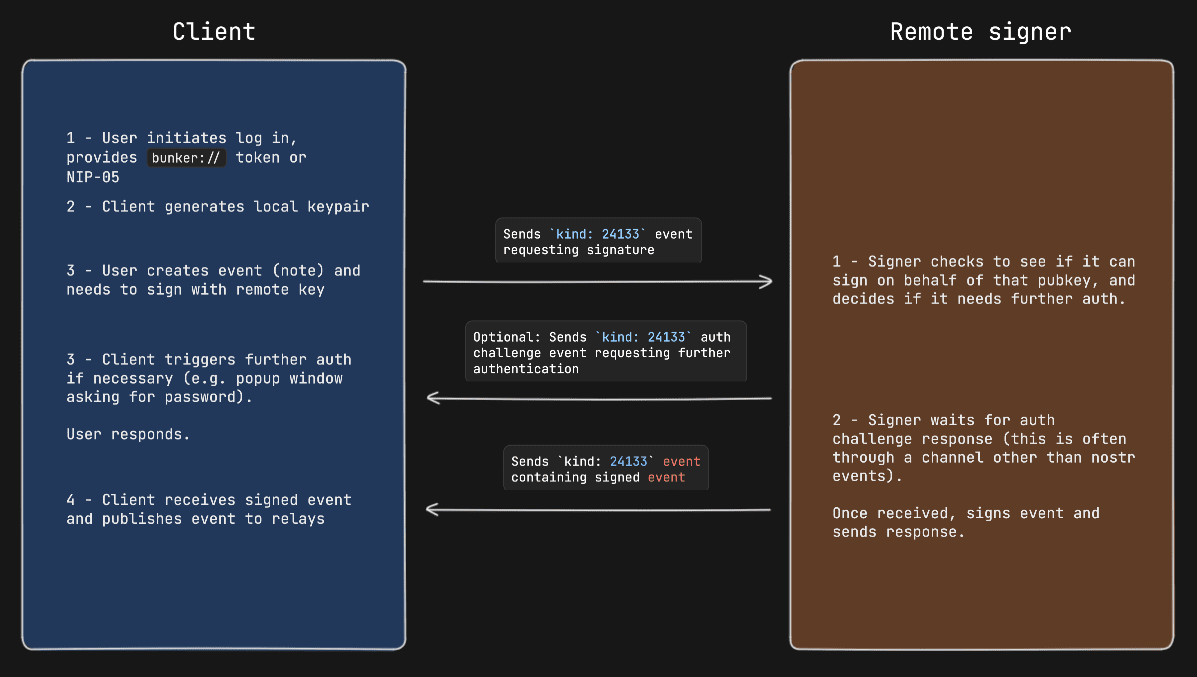
An Auth Challenge is a response that a _remote-signer_ can send back when it needs the _user_ to authenticate via other means. The response `content` object will take the following form:
|
|
|
|
```json
|
|
{
|
|
"id": <request_id>,
|
|
"result": "auth_url",
|
|
"error": <URL_to_display_to_end_user>
|
|
}
|
|
```
|
|
|
|
_client_ should display (in a popup or new tab) the URL from the `error` field and then subscribe/listen for another response from the _remote-signer_ (reusing the same request ID). This event will be sent once the user authenticates in the other window (or will never arrive if the user doesn't authenticate).
|
|
|
|
### Example event signing request with auth challenge
|
|
|
|
|
|
|
|
## Appendix
|
|
|
|
### Announcing _remote-signer_ metadata
|
|
|
|
_remote-signer_ MAY publish its metadata by using [NIP-05](05.md) and [NIP-89](89.md). With NIP-05, a request to `<remote-signer>/.well-known/nostr.json?name=_` MAY return this:
|
|
```jsonc
|
|
{
|
|
"names":{
|
|
"_": <remote-signer-app-pubkey>,
|
|
},
|
|
"nip46": {
|
|
"relays": ["wss://relay1","wss://relay2"...],
|
|
"nostrconnect_url": "https://remote-signer-domain.example/<nostrconnect>"
|
|
}
|
|
}
|
|
```
|
|
|
|
The `<remote-signer-app-pubkey>` MAY be used to verify the domain from _remote-signer_'s NIP-89 event (see below). `relays` SHOULD be used to construct a more precise `nostrconnect://` string for the specific `remote-signer`. `nostrconnect_url` template MAY be used to redirect users to _remote-signer_'s connection flow by replacing `<nostrconnect>` placeholder with an actual `nostrconnect://` string.
|
|
|
|
### Remote signer discovery via NIP-89
|
|
|
|
_remote-signer_ MAY publish a NIP-89 `kind: 31990` event with `k` tag of `24133`, which MAY also include one or more `relay` tags and MAY include `nostrconnect_url` tag. The semantics of `relay` and `nostrconnect_url` tags are the same as in the section above.
|
|
|
|
_client_ MAY improve UX by discovering _remote-signers_ using their `kind: 31990` events. _client_ MAY then pre-generate `nostrconnect://` strings for the _remote-signers_, and SHOULD in that case verify that `kind: 31990` event's author is mentioned in signer's `nostr.json?name=_` file as `<remote-signer-app-pubkey>`.
|